
ᐅ Sound insulation in timber frame construction. Any recommendations?
Created on: 25 Apr 2021 20:05
C
Cola341Hello,
we are building a single-family house using a timber frame construction with a basement, ground floor, and upper floor.
The spaces between the rafters between the basement and ground floor are insulated with cellulose. The roof is also insulated with cellulose. The ceiling between the ground floor and upper floor is empty, as it does not require insulation. Now we are considering whether it would be beneficial to fill these cavities with something to improve sound insulation between the ground floor and upper floor. Any recommendations?
Thank you!
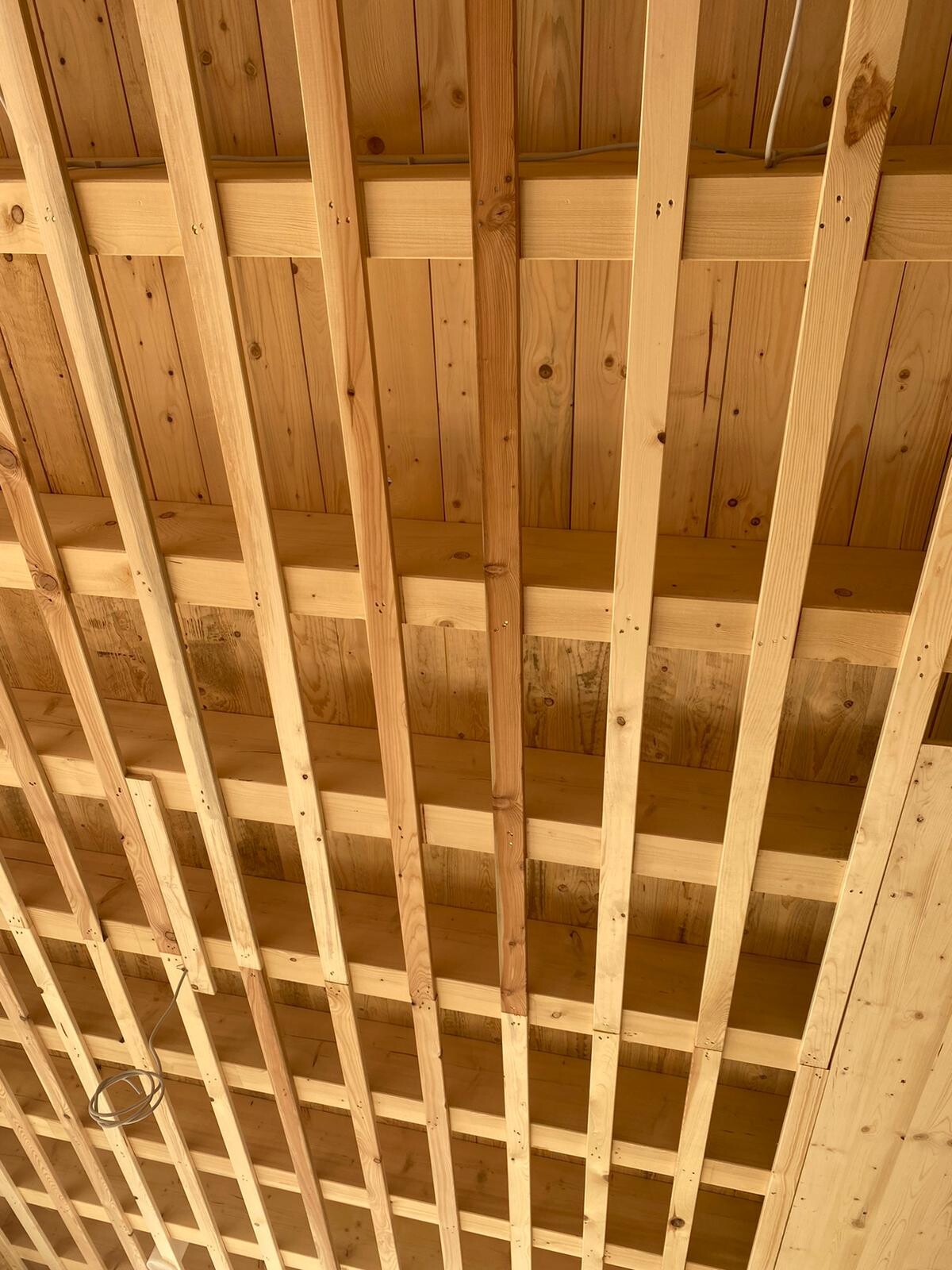
we are building a single-family house using a timber frame construction with a basement, ground floor, and upper floor.
The spaces between the rafters between the basement and ground floor are insulated with cellulose. The roof is also insulated with cellulose. The ceiling between the ground floor and upper floor is empty, as it does not require insulation. Now we are considering whether it would be beneficial to fill these cavities with something to improve sound insulation between the ground floor and upper floor. Any recommendations?
Thank you!

Of course, when empty, it acts as a great resonator, so it’s best to fill it with as heavy insulation as possible (mineral wool/stone wool, or even better, blown-in loose fill) to reduce sound transmission. However, it should not be completely filled; filling 50-60% of the rafter height is sufficient.

M
Myrna_Loy25 Apr 2021 21:30Lightweight expanded clay aggregate fills or blown-in cellulose insulation. Mineral wool does not have enough mass.
The goal is to prevent the transmission of both high and low frequencies. Using just mass alone is not sufficient but already a good solution. Multiple layers consisting of solid "mass" combined with a soft layer for decoupling help even more. However, this question actually comes rather late. Ideally, such considerations should always be integrated directly by the architect from the start, so the entire floor structure can be designed accordingly. How is the upper floor construction planned?
Achjay
Why not fill it completely? Is there a specific reason behind the 50-60%? Is it related to costs? My beams are 24cm (9.5 inches). So I could blow in 24cm (9.5 inches).
Aggregates are mainly good for impact sound insulation, right? Unfortunately, that doesn’t work for us structurally because of the large open floor plan. I’m mainly concerned about sound from speech.
Floating cement screed over thermal and impact sound insulation (rigid foam boards and mineral wool boards). After that, a special mat for impact sound is installed by the flooring contractor, then vinyl flooring is applied.
i_b_n_a_n schrieb:
It shouldn’t be completely filled; 50-60% of the rafter height is sufficient.
Why not fill it completely? Is there a specific reason behind the 50-60%? Is it related to costs? My beams are 24cm (9.5 inches). So I could blow in 24cm (9.5 inches).
Myrna_Loy schrieb:
Expanded clay aggregates or cellulose blown-in insulation. Mineral wool does not have enough mass.
Aggregates are mainly good for impact sound insulation, right? Unfortunately, that doesn’t work for us structurally because of the large open floor plan. I’m mainly concerned about sound from speech.
i_b_n_a_n schrieb:
How is the upper floor construction planned?
Floating cement screed over thermal and impact sound insulation (rigid foam boards and mineral wool boards). After that, a special mat for impact sound is installed by the flooring contractor, then vinyl flooring is applied.