
ᐅ Soundproofing and Insulation Specifications for Windows with "From-To" Values?
Created on: 15 Apr 2017 21:37
D
DReffects
Hello dear forum community!
We have chosen Internorm windows KF 410 – on the website, the sound insulation value is listed as "34 to 45 dB," and for thermal insulation, it says "Uw up to 0.62." I’m a bit confused. Does this mean it reduces sound by 45 dB or not?
How exactly should this be understood?
On the delivered windows it says:
Sound insulation: 34 dB
Thermal transmittance (U-value): 0.77 W/m²K
It would be great if someone could provide some information 🙂
Thanks & best regards
We have chosen Internorm windows KF 410 – on the website, the sound insulation value is listed as "34 to 45 dB," and for thermal insulation, it says "Uw up to 0.62." I’m a bit confused. Does this mean it reduces sound by 45 dB or not?
How exactly should this be understood?
On the delivered windows it says:
Sound insulation: 34 dB
Thermal transmittance (U-value): 0.77 W/m²K
It would be great if someone could provide some information 🙂
Thanks & best regards
Windows are custom configured. In the standard version, they provide sound insulation of 34 dB. For an additional charge, you can get up to 45 dB. This is achieved by using thicker glass, which reduces vibration.
The same applies to the other features, including thermal insulation.
For example, burglary resistance can be up to RC2. However, the standard version is likely RC0.
It seems you have received the standard version. I assume that is what you ordered.
The same applies to the other features, including thermal insulation.
For example, burglary resistance can be up to RC2. However, the standard version is likely RC0.
It seems you have received the standard version. I assume that is what you ordered.

DReffects schrieb:
The dealer just said that the Internorm window is clearly better because it offers higher sound insulation and a lower U-value. Almost every seller claims their product is superior.
As previously explained, the sound insulation values depend, among other factors, on the thickness of the glass, which is related to the frame depth of the window.
The U-value depends, among other things, on the cavity between the panes. The thicker the glass panes, the smaller the cavity. For laminated safety glass (VSG), for example, an additional interlayer film is incorporated, which also takes up space. Therefore, depending on the window size, the U-value of windows with laminated glass panes may vary slightly.
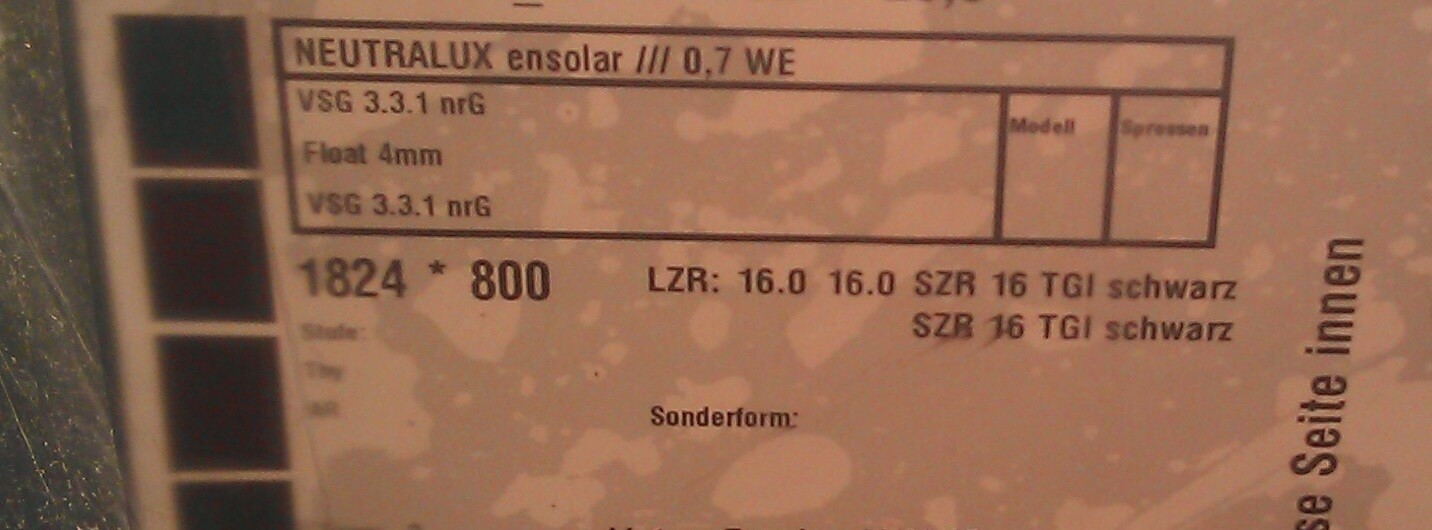
You can verify what is stated in the contract by comparing the data on the label attached to the glass at the time of delivery.
If a window consists of multiple panes (for example, in floor-to-ceiling windows without a railing, but with laminated safety glass (VSG) in the lower section), the panes may have different Ug values.
The important value is the Uw value. This consists of: Uw (window) = Ug (glass) + Uf (frame).
If a window consists of multiple panes (for example, in floor-to-ceiling windows without a railing, but with laminated safety glass (VSG) in the lower section), the panes may have different Ug values.
The important value is the Uw value. This consists of: Uw (window) = Ug (glass) + Uf (frame).
Similar topics