
ᐅ Experiences with ground-source heat pumps using a borehole and water as the heat transfer medium?
Created on: 1 Feb 2023 23:05
N
NilsHolgersson
Hello everyone,
we are about to build a house (key details below). So far, a ground-to-air heat pump is planned. However, the more I read about it, the more doubtful I become whether it is the right choice: numerous reports about air-to-water heat pumps breaking down in freezing temperatures (when you actually need them), malfunctioning defrost cycles of the outdoor unit, noise emissions from the outdoor unit, and a maximum lifespan of 15-20 years.
Therefore, I am considering a ground-to-water heat pump as an alternative. Our plot is rather small, so drilling is the only option. I am aware of the disadvantages like initial and drilling costs and the requirement for a building permit/planning permission, and I accept these. In the end, I need a system that works reliably without breaking down in winter conditions (otherwise, the whole family has to wait for a week or more in a cold house until repairs are done), that operates relatively quietly, and possibly lasts a long time. A passive cooling function in summer is also attractive.
These are my considerations, now the questions:
1. Does anyone have experience with ground-to-water heat pumps with probes? Especially whether they actually work without problems?
2. The compressor would then be located in the basement along with the pump – how quiet is it?
3. Where is the drilling usually done for the probes – directly under the house or beside it? Regarding the timing – should this be completed before construction starts or can it be done in parallel next to it?
4. Approximately how long does the approval process take (possibly including water law permits)?
Key details of the house:
Thank you very much!
Best regards
Nils
we are about to build a house (key details below). So far, a ground-to-air heat pump is planned. However, the more I read about it, the more doubtful I become whether it is the right choice: numerous reports about air-to-water heat pumps breaking down in freezing temperatures (when you actually need them), malfunctioning defrost cycles of the outdoor unit, noise emissions from the outdoor unit, and a maximum lifespan of 15-20 years.
Therefore, I am considering a ground-to-water heat pump as an alternative. Our plot is rather small, so drilling is the only option. I am aware of the disadvantages like initial and drilling costs and the requirement for a building permit/planning permission, and I accept these. In the end, I need a system that works reliably without breaking down in winter conditions (otherwise, the whole family has to wait for a week or more in a cold house until repairs are done), that operates relatively quietly, and possibly lasts a long time. A passive cooling function in summer is also attractive.
These are my considerations, now the questions:
1. Does anyone have experience with ground-to-water heat pumps with probes? Especially whether they actually work without problems?
2. The compressor would then be located in the basement along with the pump – how quiet is it?
3. Where is the drilling usually done for the probes – directly under the house or beside it? Regarding the timing – should this be completed before construction starts or can it be done in parallel next to it?
4. Approximately how long does the approval process take (possibly including water law permits)?
Key details of the house:
- Semi-detached house, solid construction, not a KfW-standard house (EnEV 2016)
- Two full floors plus basement, ground floor + upper floor 68 + 68 m² (732 + 732 sq ft), plus about 30 m² (320 sq ft) of heated basement area
- Underfloor heating, controlled ventilation system (mechanical ventilation) with heat recovery and enthalpy heat exchanger
- No photovoltaic system planned primarily
Thank you very much!
Best regards
Nils
Our general contractor approved the upgrade from an air-to-water heat pump to a ground-source heat pump without any issues. However, he excluded the drilling work, so we had to handle that ourselves. The drilling company installed the pipes underground through the pre-laid conduits/foundation penetrations into the utility room; from there, the heating engineer takes over. Overall, a fairly straightforward process.
I can only agree with the previous speakers. Separate the drilling and heating contractor.
It is important to have a heat load calculation from the heating specialist (we received it from the energy expert and gave it to the heating contractor/drilling company) so that the drilling company can design the borehole depth. Have several drilling companies submit quotes based on the heat load calculation, site plan, and some additional information, then the process will go smoothly. Search for certified drillers with around 120 W per meter (cert Bau 120W) in your area. (In our case, the more distant companies were actually cheaper.)
It is important to have a heat load calculation from the heating specialist (we received it from the energy expert and gave it to the heating contractor/drilling company) so that the drilling company can design the borehole depth. Have several drilling companies submit quotes based on the heat load calculation, site plan, and some additional information, then the process will go smoothly. Search for certified drillers with around 120 W per meter (cert Bau 120W) in your area. (In our case, the more distant companies were actually cheaper.)
On this topic, do you all have an ugly pressure relief tank in case it’s ever needed? Or how was this handled in your setups? The heating technician says it shouldn’t be discharged into the wastewater system.
PS Thread starter: Above the ball valves was the heating technician, and below, including the ball valves, was the plumber.
– The utility room area still needs to be tidied up. 😉
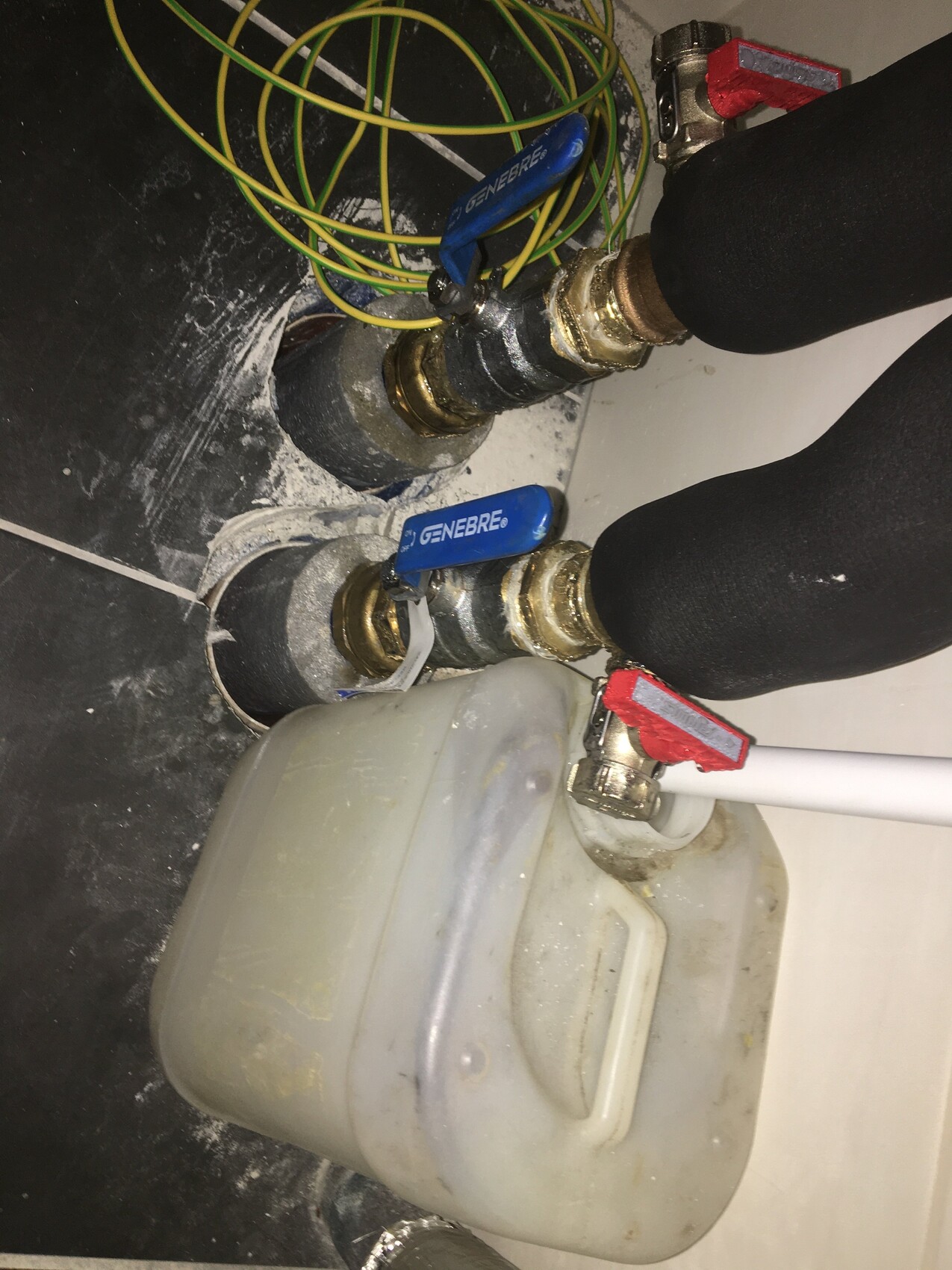
PS Thread starter: Above the ball valves was the heating technician, and below, including the ball valves, was the plumber.
– The utility room area still needs to be tidied up. 😉

Stephan— schrieb:
Do you all also have an ugly pressure relief tank, in case you ever need something like that? Well, we don’t have one ... but we do have an expansion vessel installed between the probes and the heat pump.Similar topics