
ᐅ Experiences with ground-source heat pumps using a borehole and water as the heat transfer medium?
Created on: 1 Feb 2023 23:05
N
NilsHolgerssonN
NilsHolgersson1 Feb 2023 23:05Hello everyone,
we are about to build a house (key details below). So far, a ground-to-air heat pump is planned. However, the more I read about it, the more doubtful I become whether it is the right choice: numerous reports about air-to-water heat pumps breaking down in freezing temperatures (when you actually need them), malfunctioning defrost cycles of the outdoor unit, noise emissions from the outdoor unit, and a maximum lifespan of 15-20 years.
Therefore, I am considering a ground-to-water heat pump as an alternative. Our plot is rather small, so drilling is the only option. I am aware of the disadvantages like initial and drilling costs and the requirement for a building permit/planning permission, and I accept these. In the end, I need a system that works reliably without breaking down in winter conditions (otherwise, the whole family has to wait for a week or more in a cold house until repairs are done), that operates relatively quietly, and possibly lasts a long time. A passive cooling function in summer is also attractive.
These are my considerations, now the questions:
1. Does anyone have experience with ground-to-water heat pumps with probes? Especially whether they actually work without problems?
2. The compressor would then be located in the basement along with the pump – how quiet is it?
3. Where is the drilling usually done for the probes – directly under the house or beside it? Regarding the timing – should this be completed before construction starts or can it be done in parallel next to it?
4. Approximately how long does the approval process take (possibly including water law permits)?
Key details of the house:
Thank you very much!
Best regards
Nils
we are about to build a house (key details below). So far, a ground-to-air heat pump is planned. However, the more I read about it, the more doubtful I become whether it is the right choice: numerous reports about air-to-water heat pumps breaking down in freezing temperatures (when you actually need them), malfunctioning defrost cycles of the outdoor unit, noise emissions from the outdoor unit, and a maximum lifespan of 15-20 years.
Therefore, I am considering a ground-to-water heat pump as an alternative. Our plot is rather small, so drilling is the only option. I am aware of the disadvantages like initial and drilling costs and the requirement for a building permit/planning permission, and I accept these. In the end, I need a system that works reliably without breaking down in winter conditions (otherwise, the whole family has to wait for a week or more in a cold house until repairs are done), that operates relatively quietly, and possibly lasts a long time. A passive cooling function in summer is also attractive.
These are my considerations, now the questions:
1. Does anyone have experience with ground-to-water heat pumps with probes? Especially whether they actually work without problems?
2. The compressor would then be located in the basement along with the pump – how quiet is it?
3. Where is the drilling usually done for the probes – directly under the house or beside it? Regarding the timing – should this be completed before construction starts or can it be done in parallel next to it?
4. Approximately how long does the approval process take (possibly including water law permits)?
Key details of the house:
- Semi-detached house, solid construction, not a KfW-standard house (EnEV 2016)
- Two full floors plus basement, ground floor + upper floor 68 + 68 m² (732 + 732 sq ft), plus about 30 m² (320 sq ft) of heated basement area
- Underfloor heating, controlled ventilation system (mechanical ventilation) with heat recovery and enthalpy heat exchanger
- No photovoltaic system planned primarily
Thank you very much!
Best regards
Nils
W
WilderSueden2 Feb 2023 09:51We are installing a ground-source heat pump. We won’t be moving in until the weekend after next, so I can’t say much about the noise level yet, but ground-source heat pumps are generally known to be quieter. Our drilling took place right next to the house after the shell was completed. The pipes then enter the house through a core drilling, and after that, you can build over it. The drilling company was given a power of attorney for the permit. It took about 2 months and cost around 500 euros.
Since you are building a semi-detached house, the equipment and crew are quite large and need space. You might have to close the street.
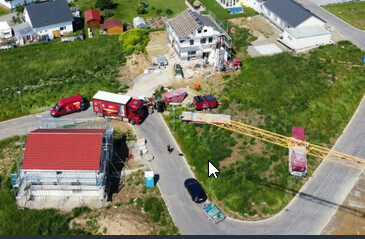
Since you are building a semi-detached house, the equipment and crew are quite large and need space. You might have to close the street.

Experience so far is about 5 months.
Nothing has happened yet.
According to the heating engineer, nothing major should occur in connection with the probe.
It is more likely that the heating system will cause problems. And, as with any equipment, you can occasionally get a lemon.
I barely hear anything from the compressor. The controlled residential ventilation system is louder—but only when standing right next to it.
Drilling is usually done next to the house.
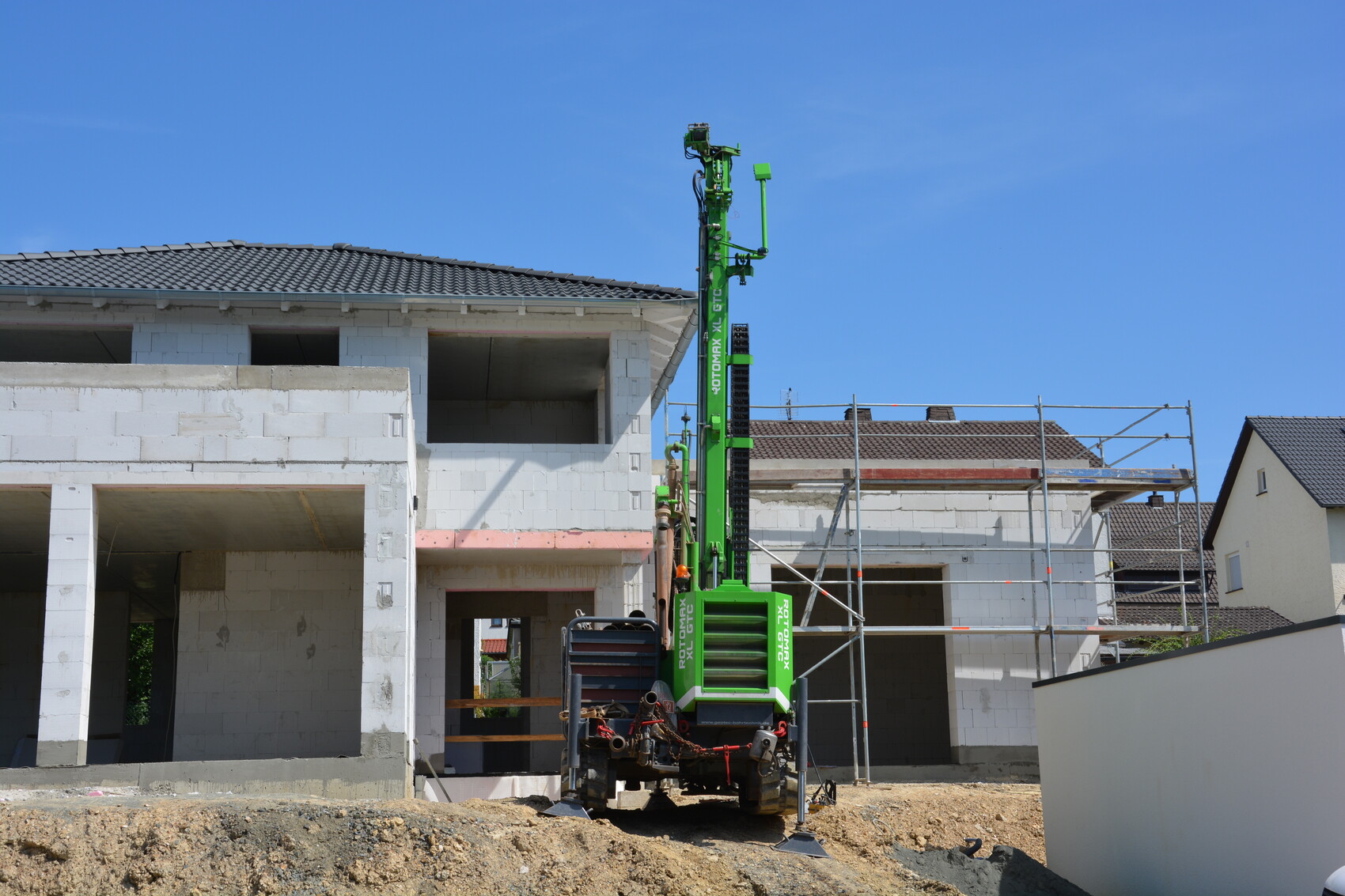
The drilling rig needs space to be set up. The drilling process itself is uneventful.
The time until approval depends on how deep you drill.
In our case, the county could issue the permit up to 100 meters (330 feet) -> which is relatively quick.
Since we needed 110 meters (360 feet), Berlin had to approve it, along with the radiation protection authority—due to potential radioactive waste storage concerns.
Duration: about 8 weeks.
An alternative, if deeper drilling is required due to heat demand but you don’t want to wait, is to perform two separate drillings.
The drilling itself was also done relatively late for us: about 2–3 weeks before the heating system delivery. It only took 2 days.
Nothing has happened yet.
According to the heating engineer, nothing major should occur in connection with the probe.
It is more likely that the heating system will cause problems. And, as with any equipment, you can occasionally get a lemon.
I barely hear anything from the compressor. The controlled residential ventilation system is louder—but only when standing right next to it.
Drilling is usually done next to the house.
The drilling rig needs space to be set up. The drilling process itself is uneventful.
The time until approval depends on how deep you drill.
In our case, the county could issue the permit up to 100 meters (330 feet) -> which is relatively quick.
Since we needed 110 meters (360 feet), Berlin had to approve it, along with the radiation protection authority—due to potential radioactive waste storage concerns.
Duration: about 8 weeks.
An alternative, if deeper drilling is required due to heat demand but you don’t want to wait, is to perform two separate drillings.
The drilling itself was also done relatively late for us: about 2–3 weeks before the heating system delivery. It only took 2 days.
We also had drilling done. The borehole must have a minimum distance of 3 meters (10 feet) from the property boundary. The drilling company took care of the permit (building permit / planning permission) and drilling insurance themselves. The whole process cost around €500 and was completed quite quickly, in just a few weeks.
The drilling rig was fairly small, occupying an area of maybe less than 1.0 by 2.0 meters (3.3 by 6.6 feet), plus a water tank and compressor, so still quite manageable.
We opted for a single borehole to the full depth of 100 meters (330 feet). Drilling took place once the shell of the building was completed.
It’s worth mentioning that I sent out over 30 inquiries, including to companies outside the region. We received 7 offers; the rest were fully booked for the long term. The quotes ranged from €7,900 to over €22,000.
I can’t comment on noise levels yet, but the heating engineer assures me the pump is very quiet.
The heating engineer roughly described the difference between the brine-water heat pump and the air-water heat pump as follows: operating an air-water heat pump is like driving a car in city traffic—stop and go, depending on the outside air temperature. The ground source heat pump is more like highway driving, where the pump runs steadily and evenly—thus, a gentler operation. Whether this holds true remains to be seen.
The drilling rig was fairly small, occupying an area of maybe less than 1.0 by 2.0 meters (3.3 by 6.6 feet), plus a water tank and compressor, so still quite manageable.
We opted for a single borehole to the full depth of 100 meters (330 feet). Drilling took place once the shell of the building was completed.
It’s worth mentioning that I sent out over 30 inquiries, including to companies outside the region. We received 7 offers; the rest were fully booked for the long term. The quotes ranged from €7,900 to over €22,000.
I can’t comment on noise levels yet, but the heating engineer assures me the pump is very quiet.
The heating engineer roughly described the difference between the brine-water heat pump and the air-water heat pump as follows: operating an air-water heat pump is like driving a car in city traffic—stop and go, depending on the outside air temperature. The ground source heat pump is more like highway driving, where the pump runs steadily and evenly—thus, a gentler operation. Whether this holds true remains to be seen.
Our ground-source heat pump has been running for 2 months and hums quietly, if anything louder than a 2010 refrigerator (but only when it really needs to heat). We have two 80m (262 feet) boreholes in front of the house. If space is limited, boreholes can also be installed beneath the house before pouring the concrete floor slab, but the boreholes in front of the house can also be built over. So far, we have no regrets about our Novelan system and currently have a measured annual performance factor of 6.17 (though only for a short period).
Regarding the commissioning with the Alphainno: the manufacturer was impressed by the 24-hour run time per start/stop cycle (which is good for a long service life). An air-to-water heat pump is an unattractive external unit visible from outside.
Our unit is about the size of a large refrigerator and occupies exactly that amount of space in the utility room (plus the supply and return piping, etc.). The compressor is located at the bottom with the storage tank above, making the system very compact.
Cooling performance can only be evaluated firmly in summer.
The boreholes were drilled only after we moved in (due to frost, workload, and timing). It is important, if the boreholes are done late, to have two KG DN100 pipes with a maximum of 15-degree bends installed beforehand (under the floor slab). Doing this before construction has the advantage that the unit has space on the property but you would never have access to the connections again if something should happen.
My conclusion so far: absolutely in favor of ground-source. 🙂
Regarding the commissioning with the Alphainno: the manufacturer was impressed by the 24-hour run time per start/stop cycle (which is good for a long service life). An air-to-water heat pump is an unattractive external unit visible from outside.
Our unit is about the size of a large refrigerator and occupies exactly that amount of space in the utility room (plus the supply and return piping, etc.). The compressor is located at the bottom with the storage tank above, making the system very compact.
Cooling performance can only be evaluated firmly in summer.
The boreholes were drilled only after we moved in (due to frost, workload, and timing). It is important, if the boreholes are done late, to have two KG DN100 pipes with a maximum of 15-degree bends installed beforehand (under the floor slab). Doing this before construction has the advantage that the unit has space on the property but you would never have access to the connections again if something should happen.
My conclusion so far: absolutely in favor of ground-source. 🙂

Drilling in summer 2018 before the shell was completed, 2 x 70 meters (230 feet).
The district approval came very quickly, €353.13.
The heating system was commissioned in autumn 2018. Since then, it has operated without issues and is whisper-quiet.
The 6 kW heat pump heats 190 m² (2045 sq ft) KfW 55 standard.
The electric auxiliary heating rod was deactivated after the screed drying program.
Annual consumption without photovoltaic system is about 4200 kWh.
All in all: exactly the right decision. Would do it again anytime.
P.S.: Be sure to have empty conduits installed for future photovoltaic systems!
The district approval came very quickly, €353.13.
The heating system was commissioned in autumn 2018. Since then, it has operated without issues and is whisper-quiet.
The 6 kW heat pump heats 190 m² (2045 sq ft) KfW 55 standard.
The electric auxiliary heating rod was deactivated after the screed drying program.
Annual consumption without photovoltaic system is about 4200 kWh.
All in all: exactly the right decision. Would do it again anytime.
P.S.: Be sure to have empty conduits installed for future photovoltaic systems!
Similar topics