
We plan to build on a plot of land in Brandenburg, south of Potsdam.
Plot Information
The plot is currently mostly covered with pine trees, some of which are around 100 years old, along with a few yews, oaks, and bushes. The area has been unmanaged for at least 50 years. At least the rear third (northeast area) is intended to remain forested, as part of the adjacent larger woodland.
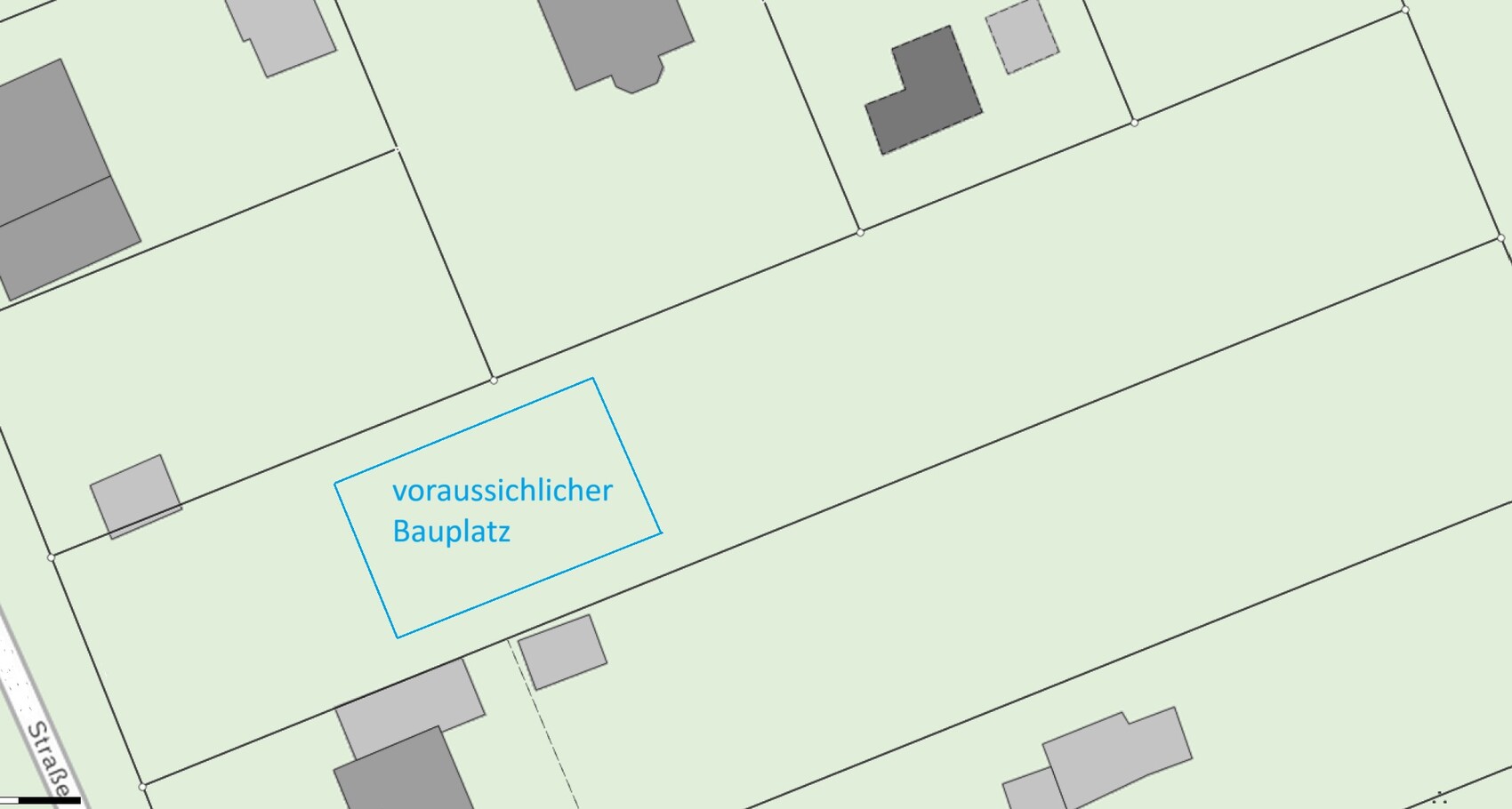
The plot is oriented approximately northeast – southwest.
Street access is on the southwest side (bottom of the plan). At this end of the plot, there are a few very tall pines with some yews and an oak in between. The oak is not very old but is an interesting multi-stem tree. I want to preserve this green screen, which will likely be challenging since construction vehicles require a certain size and height.
On the southeast side (right on the plan) there is an overly large and mostly unattractive boundary structure (garage and shed), which is not very appealing.
The neighboring plots on the northwest side (left on the plan) together have a similar amount of boundary structures but less intrusive and located further towards the top of the plan. Overall, the northwest side is greener because the neighboring buildings are set further back from the property boundary.
Development Plan / Restrictions
There is no formal development plan, but local regulations set general rules, such as ridge height, setback distances, and garage roof shape. If these are specified anywhere, floor area ratio and plot ratio probably only play a theoretical role for this project and plot size.
Plot size: >2000m² (21,528ft²)
Slope: none
Floor area ratio unknown
Plot ratio unknown
Building window, building line, and boundary >3m (10ft) setback
Outbuildings allowed along boundary
Number of parking spaces not specified
Number of storeys not specified
House roof shape: roof pitch 25°–50°, excluding roof extensions
Garage: gable roof facing street
Architectural style: no specific requirements
Orientation: gable end or eaves aligned to street
Maximum heights/restrictions: ridge height max. 9.0m (30ft)
Other specifications: ground floor top edge max. 80cm (2.6ft)
Client Requirements
Architectural style, roof type, building type: gable roof
Orientation: photovoltaic panels on the south-facing roof side, gable end facing street
Basement, storeys: basement + ground floor + first floor
Number of occupants, ages: 3+1, ages 17–55+
Space requirements on ground floor, first floor:
Ground floor: living room, kitchen, dining area, guest bathroom
First floor: bedrooms, bathroom
Two additional rooms on ground floor or first floor
Office: mainly home office for one person
Guests per year: 1 (about 20 extended weekends)
Open or closed architecture: window-obscuring bathroom and bedroom doors
Conservative or modern style: conservative
Preferred construction method: solid gas concrete blocks (e.g. Ytong or similar)
Open kitchen with cooking island: semi-open, preferably with (half) island
Number of dining seats: 4 (expandable to 8)
Fireplace: yes
Music/stereo/TV wall: rather simple / stereo system yes, no built-in wall unit / large screen
Balcony/roof terrace: balcony yes / roof terrace no
Garage/carport: garage
Utility garden, greenhouse: garden yes, greenhouse later
Additional Requests / Special Features / Daily Routine, including reasons why certain things are wanted or not:
The plot is quite narrow at just under 20m (65ft) wide for my desired house, which includes a partially integrated side double garage and a large sunny southwest terrace, so the best compromise must be found.
Due to the tall trees on the southwest, we expect western sun only during summer. Also, two neighbor’s pine trees cast shade from the south on the likely building site.
When not sleeping, we mainly live on the ground floor, so this has planning priority. The kitchen is an important room, so we prefer a (semi-)open connection to the living room. At least one of us regularly works from home, so a suitable workstation is necessary, but a dedicated home office room is not essential.
Light is important in the living area (kitchen and living room), so we want the top edges of the windows to be as high as possible with roller shutters.
The fireplace is a 95% must-have as a supplementary heat source (and hopefully a cozy feature). Good positioning is a priority, but if possible, we’d like a water-carrying fireplace connected to a buffer tank and/or an additional hot water heating circuit for the bathrooms (e.g., large towel radiators). A ground heat load is planned via an air-to-water heat pump for underfloor heating. Additionally, air conditioning is planned in the master bedroom and child’s room 1.
A central ventilation system is probably too expensive.
The master bedroom should accommodate a double bed and a row of wardrobes.
Child’s room 1 will still serve as a youth room for a few years, later becoming a second bedroom (due to reported nighttime noise of uncertain cause).
The multi-purpose room is not yet definitively assigned: either home office or utility room with space for washing machine and dryer, or storage room.
Preferred room orientations (due to morning sun): kitchen, bathroom, and bedroom facing the garden.
The gable end facing the street seems sensible since photovoltaics are planned on the roof, and the south-facing side (+/- 30°) is expected to have the least shading.
My wife’s wish for a balcony on the bedroom is “because it looks better.”
If built, we would like access to the balcony from the bedroom and the bathroom.
A basement is a 95% must-have due to various hobbies requiring significant space and tools. Also, all technical equipment is planned to be located in the basement.
A garage is essential (as large as possible for 1–2 cars, bicycles, and garden tools), but the house has higher priority. If necessary, the garage can be built later and/or an additional carport added on the street side, or even an underground garage (a small dream).
We now consider a connecting door between house and garage impractical. With the entrance on the gable side, the path is short and convenient anyway.
Gas concrete as preferred wall material was chosen because of its combination of easy handling during shell construction (which tends to avoid the common poor work that can cause thermal bridges), very good sound insulation, pleasant indoor climate, minor advantages during interior finishing, and previous DIY experience with the material. It is also non-combustible, avoids producing large amounts of hazardous waste, and structurally the walls are not potential habitats for insects or small rodents.
House Design
Design origin: by me
-Not designed by a construction company planner yet
-Architect is being sought
-Do-it-yourself approach: yes (reading, trying, thinking, reading, trying, ...)
What do you especially like? Why?
Entrance on street side (front view preferred over side entrance)
Layout of kitchen, bathroom, bedrooms
Kitchen with large work surface, appliance space, and storage
Sauna in the bright bathroom
Bright living room with fireplace
Hallways on ground and first floors and staircase with daylight
Coatroom near entrance (though small)
Small but fully functional guest WC on ground floor
What do you dislike? Why?
Costs likely at the budget limit
Easy access to attic not resolved
Attic usage not finalized
Little distance to right side property boundary
Relatively large hallway areas
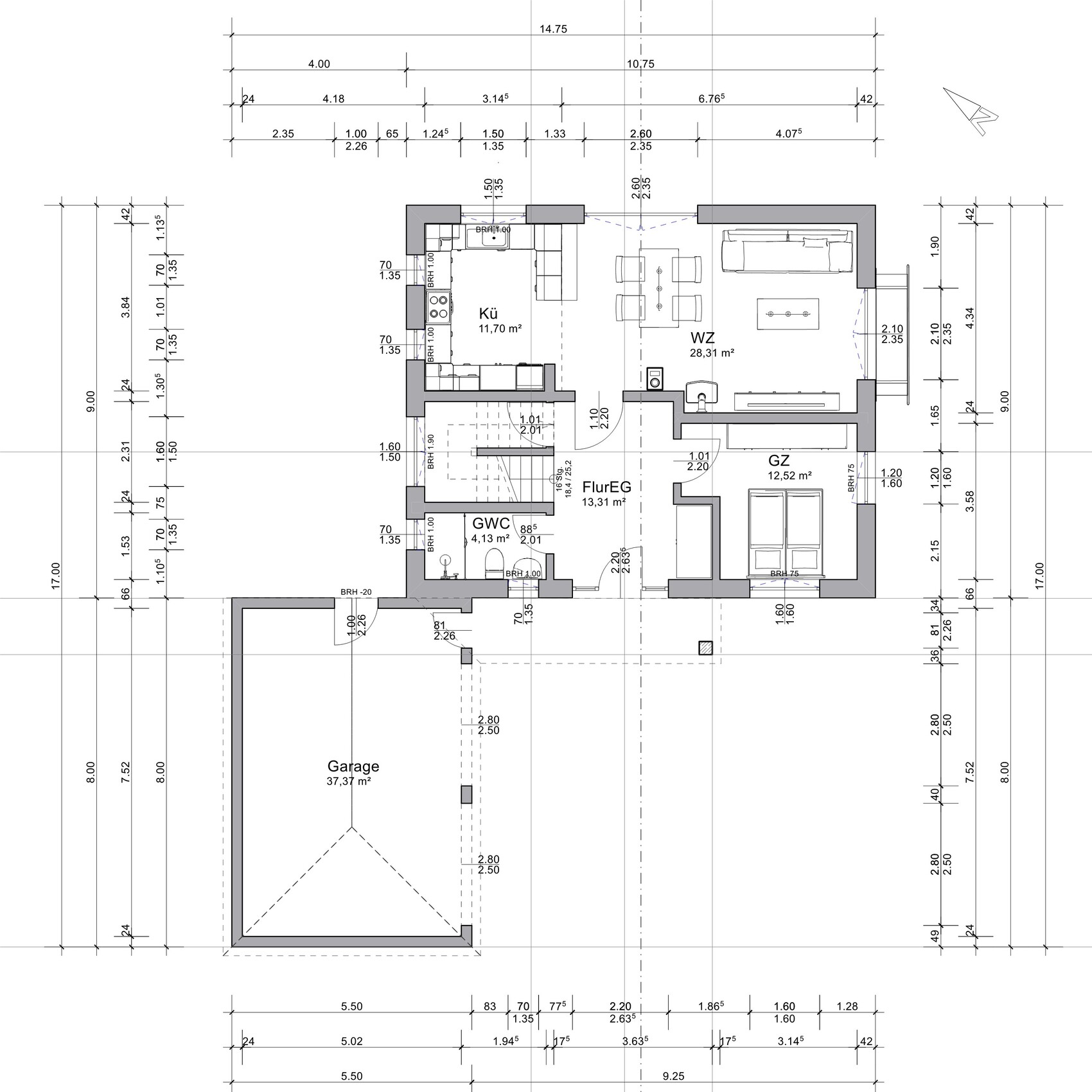
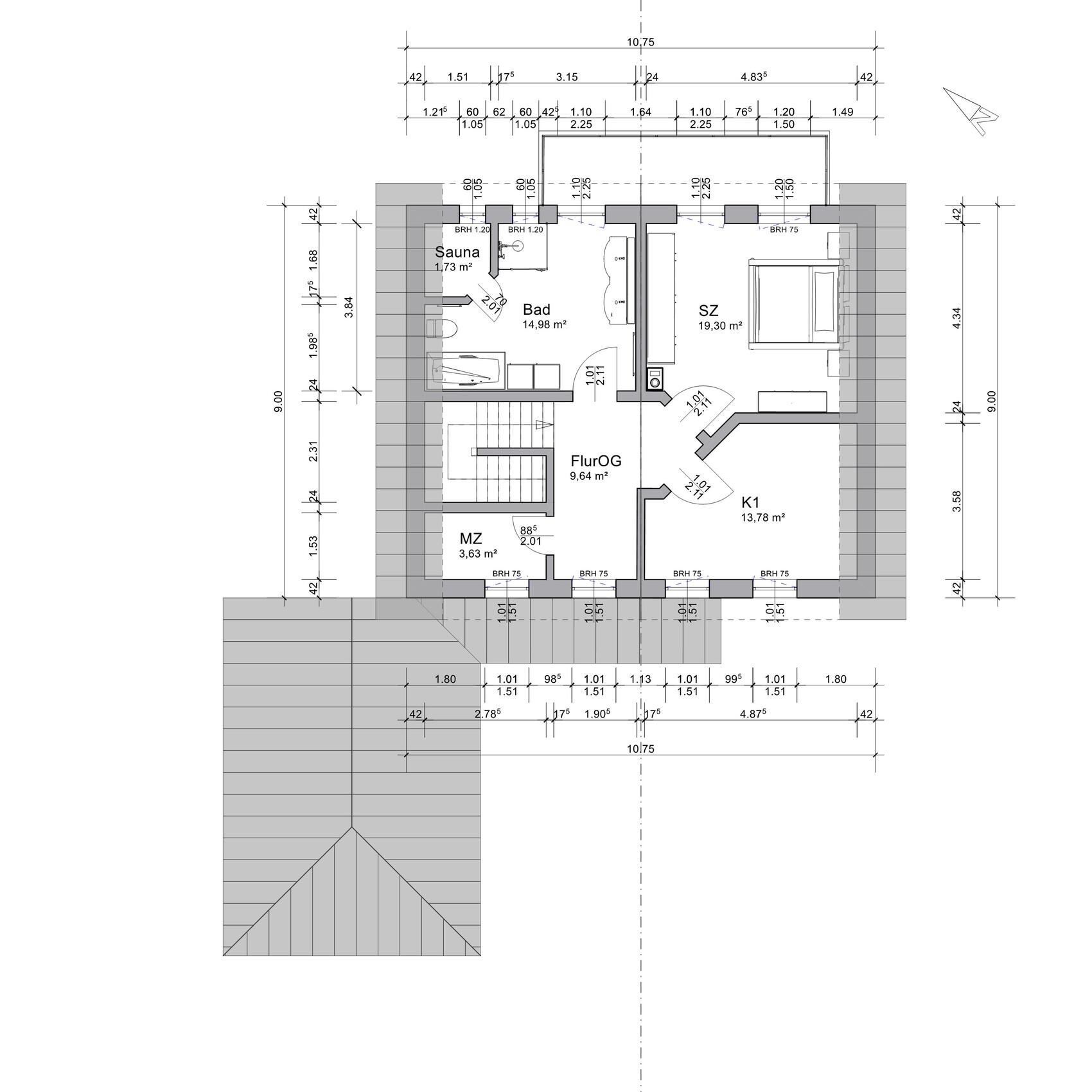
Living area (according to CAD program): 135m² (EG 71m², OG 64m²) (1453ft² total; ground floor 764ft², first floor 689ft²)
Estimated price per architect/planner: unknown but would like to know
Personal price limit for the house, including equipment: 550,000 EUR
Personal preferred heating technology: oil/gas (more independent under various situations) and fireplace
Most likely heating system realistically planned: air-to-water heat pump (for various reasons) + fireplace
Possibly additional split air conditioners in master bedroom and child’s room 1
If you have to forgo something, which details or extensions
-can be omitted: balcony, double garage, finished attic
-cannot be omitted: light
Why is the design the way it is now?
The design is one of the results of two years of reading, viewing, own experiences, consideration, and experimentation. There are now many design variants; four or five are basically acceptable to us, each with different pros and cons.
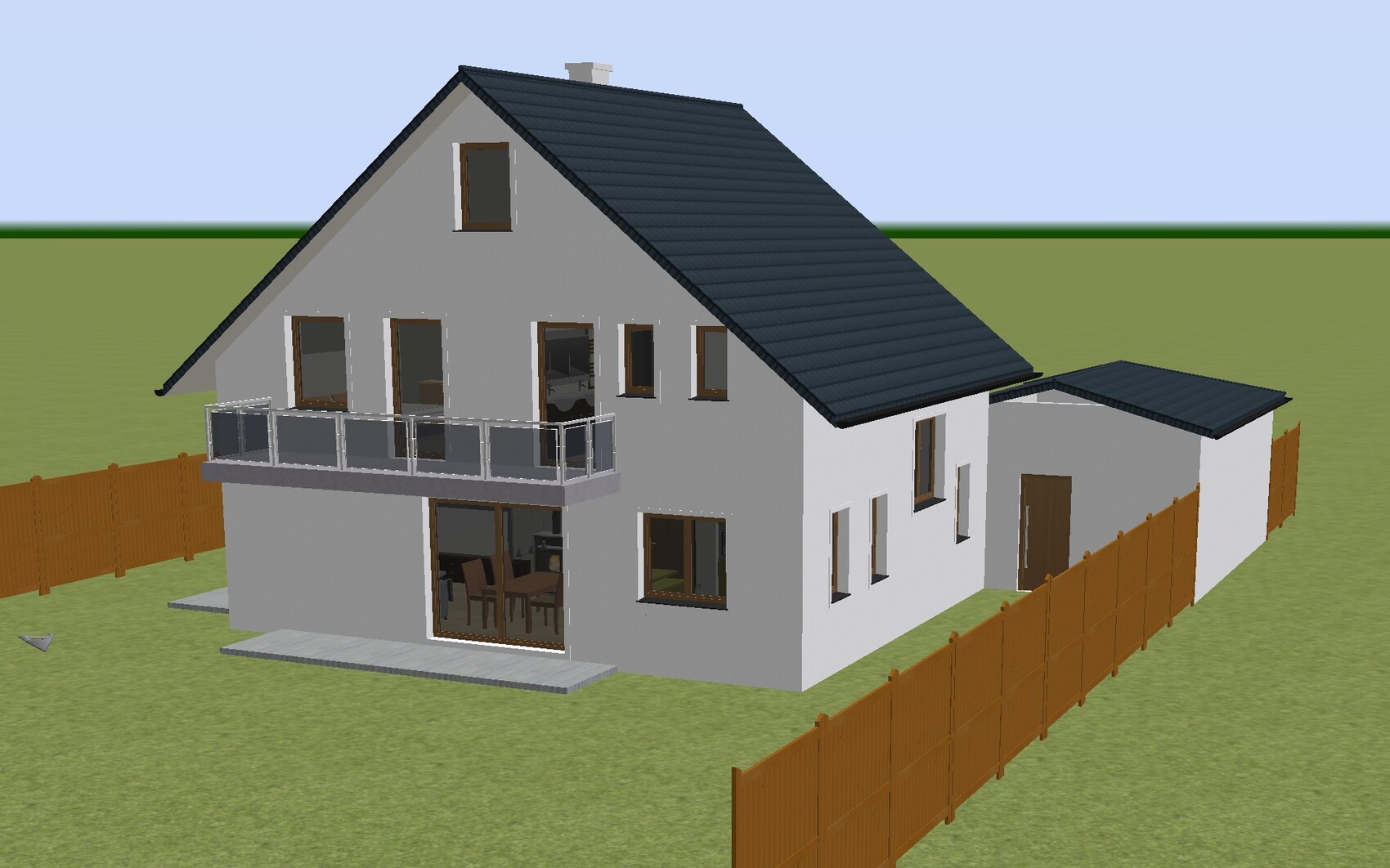
This is one of the options with the smallest living area. I transferred it into a mediocre (very stubborn) CAD system because it provides automatic dimensioning. The system also helps my 3D spatial imagination (e.g., stairs under roof slope, walls stacked, first-floor windows within the building volume, roof in general).
Many details are not finalized yet (e.g., stair to attic, windows, …) because of my lack of knowledge and experience. Also, some window and door types are simply not available in the CAD program; others are stubbornly displayed incorrectly.
The furniture layout shown is currently the best idea, but there are certainly better options (e.g., for the bathrooms).
Thank you in advance for your suggestions and help.

Plot Information
The plot is currently mostly covered with pine trees, some of which are around 100 years old, along with a few yews, oaks, and bushes. The area has been unmanaged for at least 50 years. At least the rear third (northeast area) is intended to remain forested, as part of the adjacent larger woodland.
The plot is oriented approximately northeast – southwest.
Street access is on the southwest side (bottom of the plan). At this end of the plot, there are a few very tall pines with some yews and an oak in between. The oak is not very old but is an interesting multi-stem tree. I want to preserve this green screen, which will likely be challenging since construction vehicles require a certain size and height.
On the southeast side (right on the plan) there is an overly large and mostly unattractive boundary structure (garage and shed), which is not very appealing.
The neighboring plots on the northwest side (left on the plan) together have a similar amount of boundary structures but less intrusive and located further towards the top of the plan. Overall, the northwest side is greener because the neighboring buildings are set further back from the property boundary.
Development Plan / Restrictions
There is no formal development plan, but local regulations set general rules, such as ridge height, setback distances, and garage roof shape. If these are specified anywhere, floor area ratio and plot ratio probably only play a theoretical role for this project and plot size.
Plot size: >2000m² (21,528ft²)
Slope: none
Floor area ratio unknown
Plot ratio unknown
Building window, building line, and boundary >3m (10ft) setback
Outbuildings allowed along boundary
Number of parking spaces not specified
Number of storeys not specified
House roof shape: roof pitch 25°–50°, excluding roof extensions
Garage: gable roof facing street
Architectural style: no specific requirements
Orientation: gable end or eaves aligned to street
Maximum heights/restrictions: ridge height max. 9.0m (30ft)
Other specifications: ground floor top edge max. 80cm (2.6ft)
Client Requirements
Architectural style, roof type, building type: gable roof
Orientation: photovoltaic panels on the south-facing roof side, gable end facing street
Basement, storeys: basement + ground floor + first floor
Number of occupants, ages: 3+1, ages 17–55+
Space requirements on ground floor, first floor:
Ground floor: living room, kitchen, dining area, guest bathroom
First floor: bedrooms, bathroom
Two additional rooms on ground floor or first floor
Office: mainly home office for one person
Guests per year: 1 (about 20 extended weekends)
Open or closed architecture: window-obscuring bathroom and bedroom doors
Conservative or modern style: conservative
Preferred construction method: solid gas concrete blocks (e.g. Ytong or similar)
Open kitchen with cooking island: semi-open, preferably with (half) island
Number of dining seats: 4 (expandable to 8)
Fireplace: yes
Music/stereo/TV wall: rather simple / stereo system yes, no built-in wall unit / large screen
Balcony/roof terrace: balcony yes / roof terrace no
Garage/carport: garage
Utility garden, greenhouse: garden yes, greenhouse later
Additional Requests / Special Features / Daily Routine, including reasons why certain things are wanted or not:
The plot is quite narrow at just under 20m (65ft) wide for my desired house, which includes a partially integrated side double garage and a large sunny southwest terrace, so the best compromise must be found.
Due to the tall trees on the southwest, we expect western sun only during summer. Also, two neighbor’s pine trees cast shade from the south on the likely building site.
When not sleeping, we mainly live on the ground floor, so this has planning priority. The kitchen is an important room, so we prefer a (semi-)open connection to the living room. At least one of us regularly works from home, so a suitable workstation is necessary, but a dedicated home office room is not essential.
Light is important in the living area (kitchen and living room), so we want the top edges of the windows to be as high as possible with roller shutters.
The fireplace is a 95% must-have as a supplementary heat source (and hopefully a cozy feature). Good positioning is a priority, but if possible, we’d like a water-carrying fireplace connected to a buffer tank and/or an additional hot water heating circuit for the bathrooms (e.g., large towel radiators). A ground heat load is planned via an air-to-water heat pump for underfloor heating. Additionally, air conditioning is planned in the master bedroom and child’s room 1.
A central ventilation system is probably too expensive.
The master bedroom should accommodate a double bed and a row of wardrobes.
Child’s room 1 will still serve as a youth room for a few years, later becoming a second bedroom (due to reported nighttime noise of uncertain cause).
The multi-purpose room is not yet definitively assigned: either home office or utility room with space for washing machine and dryer, or storage room.
Preferred room orientations (due to morning sun): kitchen, bathroom, and bedroom facing the garden.
The gable end facing the street seems sensible since photovoltaics are planned on the roof, and the south-facing side (+/- 30°) is expected to have the least shading.
My wife’s wish for a balcony on the bedroom is “because it looks better.”
If built, we would like access to the balcony from the bedroom and the bathroom.
A basement is a 95% must-have due to various hobbies requiring significant space and tools. Also, all technical equipment is planned to be located in the basement.
A garage is essential (as large as possible for 1–2 cars, bicycles, and garden tools), but the house has higher priority. If necessary, the garage can be built later and/or an additional carport added on the street side, or even an underground garage (a small dream).
We now consider a connecting door between house and garage impractical. With the entrance on the gable side, the path is short and convenient anyway.
Gas concrete as preferred wall material was chosen because of its combination of easy handling during shell construction (which tends to avoid the common poor work that can cause thermal bridges), very good sound insulation, pleasant indoor climate, minor advantages during interior finishing, and previous DIY experience with the material. It is also non-combustible, avoids producing large amounts of hazardous waste, and structurally the walls are not potential habitats for insects or small rodents.
House Design
Design origin: by me
-Not designed by a construction company planner yet
-Architect is being sought
-Do-it-yourself approach: yes (reading, trying, thinking, reading, trying, ...)
What do you especially like? Why?
Entrance on street side (front view preferred over side entrance)
Layout of kitchen, bathroom, bedrooms
Kitchen with large work surface, appliance space, and storage
Sauna in the bright bathroom
Bright living room with fireplace
Hallways on ground and first floors and staircase with daylight
Coatroom near entrance (though small)
Small but fully functional guest WC on ground floor
What do you dislike? Why?
Costs likely at the budget limit
Easy access to attic not resolved
Attic usage not finalized
Little distance to right side property boundary
Relatively large hallway areas
Living area (according to CAD program): 135m² (EG 71m², OG 64m²) (1453ft² total; ground floor 764ft², first floor 689ft²)
Estimated price per architect/planner: unknown but would like to know
Personal price limit for the house, including equipment: 550,000 EUR
Personal preferred heating technology: oil/gas (more independent under various situations) and fireplace
Most likely heating system realistically planned: air-to-water heat pump (for various reasons) + fireplace
Possibly additional split air conditioners in master bedroom and child’s room 1
If you have to forgo something, which details or extensions
-can be omitted: balcony, double garage, finished attic
-cannot be omitted: light
Why is the design the way it is now?
The design is one of the results of two years of reading, viewing, own experiences, consideration, and experimentation. There are now many design variants; four or five are basically acceptable to us, each with different pros and cons.
This is one of the options with the smallest living area. I transferred it into a mediocre (very stubborn) CAD system because it provides automatic dimensioning. The system also helps my 3D spatial imagination (e.g., stairs under roof slope, walls stacked, first-floor windows within the building volume, roof in general).
Many details are not finalized yet (e.g., stair to attic, windows, …) because of my lack of knowledge and experience. Also, some window and door types are simply not available in the CAD program; others are stubbornly displayed incorrectly.
The furniture layout shown is currently the best idea, but there are certainly better options (e.g., for the bathrooms).
Thank you in advance for your suggestions and help.
S
Sandstapler18 May 2025 16:03ypg schrieb:
No, it’s the most expensive option because you lose (heating) energy through an open window. That’s why controlled residential ventilation is generally recommended.No, this concerns the warm half of the year when the heating is off.If the hobby here is such a secret, then as a respondent you have to generalize.It’s no secret. The connection made between the floor plan and the hobby was surprising to me. I had assumed that stating a basement was needed for some of my hobbies was sufficient. See my previous post.Personally, I fundamentally complain that in places where people live, space is relatively tight, costs are involved, and money is rather spent on a basement instead. In my lifestyle— and you have argued similarly—people want everyday living to be spacious, bright, and comfortable. You achieve this by having walkways, not placing furniture too close to windows, etc.Living room or other rooms: sometimes 30cm (12 inches) more or less can make a crucial difference. Even a sliding door needs enough space to walk through. Here, the fireplace is a hindrance, as well as the insufficient width. And yes, I would assign the extra space to the chill-out area and classify it under the dining or kitchen area. If an area, like the dining space here, also serves as a passage to other functions, it needs to work well as such. But it doesn’t here.How many rounds of this are we on now? I get the impression that many things are criticized, but the real issue is the dining and fireplace area. Even the frequently mentioned cost factor is not really related to the floor plan.Whether you can “turn around” in the living area does not matter at all when watching TV.Oh, suddenly? There is no question about it either. You can. I already explained that.And yes, a sauna is generally better located outdoors since after sauna sessions, you might, for example, use a jacuzzi or an ice bath. Whatever. But I can also understand planning it indoors if the space allows.Thanks for your opinion; mine differs. And the space allows it.Then just ask what is unergonomic about the kitchen.I already did. See here:Sandstapler schrieb:
Stove in the center, counter space on both sides, fridge on the left, sink two steps to the right, dishwasher next to the sink, space for small appliances, plus a large prep area, storage within reach—what’s unergonomic about that?You assume the normal daily routine of a typical family. That includes sometimes having guests, watching sports separately (with friends), Tupperware parties (meaning other social gatherings). Maybe that’s not happening where you are currently. Possibly it’s due to the current situation? People adapt. Meaning: if the space isn’t there, events simply don’t take place.The comparison is way too long for me. It’s human nature to see oneself as the norm. If that’s normal for you, of course you need rooms that support it.That’s because you already call a draft floor plan final and are very rigid about details ...Have I? That’s exactly what I said in the initial post:There are now plenty of design variants. Four or five are basically acceptable for us, each with different pros and cons. This is one of them, the one with the smallest living area. ... Many details are not finalized yet (e.g., stairs to the attic, windows, …) because I lack knowledge and experience.Find the word “final.” Note the word before it. A little later I wrote:This is no longer a preliminary draft.I assume there’s room between “preliminary draft” and “final” for “draft.” And I consider this the draft.... and let’s be honest: you’re convinced by the design and not open to a more functional alternative.Let’s be honest. That’s another assumption. And “functional” is such a vague buzzword; everyone can interpret what they want. As I wrote a few lines earlier (and in the original post), I still have several other designs. This is just the smallest one. Why would I have others if I were so completely convinced by this one?You already recognized some bottlenecks before posting it here. You notice two or three more even now.Other than “functional” deficiencies, right?That basically means your work—entering the design into software—was wasted. Patching it like a Tetris game often leads to much bigger flaws.Not at all! It really helped me—and my wife, who demands to see floor plans in 3D. Only minor fixes are patched; bigger revisions and restarts happen in Paint.For a basement, you can calculate about 1,000€–1,500€ per m² (93–139 USD per sq ft). In your case, with 80m² (860 sq ft) floor area, that’s 80,000–120,000€ (93,000–140,000 USD). By the way, parapet walls of 75cm (30 inches) on the upper floor are too low and not allowed.Thanks. That’s valuable information. It helps. More like this, please.S
Sandstapler18 May 2025 16:49ypg schrieb:
I guess the problem here is that you’re planning just for yourself ...Yes.... and you’re not confronting facts or realities that you’re unfamiliar with.Haha, good one.You’ve been working on the perfect house for two years and haven’t even asked this or that question on the forum.True to some extent, if we remove the word “perfect” from the sentence. My life situation has changed in many ways over the past few years. What would have been perfect two years ago isn’t anymore today. And in two years, it will be different again. So I consider the term perfect to be very subjective and fluid.
It also took me a long time to figure out what I really want/need/would like/can ignore.
I didn’t waste time, but started early. And I’m not planning for now, but for the near future.
Is there a way to see how old my account is here?
You rely solely on your own knowledge. Maybe that’s also why the living area is planned almost identically to how you know it.That’s almost a coincidence; it resulted from the location of the open-plan area in this (and only this) design. But it had the advantage that certain concerns about dimensions and distances could be confirmed or dismissed by measuring the actual space.
Heating costs won’t be halved. Around 90% or so of the heating costs only occur during the heating season. A comfort fireplace, even a high-quality one, supports but does not replace the main heating system.My mistake, sorry. The heating costs were halved, but not solely because of the fireplace. A significant part of the savings came from switching hot water heating to electricity, supplied by the photovoltaic system or batteries. As a result, the main heating system operates only three months a year, and even then only at base load. This wouldn’t be possible without a good fireplace (and photovoltaic system).
No, of course a sauna house isn’t cheap. But still less expensive than 3000€ per living square meter. Plus, such a building allows for generous use of living space within your own property. Most people enjoy walking 20 meters to the sauna instead of just staying in the family bathroom.I get that, but unfortunately I’m not one of most people. So the sauna in the bathroom “wastes” about 6000 euros. If we subtract the cost of the sauna house from that, how much savings are we actually talking about?
Sandstapler schrieb:
More of this kind, please.I think this forum might not be the right place for you if you want to be dismissive and judge the quality of the responses. Also, there are overlaps in how answers are structured, which probably shouldn’t be judged—just as we don’t get annoyed when information is provided only after being asked. After all, you are participating in a floor plan discussion, not the specialized "windows" section.
How others interact with you is up to them—I’m stepping out.

Sandstapler schrieb:
No one has denied that. I don’t know how it was or is for others, but for me it helped a lot to identify and distinguish dreams, wishes, and necessities. The term “preliminary design” refers to a crucial stage of concept development (design phase 2) — if done properly — not a draft design (design phase 3) that simply hasn’t yet reached complete satisfaction.
Sandstapler schrieb:
I would have assumed a good preliminary design convinces by good spatial planning, no matter on which medium it was created. Changing a Paint-clicked draft is faster than on a scribbled one, and you can always revert to an earlier saved version. What was exactly the advantage of scribbling again? A good preliminary design is convincing if it adds up — if not, it should be discarded, not erased. The advantage of scribbling is that with each iteration you recognize earlier where you took the wrong turn. Or simply put: years of learning instead of wasted years.
Sandstapler schrieb:
I would not have expected that a 4cm wall thickness difference is so important in a design. With 60x42cm (24x17 inches) bricks, clean joints are easy to achieve. I managed that myself even with 50x36cm (20x14 inches) bricks. The difference between 20cm (8 inches) and 24cm (9.5 inches) is not just 4cm (1.5 inches), but the fundamental difference between a “general” and a “specific” approach.
Achieving clean joints means that modern dry interlocking replaces the formerly common mortar joints. The joint is then still cut and wet-mortared when laid.
Sandstapler schrieb:
The assumption related to budget issues, not that a basement is expensive. Was that unclear? The reason for the basement is in the opening post. No one doubts that a basement (absolutely) is expensive, as per the 11ant basement rule. Rather, it serves to answer whether building a basement in a specific case is actually (relatively) more costly than avoiding it.
Sandstapler schrieb:
Anyone who finds a display cozy should use it. I find fireplaces beautiful, so I have a fireplace. On my property there are numerous cubic meters of wood that must be felled for construction. With that I can feed a fireplace for years. Or I let the wood rot because some people don’t like fireplaces.
Hydronic systems spread or even buffer the heat output of a fireplace. Cheap polemics won’t change that. There was no polemic. I am aware of the effect and purpose of hydronic systems; of course, a fireplace simulation must be appropriate here (obviously weighed against the advantages). Whether you are allowed to fell trees without forest conversion just because the land is already designated as building land: I linked you reading material (specifically from Brandenburg) on that. Incidentally, it is not people but building regulations that “dislike” fireplaces. They are often required to be designed like towering industrial chimneys and their locations dictated by setback requirements; they always require agreement with the chimney sweep and regular inspections. The contribution of their coziness to efficiency is often more a matter of taste than fact.
https://www.instagram.com/11antgmxde/
https://www.linkedin.com/company/bauen-jetzt/
W
wiltshire19 May 2025 11:20I have read the thread carefully and come to the conclusion that you are acting thoughtfully and with your own judgment, consciously accepting the drawbacks of your design. Everyone has different requirements, and we also live in a house that hardly cares about what is “usually” done.
A large kitchen, a small casual seating area—things get tight with many stairs—that all seems like reasonable decisions to me. Much has already been discussed regarding the windows and guest room.
Still, I have a few thoughts to add:
1. On the upper floor, you have the option to enlarge the master bedroom by sacrificing the hallway window.
2. Access to the property – You won’t need heavy machinery for the forest area. I speak from experience. If you ever need to cut down a tree, a chainsaw and possibly a winch are sufficient. You can process and stack the wood on-site. How much “heavy equipment” you want to use for landscaping is up to you. I would at least allow for the width of a mini excavator.
3. Regarding the heating system – Besides cost efficiency and resale value, I believe comfort with temperature control plays a major role—and that is an individual matter that directly affects living quality. I would never want underfloor heating again—we had it in our first house. Now we are happy with a combination of a masonry heater (which would take up too much space in your case, but politically it is not threatened due to its efficiency—if reason prevailed) and infrared heating. Infrared has higher operating costs but is inexpensive to install and requires no maintenance. Sure, for resale, what is considered “standard” counts. I don’t care much about that if I enjoy a higher living quality in the meantime.
4. Regarding the stove—the installation location, chimney routing, and the idea of connecting a water jacket do not seem well thought out to me. I think of things like minimum clearances, sight lines, space for maintenance (also of the water jacket), etc. From my perspective, a stove, whether a wood-burning stove or masonry heater, is much more than a “piece of furniture.” The technical requirements, as well as consideration of output, heating curve, etc., belong in the house planning. We have a wood stove in each of the two children’s apartments. They look great but take up a lot of space and the heating curve does not match well with the insulation standard. If you understand this relationship and accept the disadvantages, it can be exactly right. The only problem would be having false expectations.
5. On your property, it wouldn’t be a problem to place the garage/carport as a separate building somewhere else. This would give you more design flexibility regarding access to the garden area behind the house.
I won’t comment on the budget. Wishes usually cost money. If funds aren’t sufficient to fulfill them, it’s worth considering what comes closest to meeting those wishes. Prioritizing is worthwhile. These considerations helped us:
1. How much cost is saved by not fulfilling this wish?
2. To what extent does fulfilling the wish directly contribute to our quality of life? (What is really behind it?)
3. What alternatives achieve the same goal? (See 2)
4. What does it mean to fulfill the wish later? (Effort, costs, etc.)
5. What’s the point of it? (§9 Cologne Basic Law) Meaning: After some time, revisit question 2.
We decided not to implement a few wishes. These include the hillside elevator (we only miss it a few days a year), aluminum-wood windows (we don’t notice daily that the windows are plastic, the tactile quality is better than expected), folding glass doors in the children’s apartments (one was turned into my office. The terrace door is sufficient. Folding doors in the living room are fantastic—that’s enough), the sauna (there will be a barrel sauna instead…), green roof on the sloped north-side roof (the “absence” is not noticeable at all), and the carport (approved but built later). For comfort in a house, “features” are less important than many people think.
A large kitchen, a small casual seating area—things get tight with many stairs—that all seems like reasonable decisions to me. Much has already been discussed regarding the windows and guest room.
Still, I have a few thoughts to add:
1. On the upper floor, you have the option to enlarge the master bedroom by sacrificing the hallway window.
2. Access to the property – You won’t need heavy machinery for the forest area. I speak from experience. If you ever need to cut down a tree, a chainsaw and possibly a winch are sufficient. You can process and stack the wood on-site. How much “heavy equipment” you want to use for landscaping is up to you. I would at least allow for the width of a mini excavator.
3. Regarding the heating system – Besides cost efficiency and resale value, I believe comfort with temperature control plays a major role—and that is an individual matter that directly affects living quality. I would never want underfloor heating again—we had it in our first house. Now we are happy with a combination of a masonry heater (which would take up too much space in your case, but politically it is not threatened due to its efficiency—if reason prevailed) and infrared heating. Infrared has higher operating costs but is inexpensive to install and requires no maintenance. Sure, for resale, what is considered “standard” counts. I don’t care much about that if I enjoy a higher living quality in the meantime.
4. Regarding the stove—the installation location, chimney routing, and the idea of connecting a water jacket do not seem well thought out to me. I think of things like minimum clearances, sight lines, space for maintenance (also of the water jacket), etc. From my perspective, a stove, whether a wood-burning stove or masonry heater, is much more than a “piece of furniture.” The technical requirements, as well as consideration of output, heating curve, etc., belong in the house planning. We have a wood stove in each of the two children’s apartments. They look great but take up a lot of space and the heating curve does not match well with the insulation standard. If you understand this relationship and accept the disadvantages, it can be exactly right. The only problem would be having false expectations.
5. On your property, it wouldn’t be a problem to place the garage/carport as a separate building somewhere else. This would give you more design flexibility regarding access to the garden area behind the house.
I won’t comment on the budget. Wishes usually cost money. If funds aren’t sufficient to fulfill them, it’s worth considering what comes closest to meeting those wishes. Prioritizing is worthwhile. These considerations helped us:
1. How much cost is saved by not fulfilling this wish?
2. To what extent does fulfilling the wish directly contribute to our quality of life? (What is really behind it?)
3. What alternatives achieve the same goal? (See 2)
4. What does it mean to fulfill the wish later? (Effort, costs, etc.)
5. What’s the point of it? (§9 Cologne Basic Law) Meaning: After some time, revisit question 2.
We decided not to implement a few wishes. These include the hillside elevator (we only miss it a few days a year), aluminum-wood windows (we don’t notice daily that the windows are plastic, the tactile quality is better than expected), folding glass doors in the children’s apartments (one was turned into my office. The terrace door is sufficient. Folding doors in the living room are fantastic—that’s enough), the sauna (there will be a barrel sauna instead…), green roof on the sloped north-side roof (the “absence” is not noticeable at all), and the carport (approved but built later). For comfort in a house, “features” are less important than many people think.
S
Sandstapler19 May 2025 13:21motorradsilke schrieb:
I would place the chimney in the upper corridor corner on the right side of the floor plan. Please excuse the late reply; I somehow missed the post.
That would be the perfect solution for the chimney position on the ground floor, but unfortunately, it doesn’t work with the current layout of the upper floor. The chimney would be located right in front of the bedroom door. However, since the ground floor needs to be modified anyway, I will have more options for the upper floor as well.
These 45° walls aren’t really ideal either.
Oh. <totally serious look>
Of course, I’m starting with the upper floor. That’s obvious. I would never try anything else. </totally serious look>
Similar topics