
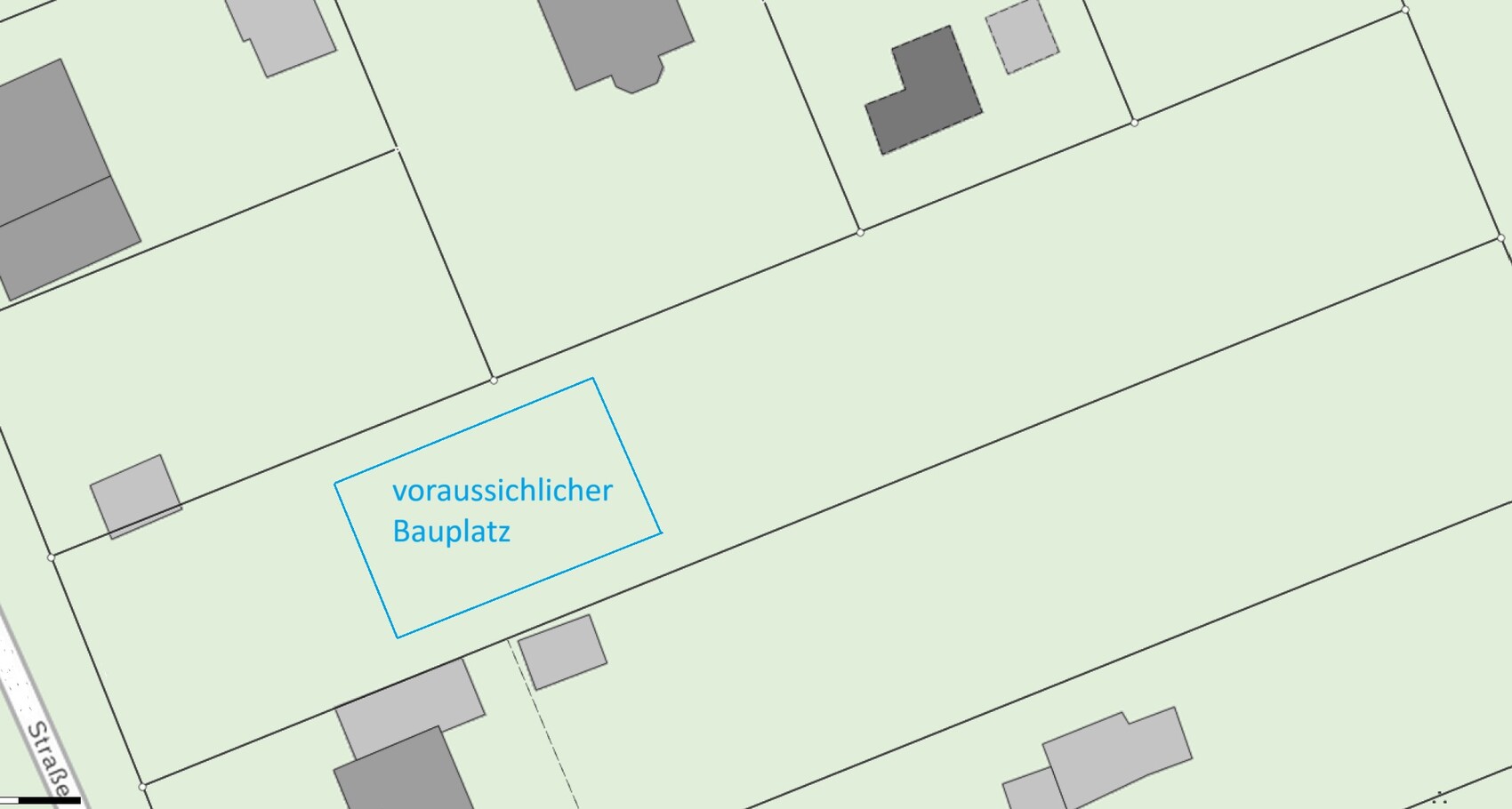
We plan to build on a plot of land in Brandenburg, south of Potsdam.
Plot Information
The plot is currently mostly covered with pine trees, some of which are around 100 years old, along with a few yews, oaks, and bushes. The area has been unmanaged for at least 50 years. At least the rear third (northeast area) is intended to remain forested, as part of the adjacent larger woodland.
The plot is oriented approximately northeast – southwest.
Street access is on the southwest side (bottom of the plan). At this end of the plot, there are a few very tall pines with some yews and an oak in between. The oak is not very old but is an interesting multi-stem tree. I want to preserve this green screen, which will likely be challenging since construction vehicles require a certain size and height.
On the southeast side (right on the plan) there is an overly large and mostly unattractive boundary structure (garage and shed), which is not very appealing.
The neighboring plots on the northwest side (left on the plan) together have a similar amount of boundary structures but less intrusive and located further towards the top of the plan. Overall, the northwest side is greener because the neighboring buildings are set further back from the property boundary.
Development Plan / Restrictions
There is no formal development plan, but local regulations set general rules, such as ridge height, setback distances, and garage roof shape. If these are specified anywhere, floor area ratio and plot ratio probably only play a theoretical role for this project and plot size.
Plot size: >2000m² (21,528ft²)
Slope: none
Floor area ratio unknown
Plot ratio unknown
Building window, building line, and boundary >3m (10ft) setback
Outbuildings allowed along boundary
Number of parking spaces not specified
Number of storeys not specified
House roof shape: roof pitch 25°–50°, excluding roof extensions
Garage: gable roof facing street
Architectural style: no specific requirements
Orientation: gable end or eaves aligned to street
Maximum heights/restrictions: ridge height max. 9.0m (30ft)
Other specifications: ground floor top edge max. 80cm (2.6ft)
Client Requirements
Architectural style, roof type, building type: gable roof
Orientation: photovoltaic panels on the south-facing roof side, gable end facing street
Basement, storeys: basement + ground floor + first floor
Number of occupants, ages: 3+1, ages 17–55+
Space requirements on ground floor, first floor:
Ground floor: living room, kitchen, dining area, guest bathroom
First floor: bedrooms, bathroom
Two additional rooms on ground floor or first floor
Office: mainly home office for one person
Guests per year: 1 (about 20 extended weekends)
Open or closed architecture: window-obscuring bathroom and bedroom doors
Conservative or modern style: conservative
Preferred construction method: solid gas concrete blocks (e.g. Ytong or similar)
Open kitchen with cooking island: semi-open, preferably with (half) island
Number of dining seats: 4 (expandable to 8)
Fireplace: yes
Music/stereo/TV wall: rather simple / stereo system yes, no built-in wall unit / large screen
Balcony/roof terrace: balcony yes / roof terrace no
Garage/carport: garage
Utility garden, greenhouse: garden yes, greenhouse later
Additional Requests / Special Features / Daily Routine, including reasons why certain things are wanted or not:
The plot is quite narrow at just under 20m (65ft) wide for my desired house, which includes a partially integrated side double garage and a large sunny southwest terrace, so the best compromise must be found.
Due to the tall trees on the southwest, we expect western sun only during summer. Also, two neighbor’s pine trees cast shade from the south on the likely building site.
When not sleeping, we mainly live on the ground floor, so this has planning priority. The kitchen is an important room, so we prefer a (semi-)open connection to the living room. At least one of us regularly works from home, so a suitable workstation is necessary, but a dedicated home office room is not essential.
Light is important in the living area (kitchen and living room), so we want the top edges of the windows to be as high as possible with roller shutters.
The fireplace is a 95% must-have as a supplementary heat source (and hopefully a cozy feature). Good positioning is a priority, but if possible, we’d like a water-carrying fireplace connected to a buffer tank and/or an additional hot water heating circuit for the bathrooms (e.g., large towel radiators). A ground heat load is planned via an air-to-water heat pump for underfloor heating. Additionally, air conditioning is planned in the master bedroom and child’s room 1.
A central ventilation system is probably too expensive.
The master bedroom should accommodate a double bed and a row of wardrobes.
Child’s room 1 will still serve as a youth room for a few years, later becoming a second bedroom (due to reported nighttime noise of uncertain cause).
The multi-purpose room is not yet definitively assigned: either home office or utility room with space for washing machine and dryer, or storage room.
Preferred room orientations (due to morning sun): kitchen, bathroom, and bedroom facing the garden.
The gable end facing the street seems sensible since photovoltaics are planned on the roof, and the south-facing side (+/- 30°) is expected to have the least shading.
My wife’s wish for a balcony on the bedroom is “because it looks better.”
If built, we would like access to the balcony from the bedroom and the bathroom.
A basement is a 95% must-have due to various hobbies requiring significant space and tools. Also, all technical equipment is planned to be located in the basement.
A garage is essential (as large as possible for 1–2 cars, bicycles, and garden tools), but the house has higher priority. If necessary, the garage can be built later and/or an additional carport added on the street side, or even an underground garage (a small dream).
We now consider a connecting door between house and garage impractical. With the entrance on the gable side, the path is short and convenient anyway.
Gas concrete as preferred wall material was chosen because of its combination of easy handling during shell construction (which tends to avoid the common poor work that can cause thermal bridges), very good sound insulation, pleasant indoor climate, minor advantages during interior finishing, and previous DIY experience with the material. It is also non-combustible, avoids producing large amounts of hazardous waste, and structurally the walls are not potential habitats for insects or small rodents.
House Design
Design origin: by me
-Not designed by a construction company planner yet
-Architect is being sought
-Do-it-yourself approach: yes (reading, trying, thinking, reading, trying, ...)
What do you especially like? Why?
Entrance on street side (front view preferred over side entrance)
Layout of kitchen, bathroom, bedrooms
Kitchen with large work surface, appliance space, and storage
Sauna in the bright bathroom
Bright living room with fireplace
Hallways on ground and first floors and staircase with daylight
Coatroom near entrance (though small)
Small but fully functional guest WC on ground floor
What do you dislike? Why?
Costs likely at the budget limit
Easy access to attic not resolved
Attic usage not finalized
Little distance to right side property boundary
Relatively large hallway areas
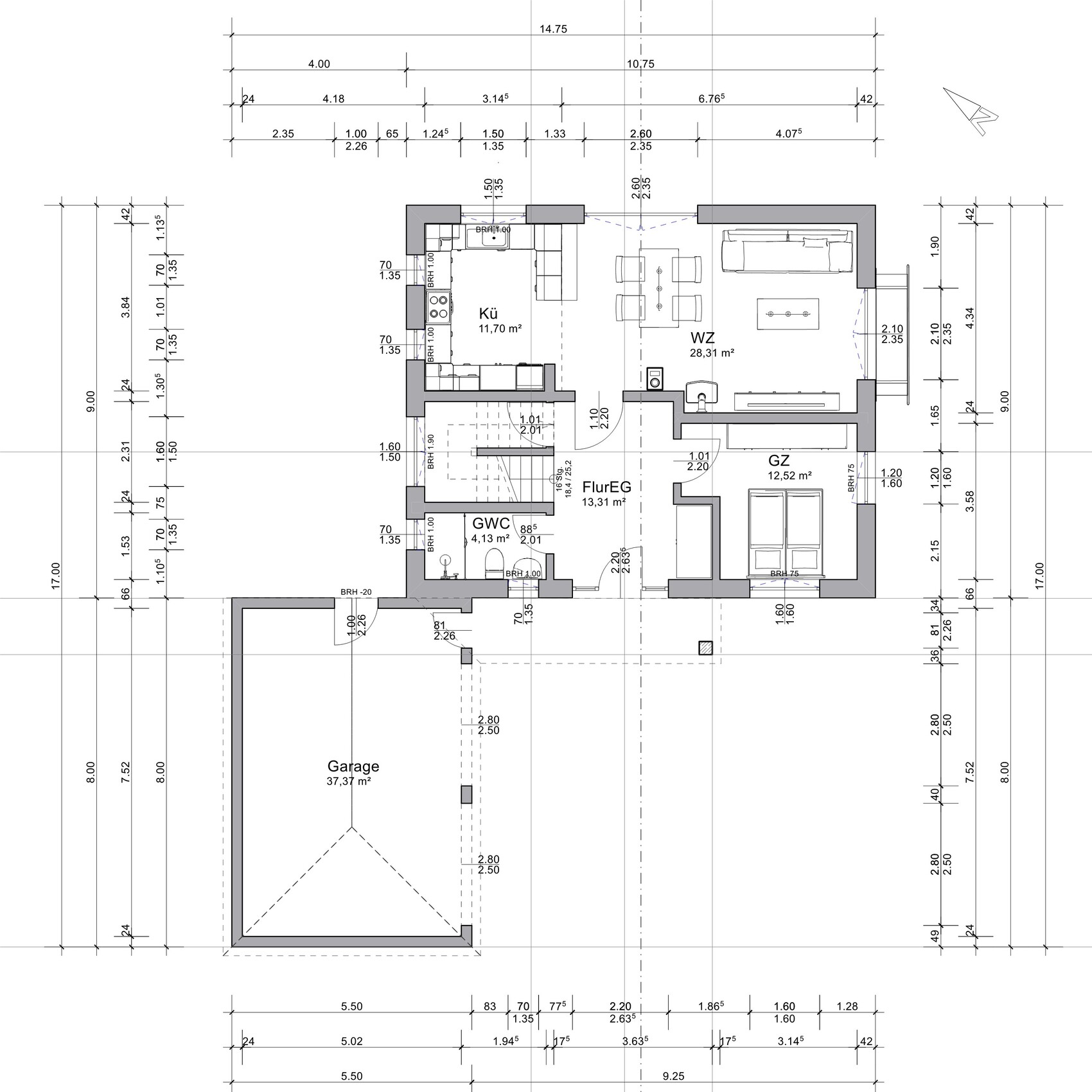
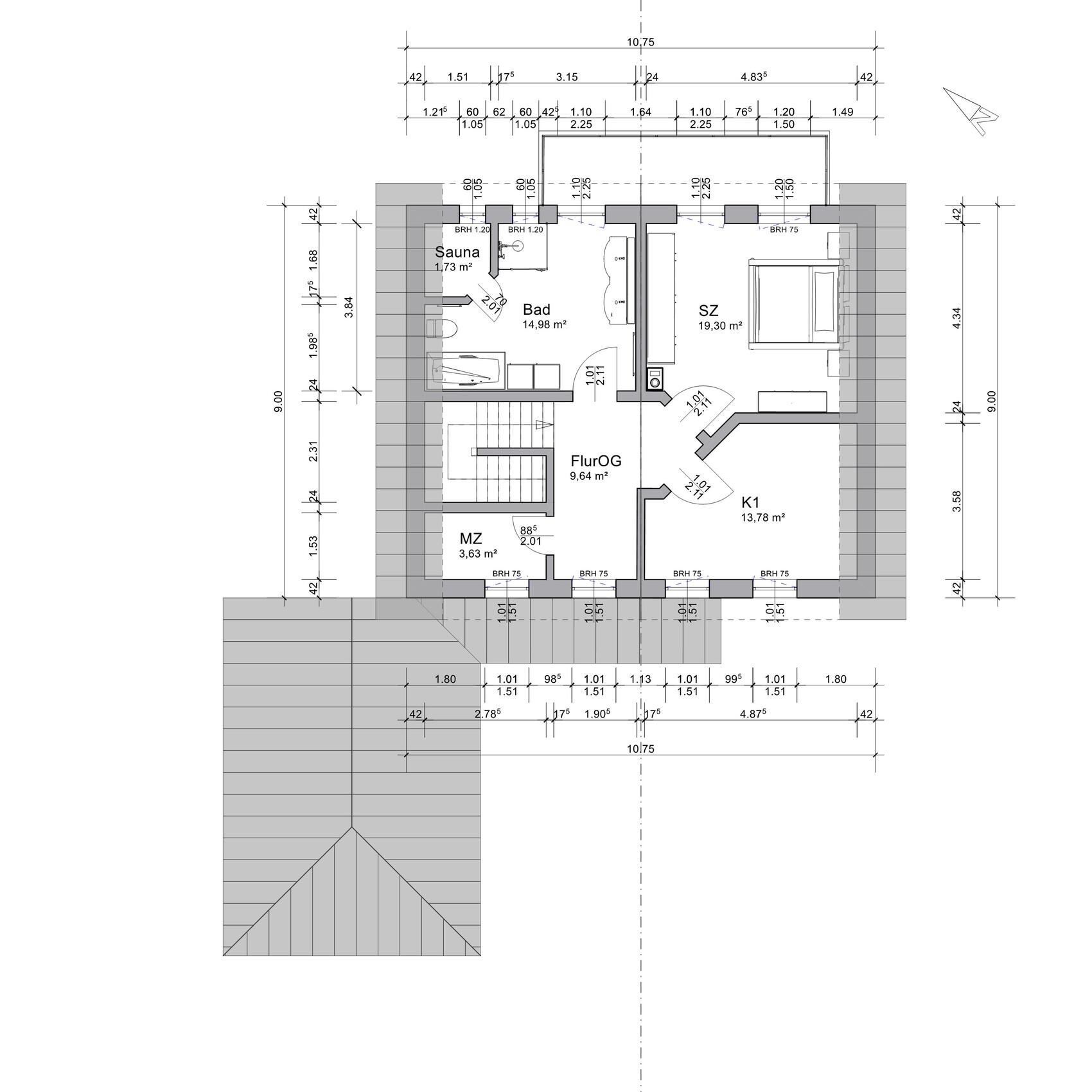
Living area (according to CAD program): 135m² (EG 71m², OG 64m²) (1453ft² total; ground floor 764ft², first floor 689ft²)
Estimated price per architect/planner: unknown but would like to know
Personal price limit for the house, including equipment: 550,000 EUR
Personal preferred heating technology: oil/gas (more independent under various situations) and fireplace
Most likely heating system realistically planned: air-to-water heat pump (for various reasons) + fireplace
Possibly additional split air conditioners in master bedroom and child’s room 1
If you have to forgo something, which details or extensions
-can be omitted: balcony, double garage, finished attic
-cannot be omitted: light
Why is the design the way it is now?
The design is one of the results of two years of reading, viewing, own experiences, consideration, and experimentation. There are now many design variants; four or five are basically acceptable to us, each with different pros and cons.
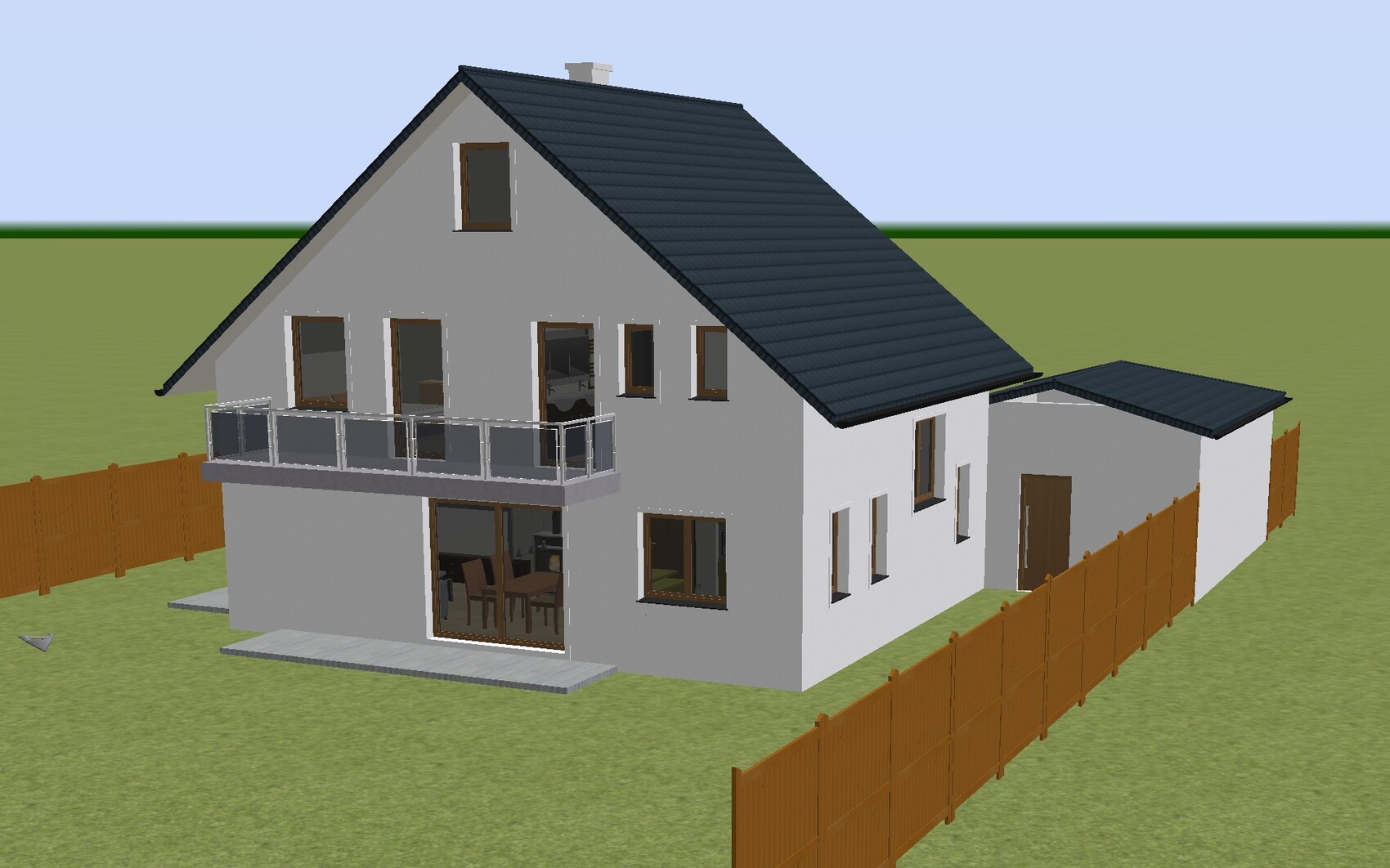
This is one of the options with the smallest living area. I transferred it into a mediocre (very stubborn) CAD system because it provides automatic dimensioning. The system also helps my 3D spatial imagination (e.g., stairs under roof slope, walls stacked, first-floor windows within the building volume, roof in general).
Many details are not finalized yet (e.g., stair to attic, windows, …) because of my lack of knowledge and experience. Also, some window and door types are simply not available in the CAD program; others are stubbornly displayed incorrectly.
The furniture layout shown is currently the best idea, but there are certainly better options (e.g., for the bathrooms).
Thank you in advance for your suggestions and help.

Plot Information
The plot is currently mostly covered with pine trees, some of which are around 100 years old, along with a few yews, oaks, and bushes. The area has been unmanaged for at least 50 years. At least the rear third (northeast area) is intended to remain forested, as part of the adjacent larger woodland.
The plot is oriented approximately northeast – southwest.
Street access is on the southwest side (bottom of the plan). At this end of the plot, there are a few very tall pines with some yews and an oak in between. The oak is not very old but is an interesting multi-stem tree. I want to preserve this green screen, which will likely be challenging since construction vehicles require a certain size and height.
On the southeast side (right on the plan) there is an overly large and mostly unattractive boundary structure (garage and shed), which is not very appealing.
The neighboring plots on the northwest side (left on the plan) together have a similar amount of boundary structures but less intrusive and located further towards the top of the plan. Overall, the northwest side is greener because the neighboring buildings are set further back from the property boundary.
Development Plan / Restrictions
There is no formal development plan, but local regulations set general rules, such as ridge height, setback distances, and garage roof shape. If these are specified anywhere, floor area ratio and plot ratio probably only play a theoretical role for this project and plot size.
Plot size: >2000m² (21,528ft²)
Slope: none
Floor area ratio unknown
Plot ratio unknown
Building window, building line, and boundary >3m (10ft) setback
Outbuildings allowed along boundary
Number of parking spaces not specified
Number of storeys not specified
House roof shape: roof pitch 25°–50°, excluding roof extensions
Garage: gable roof facing street
Architectural style: no specific requirements
Orientation: gable end or eaves aligned to street
Maximum heights/restrictions: ridge height max. 9.0m (30ft)
Other specifications: ground floor top edge max. 80cm (2.6ft)
Client Requirements
Architectural style, roof type, building type: gable roof
Orientation: photovoltaic panels on the south-facing roof side, gable end facing street
Basement, storeys: basement + ground floor + first floor
Number of occupants, ages: 3+1, ages 17–55+
Space requirements on ground floor, first floor:
Ground floor: living room, kitchen, dining area, guest bathroom
First floor: bedrooms, bathroom
Two additional rooms on ground floor or first floor
Office: mainly home office for one person
Guests per year: 1 (about 20 extended weekends)
Open or closed architecture: window-obscuring bathroom and bedroom doors
Conservative or modern style: conservative
Preferred construction method: solid gas concrete blocks (e.g. Ytong or similar)
Open kitchen with cooking island: semi-open, preferably with (half) island
Number of dining seats: 4 (expandable to 8)
Fireplace: yes
Music/stereo/TV wall: rather simple / stereo system yes, no built-in wall unit / large screen
Balcony/roof terrace: balcony yes / roof terrace no
Garage/carport: garage
Utility garden, greenhouse: garden yes, greenhouse later
Additional Requests / Special Features / Daily Routine, including reasons why certain things are wanted or not:
The plot is quite narrow at just under 20m (65ft) wide for my desired house, which includes a partially integrated side double garage and a large sunny southwest terrace, so the best compromise must be found.
Due to the tall trees on the southwest, we expect western sun only during summer. Also, two neighbor’s pine trees cast shade from the south on the likely building site.
When not sleeping, we mainly live on the ground floor, so this has planning priority. The kitchen is an important room, so we prefer a (semi-)open connection to the living room. At least one of us regularly works from home, so a suitable workstation is necessary, but a dedicated home office room is not essential.
Light is important in the living area (kitchen and living room), so we want the top edges of the windows to be as high as possible with roller shutters.
The fireplace is a 95% must-have as a supplementary heat source (and hopefully a cozy feature). Good positioning is a priority, but if possible, we’d like a water-carrying fireplace connected to a buffer tank and/or an additional hot water heating circuit for the bathrooms (e.g., large towel radiators). A ground heat load is planned via an air-to-water heat pump for underfloor heating. Additionally, air conditioning is planned in the master bedroom and child’s room 1.
A central ventilation system is probably too expensive.
The master bedroom should accommodate a double bed and a row of wardrobes.
Child’s room 1 will still serve as a youth room for a few years, later becoming a second bedroom (due to reported nighttime noise of uncertain cause).
The multi-purpose room is not yet definitively assigned: either home office or utility room with space for washing machine and dryer, or storage room.
Preferred room orientations (due to morning sun): kitchen, bathroom, and bedroom facing the garden.
The gable end facing the street seems sensible since photovoltaics are planned on the roof, and the south-facing side (+/- 30°) is expected to have the least shading.
My wife’s wish for a balcony on the bedroom is “because it looks better.”
If built, we would like access to the balcony from the bedroom and the bathroom.
A basement is a 95% must-have due to various hobbies requiring significant space and tools. Also, all technical equipment is planned to be located in the basement.
A garage is essential (as large as possible for 1–2 cars, bicycles, and garden tools), but the house has higher priority. If necessary, the garage can be built later and/or an additional carport added on the street side, or even an underground garage (a small dream).
We now consider a connecting door between house and garage impractical. With the entrance on the gable side, the path is short and convenient anyway.
Gas concrete as preferred wall material was chosen because of its combination of easy handling during shell construction (which tends to avoid the common poor work that can cause thermal bridges), very good sound insulation, pleasant indoor climate, minor advantages during interior finishing, and previous DIY experience with the material. It is also non-combustible, avoids producing large amounts of hazardous waste, and structurally the walls are not potential habitats for insects or small rodents.
House Design
Design origin: by me
-Not designed by a construction company planner yet
-Architect is being sought
-Do-it-yourself approach: yes (reading, trying, thinking, reading, trying, ...)
What do you especially like? Why?
Entrance on street side (front view preferred over side entrance)
Layout of kitchen, bathroom, bedrooms
Kitchen with large work surface, appliance space, and storage
Sauna in the bright bathroom
Bright living room with fireplace
Hallways on ground and first floors and staircase with daylight
Coatroom near entrance (though small)
Small but fully functional guest WC on ground floor
What do you dislike? Why?
Costs likely at the budget limit
Easy access to attic not resolved
Attic usage not finalized
Little distance to right side property boundary
Relatively large hallway areas
Living area (according to CAD program): 135m² (EG 71m², OG 64m²) (1453ft² total; ground floor 764ft², first floor 689ft²)
Estimated price per architect/planner: unknown but would like to know
Personal price limit for the house, including equipment: 550,000 EUR
Personal preferred heating technology: oil/gas (more independent under various situations) and fireplace
Most likely heating system realistically planned: air-to-water heat pump (for various reasons) + fireplace
Possibly additional split air conditioners in master bedroom and child’s room 1
If you have to forgo something, which details or extensions
-can be omitted: balcony, double garage, finished attic
-cannot be omitted: light
Why is the design the way it is now?
The design is one of the results of two years of reading, viewing, own experiences, consideration, and experimentation. There are now many design variants; four or five are basically acceptable to us, each with different pros and cons.
This is one of the options with the smallest living area. I transferred it into a mediocre (very stubborn) CAD system because it provides automatic dimensioning. The system also helps my 3D spatial imagination (e.g., stairs under roof slope, walls stacked, first-floor windows within the building volume, roof in general).
Many details are not finalized yet (e.g., stair to attic, windows, …) because of my lack of knowledge and experience. Also, some window and door types are simply not available in the CAD program; others are stubbornly displayed incorrectly.
The furniture layout shown is currently the best idea, but there are certainly better options (e.g., for the bathrooms).
Thank you in advance for your suggestions and help.
filosof schrieb:
Regarding the topic of a wood stove in a well-insulated house combined with a heat pump, I can share my own 0.05€ based on experience: My experience with this was brief and similar. @motorradsilke apparently manages quite well with this combination, and depending on user habits, it might work out, or as @filosof prefers, it can be acceptable when used only occasionally or during transitional seasons. As always, there are many different opinions.
In this case, however, the original poster wants to omit the mechanical ventilation with heat recovery for cost reasons and has planned rather small rooms with limited space to move around. Also, in my opinion, a two-person household, at least partially retired, might be easier to manage differently than a household with a child or teenager.
These additional reasons would steer me away from underfloor heating or the wood stove as well, especially since the budget is tight elsewhere (for example, in the basement and other areas).
Compared to our old house, we also couldn’t imagine how effective good insulation would be, nor the benefits of mechanical ventilation with heat recovery — that was all new to us as well.
M
motorradsilke18 May 2025 06:26filosof schrieb:
For us, the wood stove was a fixed choice. We love the cozy warmth of a wood fire!
What we underestimated: a heat pump combined with underfloor heating only runs efficiently if it operates continuously – meaning the temperature in the house stays consistently within the comfort zone. Only if the same comfort level is maintained throughout the day.
From my perspective, that is the major drawback of underfloor heating – you can’t quickly adjust the temperature. During the day, when we’re active, we like 20/21°C (68/70°F). That’s how the underfloor heating is set. But in the evening, that feels too cold for us. Or if we come home chilled, we want to warm up quickly. That’s why the stove was a fixed decision for us as well. We built it and wouldn’t want to do without it. In winter, it runs almost every day. In transitional seasons, we heat exclusively with the stove. That’s when the benefits of an insulated house come into play again: after heating the stove in the evening, it stays pleasantly warm, and the heat remains during the day.
However, I wouldn’t want to heat exclusively with the stove. On one hand, because we’re often away for long periods in winter and then my son would have to heat additionally. On the other, I wouldn’t like the restriction involved. We also considered integrating a water-jacket stove but eventually decided against it.
S
Sandstapler18 May 2025 07:17Thank you very much for the many detailed contributions.
I will try to answer everything, but probably more in a block rather than by quoting, since there are quite a few overlaps.
I will try to answer everything, but probably more in a block rather than by quoting, since there are quite a few overlaps.
S
Sandstapler18 May 2025 07:38Below, I have compiled posts from @ypg and others, but for better clarity, I have arranged them by room.
I hope this is acceptable.
Basement
Too expensive, unnecessary, for hobbies and
I would be interested to know which assumptions regarding hobbies and tool equipment this is based on.
For none of my hobbies is “space in the garden” even remotely an option. We’re not talking about two screwdrivers and a hammer here. And I certainly do not want my hobby to depend on nice weather.
Kitchen
These are acceptable opinions but lack factual basis.
The kitchen is sufficiently sized for our needs (working together with two or three people works well). The room depth could certainly be reduced by 30cm (12 inches) without it feeling cramped. That makes a difference of 1.5m² (16ft²). But since the dining area becomes somewhat larger, this is an important note for detailed kitchen planning.
Stove in the center, counter space on both sides, refrigerator on the left and sink on the right a couple of steps away, dishwasher next to the sink, available counter space for small appliances, plus a large prep area, storage within easy reach—what is non-ergonomic about that?
Open Plan Living Area
Our current living room measures 6.90 x 3.95m (22.6 x 13.0 ft). The balcony door is on the right in the same position, slightly wider. Furnishing is almost exactly as in the floor plan, including a table for four and a TV. Currently, the sofa is a 3+2 seating set, set 30cm (12 inches) away from the wall, because that “wall” is a floor-to-ceiling window 2.5m (8 ft) wide with white curtains. Between the TV and the coffee table, we have a passage width of 1.4m (55 inches). We have never had any issues turning around in the living room.
In the floor plan, the living room area is 4.30m (14 ft) deep, and the two-seater sofa is missing. What exactly is too tight there?
The final type of fireplace to be installed (freestanding/built-in/wood-burning or water-heated) will be decided in due course together with the architect, stove installer, and chimney sweep. And it will definitely be used.
Unfortunately, we do not have the same flexibility in timing with the chimney.
Dining Area
It is tight.
This does not change the fact that we regularly are only three people, and the table can also be positioned crosswise when guests arrive.
A sliding door is planned as the exit to the outside (incorrectly shown in the plan).
The chimney is in the way, and a satisfactory solution has not yet been found.
Guest Room
All comments are correct. Thanks to everyone. This room requires revision.
Guest Bathroom
The shower measures 153 x 95cm (60 x 37 inches) rough construction size, so probably 145 x 90cm (57 x 35 inches) with tiles. Not great, but it is not a spa oasis—it is a guest bathroom with a shower.
The sink cannot be placed as drawn, that is true. Nor can the mirror. But why it is said that you cannot brush your teeth at a hand basin, I do not know.
I will try to see if simply mirroring the room solves the sink problem.
Hallway
I hate it when visitors have to squeeze past me to close the door behind them.
Currently, the hallway is 152cm (60 inches) wide. That might work as a bare corridor, but with minimal furnishings (a narrow bench on one side, 29cm (11 inches) deep shoe cabinets on the other) that is a “never again” situation.
However, if the general opinion is that 2m (6.5 ft) width is sufficient, that is useful input. Thanks.
A narrower hallway would create more space in the guest bathroom and/or guest room.
Staircase
It does take up space, but the space was there first. And since space was available at this location...
Omitting the landing either leads to a larger and/or “awkward” hallway or forces giving up the guest shower.
To be continued.
I hope this is acceptable.
Basement
Too expensive, unnecessary, for hobbies and
“A shed for tools offers more potential than an underground floor.”
I would be interested to know which assumptions regarding hobbies and tool equipment this is based on.
For none of my hobbies is “space in the garden” even remotely an option. We’re not talking about two screwdrivers and a hammer here. And I certainly do not want my hobby to depend on nice weather.
Kitchen
Too big …
Non-ergonomic…
These are acceptable opinions but lack factual basis.
The kitchen is sufficiently sized for our needs (working together with two or three people works well). The room depth could certainly be reduced by 30cm (12 inches) without it feeling cramped. That makes a difference of 1.5m² (16ft²). But since the dining area becomes somewhat larger, this is an important note for detailed kitchen planning.
Stove in the center, counter space on both sides, refrigerator on the left and sink on the right a couple of steps away, dishwasher next to the sink, available counter space for small appliances, plus a large prep area, storage within easy reach—what is non-ergonomic about that?
Open Plan Living Area
“You can hardly turn around in the living/dining area because it’s so cramped.”
Our current living room measures 6.90 x 3.95m (22.6 x 13.0 ft). The balcony door is on the right in the same position, slightly wider. Furnishing is almost exactly as in the floor plan, including a table for four and a TV. Currently, the sofa is a 3+2 seating set, set 30cm (12 inches) away from the wall, because that “wall” is a floor-to-ceiling window 2.5m (8 ft) wide with white curtains. Between the TV and the coffee table, we have a passage width of 1.4m (55 inches). We have never had any issues turning around in the living room.
In the floor plan, the living room area is 4.30m (14 ft) deep, and the two-seater sofa is missing. What exactly is too tight there?
“Then plan a fireplace that is both usable and functional!”
The final type of fireplace to be installed (freestanding/built-in/wood-burning or water-heated) will be decided in due course together with the architect, stove installer, and chimney sweep. And it will definitely be used.
Unfortunately, we do not have the same flexibility in timing with the chimney.
Dining Area
It is tight.
This does not change the fact that we regularly are only three people, and the table can also be positioned crosswise when guests arrive.
A sliding door is planned as the exit to the outside (incorrectly shown in the plan).
The chimney is in the way, and a satisfactory solution has not yet been found.
Guest Room
All comments are correct. Thanks to everyone. This room requires revision.
Guest Bathroom
The shower measures 153 x 95cm (60 x 37 inches) rough construction size, so probably 145 x 90cm (57 x 35 inches) with tiles. Not great, but it is not a spa oasis—it is a guest bathroom with a shower.
The sink cannot be placed as drawn, that is true. Nor can the mirror. But why it is said that you cannot brush your teeth at a hand basin, I do not know.
I will try to see if simply mirroring the room solves the sink problem.
Hallway
I hate it when visitors have to squeeze past me to close the door behind them.
Currently, the hallway is 152cm (60 inches) wide. That might work as a bare corridor, but with minimal furnishings (a narrow bench on one side, 29cm (11 inches) deep shoe cabinets on the other) that is a “never again” situation.
However, if the general opinion is that 2m (6.5 ft) width is sufficient, that is useful input. Thanks.
A narrower hallway would create more space in the guest bathroom and/or guest room.
Staircase
“The half-landing staircase is a space eater and belongs in office buildings or houses over 160, 170m².”
It does take up space, but the space was there first. And since space was available at this location...
Omitting the landing either leads to a larger and/or “awkward” hallway or forces giving up the guest shower.
To be continued.
M
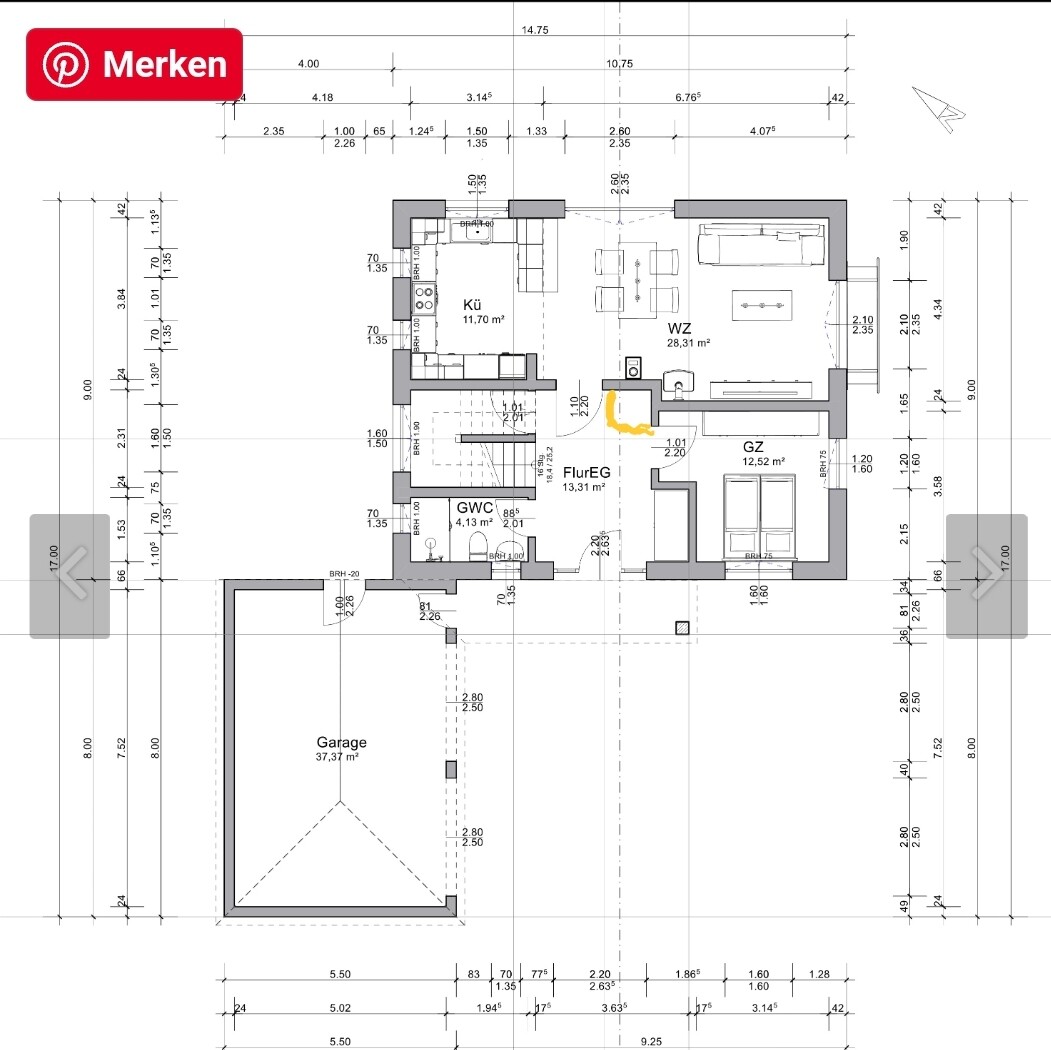
motorradsilke18 May 2025 07:49I would place the chimney in the upper right corner of the hallway on the floor plan.
S
Sandstapler18 May 2025 07:59Upper Floor
Unfortunately, I forgot to mention that, for reasons unknown to me, the software stubbornly draws the cut edge of the gray roof surfaces at about 170cm (67 inches) above the finished floor level. I apologize for that.
The generated sections as a whole are unusable; otherwise, I would have uploaded one. I have to focus on relevant measurements individually.
Bathroom
That may be true, but for at least half the year, it is the cheapest way to dry out the shower. Besides, I find it nice to look outside at greenery while showering.
The sauna window has been removed (Thanks @Costruttrice).
Balcony
Yes, rationally that is almost my opinion too. But it is just mine.
I openly admit, however, that we have no idea how expensive the balcony would be.
Children’s Room
According to the software, the living area is 13m² (140 sq ft). The floor area is about 16m² (172 sq ft).
Along the wall at the top of the plan, about 2m (6.5 ft) wardrobe width with 2m (6.5 ft) height is possible, plus space under the sloping roof. Too little?
Living Comfort
We are currently three or four people. The kitchen is relatively large for exactly that reason: it often happens that more than one person is working there.
Where else would you not bump into each other?
I don’t understand. Why can’t you watch TV on the sofa while others sit at the table and drink coffee? It rarely happens for us anyway. We usually do both together.
Yes, it still is.
The focus of the OP is kitchen, living room, and bathroom (not in order). That does not mean everything else is unimportant.
Furniture
That using fewer secondhand furniture pieces, which is clearly the better financial solution for us, should be relevant to the floor plan was unexpected. The initial post is already long enough that not everyone wanted to read it all. So as an addition: when the transport and storage costs of a ten-year-old sofa or wardrobe significantly exceed the cost of disposal plus new purchase, I buy new.
But yes, “hardly reusing any furniture” is a bit exaggerated. About one-third will be moved.
Design
I: “And I would have assumed a good preliminary design is convincing through good room layout.”
It’s a pity you didn’t realize what my statement referred to.
In the original post, it says that I am still looking for an architect. Why is it assumed for the second time now that it will be a cheap designer?
And even if it is, I have many kind and less kind experiences with service price vs. service quality.
Unfortunately, I forgot to mention that, for reasons unknown to me, the software stubbornly draws the cut edge of the gray roof surfaces at about 170cm (67 inches) above the finished floor level. I apologize for that.
The generated sections as a whole are unusable; otherwise, I would have uploaded one. I have to focus on relevant measurements individually.
Bathroom
A window in the shower is unwise.
That may be true, but for at least half the year, it is the cheapest way to dry out the shower. Besides, I find it nice to look outside at greenery while showering.
The sauna window has been removed (Thanks @Costruttrice).
Balcony
Why on earth do you need an expensive balcony when you have such a large plot of land?
Yes, rationally that is almost my opinion too. But it is just mine.
I openly admit, however, that we have no idea how expensive the balcony would be.
Children’s Room
The children’s room has only one wall where a wardrobe can be placed. Floor dimensions of about 13,xy result in an estimated 10sqm.
According to the software, the living area is 13m² (140 sq ft). The floor area is about 16m² (172 sq ft).
Along the wall at the top of the plan, about 2m (6.5 ft) wardrobe width with 2m (6.5 ft) height is possible, plus space under the sloping roof. Too little?
Living Comfort
For me, living comfort is about space. Space so that all individuals living in the house can develop individually and not constantly have to say “can I get through?”
We are currently three or four people. The kitchen is relatively large for exactly that reason: it often happens that more than one person is working there.
Where else would you not bump into each other?
“No one can watch TV undisturbed here while others drink coffee.”
I don’t understand. Why can’t you watch TV on the sofa while others sit at the table and drink coffee? It rarely happens for us anyway. We usually do both together.
Of course, more space is expensive.
Not if it is distributed where it is needed.
Yes, it still is.
The focus of the OP is kitchen, hallway, and basement ...
The focus of the OP is kitchen, living room, and bathroom (not in order). That does not mean everything else is unimportant.
Furniture
That using fewer secondhand furniture pieces, which is clearly the better financial solution for us, should be relevant to the floor plan was unexpected. The initial post is already long enough that not everyone wanted to read it all. So as an addition: when the transport and storage costs of a ten-year-old sofa or wardrobe significantly exceed the cost of disposal plus new purchase, I buy new.
But yes, “hardly reusing any furniture” is a bit exaggerated. About one-third will be moved.
Design
I: “And I would have assumed a good preliminary design is convincing through good room layout.”
But you don’t have that. You don’t have a good room layout!
But don’t expect a cheap designer to fix your bad draft.
It’s a pity you didn’t realize what my statement referred to.
In the original post, it says that I am still looking for an architect. Why is it assumed for the second time now that it will be a cheap designer?
And even if it is, I have many kind and less kind experiences with service price vs. service quality.
Similar topics