
We plan to build on a plot of land in Brandenburg, south of Potsdam.
Plot Information
The plot is currently mostly covered with pine trees, some of which are around 100 years old, along with a few yews, oaks, and bushes. The area has been unmanaged for at least 50 years. At least the rear third (northeast area) is intended to remain forested, as part of the adjacent larger woodland.
The plot is oriented approximately northeast – southwest.
Street access is on the southwest side (bottom of the plan). At this end of the plot, there are a few very tall pines with some yews and an oak in between. The oak is not very old but is an interesting multi-stem tree. I want to preserve this green screen, which will likely be challenging since construction vehicles require a certain size and height.
On the southeast side (right on the plan) there is an overly large and mostly unattractive boundary structure (garage and shed), which is not very appealing.
The neighboring plots on the northwest side (left on the plan) together have a similar amount of boundary structures but less intrusive and located further towards the top of the plan. Overall, the northwest side is greener because the neighboring buildings are set further back from the property boundary.
Development Plan / Restrictions
There is no formal development plan, but local regulations set general rules, such as ridge height, setback distances, and garage roof shape. If these are specified anywhere, floor area ratio and plot ratio probably only play a theoretical role for this project and plot size.
Plot size: >2000m² (21,528ft²)
Slope: none
Floor area ratio unknown
Plot ratio unknown
Building window, building line, and boundary >3m (10ft) setback
Outbuildings allowed along boundary
Number of parking spaces not specified
Number of storeys not specified
House roof shape: roof pitch 25°–50°, excluding roof extensions
Garage: gable roof facing street
Architectural style: no specific requirements
Orientation: gable end or eaves aligned to street
Maximum heights/restrictions: ridge height max. 9.0m (30ft)
Other specifications: ground floor top edge max. 80cm (2.6ft)
Client Requirements
Architectural style, roof type, building type: gable roof
Orientation: photovoltaic panels on the south-facing roof side, gable end facing street
Basement, storeys: basement + ground floor + first floor
Number of occupants, ages: 3+1, ages 17–55+
Space requirements on ground floor, first floor:
Ground floor: living room, kitchen, dining area, guest bathroom
First floor: bedrooms, bathroom
Two additional rooms on ground floor or first floor
Office: mainly home office for one person
Guests per year: 1 (about 20 extended weekends)
Open or closed architecture: window-obscuring bathroom and bedroom doors
Conservative or modern style: conservative
Preferred construction method: solid gas concrete blocks (e.g. Ytong or similar)
Open kitchen with cooking island: semi-open, preferably with (half) island
Number of dining seats: 4 (expandable to 8)
Fireplace: yes
Music/stereo/TV wall: rather simple / stereo system yes, no built-in wall unit / large screen
Balcony/roof terrace: balcony yes / roof terrace no
Garage/carport: garage
Utility garden, greenhouse: garden yes, greenhouse later
Additional Requests / Special Features / Daily Routine, including reasons why certain things are wanted or not:
The plot is quite narrow at just under 20m (65ft) wide for my desired house, which includes a partially integrated side double garage and a large sunny southwest terrace, so the best compromise must be found.
Due to the tall trees on the southwest, we expect western sun only during summer. Also, two neighbor’s pine trees cast shade from the south on the likely building site.
When not sleeping, we mainly live on the ground floor, so this has planning priority. The kitchen is an important room, so we prefer a (semi-)open connection to the living room. At least one of us regularly works from home, so a suitable workstation is necessary, but a dedicated home office room is not essential.
Light is important in the living area (kitchen and living room), so we want the top edges of the windows to be as high as possible with roller shutters.
The fireplace is a 95% must-have as a supplementary heat source (and hopefully a cozy feature). Good positioning is a priority, but if possible, we’d like a water-carrying fireplace connected to a buffer tank and/or an additional hot water heating circuit for the bathrooms (e.g., large towel radiators). A ground heat load is planned via an air-to-water heat pump for underfloor heating. Additionally, air conditioning is planned in the master bedroom and child’s room 1.
A central ventilation system is probably too expensive.
The master bedroom should accommodate a double bed and a row of wardrobes.
Child’s room 1 will still serve as a youth room for a few years, later becoming a second bedroom (due to reported nighttime noise of uncertain cause).
The multi-purpose room is not yet definitively assigned: either home office or utility room with space for washing machine and dryer, or storage room.
Preferred room orientations (due to morning sun): kitchen, bathroom, and bedroom facing the garden.
The gable end facing the street seems sensible since photovoltaics are planned on the roof, and the south-facing side (+/- 30°) is expected to have the least shading.
My wife’s wish for a balcony on the bedroom is “because it looks better.”
If built, we would like access to the balcony from the bedroom and the bathroom.
A basement is a 95% must-have due to various hobbies requiring significant space and tools. Also, all technical equipment is planned to be located in the basement.
A garage is essential (as large as possible for 1–2 cars, bicycles, and garden tools), but the house has higher priority. If necessary, the garage can be built later and/or an additional carport added on the street side, or even an underground garage (a small dream).
We now consider a connecting door between house and garage impractical. With the entrance on the gable side, the path is short and convenient anyway.
Gas concrete as preferred wall material was chosen because of its combination of easy handling during shell construction (which tends to avoid the common poor work that can cause thermal bridges), very good sound insulation, pleasant indoor climate, minor advantages during interior finishing, and previous DIY experience with the material. It is also non-combustible, avoids producing large amounts of hazardous waste, and structurally the walls are not potential habitats for insects or small rodents.
House Design
Design origin: by me
-Not designed by a construction company planner yet
-Architect is being sought
-Do-it-yourself approach: yes (reading, trying, thinking, reading, trying, ...)
What do you especially like? Why?
Entrance on street side (front view preferred over side entrance)
Layout of kitchen, bathroom, bedrooms
Kitchen with large work surface, appliance space, and storage
Sauna in the bright bathroom
Bright living room with fireplace
Hallways on ground and first floors and staircase with daylight
Coatroom near entrance (though small)
Small but fully functional guest WC on ground floor
What do you dislike? Why?
Costs likely at the budget limit
Easy access to attic not resolved
Attic usage not finalized
Little distance to right side property boundary
Relatively large hallway areas
Living area (according to CAD program): 135m² (EG 71m², OG 64m²) (1453ft² total; ground floor 764ft², first floor 689ft²)
Estimated price per architect/planner: unknown but would like to know
Personal price limit for the house, including equipment: 550,000 EUR
Personal preferred heating technology: oil/gas (more independent under various situations) and fireplace
Most likely heating system realistically planned: air-to-water heat pump (for various reasons) + fireplace
Possibly additional split air conditioners in master bedroom and child’s room 1
If you have to forgo something, which details or extensions
-can be omitted: balcony, double garage, finished attic
-cannot be omitted: light
Why is the design the way it is now?
The design is one of the results of two years of reading, viewing, own experiences, consideration, and experimentation. There are now many design variants; four or five are basically acceptable to us, each with different pros and cons.
This is one of the options with the smallest living area. I transferred it into a mediocre (very stubborn) CAD system because it provides automatic dimensioning. The system also helps my 3D spatial imagination (e.g., stairs under roof slope, walls stacked, first-floor windows within the building volume, roof in general).
Many details are not finalized yet (e.g., stair to attic, windows, …) because of my lack of knowledge and experience. Also, some window and door types are simply not available in the CAD program; others are stubbornly displayed incorrectly.
The furniture layout shown is currently the best idea, but there are certainly better options (e.g., for the bathrooms).
Thank you in advance for your suggestions and help.
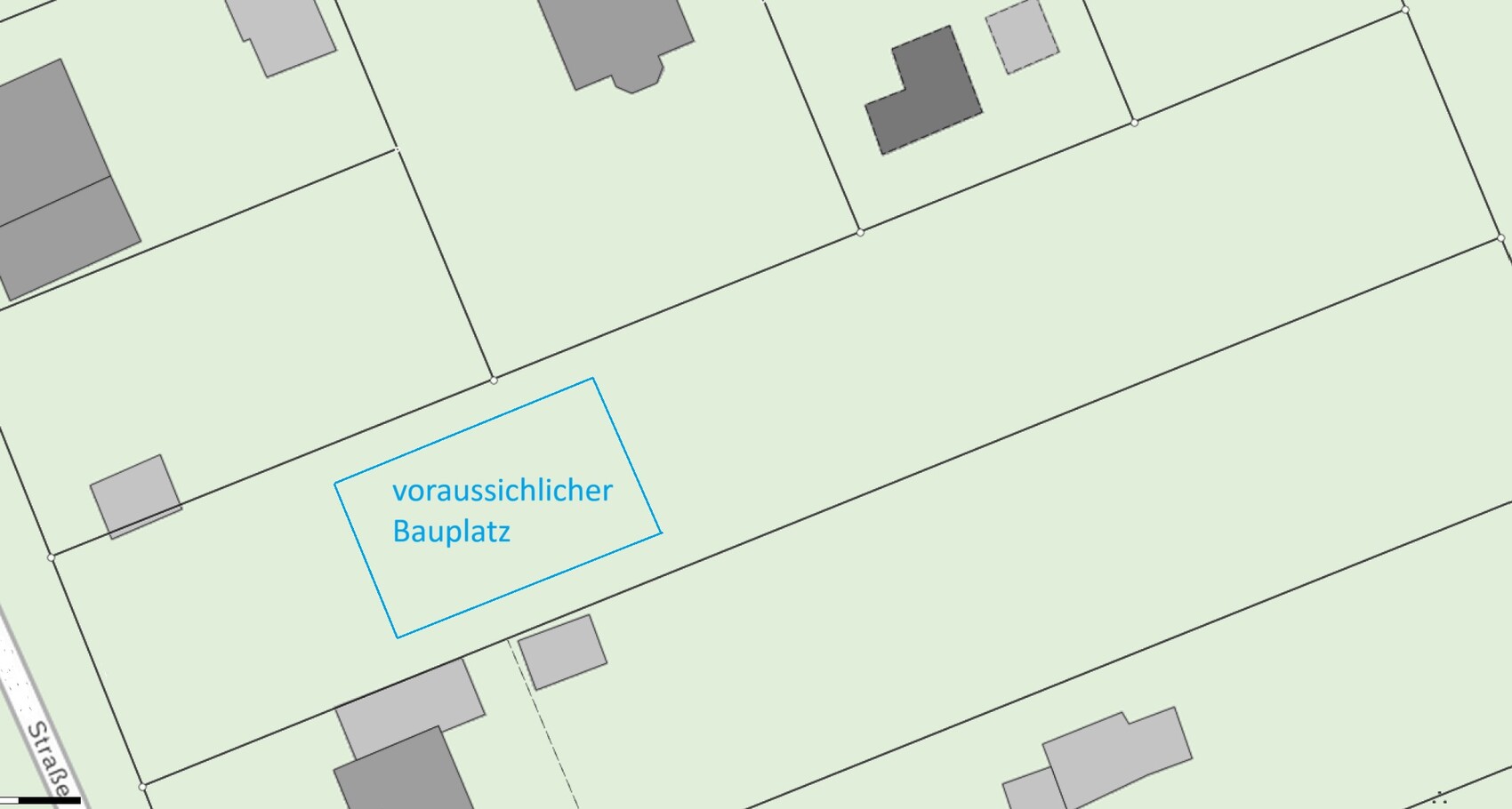
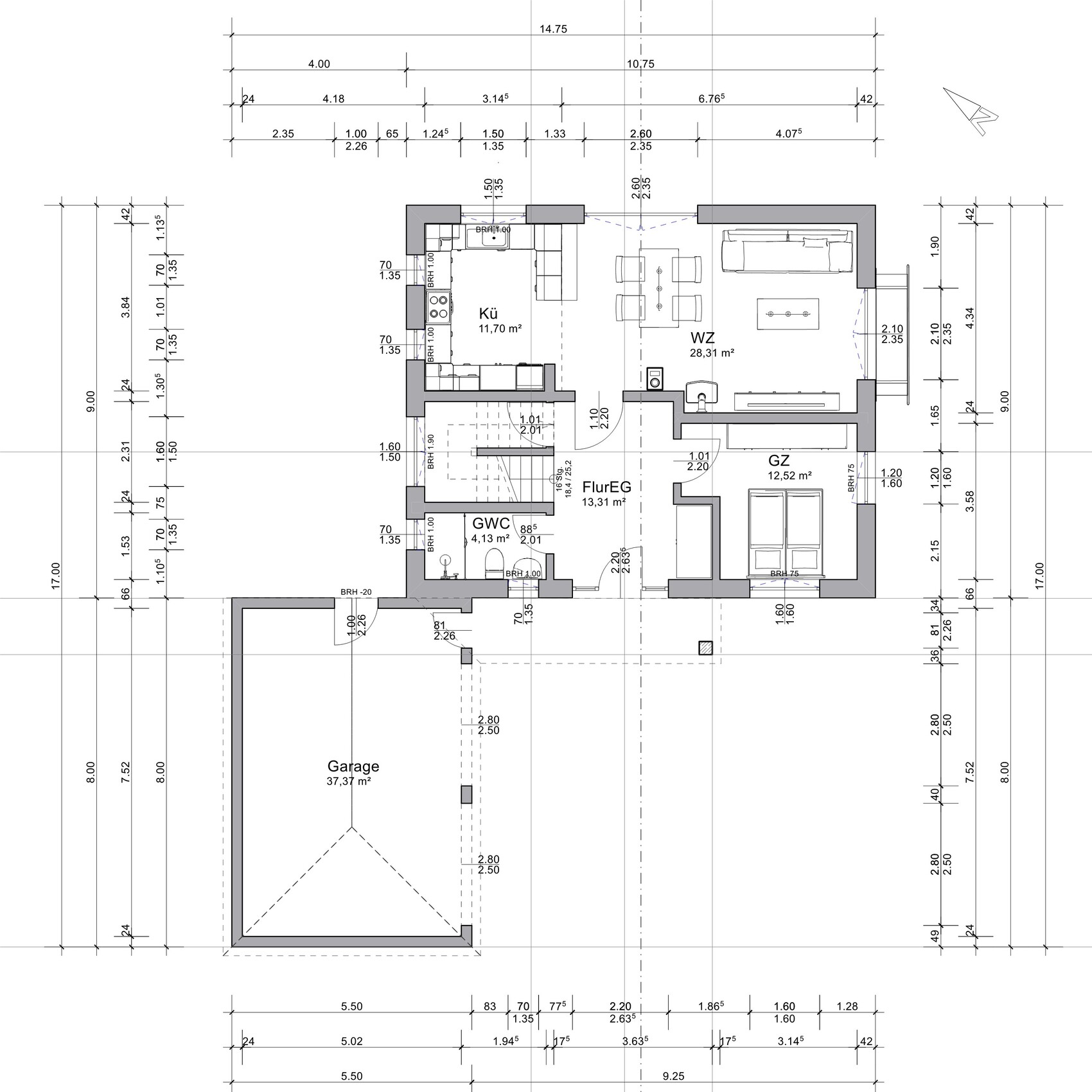
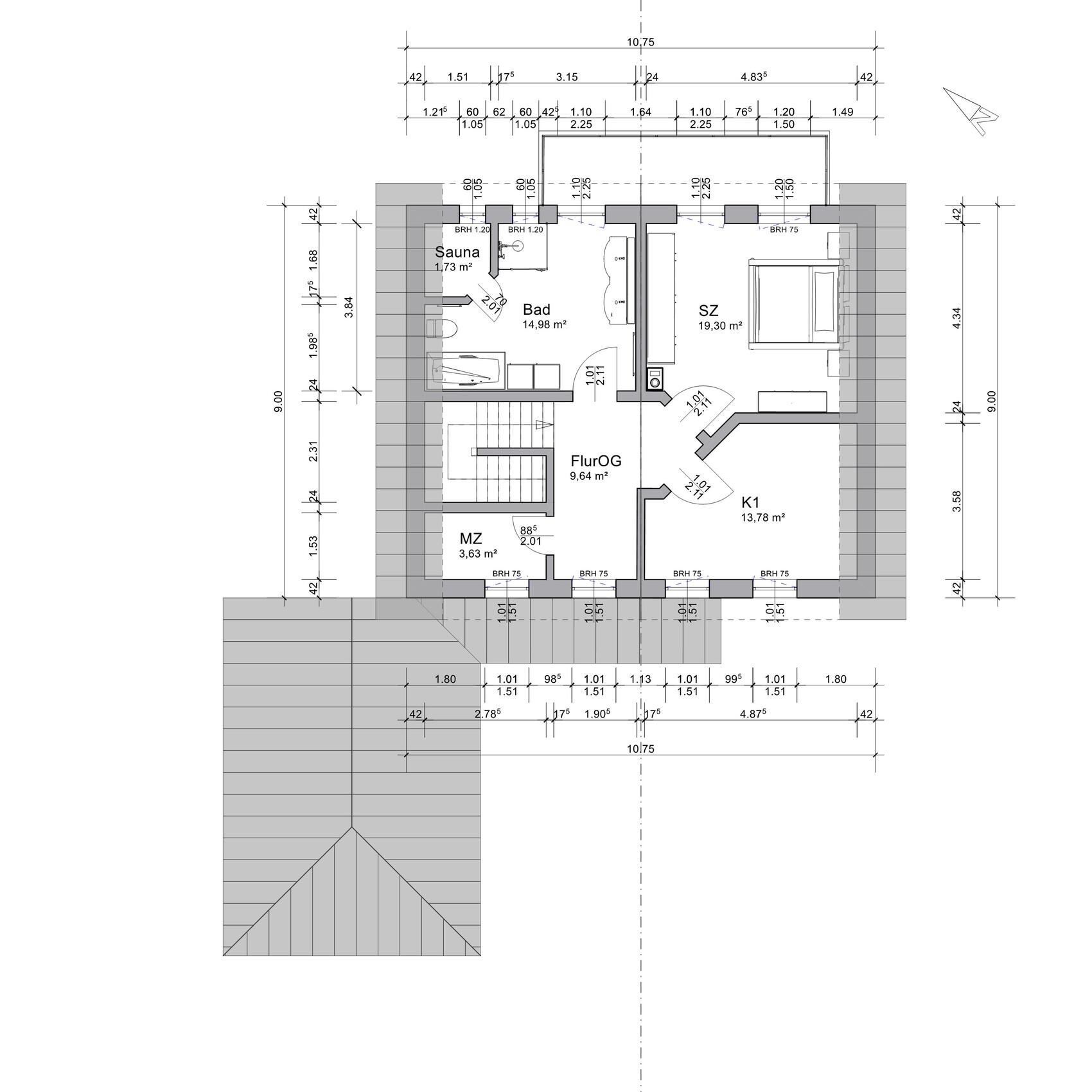

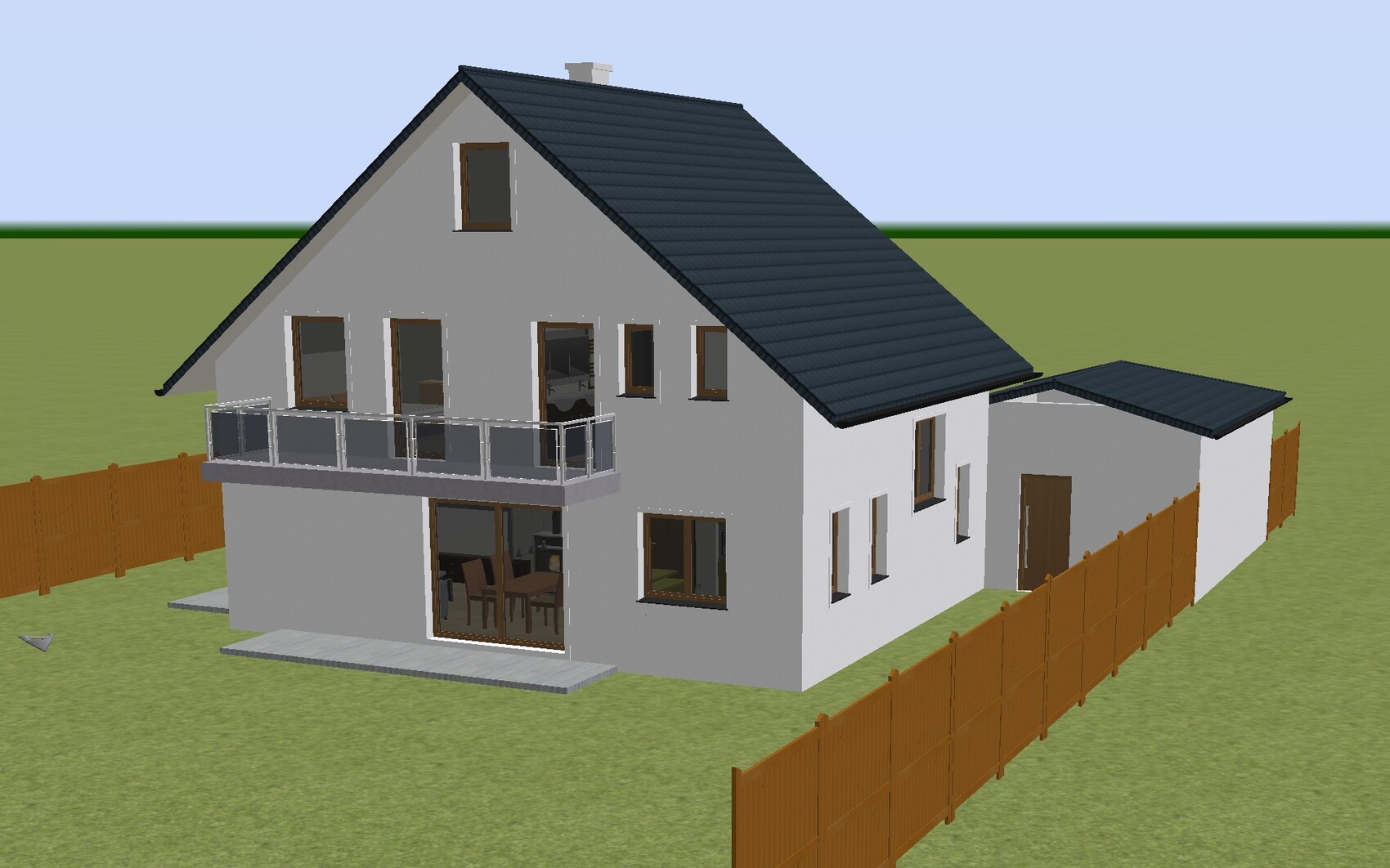
Plot Information
The plot is currently mostly covered with pine trees, some of which are around 100 years old, along with a few yews, oaks, and bushes. The area has been unmanaged for at least 50 years. At least the rear third (northeast area) is intended to remain forested, as part of the adjacent larger woodland.
The plot is oriented approximately northeast – southwest.
Street access is on the southwest side (bottom of the plan). At this end of the plot, there are a few very tall pines with some yews and an oak in between. The oak is not very old but is an interesting multi-stem tree. I want to preserve this green screen, which will likely be challenging since construction vehicles require a certain size and height.
On the southeast side (right on the plan) there is an overly large and mostly unattractive boundary structure (garage and shed), which is not very appealing.
The neighboring plots on the northwest side (left on the plan) together have a similar amount of boundary structures but less intrusive and located further towards the top of the plan. Overall, the northwest side is greener because the neighboring buildings are set further back from the property boundary.
Development Plan / Restrictions
There is no formal development plan, but local regulations set general rules, such as ridge height, setback distances, and garage roof shape. If these are specified anywhere, floor area ratio and plot ratio probably only play a theoretical role for this project and plot size.
Plot size: >2000m² (21,528ft²)
Slope: none
Floor area ratio unknown
Plot ratio unknown
Building window, building line, and boundary >3m (10ft) setback
Outbuildings allowed along boundary
Number of parking spaces not specified
Number of storeys not specified
House roof shape: roof pitch 25°–50°, excluding roof extensions
Garage: gable roof facing street
Architectural style: no specific requirements
Orientation: gable end or eaves aligned to street
Maximum heights/restrictions: ridge height max. 9.0m (30ft)
Other specifications: ground floor top edge max. 80cm (2.6ft)
Client Requirements
Architectural style, roof type, building type: gable roof
Orientation: photovoltaic panels on the south-facing roof side, gable end facing street
Basement, storeys: basement + ground floor + first floor
Number of occupants, ages: 3+1, ages 17–55+
Space requirements on ground floor, first floor:
Ground floor: living room, kitchen, dining area, guest bathroom
First floor: bedrooms, bathroom
Two additional rooms on ground floor or first floor
Office: mainly home office for one person
Guests per year: 1 (about 20 extended weekends)
Open or closed architecture: window-obscuring bathroom and bedroom doors
Conservative or modern style: conservative
Preferred construction method: solid gas concrete blocks (e.g. Ytong or similar)
Open kitchen with cooking island: semi-open, preferably with (half) island
Number of dining seats: 4 (expandable to 8)
Fireplace: yes
Music/stereo/TV wall: rather simple / stereo system yes, no built-in wall unit / large screen
Balcony/roof terrace: balcony yes / roof terrace no
Garage/carport: garage
Utility garden, greenhouse: garden yes, greenhouse later
Additional Requests / Special Features / Daily Routine, including reasons why certain things are wanted or not:
The plot is quite narrow at just under 20m (65ft) wide for my desired house, which includes a partially integrated side double garage and a large sunny southwest terrace, so the best compromise must be found.
Due to the tall trees on the southwest, we expect western sun only during summer. Also, two neighbor’s pine trees cast shade from the south on the likely building site.
When not sleeping, we mainly live on the ground floor, so this has planning priority. The kitchen is an important room, so we prefer a (semi-)open connection to the living room. At least one of us regularly works from home, so a suitable workstation is necessary, but a dedicated home office room is not essential.
Light is important in the living area (kitchen and living room), so we want the top edges of the windows to be as high as possible with roller shutters.
The fireplace is a 95% must-have as a supplementary heat source (and hopefully a cozy feature). Good positioning is a priority, but if possible, we’d like a water-carrying fireplace connected to a buffer tank and/or an additional hot water heating circuit for the bathrooms (e.g., large towel radiators). A ground heat load is planned via an air-to-water heat pump for underfloor heating. Additionally, air conditioning is planned in the master bedroom and child’s room 1.
A central ventilation system is probably too expensive.
The master bedroom should accommodate a double bed and a row of wardrobes.
Child’s room 1 will still serve as a youth room for a few years, later becoming a second bedroom (due to reported nighttime noise of uncertain cause).
The multi-purpose room is not yet definitively assigned: either home office or utility room with space for washing machine and dryer, or storage room.
Preferred room orientations (due to morning sun): kitchen, bathroom, and bedroom facing the garden.
The gable end facing the street seems sensible since photovoltaics are planned on the roof, and the south-facing side (+/- 30°) is expected to have the least shading.
My wife’s wish for a balcony on the bedroom is “because it looks better.”
If built, we would like access to the balcony from the bedroom and the bathroom.
A basement is a 95% must-have due to various hobbies requiring significant space and tools. Also, all technical equipment is planned to be located in the basement.
A garage is essential (as large as possible for 1–2 cars, bicycles, and garden tools), but the house has higher priority. If necessary, the garage can be built later and/or an additional carport added on the street side, or even an underground garage (a small dream).
We now consider a connecting door between house and garage impractical. With the entrance on the gable side, the path is short and convenient anyway.
Gas concrete as preferred wall material was chosen because of its combination of easy handling during shell construction (which tends to avoid the common poor work that can cause thermal bridges), very good sound insulation, pleasant indoor climate, minor advantages during interior finishing, and previous DIY experience with the material. It is also non-combustible, avoids producing large amounts of hazardous waste, and structurally the walls are not potential habitats for insects or small rodents.
House Design
Design origin: by me
-Not designed by a construction company planner yet
-Architect is being sought
-Do-it-yourself approach: yes (reading, trying, thinking, reading, trying, ...)
What do you especially like? Why?
Entrance on street side (front view preferred over side entrance)
Layout of kitchen, bathroom, bedrooms
Kitchen with large work surface, appliance space, and storage
Sauna in the bright bathroom
Bright living room with fireplace
Hallways on ground and first floors and staircase with daylight
Coatroom near entrance (though small)
Small but fully functional guest WC on ground floor
What do you dislike? Why?
Costs likely at the budget limit
Easy access to attic not resolved
Attic usage not finalized
Little distance to right side property boundary
Relatively large hallway areas
Living area (according to CAD program): 135m² (EG 71m², OG 64m²) (1453ft² total; ground floor 764ft², first floor 689ft²)
Estimated price per architect/planner: unknown but would like to know
Personal price limit for the house, including equipment: 550,000 EUR
Personal preferred heating technology: oil/gas (more independent under various situations) and fireplace
Most likely heating system realistically planned: air-to-water heat pump (for various reasons) + fireplace
Possibly additional split air conditioners in master bedroom and child’s room 1
If you have to forgo something, which details or extensions
-can be omitted: balcony, double garage, finished attic
-cannot be omitted: light
Why is the design the way it is now?
The design is one of the results of two years of reading, viewing, own experiences, consideration, and experimentation. There are now many design variants; four or five are basically acceptable to us, each with different pros and cons.
This is one of the options with the smallest living area. I transferred it into a mediocre (very stubborn) CAD system because it provides automatic dimensioning. The system also helps my 3D spatial imagination (e.g., stairs under roof slope, walls stacked, first-floor windows within the building volume, roof in general).
Many details are not finalized yet (e.g., stair to attic, windows, …) because of my lack of knowledge and experience. Also, some window and door types are simply not available in the CAD program; others are stubbornly displayed incorrectly.
The furniture layout shown is currently the best idea, but there are certainly better options (e.g., for the bathrooms).
Thank you in advance for your suggestions and help.
W
wiltshire19 May 2025 20:55Arauki11 schrieb:
I would really recommend you start thinking more creatively and especially imagine your life "without" the teenager(s), because that stage will probably be over soon. That was indeed our approach when building. We created separate apartments for the boys, aged 17 and 19 at the time, each with its own entrance door, bathroom, and kitchenette. One has now moved out, and the apartment is used as an office and guest accommodation. If finances get tight, we could offer it as an Airbnb. (With me, you never know—I just took a creative break for nine months and started a start-up in November…)
Arauki11 schrieb:
I'm getting the urge to build again...... Me too.
S
Siedler3419 May 2025 22:33Sandstapler schrieb:
The dining area is really... modest. Something needs to be done.
However, I don’t want the space to be reduced to just a dining area; it’s also partly a living room.Could you design the kitchen as a U-shape so that the dining table can be rotated 90 degrees in the room when needed (e.g., when hosting several guests)?W
wiltshire20 May 2025 09:36I just thought of something related to heating technology – a central masonry heater. It warms the kitchen, dining area, living room, hallway, guest room, as well as the stairwell and upper hallway. The area shown in orange represents the heat storage mass; a glass door can be installed facing the dining area. It’s also possible to have two doors, but that reduces efficiency. Of course, the heater doesn’t have to be square; rounded or angled shapes work well in the hallway and guest room.

The guest bathroom will have an infrared heater built into the mirror, and the upstairs bathroom as well as the bedrooms and children’s rooms will each have a decentralized air conditioning system. Whether the rooms downstairs also need air conditioning is a matter of personal preference.
The cost for such a masonry heater, including the chimney, with a premium insert and electronic combustion control (which achieves over 90% efficiency) is about 25,000€. If you estimate roughly 70m² (750 ft²) of heated space and 40 kWh/m² per year, you need around 2,800 kWh. Spruce wood contains 4.5 kWh/kg. You end up with roughly 4 kWh of heat loss during combustion in the masonry heater, which equals about 700 kg, or roughly 3 cubic meters of stacked wood (ster). Obviously, the masonry heater prefers beech wood because it burns longer and more evenly, resulting in slightly lower efficiency, and your personal heating habits will also affect this. Add about one cubic meter for that. Operating costs are therefore very low – especially since you harvest your own heating energy onsite during house construction. A 20-meter (66 ft) spruce log with a 30cm (12 in) diameter will provide you with almost a year’s worth of heating energy according to this rough estimation. Please double-check the calculations yourself, as this is just an off-the-cuff estimate.
The guest bathroom will have an infrared heater built into the mirror, and the upstairs bathroom as well as the bedrooms and children’s rooms will each have a decentralized air conditioning system. Whether the rooms downstairs also need air conditioning is a matter of personal preference.
The cost for such a masonry heater, including the chimney, with a premium insert and electronic combustion control (which achieves over 90% efficiency) is about 25,000€. If you estimate roughly 70m² (750 ft²) of heated space and 40 kWh/m² per year, you need around 2,800 kWh. Spruce wood contains 4.5 kWh/kg. You end up with roughly 4 kWh of heat loss during combustion in the masonry heater, which equals about 700 kg, or roughly 3 cubic meters of stacked wood (ster). Obviously, the masonry heater prefers beech wood because it burns longer and more evenly, resulting in slightly lower efficiency, and your personal heating habits will also affect this. Add about one cubic meter for that. Operating costs are therefore very low – especially since you harvest your own heating energy onsite during house construction. A 20-meter (66 ft) spruce log with a 30cm (12 in) diameter will provide you with almost a year’s worth of heating energy according to this rough estimation. Please double-check the calculations yourself, as this is just an off-the-cuff estimate.
S
Sandstapler20 May 2025 15:19Hello and thanks in advance to everyone.
Unfortunately, I am quite busy this week.
I will reply to everything over the weekend.
Unfortunately, I am quite busy this week.
I will reply to everything over the weekend.
 In der Ruine21 May 2025 06:14
Since you need to watch your budget, I would suggest cutting the balcony first. Nobody actually uses a balcony when they have a nice garden. I see many of these “add-ons” around here and have never seen anyone sitting on them.
W
wiltshire21 May 2025 11:43In der Ruine schrieb:
Since you probably need to watch your budget, I would first cut the balcony. Nobody really sits on the balcony if they have a nice garden. From the sauna, to the shower, and then a very short walk outside to a lounger on the balcony for complete privacy—I find that totally understandable. I also prefer having direct outdoor access from the bedroom—in the upper floor, you need a balcony if the hillside location doesn’t provide that.
I would rather save on the garage or build it later.
Similar topics