
Hello,
unfortunately, my post simply disappeared again yesterday, so I’ll try my luck once more.
A brief introduction: I am 48, female, single, and based in northern Baden-Württemberg.
I’m still at the very beginning of my house-building planning but already own a plot of land, for which I will sign the purchase contract in the coming weeks.
I want a small, single-story house without a basement, with a small, low-maintenance garden and nothing fancy.
It is unclear whether another person might move in ever, so I don’t want to plan for that at this point.
Basically, it would depend on the cost what 10-15 m² (100-160 sq ft) more would mean, as my budget is naturally limited.
Room plan
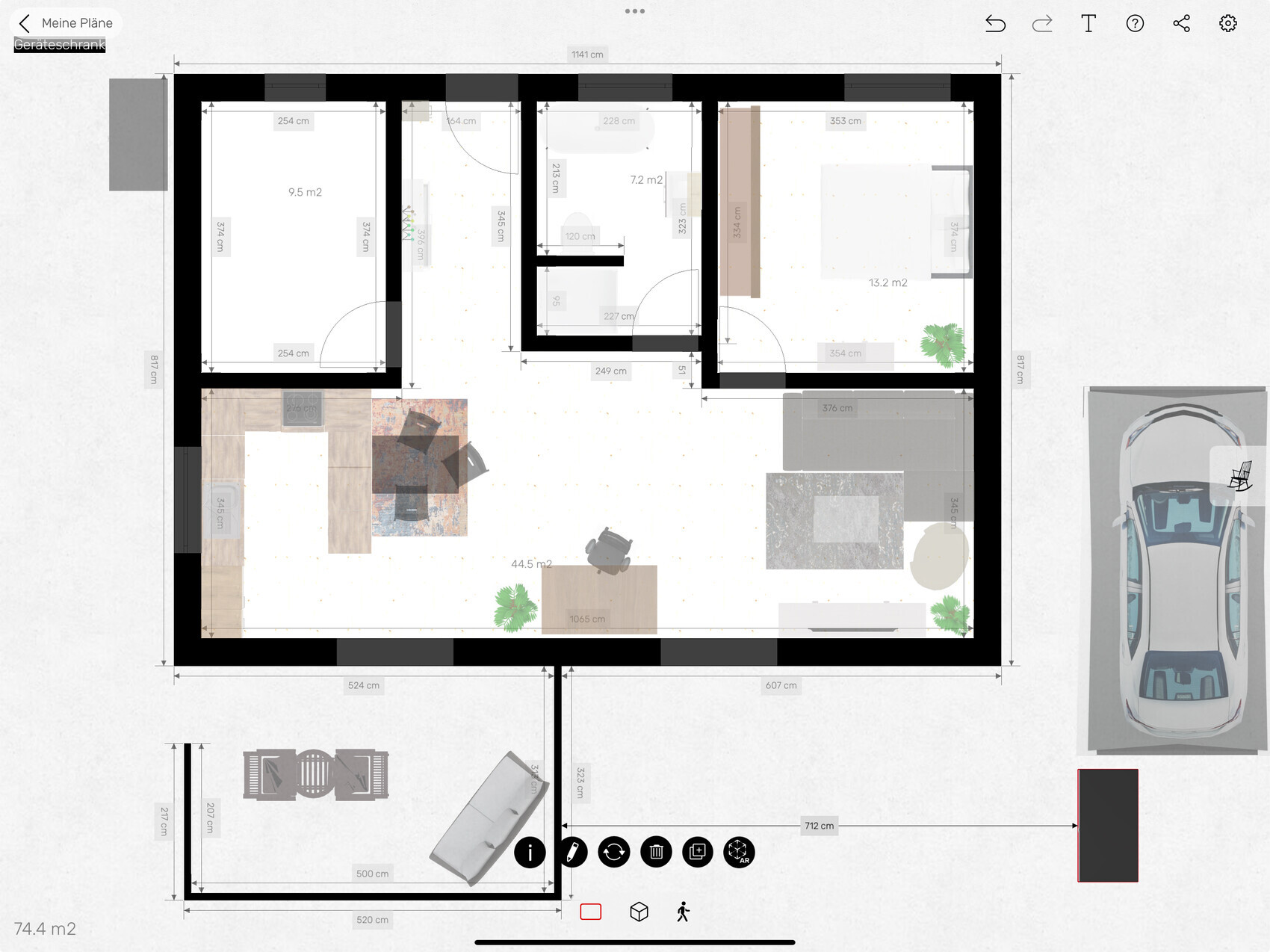
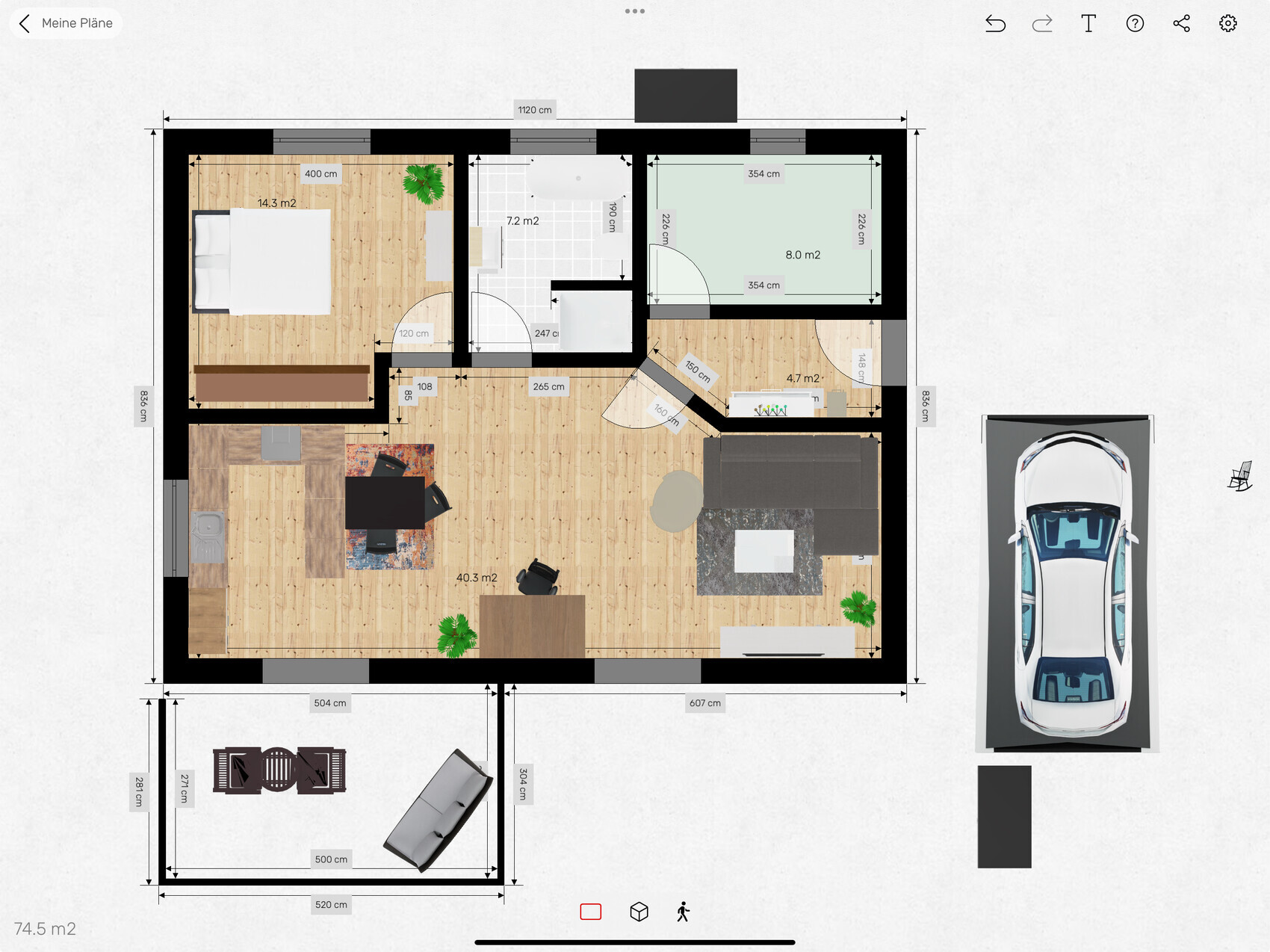
Kitchen + Dining + Living + Work approx. 40 m² (430 sq ft)
Bedroom approx. 14 m² (150 sq ft)
Dressing room -
Work/Guest/Child room approx. 10 m² (110 sq ft) optional
Bathroom + WC approx. 7 m² (75 sq ft)
Hallway approx. 5 m² (55 sq ft)
Utility room approx. 8 m² (85 sq ft)
Guest WC -
Storage room -
Total approx. 75 - 85 m² (810 - 915 sq ft)
Questionnaire regarding the floor plan:
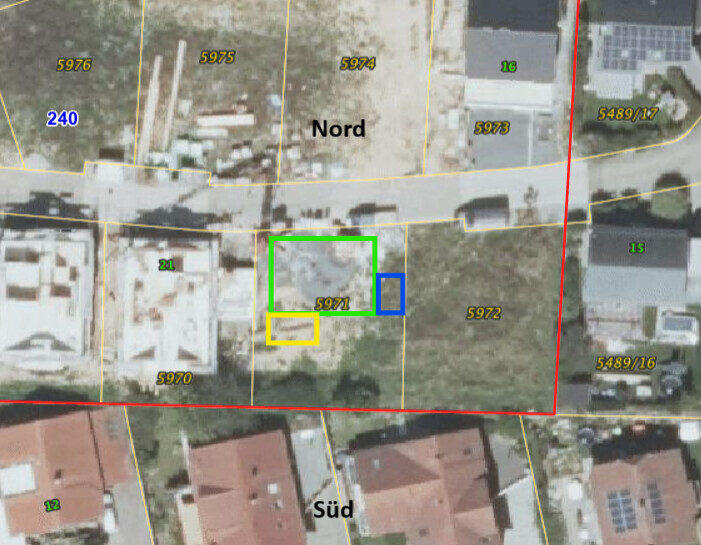
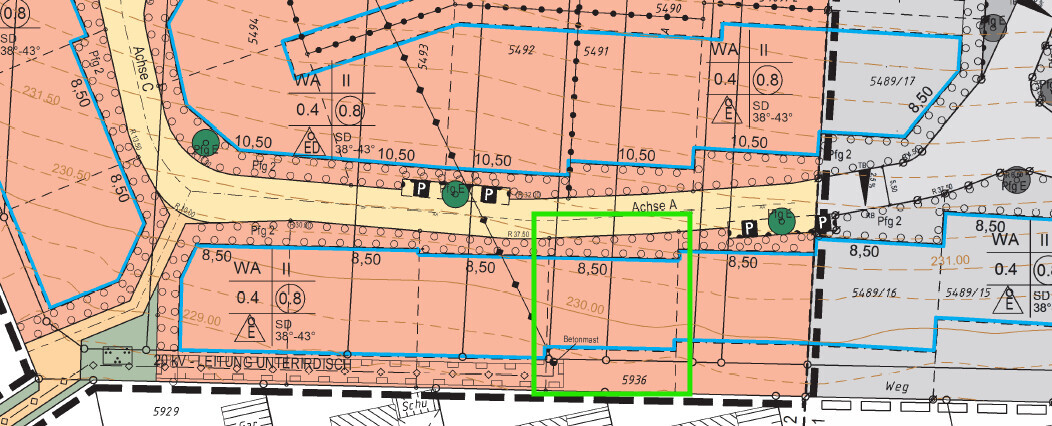
Attached are a section of the development plan and a rough drawing of the house (green), carport (blue) and patio (yellow) on the screenshot from Boris BW.
I have also attached my first attempts at floor plans (once with the entrance in the north and once in the east). I probably used the wrong tool for drafting, but I hope something can still be understood or used.
I look forward to constructive feedback.
Thank you in advance for your time.
unfortunately, my post simply disappeared again yesterday, so I’ll try my luck once more.
A brief introduction: I am 48, female, single, and based in northern Baden-Württemberg.
I’m still at the very beginning of my house-building planning but already own a plot of land, for which I will sign the purchase contract in the coming weeks.
I want a small, single-story house without a basement, with a small, low-maintenance garden and nothing fancy.
It is unclear whether another person might move in ever, so I don’t want to plan for that at this point.
Basically, it would depend on the cost what 10-15 m² (100-160 sq ft) more would mean, as my budget is naturally limited.
Room plan
Kitchen + Dining + Living + Work approx. 40 m² (430 sq ft)
Bedroom approx. 14 m² (150 sq ft)
Dressing room -
Work/Guest/Child room approx. 10 m² (110 sq ft) optional
Bathroom + WC approx. 7 m² (75 sq ft)
Hallway approx. 5 m² (55 sq ft)
Utility room approx. 8 m² (85 sq ft)
Guest WC -
Storage room -
Total approx. 75 - 85 m² (810 - 915 sq ft)
Questionnaire regarding the floor plan:
| Development plan / restrictions | |
| Plot size | 392 m² (4,220 sq ft) |
| Slope | North-south gradient approx. 1.5 m on 21 m (5 ft on 69 ft) |
| Site coverage ratio | 0.4 |
| Floor area ratio | 0.8 |
| Building envelope, building line and boundary | see development plan |
| Edge development | Setbacks according to open construction style |
| Number of parking spaces | 1.5 (rounded up) per dwelling unit, so 2 |
| Number of stories | II (two stories) |
| Roof type | Pitch 38–43°, half-hip roof or double shed roof |
| Architectural style | ? |
| Orientation | East-West |
| Maximum heights / limits | 8.5 m (28 ft) |
| Further requirements | Cistern of 4.5 m³ (160 cu ft) recommended Garage: with gable roof or green flat roof, carports? Filling allowed up to 1.8 m (6 ft) |
| Builder’s requirements | |
| Style, roof form, building type | Exemption from gable roof at 30°? Bungalow |
| Basement, number of floors | One story without basement |
| Number of people, age | see introduction |
| Space requirements on ground and upper floors | Ground floor 75-80 m² (810 - 860 sq ft) |
| Office: family use or home office? | Home office, integrated in living-dining area |
| Number of overnight guests per year | 0–1 |
| Open or closed architecture | ? |
| Traditional or modern construction style | ? |
| Open kitchen, kitchen island | Kitchen island with depth like regular kitchen cabinets, followed by dining table |
| Number of dining seats | max 4 |
| Fireplace | Undecided |
| Music / stereo wall | No |
| Balcony, roof terrace | No |
| Garage, carport | 1 carport, 1 parking space |
| Vegetable garden, greenhouse | No |
| Further wishes / special features / daily routine, including reasons why some things should be included or not | - No separate office for home office because I don’t want to spend most of the day in a smaller room but rather in the living room with a view of the garden - Retractable staircase to the attic (additional storage space) - Wall in bedroom for wardrobe at least 2.75 m (9 ft) long - Wall in living room at least 2.45 m (8 ft) long for lowboard with TV - Bathtub – uncertain if necessary - Larger shower 90 x 120 cm (36 x 47 inches) with tiled partition wall (avoid glass wall) |
| House design | |
| Who designed the plan: | DIY, based on floor plans from Hanse Haus and various other small house providers |
| What do you like? Why? | Open living-dining-working area in the southern part of the house, utility room not directly next to the bedroom (noise from technical equipment) |
| What do you dislike? Why? | Possibly the hallway / entrance area is rather small |
| Cost estimate according to architect / planner: | ? |
| Personal price limit for the house, incl. equipment: | 250,000–270,000 Euros (approx. 270,000–290,000 USD) turnkey, excluding foundation slab, earthworks, secondary building costs, furnishings, and landscaping |
| Preferred heating system: | Not yet decided, possibly underfloor heating |
| Other considerations | Maximum house length 11.5 m (38 ft) because plot width approx. 18 m (59 ft) minus carport 3 m (10 ft) minus setback 2.5 m (8 ft) minus 1 m (3 ft) buffer in case plot is shorter than 18 m (measured on Boris BW) Carport position could also be on the west side To maximize green space and deal with the slope: house with long side parallel to the street No preference yet regarding solid construction or timber frame, KfW 55 or 40 or X standard |
| Outdoor facilities | - Patio approx. 15 m² (160 sq ft) level with the house - Lawn may have slope - Carport with parking space in front |
| Earthworks | Southern boundary: retaining wall needed to manage slope, neighbors (right and left) have done this with 1.4 m (4.5 ft) L-shaped concrete blocks or hollow blocks, rough offer from earthworks company is available (wall, grading, compacting and preparations for foundation slab, foundation slab, patio and carport [= crane location], graveling, drainage, grounding ring, multi-utility lines, site setup etc. all together approx. 60,000 Euros) |
Attached are a section of the development plan and a rough drawing of the house (green), carport (blue) and patio (yellow) on the screenshot from Boris BW.
I have also attached my first attempts at floor plans (once with the entrance in the north and once in the east). I probably used the wrong tool for drafting, but I hope something can still be understood or used.
I look forward to constructive feedback.
Thank you in advance for your time.
haydee schrieb:
Considering the financial situation, the original poster should choose a heating system. The fireplace is expensive, even if used only occasionally at first. That’s exactly why I’m thinking about alternatives besides underfloor heating plus a heat pump. For this reason, we decided on infrared heating combined with a nearly new, used masonry heater, all together costing under €10,000 (about $10,900) for a single-family house. The fireplace was only considered as an option if you like the open wood fire, like we do for example.
In this particular case, in my opinion, other alternatives to the now commonly used and expensive standard of underfloor heating plus air-to-water heat pumps should also be considered.
Before anything else, I would prioritize maximizing the house insulation.
Steffi33 schrieb:
In summer he spends days sawing his wood… that’s almost worse. That probably depends more on the type of person, as men often enjoy using devices with loud motors. I wouldn’t know where to put all that wood if someone sawed that much at my place. I don’t know how he heats or if and how his house is insulated. We often use our modern stove for the entire open-plan house, and three years ago we only ordered firewood once plus two large bundles of wood briquettes, which will probably last through this winter as well.
A properly well-insulated house simply doesn’t need nearly as much energy, so that would be my prerequisite for any new house anyway.
I believe this discussion would be better suited elsewhere. A fireplace is more of a nice-to-have.
Additionally, I assume that implementing this on an 18-meter-wide (59 feet) plot for a bungalow would not be possible between two two-story houses, as the required setbacks cannot be maintained.
Additionally, I assume that implementing this on an 18-meter-wide (59 feet) plot for a bungalow would not be possible between two two-story houses, as the required setbacks cannot be maintained.
Agreed.
My original comment was simply about whether one wants a fireplace, since this should already be considered during the floor plan discussion to find an appropriate location.
Heating topics often get quite extensive, but that’s generally not a problem as long as people – as is the case in this thread – engage in a reasonably friendly manner. I believe the original poster is reading this and taking away useful insights; that’s exactly how it should be.
A key factor is always the location and specific characteristics of the plot, which applies to the fireplace just as much as to potential views through large windows, etc. Therefore, decisions should always be made on an individual basis.
I’m looking forward to seeing how the floor plan develops. I especially like this project because it’s not the usual family home, but something different, and perhaps also because it fits better with my current life stage.
My original comment was simply about whether one wants a fireplace, since this should already be considered during the floor plan discussion to find an appropriate location.
Heating topics often get quite extensive, but that’s generally not a problem as long as people – as is the case in this thread – engage in a reasonably friendly manner. I believe the original poster is reading this and taking away useful insights; that’s exactly how it should be.
A key factor is always the location and specific characteristics of the plot, which applies to the fireplace just as much as to potential views through large windows, etc. Therefore, decisions should always be made on an individual basis.
I’m looking forward to seeing how the floor plan develops. I especially like this project because it’s not the usual family home, but something different, and perhaps also because it fits better with my current life stage.

ypg schrieb:
A fireplace is a nice-to-have feature.
Also, I assume that building it on an 18-meter-wide (59 feet) plot for a bungalow between two two-story houses is probably not possible, as the required setbacks cannot be maintained. Fireplaces and taller neighboring houses, good point: the chimney may need to be significantly higher than the house and can end up looking like the skewer of a cheese appetizer. In recent years, regulations on this have developed in a rather bureaucratic manner.
https://www.instagram.com/11antgmxde/
https://www.linkedin.com/company/bauen-jetzt/
N
Newbee-BW12 Dec 2024 20:38Thank you very much for your active participation in the search for a heating system. I can take away so much from it and incorporate it into my considerations, which is really very helpful!
My contribution on the topic of heating was intended more symbolically, as with all other aspects of this house build: to truly focus on one’s personal preferences and sometimes make choices against the mainstream if you just prefer something that way.
For example, a gallery involves considerable effort (heating, cleaning, etc.), but I would not want to do without it. The same goes for large, tall window surfaces that need cleaning or a chandelier hung high up — all completely impractical and labor-intensive, yet beautiful. You can extend this idea to elaborate gardens or flowerbeds, expensive and high-maintenance pets, and much more; the respective benefit or value lies elsewhere and, despite the high costs, hassle, and effort, it can be worth it to me. Maybe the fireplace is somewhat of a “male thing,” although my wife lights the fire in the evening even though she could easily just press a switch; she enjoys it.
Financial constraints can always and rightfully be raised, but if something feels enriching to me personally, the resulting necessities take a back seat, because I want my home to be pleasant, and beauty and comfort often cost money and/or work.
I would keep my fireplace even if the wood were twice as expensive because it brings me joy. On the other hand, I have never needed a fence or expensive technical systems around the house (my neighbor’s total is about €20,000), nor do I drive unnecessarily or prefer automation over using light switches. Everyone is different, and I like it when people boldly pursue what matters to them.
I can always understand if someone does something differently or even “oddly” because it suits their personal taste; in fact, I find that admirable. What I find “bad,” however, is when people always do the same as others, just to be safe, and even do more of it — which sometimes comes to mind when walking through residential areas or in discussions here; very little real individuality, even though we all are so different.
So, this is not about being different for the sake of it, but rather about illustrating how I see things or how they could be done. There are arguments for and against every building method, technology, or design choice, including extreme negative examples.
Very few things are truly necessary in house building, since building a home itself is a significant luxury. Financial reasons only matter to me where I don’t need something or don’t like it (fences, too much automation, trendy stylish outdoor products, tiles, flooring, etc.), so I can invest generously in areas that make sense to me.
Some things in our house are quite simple, second-hand, or used (facade, floorboards, furniture), while other parts could be more expensive; I find this deliberate prioritizing much more sensible than settling everywhere for “average.” Wo mmm.
For example, a gallery involves considerable effort (heating, cleaning, etc.), but I would not want to do without it. The same goes for large, tall window surfaces that need cleaning or a chandelier hung high up — all completely impractical and labor-intensive, yet beautiful. You can extend this idea to elaborate gardens or flowerbeds, expensive and high-maintenance pets, and much more; the respective benefit or value lies elsewhere and, despite the high costs, hassle, and effort, it can be worth it to me. Maybe the fireplace is somewhat of a “male thing,” although my wife lights the fire in the evening even though she could easily just press a switch; she enjoys it.
Financial constraints can always and rightfully be raised, but if something feels enriching to me personally, the resulting necessities take a back seat, because I want my home to be pleasant, and beauty and comfort often cost money and/or work.
I would keep my fireplace even if the wood were twice as expensive because it brings me joy. On the other hand, I have never needed a fence or expensive technical systems around the house (my neighbor’s total is about €20,000), nor do I drive unnecessarily or prefer automation over using light switches. Everyone is different, and I like it when people boldly pursue what matters to them.
I can always understand if someone does something differently or even “oddly” because it suits their personal taste; in fact, I find that admirable. What I find “bad,” however, is when people always do the same as others, just to be safe, and even do more of it — which sometimes comes to mind when walking through residential areas or in discussions here; very little real individuality, even though we all are so different.
So, this is not about being different for the sake of it, but rather about illustrating how I see things or how they could be done. There are arguments for and against every building method, technology, or design choice, including extreme negative examples.
Very few things are truly necessary in house building, since building a home itself is a significant luxury. Financial reasons only matter to me where I don’t need something or don’t like it (fences, too much automation, trendy stylish outdoor products, tiles, flooring, etc.), so I can invest generously in areas that make sense to me.
Some things in our house are quite simple, second-hand, or used (facade, floorboards, furniture), while other parts could be more expensive; I find this deliberate prioritizing much more sensible than settling everywhere for “average.” Wo mmm.
Similar topics