
Good morning,
I have the following questions:
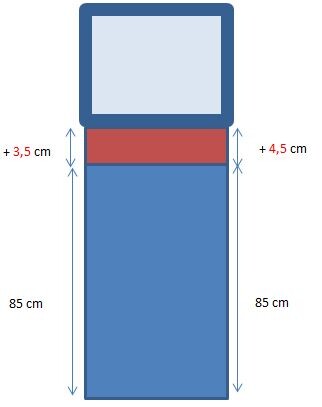
1. Would there already be a construction defect if a general contractor/building company installs a kitchen window in a turnkey single-family house in such a way that, on the inside directly below the window frame—where an interior windowsill or kitchen countertop could theoretically be installed—there are different heights (3.5cm (1.4 inches) on the left and 4.5cm (1.8 inches) on the right) causing a tilt, meaning that a windowsill or countertop could only be installed slightly slanted? I am referring to the area from the bottom edge of the window frame (inside) to the interior wall or parapet end—the area where, for example, the kitchen countertop could be built up to under the window.
(I have attached a sketch; it concerns the red-marked area, which represents the "surface" below a window, roughly the interior windowsill.)
2. What does the specification "parapet height 1.00m (3.3 feet)" mean, which is sometimes noted next to windows in floor plans? From where (bottom edge of the window frame or start of the window sash?) to where (finished floor level? screed floor level?) is this measured (inside/outside)?
3. Assuming the screed floor has already been installed in the house: when measuring, the client discovers that the current room height from the screed floor to the ceiling is 2.47m (8.1 feet) in all rooms, still without tiles or laminate installed, whereas the floor plans specify a "clear room height: 2.50m (8.2 feet)" for all rooms. Would this be considered a defect?
I know these are specific questions. Unfortunately, I could not find answers through online research. Therefore, I would be very glad if someone here could assess the situation, even if only for part of the questions! Thanks in advance.
I have the following questions:
1. Would there already be a construction defect if a general contractor/building company installs a kitchen window in a turnkey single-family house in such a way that, on the inside directly below the window frame—where an interior windowsill or kitchen countertop could theoretically be installed—there are different heights (3.5cm (1.4 inches) on the left and 4.5cm (1.8 inches) on the right) causing a tilt, meaning that a windowsill or countertop could only be installed slightly slanted? I am referring to the area from the bottom edge of the window frame (inside) to the interior wall or parapet end—the area where, for example, the kitchen countertop could be built up to under the window.
(I have attached a sketch; it concerns the red-marked area, which represents the "surface" below a window, roughly the interior windowsill.)
2. What does the specification "parapet height 1.00m (3.3 feet)" mean, which is sometimes noted next to windows in floor plans? From where (bottom edge of the window frame or start of the window sash?) to where (finished floor level? screed floor level?) is this measured (inside/outside)?
3. Assuming the screed floor has already been installed in the house: when measuring, the client discovers that the current room height from the screed floor to the ceiling is 2.47m (8.1 feet) in all rooms, still without tiles or laminate installed, whereas the floor plans specify a "clear room height: 2.50m (8.2 feet)" for all rooms. Would this be considered a defect?
I know these are specific questions. Unfortunately, I could not find answers through online research. Therefore, I would be very glad if someone here could assess the situation, even if only for part of the questions! Thanks in advance.

Tolentino schrieb:
I have read construction specifications where at one point it said clear ceiling height and only later clear structural height. Quite a few construction specifications have been copied together by so-called experts ;-) of vague wording, who often don’t really know what they are doing from a technical perspective. It just came to my mind that some kind of plagiarism checker for construction specifications would be a good idea.
https://www.instagram.com/11antgmxde/
https://www.linkedin.com/company/bauen-jetzt/
H
hampshire12 Nov 2020 15:56A ceiling height lower than expected would be very frustrating. What matters is what is stated in the scope of work. If this differs from the architect’s plan but was still approved as is, then the error did not occur during construction. If the room height was indeed built with a 2+% deviation from the scope of work, I would seek compensation either through additional work or a financial deduction—if only to avoid being stuck with the frustration alone.
If a window is installed crooked, it simply needs to be adjusted to be straight. That is definitely doable.
If a window is installed crooked, it simply needs to be adjusted to be straight. That is definitely doable.