
Good morning,
I have the following questions:
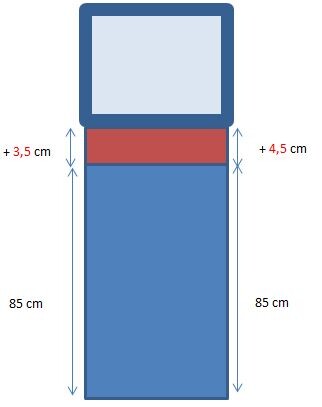
1. Would there already be a construction defect if a general contractor/building company installs a kitchen window in a turnkey single-family house in such a way that, on the inside directly below the window frame—where an interior windowsill or kitchen countertop could theoretically be installed—there are different heights (3.5cm (1.4 inches) on the left and 4.5cm (1.8 inches) on the right) causing a tilt, meaning that a windowsill or countertop could only be installed slightly slanted? I am referring to the area from the bottom edge of the window frame (inside) to the interior wall or parapet end—the area where, for example, the kitchen countertop could be built up to under the window.
(I have attached a sketch; it concerns the red-marked area, which represents the "surface" below a window, roughly the interior windowsill.)
2. What does the specification "parapet height 1.00m (3.3 feet)" mean, which is sometimes noted next to windows in floor plans? From where (bottom edge of the window frame or start of the window sash?) to where (finished floor level? screed floor level?) is this measured (inside/outside)?
3. Assuming the screed floor has already been installed in the house: when measuring, the client discovers that the current room height from the screed floor to the ceiling is 2.47m (8.1 feet) in all rooms, still without tiles or laminate installed, whereas the floor plans specify a "clear room height: 2.50m (8.2 feet)" for all rooms. Would this be considered a defect?
I know these are specific questions. Unfortunately, I could not find answers through online research. Therefore, I would be very glad if someone here could assess the situation, even if only for part of the questions! Thanks in advance.
I have the following questions:
1. Would there already be a construction defect if a general contractor/building company installs a kitchen window in a turnkey single-family house in such a way that, on the inside directly below the window frame—where an interior windowsill or kitchen countertop could theoretically be installed—there are different heights (3.5cm (1.4 inches) on the left and 4.5cm (1.8 inches) on the right) causing a tilt, meaning that a windowsill or countertop could only be installed slightly slanted? I am referring to the area from the bottom edge of the window frame (inside) to the interior wall or parapet end—the area where, for example, the kitchen countertop could be built up to under the window.
(I have attached a sketch; it concerns the red-marked area, which represents the "surface" below a window, roughly the interior windowsill.)
2. What does the specification "parapet height 1.00m (3.3 feet)" mean, which is sometimes noted next to windows in floor plans? From where (bottom edge of the window frame or start of the window sash?) to where (finished floor level? screed floor level?) is this measured (inside/outside)?
3. Assuming the screed floor has already been installed in the house: when measuring, the client discovers that the current room height from the screed floor to the ceiling is 2.47m (8.1 feet) in all rooms, still without tiles or laminate installed, whereas the floor plans specify a "clear room height: 2.50m (8.2 feet)" for all rooms. Would this be considered a defect?
I know these are specific questions. Unfortunately, I could not find answers through online research. Therefore, I would be very glad if someone here could assess the situation, even if only for part of the questions! Thanks in advance.
Yes, thanks for now. @Lumpi: sorry, you’re right. I was too eager.
Since the ceiling height obviously cannot be increased any further, the question is how to proceed appropriately. In the end, probably only a defect notice would be possible, potentially combined with a deadline of about three weeks for correction (even though that is not feasible), which would effectively result in some kind of compensation payment. I believe tearing down the house and rebuilding is not a viable option—for either party.
I am also facing the issue that the final inspection (i.e., still with 16% VAT) is planned/was planned for December.
Since the ceiling height obviously cannot be increased any further, the question is how to proceed appropriately. In the end, probably only a defect notice would be possible, potentially combined with a deadline of about three weeks for correction (even though that is not feasible), which would effectively result in some kind of compensation payment. I believe tearing down the house and rebuilding is not a viable option—for either party.
I am also facing the issue that the final inspection (i.e., still with 16% VAT) is planned/was planned for December.

First, make sure that the clear height actually refers to the finished floor level. It is quite possible that the raw floor level was meant, in which case you would have even more space available.
Furthermore, for a justified defect report, the comparison with the scope of work description is crucial. Only if it states there that the room heights are derived from the floor plan and that the dimensions given there are binding can you raise a defect.
Is it even allowed in your country to build with a ceiling height below 2.5 meters (8 feet 2 inches)? In Berlin, this would no longer be considered habitable space on the ground floor... Maybe that’s something you can use in your argument.
Furthermore, for a justified defect report, the comparison with the scope of work description is crucial. Only if it states there that the room heights are derived from the floor plan and that the dimensions given there are binding can you raise a defect.
Is it even allowed in your country to build with a ceiling height below 2.5 meters (8 feet 2 inches)? In Berlin, this would no longer be considered habitable space on the ground floor... Maybe that’s something you can use in your argument.
A
Alessandro11 Nov 2020 14:57The clear height/ceiling height is ALWAYS measured from the top edge of the floor covering to the underside of the floor slab above! If the ceiling is suspended, then the underside of the suspended ceiling is the reference point for measurement.
This is a defect because including the floor covering, you end up with (at best) 2.45m (8 feet).
And the claim that the screed would settle by 3cm (1.2 inches) over 3 years is not only incorrect but would also be critical!
This is a defect because including the floor covering, you end up with (at best) 2.45m (8 feet).
And the claim that the screed would settle by 3cm (1.2 inches) over 3 years is not only incorrect but would also be critical!
A
Alessandro12 Nov 2020 15:17No, there is nothing to discuss! Clear ceiling height is precisely defined!
The clear structural height is ALWAYS measured from the top edge of the raw floor slab to the underside of the raw ceiling slab and therefore differs from the clear ceiling height!
The clear structural height is ALWAYS measured from the top edge of the raw floor slab to the underside of the raw ceiling slab and therefore differs from the clear ceiling height!
Then always replace "halt" with "by definition." I was only pointing out that it is used inconsistently. And that may well be incorrect. However, the ground floor of the completed house does not suddenly become higher because of that. Of course, you probably have good chances for financial compensation, but I wouldn’t be able to say how much that should be.
Similar topics