
ᐅ Single-family home with an accessible granny flat on the ground floor
Created on: 30 Sep 2025 12:03
W
WoodyXYZ
Hello everyone,
we are currently facing the challenge of planning a single-family house for a family of four, including a barrier-free basement apartment on the ground floor for my parents. The whole project is on a 550sqm (5920 sq ft) mostly flat plot, with the requirement not to build over the garden.
Development Plan / Restrictions
Plot size: approx. 550sqm (5920 sq ft)
Slope: no (approx. 0.5m (1.6 ft) height difference over 22m (72 ft) plot width)
Site coverage ratio: 0.4
Floor area ratio: n.a.
Building envelope, building line and boundary: 16m (52.5 ft) west-east + 3m (9.8 ft) boundary setbacks each side, 14m (46 ft) north-south, 5m (16 ft) setback to street in front of the house
Edge development: yes (north: public access road, west and south: bike path, east: neighboring development with a semi-detached house, currently vacant)
Number of parking spaces: 4
Number of storeys: 2
Roof pitch: 0-35°
Architectural style: no hipped roof and no Bauhaus style
Orientation: south-facing (garden)
Maximum heights / limits: eaves height 5.5-7m (18-23 ft), building height 10m (33 ft)
Additional requirements: The development plan reads as eaves height must be at least 5.5m (18 ft). Our design includes a single-story “extension” that falls below this. According to the building authority, the eaves height applies only to pitched roofs, and even a bungalow would be allowed here.
Client Requirements
Style, roof type, building type: preferably converted attic with a gable roof
Basement, floors: no basement, 2 full floors + attic
Number of occupants, ages: 4 for the main unit (2 adults aged 41, 2 children aged 9 and 7) and 2 for the basement apartment (80+)
Room requirements on ground floor and upper floor:
Ground floor: barrier-free basement apartment with bedroom, shower bathroom, living room, kitchen, optional small storage room (approx. 50sqm (538 sq ft)); main apartment: living-dining area, open kitchen, (small backup kitchen/pantry), guest toilet, utility/technical room
First floor: 2 children’s rooms approx. 15sqm (161 sq ft) each facing south, master bedroom with west-facing window plus a small dressing room, bathroom with T-layout accessible to all, children’s bathroom with shower
Attic: multipurpose room (fitness, office) + storage space due to no basement
Office: family use or home office? Home office
Guest rooms per year
Open or closed layout: rather open (not including open galleries)
Conservative or modern construction: yes
Open kitchen, kitchen island: both yes
Number of dining seats: 6 in main apartment, 2(-4) in basement apartment
Fireplace: no
Music/sound wall: no idea what that is
Balcony, roof terrace: roof terrace as a nice-to-have (see design)
Garage, carport: preferably on the east side next to the basement apartment
Utility garden, greenhouse: no
Additional wishes/special features/daily routine, including reasons for or against certain features
House Design
Planner: architect
What do you like? Why?
What do you dislike? Why?
Estimated cost according to architect/planner: 500,000 (without attic)
Personal budget limit for house including equipment: 600,000
Preferred heating technology: ground source heat pump (local heating network is mandatory)
If you need to give up something, which details/extensions?
- What can you do without: garage
- What can you absolutely not do without: basement apartment
Why is the design as it is now? For example:
Which requests were implemented by the architect?
Primarily based on our wishes, which were mostly implemented already. However, we are especially bothered by the arrangement/design of the utility room, staircase, and pantry layout—at least on paper—as it’s hard to imagine this part clearly.
What makes it, in your opinion, particularly good or bad?
Fairly compact, as the entire ground floor area is not built over on the first floor.
And of course the development plan including our plot.
we are currently facing the challenge of planning a single-family house for a family of four, including a barrier-free basement apartment on the ground floor for my parents. The whole project is on a 550sqm (5920 sq ft) mostly flat plot, with the requirement not to build over the garden.
Development Plan / Restrictions
Plot size: approx. 550sqm (5920 sq ft)
Slope: no (approx. 0.5m (1.6 ft) height difference over 22m (72 ft) plot width)
Site coverage ratio: 0.4
Floor area ratio: n.a.
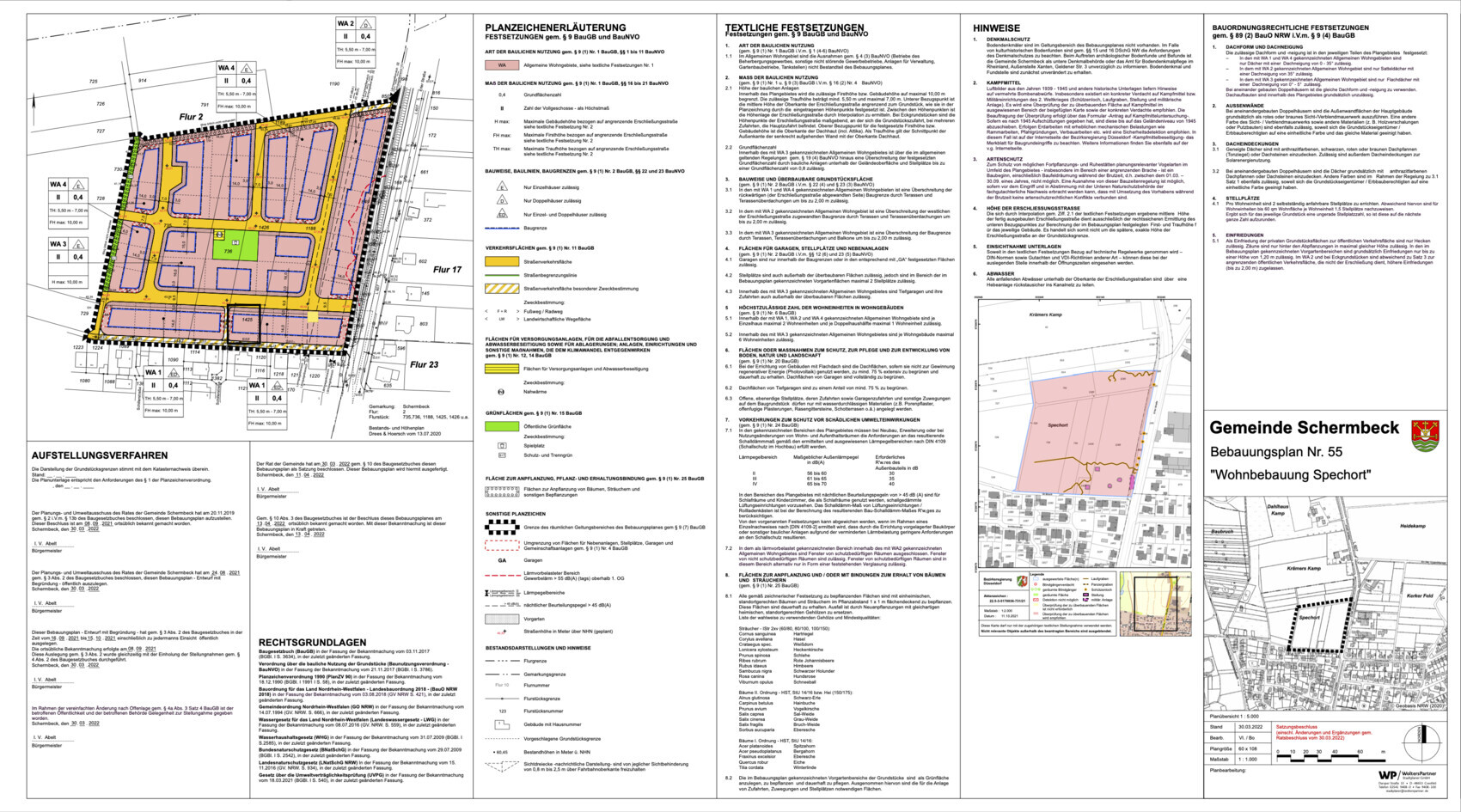
Building envelope, building line and boundary: 16m (52.5 ft) west-east + 3m (9.8 ft) boundary setbacks each side, 14m (46 ft) north-south, 5m (16 ft) setback to street in front of the house
Edge development: yes (north: public access road, west and south: bike path, east: neighboring development with a semi-detached house, currently vacant)
Number of parking spaces: 4
Number of storeys: 2
Roof pitch: 0-35°
Architectural style: no hipped roof and no Bauhaus style
Orientation: south-facing (garden)
Maximum heights / limits: eaves height 5.5-7m (18-23 ft), building height 10m (33 ft)
Additional requirements: The development plan reads as eaves height must be at least 5.5m (18 ft). Our design includes a single-story “extension” that falls below this. According to the building authority, the eaves height applies only to pitched roofs, and even a bungalow would be allowed here.
Client Requirements
Style, roof type, building type: preferably converted attic with a gable roof
Basement, floors: no basement, 2 full floors + attic
Number of occupants, ages: 4 for the main unit (2 adults aged 41, 2 children aged 9 and 7) and 2 for the basement apartment (80+)
Room requirements on ground floor and upper floor:
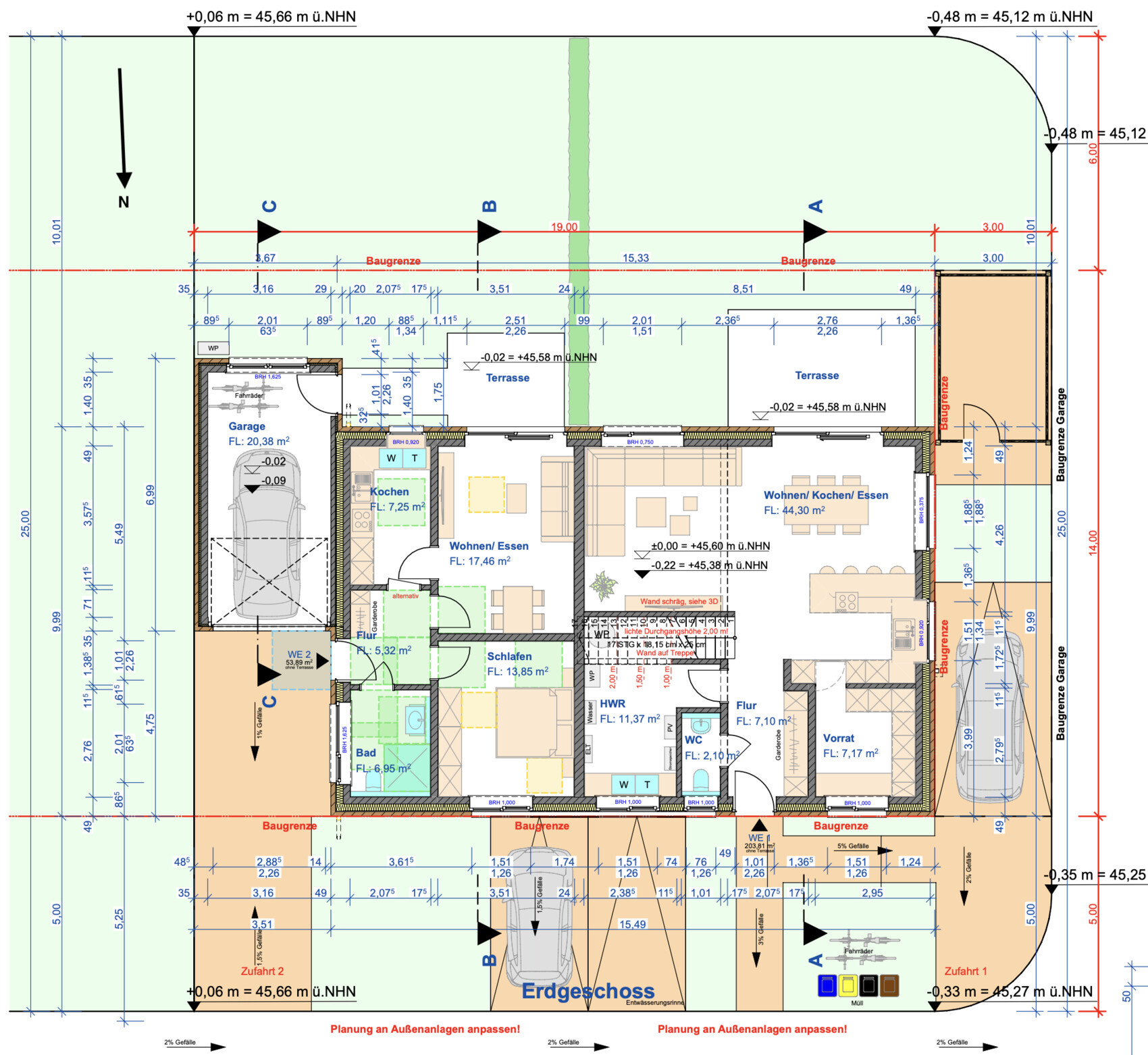
Ground floor: barrier-free basement apartment with bedroom, shower bathroom, living room, kitchen, optional small storage room (approx. 50sqm (538 sq ft)); main apartment: living-dining area, open kitchen, (small backup kitchen/pantry), guest toilet, utility/technical room
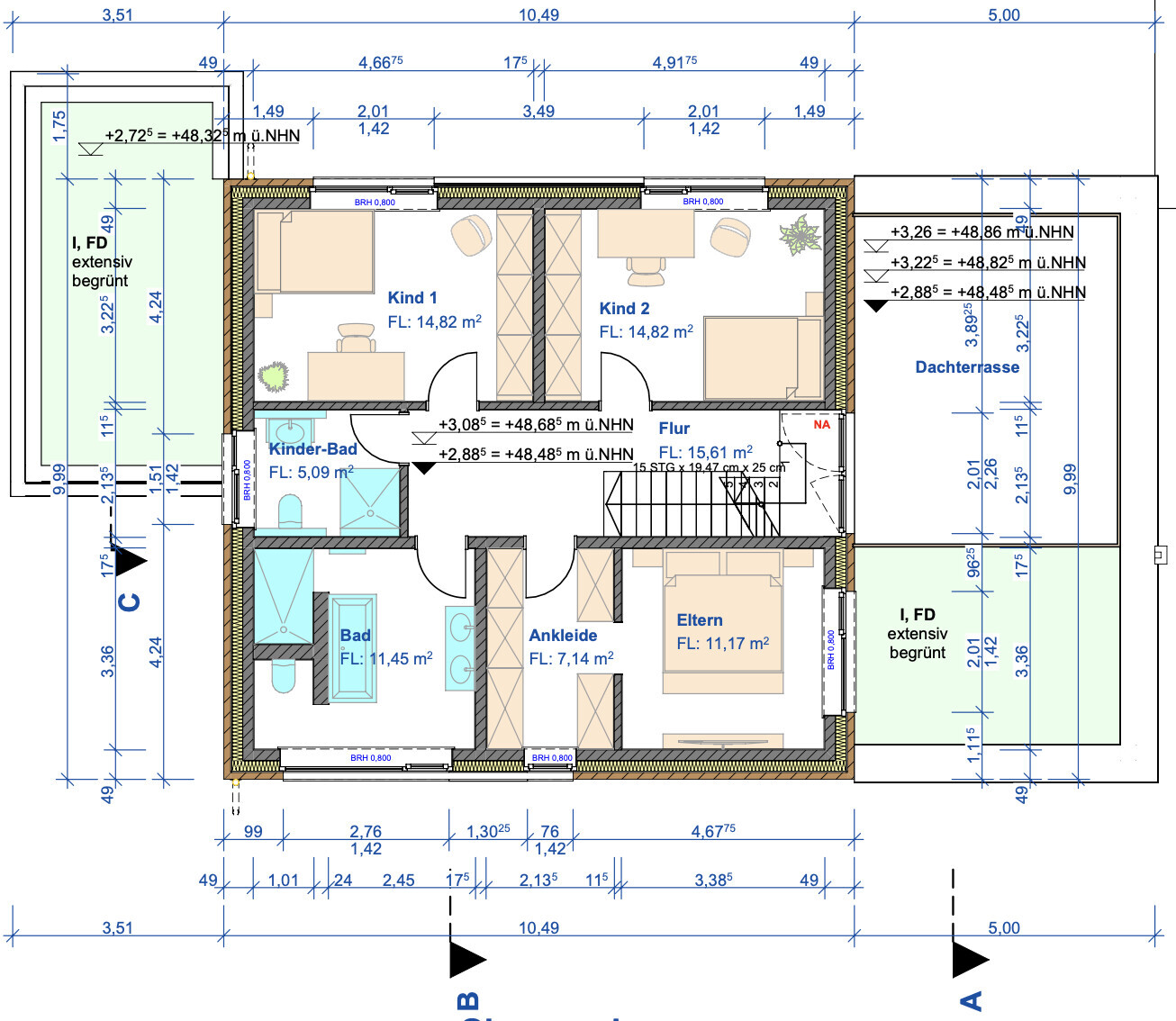
First floor: 2 children’s rooms approx. 15sqm (161 sq ft) each facing south, master bedroom with west-facing window plus a small dressing room, bathroom with T-layout accessible to all, children’s bathroom with shower
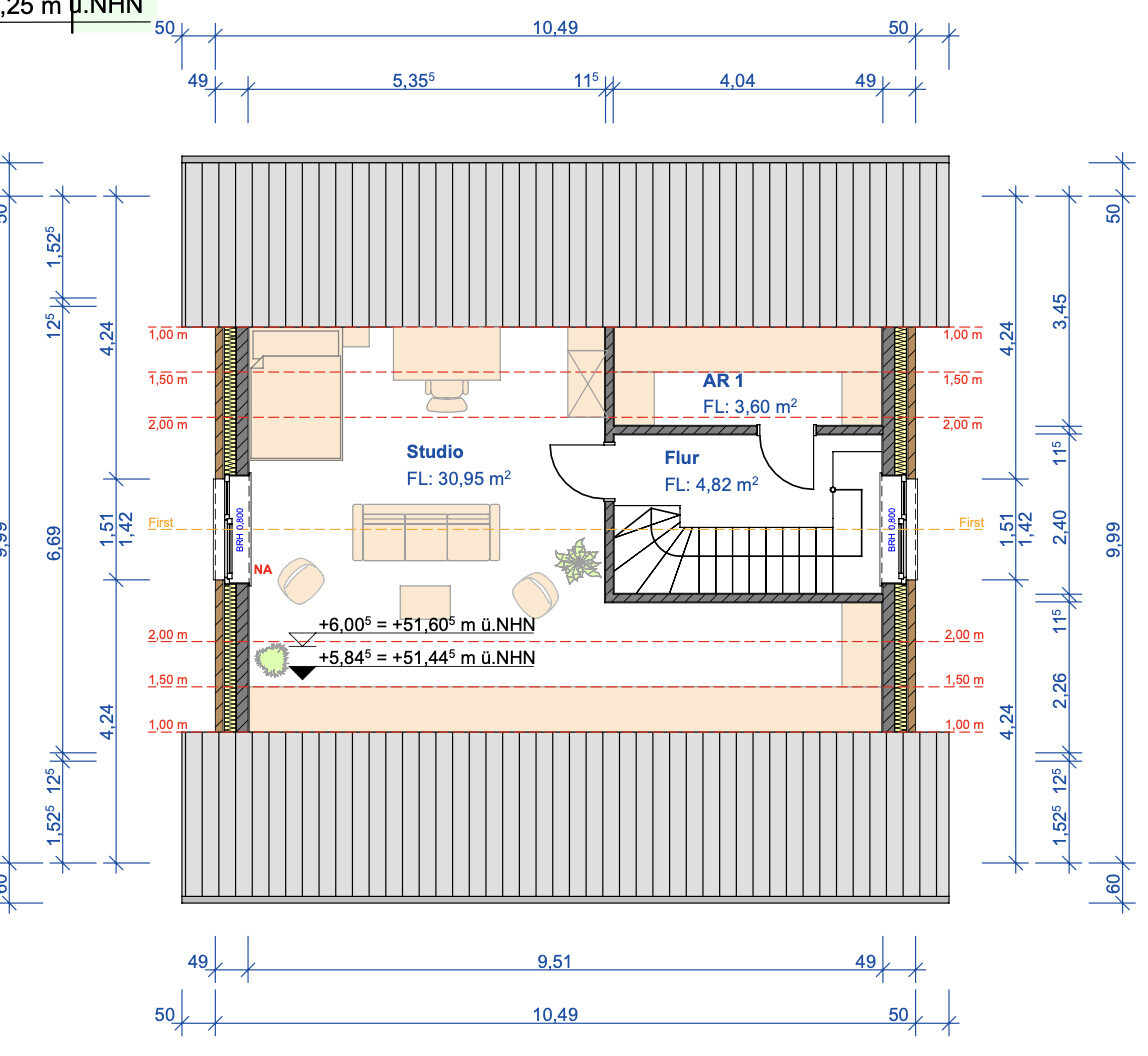
Attic: multipurpose room (fitness, office) + storage space due to no basement
Office: family use or home office? Home office
Guest rooms per year
Open or closed layout: rather open (not including open galleries)
Conservative or modern construction: yes
Open kitchen, kitchen island: both yes
Number of dining seats: 6 in main apartment, 2(-4) in basement apartment
Fireplace: no
Music/sound wall: no idea what that is
Balcony, roof terrace: roof terrace as a nice-to-have (see design)
Garage, carport: preferably on the east side next to the basement apartment
Utility garden, greenhouse: no
Additional wishes/special features/daily routine, including reasons for or against certain features
- Backup kitchen is a long-cherished wish of my wife and should not be missing.
- Utility room must provide at least 3 x 1.9m (10 x 6.2 ft) space for the heat pump and the hot water system connected to the local heating network. The room should also be used for washing and drying laundry.
- Children’s rooms facing south with about 15sqm (161 sq ft) each are mandatory.
- Building mass should not extend too deeply, to preserve garden space on the south side.
House Design
Planner: architect
What do you like? Why?
- Living-dining area plus kitchen fits our requirements. We saw it in a show home and immediately agreed we wanted it like that.
- The basement apartment is barrier-free, and the room layout basically fits well.
- No complaints about the first floor:
- Both children’s rooms are the same size (approx. 15sqm (161 sq ft)) and face south.
- Master bedroom is in the (north-)west with a west-facing window.
- Two bathrooms as requested.
- Converted attic as extra space for home office, fitness, and hobbies.
- The building is not too deep at 10m (33 ft), leaving enough garden space.
What do you dislike? Why?
- The pantry (backup kitchen) seems a bit large.
- The area around the staircase, door to the utility room, and guest toilet feels cramped and awkward.
- We actually like the straight staircase, but it is completely hidden, so only the stairwell is visible.
- The attic staircase is placed on the west gable side; we would prefer it centrally placed or at least on the north eaves side.
- No access from the basement apartment to the utility room (e.g., to do laundry).
- Garden shed currently planned in the southwest; if anything, it should go to the northwest for garden tools and bikes.
Estimated cost according to architect/planner: 500,000 (without attic)
Personal budget limit for house including equipment: 600,000
Preferred heating technology: ground source heat pump (local heating network is mandatory)
If you need to give up something, which details/extensions?
- What can you do without: garage
- What can you absolutely not do without: basement apartment
Why is the design as it is now? For example:
Which requests were implemented by the architect?
Primarily based on our wishes, which were mostly implemented already. However, we are especially bothered by the arrangement/design of the utility room, staircase, and pantry layout—at least on paper—as it’s hard to imagine this part clearly.
What makes it, in your opinion, particularly good or bad?
Fairly compact, as the entire ground floor area is not built over on the first floor.
And of course the development plan including our plot.
H
hanghaus20232 Oct 2025 18:36nordanney schrieb:
203sqm (2186 sq ft) excluding attic + garage, parking spaces, roof terrace, outdoor areas and possibly attic conversion and additional construction costs. Budget 600k
==> Something doesn’t add up. For this size, you would need at least another 750k to build safely (without attic conversion)I also think the budget is insufficient, but I don’t see a need for 1.35 million. I can’t judge the brickwork, but that is expensive too. The layout seems more like an urban villa of 10 x 10m (33 x 33 ft) plus a granny flat.N
nordanney2 Oct 2025 19:48hanghaus2023 schrieb:
I also believe the budget is not sufficient, but I don’t see how this adds up to 1.35 million.Sorry, I meant to say that you should calculate with at least 750k.Since this is more about the budget than the floor plans, I’ll provide some feedback. I hadn’t noticed that @nordanney included exterior work and such in their minimum 750k. The questionnaire I completed refers to the price limit for the house including the interior fittings. My 600k was for the house itself (including the attic conversion and garage). The roof terrace is no longer planned. For the rest, I’m budgeting 100-150k. If it turns out to be significantly more (for example, another 100k), we will need to cut costs somewhere.
H
hanghaus20233 Oct 2025 11:40The ground floor of the builders' house can easily be reduced to 10m by 7m (33ft by 23ft). This is also possible with a single-family house. That way, the budget fits. It also helps if the upper floor is positioned directly over the ground floor of the builders' house.
hanghaus2023 schrieb:
The clients’ ground floor can easily be reduced to 10*7m (33*23 feet). That’s possible even with a row house.
Then the budget fits. It also helps to place the upper floor over the clients’ ground floor. I had to look twice, but you’re right!
Simple design and construction often work better than clinging to an extension.
C
coole_socke643 Oct 2025 12:16A garage should not be omitted due to the slight difference in height and the absence of a basement; at least the foundation and slab should be prepared during the construction phase. Connections for electricity and high-voltage power supply (for an electric vehicle) can also be included. It will be more expensive to add these later. The same applies to converting the attic. Living in a finished house is much easier to tolerate than having both the interior and exterior still a construction site, especially considering the overall costs involved.
Positioning the washer and dryer stacked on top of each other on the first floor, next to the sink, can make daily life easier. Carrying laundry up and down for four people can become tedious over time.
Many builders only realize during the construction phase that their budget will not be sufficient due to rising costs (sometimes higher power ratings). This can work with possible additional financing, or it can turn into a nightmare.
Kudos to you for considering your parents’ later years and wanting to live together with them!
Positioning the washer and dryer stacked on top of each other on the first floor, next to the sink, can make daily life easier. Carrying laundry up and down for four people can become tedious over time.
Many builders only realize during the construction phase that their budget will not be sufficient due to rising costs (sometimes higher power ratings). This can work with possible additional financing, or it can turn into a nightmare.
Kudos to you for considering your parents’ later years and wanting to live together with them!
Similar topics