
ᐅ Single-family house with a small footprint, attic, and basement; neighbor approval required
Created on: 2 Oct 2015 13:52
S
sirhc
Hello everyone,
Some time ago, I shared hand-drawn sketches here for discussion. The biggest change since then is that I moved the entrance from the front to the side. I plan to review this design with a professional next week, but until then, I would like your help to identify and fix any potential weaknesses. A special feature is the significant deviation from the "square optimum," so many other interesting topics only helped me to a limited extent. Therefore, my question is: where are the major issues, what could I solve in a more elegant way, and of course, I’m also interested in what you find successful. Please excuse the pen and paper approach, but that’s how I work best on the design. Based on this, I will draw the basement, first floor, and attic over the weekend—unless the feedback turns out to be too negative.
We could build 3m (10 feet) deeper, but that would further reduce the already small garden, so we prefer not to. The roofed area in front of the garage probably requires the neighbor’s approval, right?
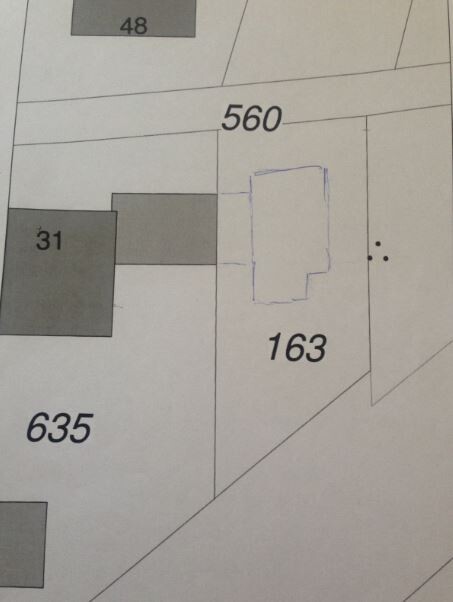
To the north is the access road (a dead-end street ending at our plot); to the south, behind the garden, runs a rail line for regional and freight trains (6 trains per hour during the day). The western neighbor built a long time ago; on the east side is a triangular plot currently covered with forest. We expect garages along the property boundary there, but a house probably won’t fit due to setback requirements.
Edit: very important — I know the windows are only partially shown. I’m still undecided about their arrangement on the east and south sides.
Development plan/restrictions
Plot size 372 sqm (front approx. 13.50m (44 feet), rear boundary beveled)
Slope none
Floor space ratio 0.4
Floor area ratio not defined
Building envelope, building line and boundary 7.50m (25 feet) wide x 15.00m (49 feet) deep, 5.00m (16 feet) setback to the street in front
Boundary construction House with 3.00m (10 feet) side setbacks each, garage on the property boundary
Number of parking spaces 3
Number of floors 1
Roof type gable roof or half-hip roof with 43° to 47° pitch
Architectural style not defined
Orientation not defined
Maximum heights/restrictions not defined
Other requirements not defined
Homeowner requirements
Style, roof type, building type classic, gable roof, solid construction, plaster finish
Basement, floors yes (basement, ground floor, first floor, attic)
Number of occupants, age 2 adults early 30s; 2 children planned
Space requirements on ground and first floors difficult to answer now; on the ground floor I have 56 sqm (600 sq ft) excluding stairs, which sounds small but looks sufficient
Office: family use or home office? no office
Overnight guests per year 10
Open or closed architecture open
Conservative or modern construction conservative
Open kitchen, cooking island yes, cooking peninsula
Number of dining seats 6-8
Fireplace yes
Music/sound wall no
Balcony, roof terrace no
Garage, carport yes, yes
Vegetable garden, greenhouse possibly, no
Other wishes/features/daily routine none
House design
Who designed it do-it-yourself
What do I like most? openness from kitchen through dining to living area; central staircase connects all floors with minimal hallway/traffic space
What do I dislike? the limitation to 7.50m (25 feet) house width causes more problems than expected; doubts whether the central staircase in the living room will be a problem
Cost estimate according to architect/designer not yet defined
Personal price limit for house including fittings not yet defined
Preferred heating system air-to-water heat pump
If you have to give up something, which details/extras
-can you give up? canopy/carport, possibly fireplace
-can you not give up? basement, garage
Best regards
sirhc
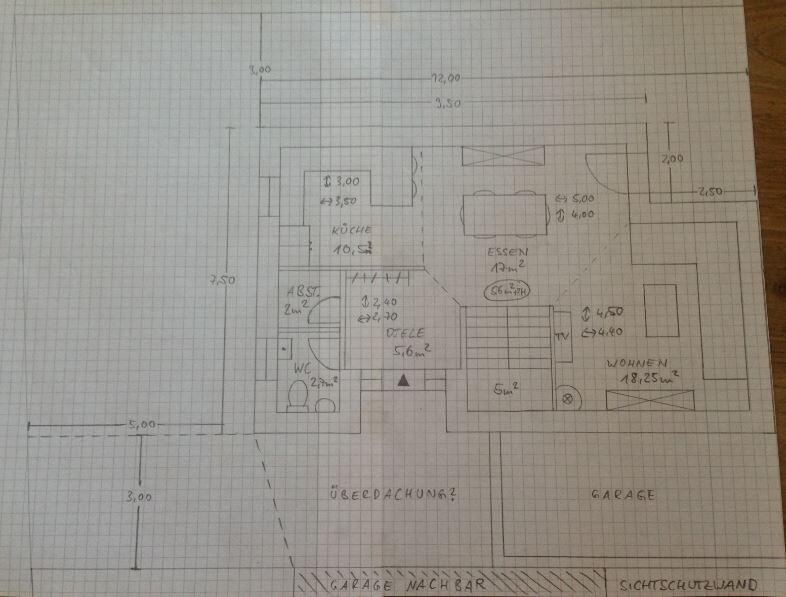
Some time ago, I shared hand-drawn sketches here for discussion. The biggest change since then is that I moved the entrance from the front to the side. I plan to review this design with a professional next week, but until then, I would like your help to identify and fix any potential weaknesses. A special feature is the significant deviation from the "square optimum," so many other interesting topics only helped me to a limited extent. Therefore, my question is: where are the major issues, what could I solve in a more elegant way, and of course, I’m also interested in what you find successful. Please excuse the pen and paper approach, but that’s how I work best on the design. Based on this, I will draw the basement, first floor, and attic over the weekend—unless the feedback turns out to be too negative.
We could build 3m (10 feet) deeper, but that would further reduce the already small garden, so we prefer not to. The roofed area in front of the garage probably requires the neighbor’s approval, right?
To the north is the access road (a dead-end street ending at our plot); to the south, behind the garden, runs a rail line for regional and freight trains (6 trains per hour during the day). The western neighbor built a long time ago; on the east side is a triangular plot currently covered with forest. We expect garages along the property boundary there, but a house probably won’t fit due to setback requirements.
Edit: very important — I know the windows are only partially shown. I’m still undecided about their arrangement on the east and south sides.
Development plan/restrictions
Plot size 372 sqm (front approx. 13.50m (44 feet), rear boundary beveled)
Slope none
Floor space ratio 0.4
Floor area ratio not defined
Building envelope, building line and boundary 7.50m (25 feet) wide x 15.00m (49 feet) deep, 5.00m (16 feet) setback to the street in front
Boundary construction House with 3.00m (10 feet) side setbacks each, garage on the property boundary
Number of parking spaces 3
Number of floors 1
Roof type gable roof or half-hip roof with 43° to 47° pitch
Architectural style not defined
Orientation not defined
Maximum heights/restrictions not defined
Other requirements not defined
Homeowner requirements
Style, roof type, building type classic, gable roof, solid construction, plaster finish
Basement, floors yes (basement, ground floor, first floor, attic)
Number of occupants, age 2 adults early 30s; 2 children planned
Space requirements on ground and first floors difficult to answer now; on the ground floor I have 56 sqm (600 sq ft) excluding stairs, which sounds small but looks sufficient
Office: family use or home office? no office
Overnight guests per year 10
Open or closed architecture open
Conservative or modern construction conservative
Open kitchen, cooking island yes, cooking peninsula
Number of dining seats 6-8
Fireplace yes
Music/sound wall no
Balcony, roof terrace no
Garage, carport yes, yes
Vegetable garden, greenhouse possibly, no
Other wishes/features/daily routine none
House design
Who designed it do-it-yourself
What do I like most? openness from kitchen through dining to living area; central staircase connects all floors with minimal hallway/traffic space
What do I dislike? the limitation to 7.50m (25 feet) house width causes more problems than expected; doubts whether the central staircase in the living room will be a problem
Cost estimate according to architect/designer not yet defined
Personal price limit for house including fittings not yet defined
Preferred heating system air-to-water heat pump
If you have to give up something, which details/extras
-can you give up? canopy/carport, possibly fireplace
-can you not give up? basement, garage
Best regards
sirhc

ypg schrieb:
What surprises me is this: the requirement is for a single-story design. You seem to stick firmly to your personal preferences, like the recessed entrance and the indented corner in the living area. How is the upper floor supposed to come into existence? Are those corners meant to be carried over upstairs? Have you thought beyond the ground floor yet? P.S. The staircase is too narrow (the railing also needs depth) and too short if it’s supposed to be a staircase with a landing. Chimney flue?Thanks for your feedback. Yes, I have thought beyond the ground floor and had to discard several staircase options because of that. What exactly do you mean by “recessed entrance”? The corners won’t be carried over to the upper floor. But you brought up another point: the recessed entrance and the indented corner in the living room together take up 7 sqm (75 sq ft) on the ground floor, which in turn costs about 5.25 sqm (56.5 sq ft) upstairs (75%) in order to comply with the single-story requirement. Am I understanding that correctly? Having or not having those 5 sqm could make a significant difference given the overall small floor area. Staircase: I thought a running width of 1 meter (39 inches) was already quite generous; a shorter landing might also be sufficient, but I will plan for a bit more space. Chimney flue – yes, that’s missing. 🙂
ypg schrieb:
That quote is from your first thread (page 7, can’t recall the date right now) about your floor plan. Has it not occurred to you to leave your next 50 years to a professional, in other words an architect? How should the upper floor with the same dimensions as the first attempt (ignoring interior walls for the moment) be any better to even justify all this discussion?
There are tens of thousands of good designs for houses narrower than 7.50 meters (24.6 feet). There are excellent single-family homes with the layout of a terraced or semi-detached house. There are great designs of houseboats and other unique homes, for example infill lots in urban areas, which are narrow. Maybe the creatives here would like and have time to draft something new, but from my experience, I would initially leave out these corners and niches because they probably interfere with practical design (and honestly, I don’t see these wishes as very important, since a terrace can be roofed in other ways). Individual solutions for useable floor space upstairs are also necessary. And if the garden has to be reduced by 2 meters (6.6 feet), I would be fine with that as even a small garden has its benefits. There’s no such thing as a perfect square.Of course, in the end, this will be left to a professional, but I want to think it through myself beforehand to figure out what makes sense and what doesn’t. I do have some new ideas for the upper floor, but haven’t put them on paper yet. Unfortunately, the tens of thousands of good designs have so far been well hidden from me. However, I would appreciate sketches as inspiration, including from you, and also without the corners. 🙂 One option for the upper floor could be custom-built wardrobes under the slopes instead of a standard wardrobe against a 2-meter (6.6 feet) wall. I know a good cabinetmaker who has already installed quality built-in wardrobes in my apartments. The “perfect square” in terms of energy efficiency, I thought, relates to surface area versus volume or something similar, and overall I have the impression that most floor plans tend toward a square shape – but it’s not that important. Best regards
B
Bauexperte5 Oct 2015 10:07Good day,
On one hand, that is understandable; on the other, I often notice that the “self-designed” plans by laypeople mostly end up in the wastebasket once they have spoken to a trained architect or planner.
Write down for yourself what is important, what absolutely must be included in the design, and what would be “nice to have.” That alone is more than most people bring to their first consultation. Mostly, people sit in front of me knowing what they do not want – which is easier, of course, to say “no,” but up to that point, they haven’t really considered their own needs and wishes for the house or plot of land yet 😉
Best regards, Bauexperte
sirhc schrieb:
Of course, in the end, a professional will handle it, but I would like to think about it myself beforehand and find out what makes sense and what doesn’t.
On one hand, that is understandable; on the other, I often notice that the “self-designed” plans by laypeople mostly end up in the wastebasket once they have spoken to a trained architect or planner.
Write down for yourself what is important, what absolutely must be included in the design, and what would be “nice to have.” That alone is more than most people bring to their first consultation. Mostly, people sit in front of me knowing what they do not want – which is easier, of course, to say “no,” but up to that point, they haven’t really considered their own needs and wishes for the house or plot of land yet 😉
Best regards, Bauexperte
However, you have only planned a 2m (6 ft 6 in) gap for the staircase. Including the stairwell opening and handrail, this will not provide a usable tread width of 100 cm (40 inches).
Also, if the staircase is to have a landing, a total stair depth of 225 cm (88.5 inches), assuming I counted the squares correctly, will not be sufficient.
Once again, here are my example stair configurations (you always have to consider the floor-to-floor height, not the room height).
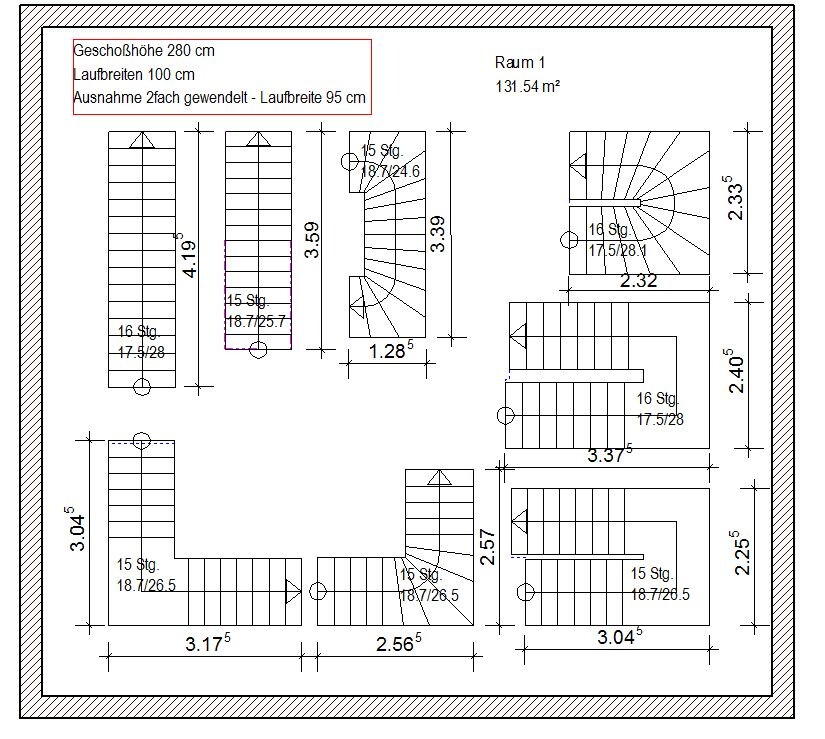
Also, if the staircase is to have a landing, a total stair depth of 225 cm (88.5 inches), assuming I counted the squares correctly, will not be sufficient.
Once again, here are my example stair configurations (you always have to consider the floor-to-floor height, not the room height).
Bauexperte schrieb:
Mostly, the people I’m dealing with know what they don’t want – which is understandable, it’s easier to say “no” – but until that moment, they haven’t really thought about their own needs and wishes for a house or plot of land. 😉That’s exactly what we don’t want for ourselves, and I imagine it’s frustrating from your perspective as well. We want to learn a bit and understand, not just bluntly say what we don’t like. 🙂
@kbt09
The staircase is drawn with a depth of 250 cm (98 inches); I found a half-landing staircase with this depth somewhere online – alternatively, a U-shaped staircase like the one you posted would also work.
Regards
With 200x250 you simply won’t get a good staircase.
And it should be obvious that 250 cm (98 inches) depth for the stair width is not enough. That leaves only 150 cm (59 inches) for each of the two flights with steps. You will always need 14 (very steep) to 15 risers. A landing equals one riser, so that leaves 13 to 14 risers, which is about 7 steps per flight. This results in a tread depth of less than 25 cm (10 inches).
And it should be obvious that 250 cm (98 inches) depth for the stair width is not enough. That leaves only 150 cm (59 inches) for each of the two flights with steps. You will always need 14 (very steep) to 15 risers. A landing equals one riser, so that leaves 13 to 14 risers, which is about 7 steps per flight. This results in a tread depth of less than 25 cm (10 inches).

I find your design really refreshing. Somehow, it immediately feels comfortable to me, even though I don’t like 45° walls.
If the staircase doesn’t have to be a landing staircase, I believe 2.20 x 2.20 meters (7.2 x 7.2 feet) should be enough. But the one-story aspect will definitely be a tough challenge. How is the headroom above the staircase exit in that regard?
The walls look very thin inside the house. I think they need to be thicker, which means all the measurements might be off again, right?
If the staircase doesn’t have to be a landing staircase, I believe 2.20 x 2.20 meters (7.2 x 7.2 feet) should be enough. But the one-story aspect will definitely be a tough challenge. How is the headroom above the staircase exit in that regard?
The walls look very thin inside the house. I think they need to be thicker, which means all the measurements might be off again, right?
Similar topics