
ᐅ Single-family house with a granny flat/apartment, 120 sqm plus a finished basement on a hillside
Created on: 10 Oct 2020 14:51
D
DJOchen
Hello everyone,
We have already gone through several designs, but there was always something unsatisfactory. Now we have completely revised everything and actually find it quite well suited to our needs. However, we’ve become a bit blind to it by now, so we would appreciate constructive criticism and opinions on the design. It is important to us to have a square floor plan (due to energy efficiency and the ratio of space to walls). We consider 9x9 m (30x30 ft) to be realistic.
Development plan / Restrictions
Plot size: 616 m² (6,630 sq ft)
Slope: yes, about 15% gradient
Site coverage ratio: 0.4
Floor area ratio: 0.8
Building zone, neighboring buildings: 3 meters (10 ft) distance to neighbors and to the street, 1.5 meters (5 ft) to the street on the east side
Boundary development: Garage/carport must fit within the building zone
Number of parking spaces: 2
Number of floors: 1.5 floors, basement allowed as full floor
Roof type: gable roof or hip roof
Architectural style: rather modern
Orientation: see floor plan
Maximum height / limits: knee wall height 75 cm (30 inches), eaves height toward street max. 6.50 m (21 ft 4 in)
No further requirements
[B]Owners’ requirements
Style, roof type, building type: gable roof
Basement, floors: basement + 1.5 floors
Number of persons: currently 2 adults (37+30 years old) and 1 child, future additional child
Space demand ground floor and upper floor: total 120 m² (1,290 sq ft)
Office: family use or home office: one office for home office
Overnight guests per year: few
Open or closed architecture: closed
Conservative or modern construction: doesn’t matter, preferably a KFW energy-efficient house
Open kitchen, cooking island: closed kitchen
Number of dining seats: 6
Fireplace: not essential but would be nice
Music / stereo wall: yes
Balcony, roof terrace: no
Garage, carport: yes, double carport
Utility garden, greenhouse: no
[B]House design
By whom is the design created: by us
What do you particularly like? Why? Sauna included. Apartment for additional KFW subsidy fits in. Office as well. Front door on the upper level is very important due to earthworks. Bathrooms are large enough.
What do you not like? Kitchen not easily accessible, upstairs hallway too large, a lot of earthworks needed for basement door.
Price estimate according to architect/planner: not yet available
Personal price limit for house including equipment: without additional costs and land: 330,000 EUR
Preferred heating technology: geothermal with photovoltaic preparation
If you have to do without, which details/features
- can you do without: reduce size
- cannot do without: sauna, office and front door side
Why is the design the way it is now: as efficient use of space as possible and as little frills such as bay windows or recesses as possible. We want to build cost-effectively.
Which corresponding wishes were implemented by the architect? Architect not involved yet
What do you think makes it particularly good or bad? Good: efficient use of space, earthworks kept at a manageable level. Not good: kitchen access, window arrangement and window sizes
[B]What is the most important/fundamental question about the floor plan in 130 characters?
Is the layout and size good? How can windows be arranged effectively? What have we missed? What works well and should definitely stay?
[/B]
We have already gone through several designs, but there was always something unsatisfactory. Now we have completely revised everything and actually find it quite well suited to our needs. However, we’ve become a bit blind to it by now, so we would appreciate constructive criticism and opinions on the design. It is important to us to have a square floor plan (due to energy efficiency and the ratio of space to walls). We consider 9x9 m (30x30 ft) to be realistic.
Development plan / Restrictions
Plot size: 616 m² (6,630 sq ft)
Slope: yes, about 15% gradient
Site coverage ratio: 0.4
Floor area ratio: 0.8
Building zone, neighboring buildings: 3 meters (10 ft) distance to neighbors and to the street, 1.5 meters (5 ft) to the street on the east side
Boundary development: Garage/carport must fit within the building zone
Number of parking spaces: 2
Number of floors: 1.5 floors, basement allowed as full floor
Roof type: gable roof or hip roof
Architectural style: rather modern
Orientation: see floor plan
Maximum height / limits: knee wall height 75 cm (30 inches), eaves height toward street max. 6.50 m (21 ft 4 in)
No further requirements
[B]Owners’ requirements
Style, roof type, building type: gable roof
Basement, floors: basement + 1.5 floors
Number of persons: currently 2 adults (37+30 years old) and 1 child, future additional child
Space demand ground floor and upper floor: total 120 m² (1,290 sq ft)
Office: family use or home office: one office for home office
Overnight guests per year: few
Open or closed architecture: closed
Conservative or modern construction: doesn’t matter, preferably a KFW energy-efficient house
Open kitchen, cooking island: closed kitchen
Number of dining seats: 6
Fireplace: not essential but would be nice
Music / stereo wall: yes
Balcony, roof terrace: no
Garage, carport: yes, double carport
Utility garden, greenhouse: no
[B]House design
By whom is the design created: by us
What do you particularly like? Why? Sauna included. Apartment for additional KFW subsidy fits in. Office as well. Front door on the upper level is very important due to earthworks. Bathrooms are large enough.
What do you not like? Kitchen not easily accessible, upstairs hallway too large, a lot of earthworks needed for basement door.
Price estimate according to architect/planner: not yet available
Personal price limit for house including equipment: without additional costs and land: 330,000 EUR
Preferred heating technology: geothermal with photovoltaic preparation
If you have to do without, which details/features
- can you do without: reduce size
- cannot do without: sauna, office and front door side
Why is the design the way it is now: as efficient use of space as possible and as little frills such as bay windows or recesses as possible. We want to build cost-effectively.
Which corresponding wishes were implemented by the architect? Architect not involved yet
What do you think makes it particularly good or bad? Good: efficient use of space, earthworks kept at a manageable level. Not good: kitchen access, window arrangement and window sizes
[B]What is the most important/fundamental question about the floor plan in 130 characters?
Is the layout and size good? How can windows be arranged effectively? What have we missed? What works well and should definitely stay?
[/B]
Great, that’s an exemplary answer.
Do you really like having sand dunes from the garden through the terrace all the way to the refrigerator?
Don’t you have breakfast outside? Don’t you eat outside? Don’t you enjoy coffee on the terrace while your child is playing?
The pantry is impractically narrow. Try drawing in shelves, a cabinet, and a freezer.
Is the kitchen supposed to be a single-wall layout?
Distance from the car to the kitchen is as far as possible.
There is no cloakroom.
I find the entrance, stairs, and door to the open-plan living area cramped—not in terms of square meters, but in terms of the overall feel.
Why not remove the tiny home office and move it down below? You have rooms with southern daylight in the basement.
On the upper floor, check what lies below the 2-meter (6.5 feet) ceiling height line: bathtub, sauna, master bed. If you are on the smaller side, this might be acceptable. There are bumps.
Do you have no clothes that need hanging space?
Where do you want to relax during sauna breaks?
Do you really like having sand dunes from the garden through the terrace all the way to the refrigerator?
Don’t you have breakfast outside? Don’t you eat outside? Don’t you enjoy coffee on the terrace while your child is playing?
The pantry is impractically narrow. Try drawing in shelves, a cabinet, and a freezer.
Is the kitchen supposed to be a single-wall layout?
Distance from the car to the kitchen is as far as possible.
There is no cloakroom.
I find the entrance, stairs, and door to the open-plan living area cramped—not in terms of square meters, but in terms of the overall feel.
Why not remove the tiny home office and move it down below? You have rooms with southern daylight in the basement.
On the upper floor, check what lies below the 2-meter (6.5 feet) ceiling height line: bathtub, sauna, master bed. If you are on the smaller side, this might be acceptable. There are bumps.
Do you have no clothes that need hanging space?
Where do you want to relax during sauna breaks?

Just a quick overview:
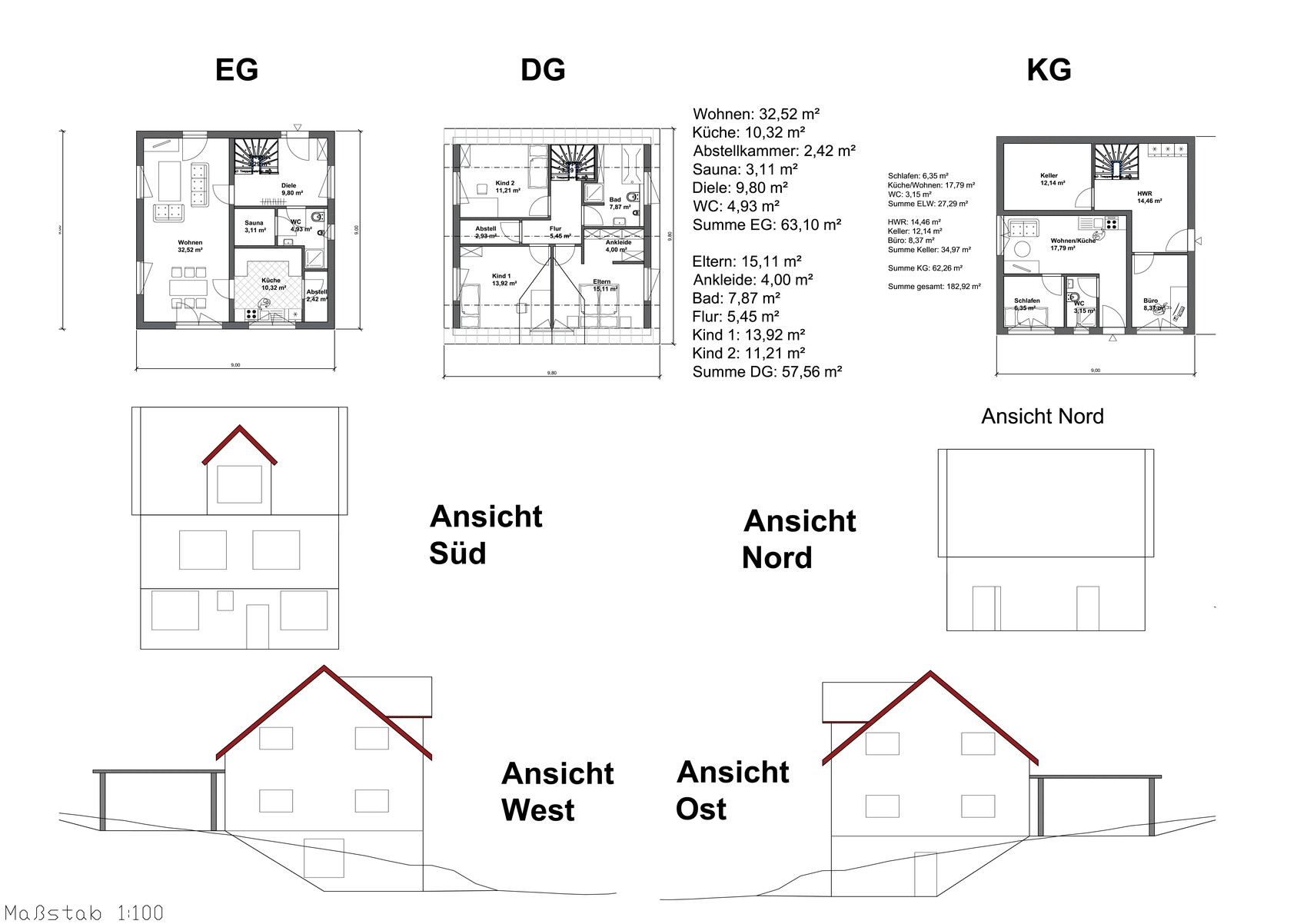
I would completely omit the storage/pantry room and instead install a full wall of tall kitchen cabinets there. This way, you can fit more inside, it looks better, and is more functional. With a 60cm (24 inches) deep cabinet, you are left with only 40cm (16 inches) of maneuvering space.
The staircase going up definitely needs a window. As a general contractor we couldn’t afford once said: "Pathway to natural light." Friends of ours have a similar staircase and have tried various built-in lights, yet it still feels dark and oppressive. It simply isn’t enjoyable to walk up there.
The walk-in closet is way too narrow! I have never consciously noticed 37cm (14.5 inches) deep Pax wardrobes. You definitely won’t be able to fit a hanger across. Even if you manage to store your clothes in there, you will have very little space to move around. Try recreating that distance with chairs or something similar. Getting dressed in the morning will become a real challenge.
Unfortunately, the points I mentioned can’t be easily corrected without affecting the layout of all the other rooms.
Regarding the basement: It looks very large and expensive for just a utility cellar. I would absolutely include it within the insulated envelope and at least partially heat it. One suggestion would be to place the office in the basement—it even has windows and a view—and free up space on the ground floor by doing so.
I would completely omit the storage/pantry room and instead install a full wall of tall kitchen cabinets there. This way, you can fit more inside, it looks better, and is more functional. With a 60cm (24 inches) deep cabinet, you are left with only 40cm (16 inches) of maneuvering space.
The staircase going up definitely needs a window. As a general contractor we couldn’t afford once said: "Pathway to natural light." Friends of ours have a similar staircase and have tried various built-in lights, yet it still feels dark and oppressive. It simply isn’t enjoyable to walk up there.
The walk-in closet is way too narrow! I have never consciously noticed 37cm (14.5 inches) deep Pax wardrobes. You definitely won’t be able to fit a hanger across. Even if you manage to store your clothes in there, you will have very little space to move around. Try recreating that distance with chairs or something similar. Getting dressed in the morning will become a real challenge.
Unfortunately, the points I mentioned can’t be easily corrected without affecting the layout of all the other rooms.
Regarding the basement: It looks very large and expensive for just a utility cellar. I would absolutely include it within the insulated envelope and at least partially heat it. One suggestion would be to place the office in the basement—it even has windows and a view—and free up space on the ground floor by doing so.
Certainly, you have done your best in your opinion. The staircase is an improvement.
However, I see many things that are inconvenient in daily life or simply do not work.
The hallway is quite narrow. It is fine for two people, but too tight for four. I don’t see any space for a stroller. I also don’t see a wardrobe large enough to store clothes for four people. Kids tend to have more stuff, and you can’t always go down to the basement to get shoes with small children.
Speaking of wardrobes: the dressing room does not have closets with a depth of 50 or 60 centimeters (20 or 24 inches), only shelves for T-shirts.
And in the storage room behind the kitchen, either a shelf or a freezer fits, but not both. As it stands, the storage room is just wasted space.
The kitchen is sufficient for a vacation home but not for a family house.
Your idea that Terra worked well for you in your apartment may be true, but life with a garden is different. Terra is linked to kitchen activities. It’s inconvenient if you always have to pass by the sofa, which is your lounging area.
Therefore, once again: move one floor to the basement level, skip a traditional basement, and build each floor 10 square meters (108 square feet) larger. Right now, you are trying to turn a 120 square meter (1,292 square feet) house into a 160 square meter (1,722 square feet) one or to squeeze it in. As a result, almost every area suffers, while the relatively large utility basement does not provide compensation in everyday life or daily routines.
However, I see many things that are inconvenient in daily life or simply do not work.
The hallway is quite narrow. It is fine for two people, but too tight for four. I don’t see any space for a stroller. I also don’t see a wardrobe large enough to store clothes for four people. Kids tend to have more stuff, and you can’t always go down to the basement to get shoes with small children.
Speaking of wardrobes: the dressing room does not have closets with a depth of 50 or 60 centimeters (20 or 24 inches), only shelves for T-shirts.
And in the storage room behind the kitchen, either a shelf or a freezer fits, but not both. As it stands, the storage room is just wasted space.
The kitchen is sufficient for a vacation home but not for a family house.
Your idea that Terra worked well for you in your apartment may be true, but life with a garden is different. Terra is linked to kitchen activities. It’s inconvenient if you always have to pass by the sofa, which is your lounging area.
DJOchen schrieb:
That is very costly, so we wanted to keep it as minimal as possible. That’s why we need the basement. However, I am currently thinking about a purely utility basement. That should significantly ease the finances.
Therefore, once again: move one floor to the basement level, skip a traditional basement, and build each floor 10 square meters (108 square feet) larger. Right now, you are trying to turn a 120 square meter (1,292 square feet) house into a 160 square meter (1,722 square feet) one or to squeeze it in. As a result, almost every area suffers, while the relatively large utility basement does not provide compensation in everyday life or daily routines.

DJOchen schrieb:
Looking forward to all comments.My kitchen unit (single-person household) is larger. There are still quite a few things that don’t work well. Try checking this against the actual apartment.https://www.instagram.com/11antgmxde/
https://www.linkedin.com/company/bauen-jetzt/
ypg schrieb:
So again: move one floor into the basement level, skip having a cellar, and build each floor 10 sqm (108 sq ft) larger. Right now, you’re trying to squeeze a 160 sqm (1,722 sq ft) house out of a 120 sqm (1,292 sq ft) footprint. This causes compromises in almost every area, while the relatively large utility cellar doesn’t provide much benefit for everyday living and daily activities. That’s right. Either you really use the cellar as a utility room, in which case the pantry, for example, on the ground floor would be removed.
If the cellar is basically useless for you, then turn it into living space! Depending on the terrain, bedrooms or the living area would go down there.
A walk-in closet in a 120 sqm (1,292 sq ft) house with two children’s rooms (and yes, also an office) is too much. You have too many rooms packed into a small area, all of which then become difficult to use. See how your kitchen is currently.
Alternatively: look for a flat plot, which would probably be more cost effective.
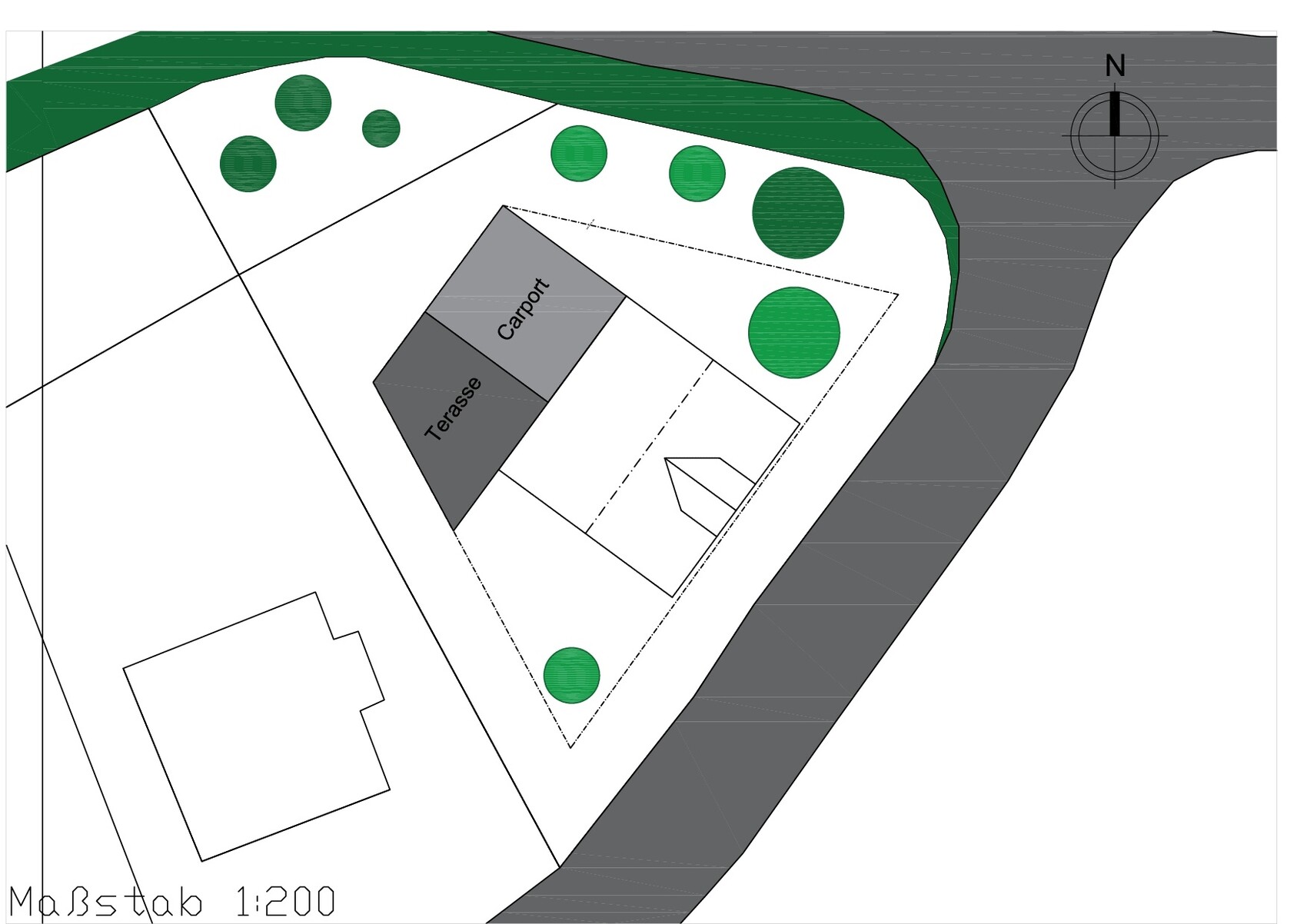
I find the positioning of the house and carport on the plot less than ideal. The carport feels like it’s placed right in the middle, which means your terrace is located only about 3 meters (10 feet) from the neighbor’s boundary—despite having more than 600 sqm (about 6,458 sq ft) of land! I’m concerned that you might end up using only the small southwest section of the garden, leaving the other three sides largely unused.
In my opinion, this could be optimized by having a single carport within the building area (building envelope) plus a side parking space outside the building area (shifting the house further toward the top of the plan), completely foregoing the carport (installing an auxiliary heater and adding a shed instead, which would move the house even further upward), or positioning the house diagonally along the northeast building line. Another option might be placing the carport in the pointed northeastern corner.
In my opinion, this could be optimized by having a single carport within the building area (building envelope) plus a side parking space outside the building area (shifting the house further toward the top of the plan), completely foregoing the carport (installing an auxiliary heater and adding a shed instead, which would move the house even further upward), or positioning the house diagonally along the northeast building line. Another option might be placing the carport in the pointed northeastern corner.
Similar topics