
ᐅ New single-family house construction, between-rafter insulation, with or without ventilated cold roof
Created on: 17 Jan 2019 16:17
B
brauk346
Hello everyone,
I am currently planning our house (construction start around early April). At the moment, I am considering the most sensible and cost-effective way to do the roof.
It will be a single-family house, 1.5 stories, 148 sqm (1593 sq ft), KFW55 standard, with a knee wall height of 1.75 m (5.7 ft) and a 30° pitched gable roof. (I have attached a cross-section.) The house measures 9 x 11.5 m (29.5 x 37.7 ft).
Would it be better to use insulation between the rafters or to create a cold roof where only the top floor ceiling is insulated? I have already read a lot online but haven’t come to a clear conclusion.
Due to the knee wall height, the roof will not have any windows, and because of the air-to-water heat pump, there will be no chimney (a fireplace is not planned either, as my partner and I are not fond of them). The roof should be functional and straightforward—nothing fancy. Since we are building without a basement, we only plan to use the small attic space for boxes and some storage.
My questions:
Which type of insulation is easier to implement? How might a setup like this look in practice?
I have looked at some examples on ubakus but am still unsure which option makes more sense.
I think insulation between the rafters might be more practical since it wouldn’t reduce the height of the attic space, which is rather small. However, it might not make sense to insulate a space that will only be used for boxes and similar storage...
I would appreciate any advice.
Best regards
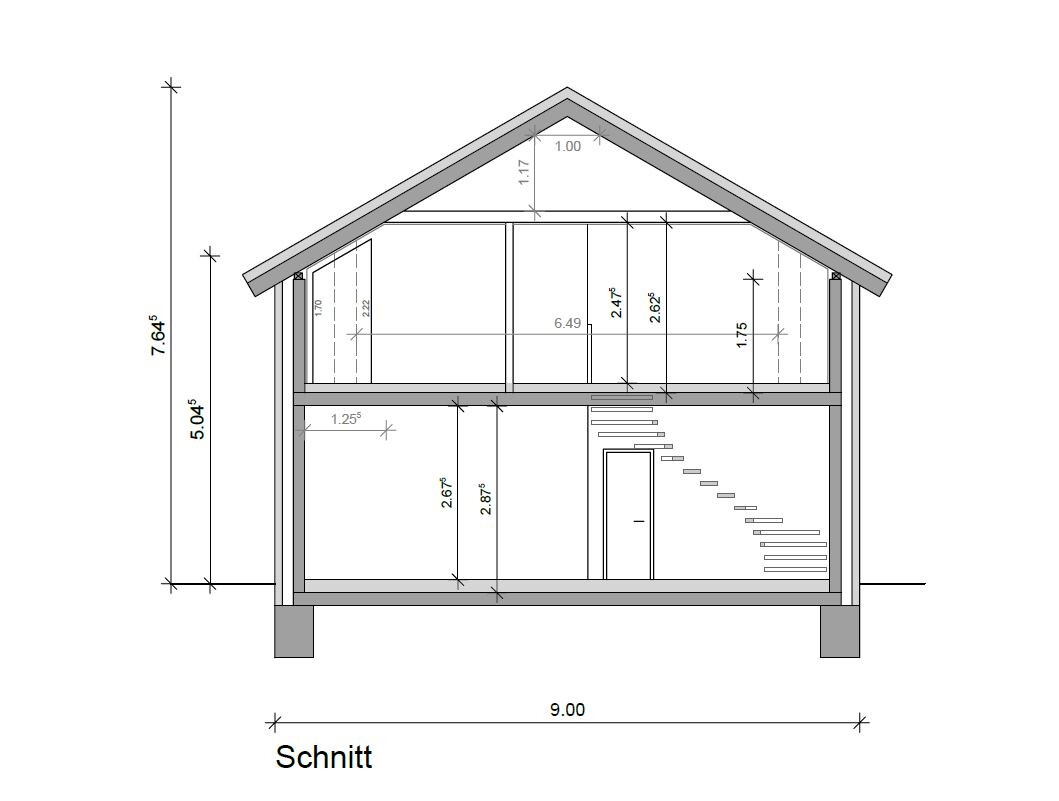
I am currently planning our house (construction start around early April). At the moment, I am considering the most sensible and cost-effective way to do the roof.
It will be a single-family house, 1.5 stories, 148 sqm (1593 sq ft), KFW55 standard, with a knee wall height of 1.75 m (5.7 ft) and a 30° pitched gable roof. (I have attached a cross-section.) The house measures 9 x 11.5 m (29.5 x 37.7 ft).
Would it be better to use insulation between the rafters or to create a cold roof where only the top floor ceiling is insulated? I have already read a lot online but haven’t come to a clear conclusion.
Due to the knee wall height, the roof will not have any windows, and because of the air-to-water heat pump, there will be no chimney (a fireplace is not planned either, as my partner and I are not fond of them). The roof should be functional and straightforward—nothing fancy. Since we are building without a basement, we only plan to use the small attic space for boxes and some storage.
My questions:
Which type of insulation is easier to implement? How might a setup like this look in practice?
I have looked at some examples on ubakus but am still unsure which option makes more sense.
I think insulation between the rafters might be more practical since it wouldn’t reduce the height of the attic space, which is rather small. However, it might not make sense to insulate a space that will only be used for boxes and similar storage...
I would appreciate any advice.
Best regards
Thank you for the tip.
The windows will be three-part.
Double casement windows measuring 1.5 x 1.5 meters (5 x 5 feet) with a fixed glazed transom below, measuring 1.5 x 0.75 meters (5 x 2.5 feet). This way, you can place something in front of it if desired and still be able to open the windows.
The windows will be three-part.
Double casement windows measuring 1.5 x 1.5 meters (5 x 5 feet) with a fixed glazed transom below, measuring 1.5 x 0.75 meters (5 x 2.5 feet). This way, you can place something in front of it if desired and still be able to open the windows.
In my opinion, the only effective way to insulate a roof with a knee wall is to do it completely, using insulation between the rafters or another roof insulation method. I find it difficult to imagine insulating only the sloped sections and leaving the rest of the roof uninsulated. If it were a full story, I would insulate the floor instead, as it is simpler and cheaper.
Guys, you’re talking like someone who’s never seen it:
1) Installing insulation only on the underside of the ceiling and sloped rafters is no problem at all and is the most cost-effective solution.
2) Install a well-sealing attic hatch.
3) Use a wooden plank floor above the insulation so you can walk on it. Tongue-and-groove boards, not OSB. The tongue-and-groove boards allow for some breathability.
4) You can store boxes with things like Christmas lights, ornaments, winter shoes, and so on up there. Nothing will happen to those items in winter or summer.
5) I have a cold roof like this and store all kinds of things there, even tools, garden cushions, etc. Nothing ever gets damaged. The only downside is that everything is cold in winter and warm in summer. Karsten
1) Installing insulation only on the underside of the ceiling and sloped rafters is no problem at all and is the most cost-effective solution.
2) Install a well-sealing attic hatch.
3) Use a wooden plank floor above the insulation so you can walk on it. Tongue-and-groove boards, not OSB. The tongue-and-groove boards allow for some breathability.
4) You can store boxes with things like Christmas lights, ornaments, winter shoes, and so on up there. Nothing will happen to those items in winter or summer.
5) I have a cold roof like this and store all kinds of things there, even tools, garden cushions, etc. Nothing ever gets damaged. The only downside is that everything is cold in winter and warm in summer. Karsten
If you only want a simple storage space in the attic and do not plan to store temperature-sensitive items there, it is more practical to insulate only the top floor ceiling. By the way, modern floor hatches do not cause significant drafts.
Advantages:
- Lower construction costs
- Reduced heated area, saving on heating costs
If you plan to convert the attic later or want a heated room there for any reason, it is better to insulate the roof from the start.
Advantages:
- Lower construction costs
- Reduced heated area, saving on heating costs
If you plan to convert the attic later or want a heated room there for any reason, it is better to insulate the roof from the start.
Similar topics