
ᐅ New single-family house construction, between-rafter insulation, with or without ventilated cold roof
Created on: 17 Jan 2019 16:17
B
brauk346Hello everyone,
I am currently planning our house (construction start around early April). At the moment, I am considering the most sensible and cost-effective way to do the roof.
It will be a single-family house, 1.5 stories, 148 sqm (1593 sq ft), KFW55 standard, with a knee wall height of 1.75 m (5.7 ft) and a 30° pitched gable roof. (I have attached a cross-section.) The house measures 9 x 11.5 m (29.5 x 37.7 ft).
Would it be better to use insulation between the rafters or to create a cold roof where only the top floor ceiling is insulated? I have already read a lot online but haven’t come to a clear conclusion.
Due to the knee wall height, the roof will not have any windows, and because of the air-to-water heat pump, there will be no chimney (a fireplace is not planned either, as my partner and I are not fond of them). The roof should be functional and straightforward—nothing fancy. Since we are building without a basement, we only plan to use the small attic space for boxes and some storage.
My questions:
Which type of insulation is easier to implement? How might a setup like this look in practice?
I have looked at some examples on ubakus but am still unsure which option makes more sense.
I think insulation between the rafters might be more practical since it wouldn’t reduce the height of the attic space, which is rather small. However, it might not make sense to insulate a space that will only be used for boxes and similar storage...
I would appreciate any advice.
Best regards
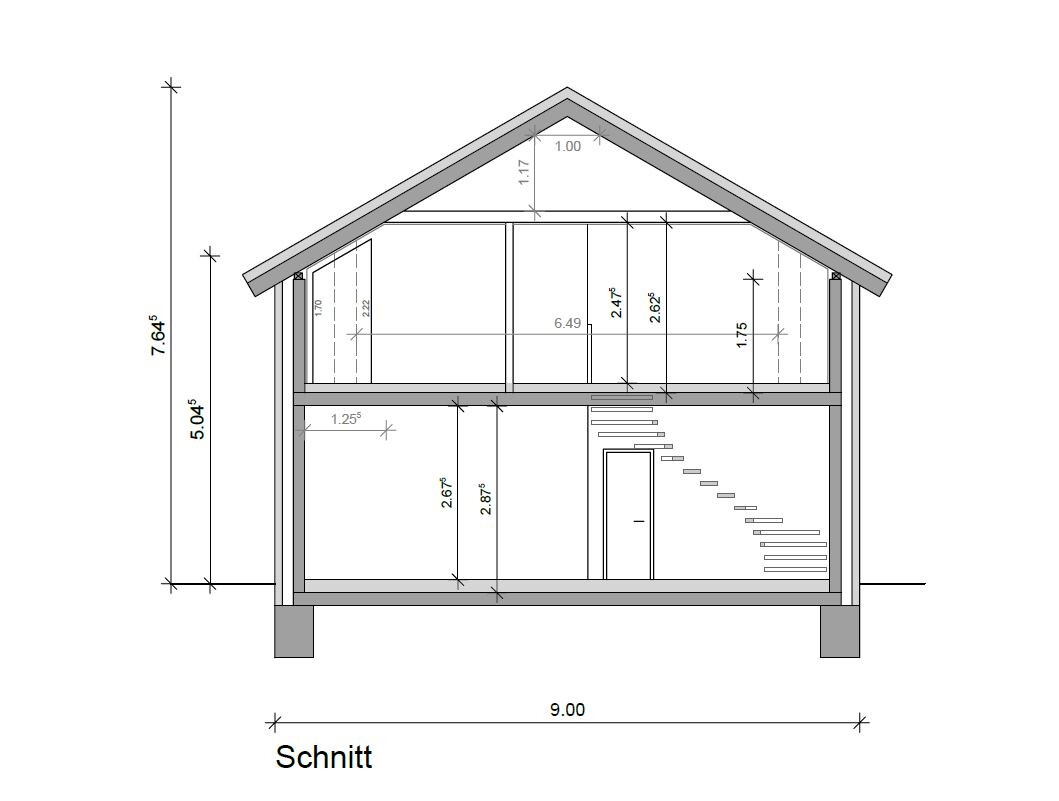
I am currently planning our house (construction start around early April). At the moment, I am considering the most sensible and cost-effective way to do the roof.
It will be a single-family house, 1.5 stories, 148 sqm (1593 sq ft), KFW55 standard, with a knee wall height of 1.75 m (5.7 ft) and a 30° pitched gable roof. (I have attached a cross-section.) The house measures 9 x 11.5 m (29.5 x 37.7 ft).
Would it be better to use insulation between the rafters or to create a cold roof where only the top floor ceiling is insulated? I have already read a lot online but haven’t come to a clear conclusion.
Due to the knee wall height, the roof will not have any windows, and because of the air-to-water heat pump, there will be no chimney (a fireplace is not planned either, as my partner and I are not fond of them). The roof should be functional and straightforward—nothing fancy. Since we are building without a basement, we only plan to use the small attic space for boxes and some storage.
My questions:
Which type of insulation is easier to implement? How might a setup like this look in practice?
I have looked at some examples on ubakus but am still unsure which option makes more sense.
I think insulation between the rafters might be more practical since it wouldn’t reduce the height of the attic space, which is rather small. However, it might not make sense to insulate a space that will only be used for boxes and similar storage...
I would appreciate any advice.
Best regards
We insulated the roof rafters.
1. Attic expansion space – not applicable in your case
2. Relatively stable temperatures in summer and winter. For storing boxes and similar items, it is not ideal if it freezes or reaches 30°C (86°F) or more in summer.
3. In our second home – attic apartment with a cold roof – there is a draft through the hatch of the attic stairs.
1. Attic expansion space – not applicable in your case
2. Relatively stable temperatures in summer and winter. For storing boxes and similar items, it is not ideal if it freezes or reaches 30°C (86°F) or more in summer.
3. In our second home – attic apartment with a cold roof – there is a draft through the hatch of the attic stairs.
Zaba12 schrieb:
How do you plan to build a cold roof with a knee wall in this case?
For me, it’s a continuous concrete ceiling, roof structure, and roof tiles.
Just asking out of curiosity.Maybe cold roof was the wrong term.
I'm considering whether I should insulate only the top floor ceiling or also the attic by adding insulation between the rafters.
I know the sloped ceiling on the upper floor needs insulation; the question is just about the floor.
My tip:
Insulate the attic. It’s best to combine insulation between the rafters with insulation above the rafters (e.g., 8cm (3 inches) wood fiber). This way, you avoid critical thermal bridges and don’t lose the very limited space in the attic.
How do you get enough light into the upper floor?
Insulate the attic. It’s best to combine insulation between the rafters with insulation above the rafters (e.g., 8cm (3 inches) wood fiber). This way, you avoid critical thermal bridges and don’t lose the very limited space in the attic.
How do you get enough light into the upper floor?
haydee schrieb:
We insulated the roof rafters.
1. Attic expansion potential – this does not apply in your case.
2. Relatively stable temperatures in summer and winter. For storing boxes and such, it is not ideal if it freezes or gets above 30°C (86°F) in summer.
3. In our second home – a top-floor apartment with a cold roof – there is a draft coming through the attic stair hatch.Thanks for the tip.
D.S._ schrieb:
My tip:
Insulate the attic. The best approach is to combine insulation between the rafters with insulation above the rafters (for example, 8cm (3 inches) of wood fiber insulation). This way, you avoid critical thermal bridges and don’t lose the limited space in the attic.
How are you planning to get enough light into the upper floor?Thanks for the tip.
On the upper floor, we basically have 4 rooms: bathroom, bedroom, child 1, and child 2 (not counting storage room and dressing room for now). On the gable sides, each room has a window element about 1.5 x 2.25m (5 x 7.4 ft). In addition, the bathroom and the two children’s rooms each get a “clerestory window” in the knee wall, approximately 1.5 x 0.7m (5 x 2.3 ft).
In the hallway or gallery, there will be two windows sized 1 x 2m (3.3 x 6.6 ft) stacked vertically.
This should provide enough daylight on the upper floor. I don’t need daylight on the ground floor—that’s where a lamp will do.
Similar topics