
ᐅ Single-family house of approximately 200 sqm with a double garage on a trapezoidal lot
Created on: 5 May 2023 15:45
M
Mucuc18
Hello dear house building forum community!
After carefully reading along for a while, I would now like to share our current design for constructive feedback.
Below are the usual details; south is at the bottom of the site plan:
Development Plan / Restrictions
Plot size | 512sqm (5509 sq ft)
Slope | No
Site coverage ratio | 160sqm (1722 sq ft) building footprint allowed for main building (+140sqm (1507 sq ft) overrun permitted for other structures)
Number of parking spaces | min. 1.5
Roof type | SD / WD or similar (mansard roofs are common in the area)
Maximum heights / limits | Ridge height 9.4m (31 ft) | Eaves height 6.5m (21 ft)
Additional requirements | Setbacks of 0.4 times the building height on two sides, 0.8 times the building height on other sides
Client Requirements
Architectural style, roof shape, building type | classic mansard-hipped roof, somewhat modern interpretation
Basement, floors | Ground floor, first floor, attic + basement
Number of occupants, ages | 2 (30 yrs, 33 yrs) + 1 (0 yrs) + occasional visitors
Space needs on ground floor, first floor | approx. 80–90sqm (860–970 sq ft) each for ground and first floors
Office | 1 office space needed for home office
Guest accommodation per year | to be determined, sometimes longer visits
Open or closed layout | rather open, but with adequate sound insulation and privacy
Conservative or modern construction | rather modern
Open kitchen, kitchen island | large open kitchen with island is important
Seating for dining | 4–6 seats regularly available, with option to extend
Fireplace | yes
Music / stereo wall | no, flexible hi-fi system
Balcony, roof terrace | no
Garage, carport | double garage
Utility garden, greenhouse | garden with beds and 2–3 trees, enclosed by hedge
House Design
Planner: architect & own ideas/drawings
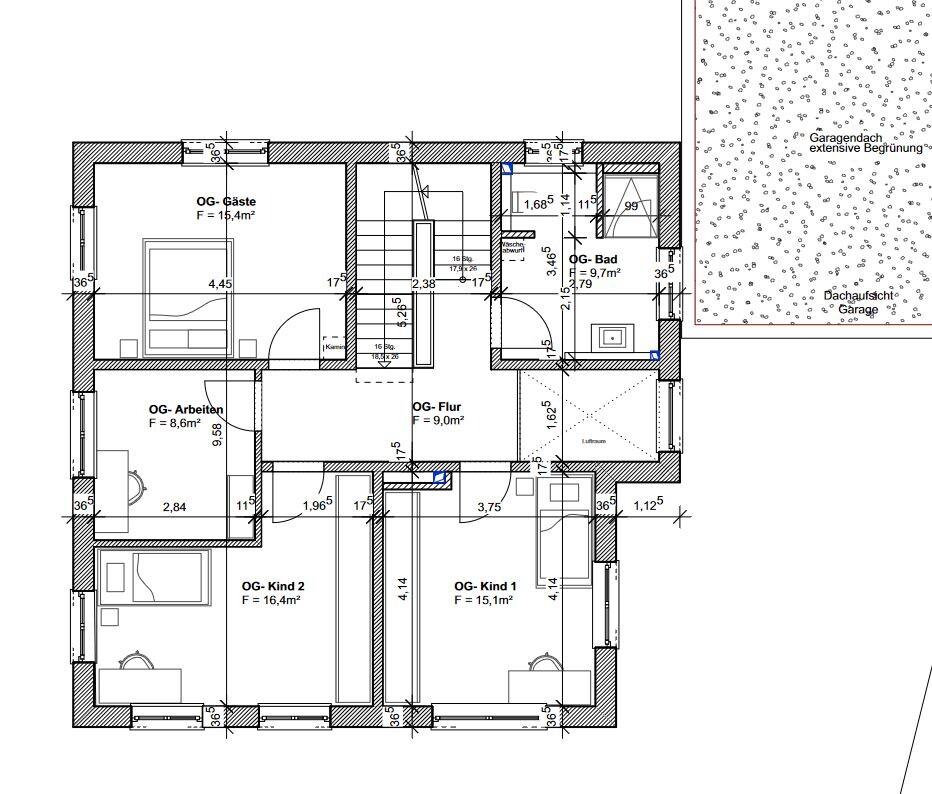
What do you like most? Why? Separate parents’ floor, spacious open living area, straight staircase, number of rooms on first floor (flexibility), sufficient wardrobe space, staircase separated from living room
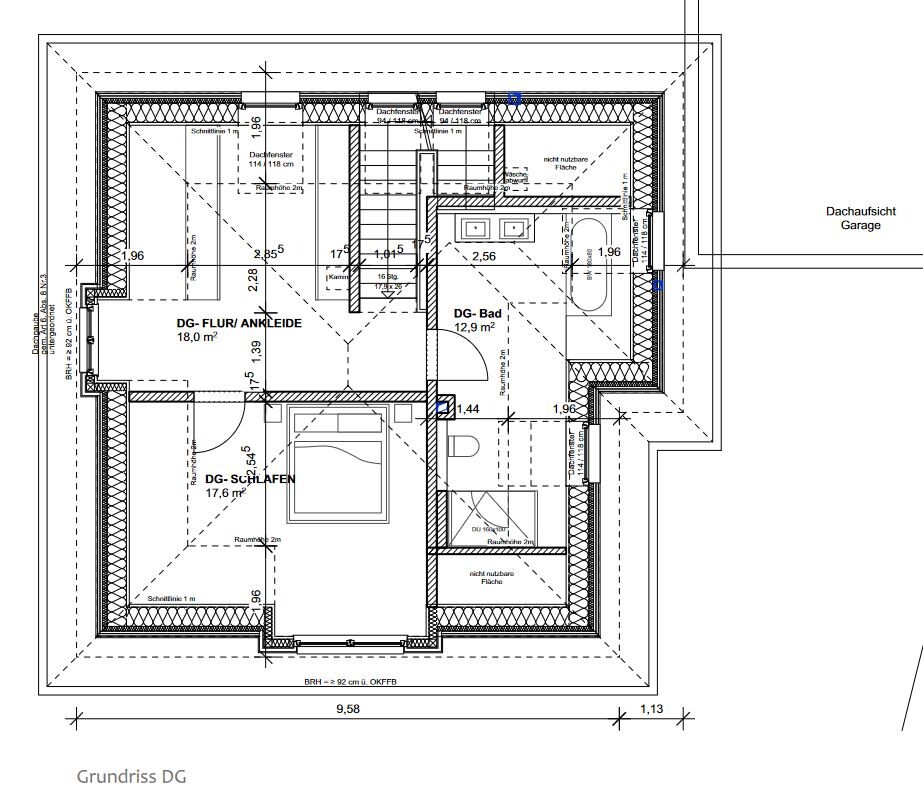
What do you dislike? Why? Location possibilities for heat pump outdoor unit, attic possibly has somewhat excessive space that might not be used efficiently (sloping ceilings)
Cost estimate by architect/planner: none so far
Budget for house including equipment: 1.4–1.5 million
Preferred heating technology: air-to-water heat pump
If you have to give up something, which details/features
- can be omitted: fireplace, pool, possibly double garage
- cannot be omitted: preferably a “large” garden
Why was the design developed this way? For example,
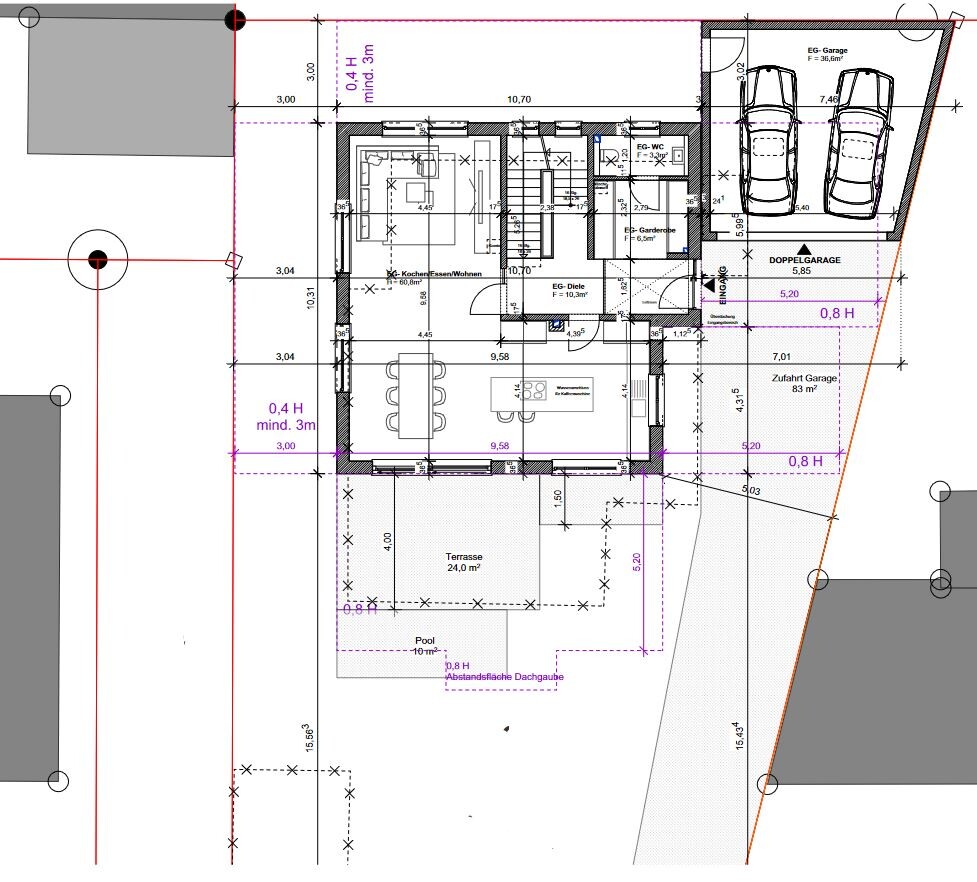
A mix of own ideas and architect’s input, along with several rounds of improvements over recent weeks. The main focus is on maintaining as much contiguous garden space as possible on a relatively small lot. Therefore, a setback on the east side is planned to comply with setbacks on the trapezoidal plot. The three floors plus basement help keep the house footprint small and separate the parents’ area from the children/guest area. We feel our wishes are well implemented in the current floor plan. Minor details such as window dimensions still need adjustment (e.g., equal-sized windows on the first floor west side, possibly a slightly larger sliding door on the ground floor, etc.).
What is the most important / basic question about the floor plan in 130 characters?
Do you see potential for improvement that we should consider or any no-gos we need to rethink? We are quite happy with the current status but appreciate input on aspects we may have overlooked or rationalized too optimistically.
Ground Floor
First Floor
Attic
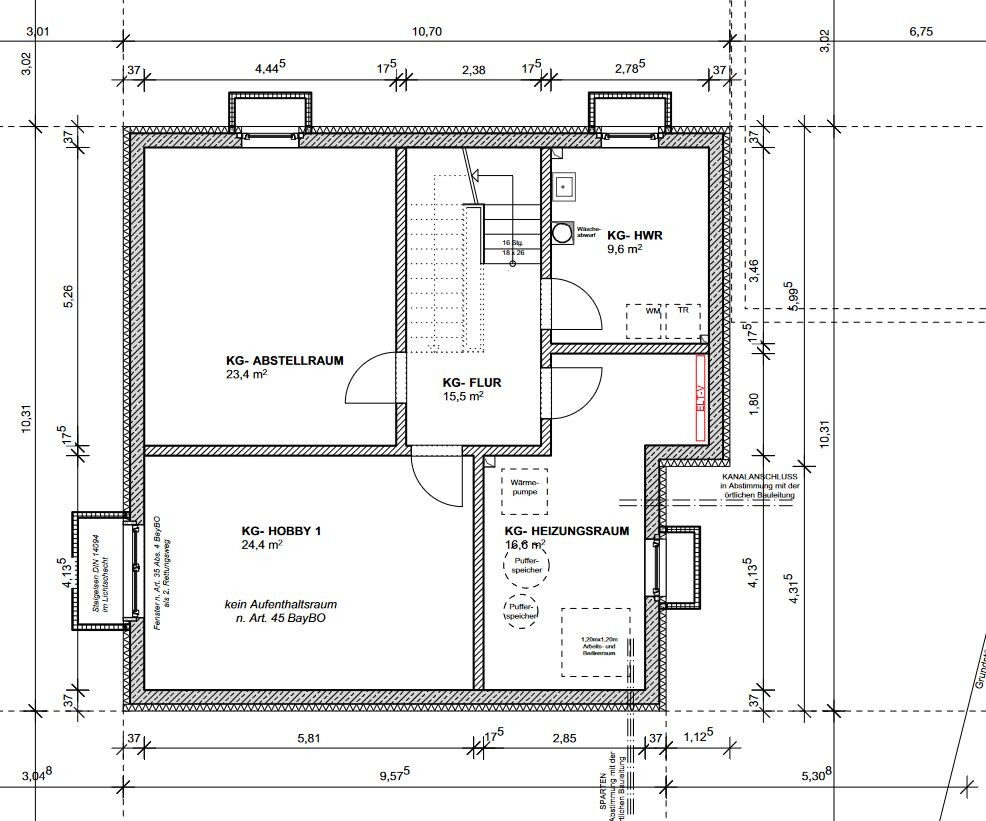
Basement
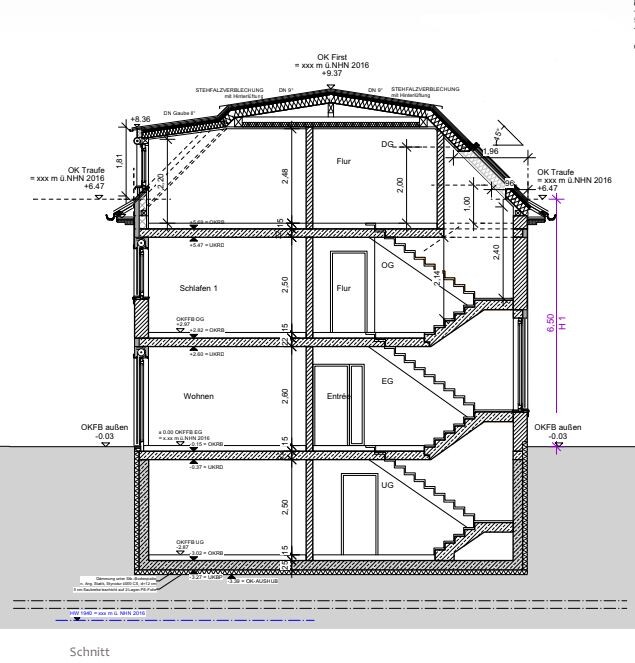
Section
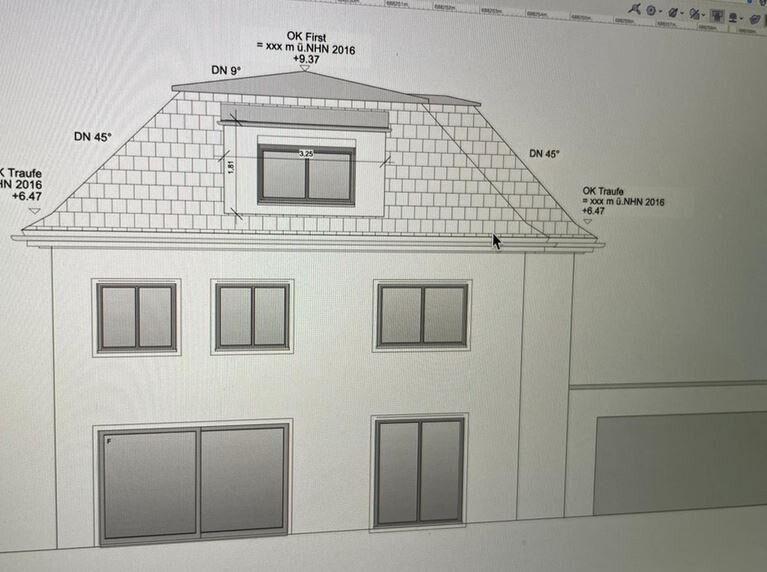
South Elevation
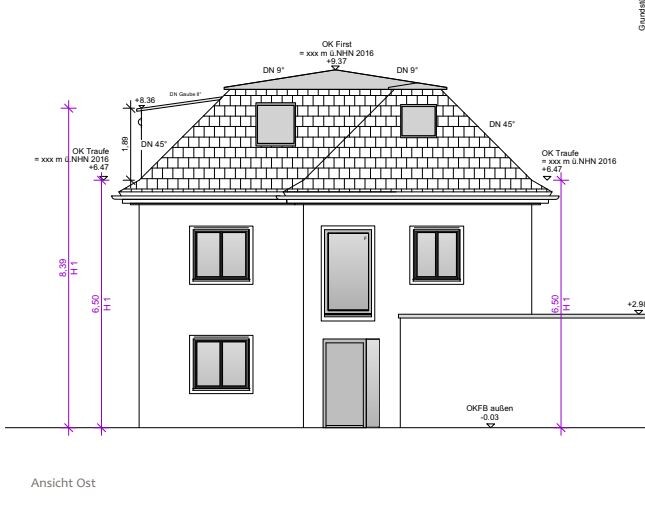
East Elevation
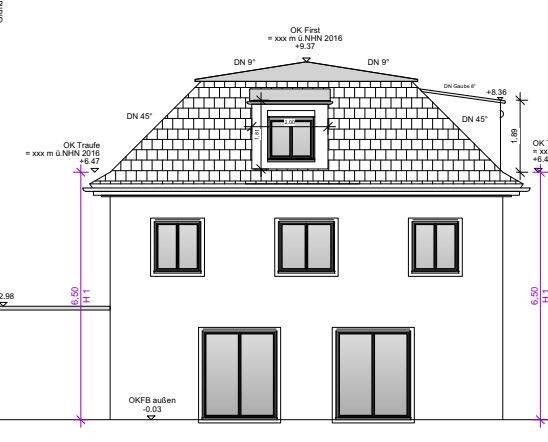
West Elevation
After carefully reading along for a while, I would now like to share our current design for constructive feedback.
Below are the usual details; south is at the bottom of the site plan:
Development Plan / Restrictions
Plot size | 512sqm (5509 sq ft)
Slope | No
Site coverage ratio | 160sqm (1722 sq ft) building footprint allowed for main building (+140sqm (1507 sq ft) overrun permitted for other structures)
Number of parking spaces | min. 1.5
Roof type | SD / WD or similar (mansard roofs are common in the area)
Maximum heights / limits | Ridge height 9.4m (31 ft) | Eaves height 6.5m (21 ft)
Additional requirements | Setbacks of 0.4 times the building height on two sides, 0.8 times the building height on other sides
Client Requirements
Architectural style, roof shape, building type | classic mansard-hipped roof, somewhat modern interpretation
Basement, floors | Ground floor, first floor, attic + basement
Number of occupants, ages | 2 (30 yrs, 33 yrs) + 1 (0 yrs) + occasional visitors
Space needs on ground floor, first floor | approx. 80–90sqm (860–970 sq ft) each for ground and first floors
Office | 1 office space needed for home office
Guest accommodation per year | to be determined, sometimes longer visits
Open or closed layout | rather open, but with adequate sound insulation and privacy
Conservative or modern construction | rather modern
Open kitchen, kitchen island | large open kitchen with island is important
Seating for dining | 4–6 seats regularly available, with option to extend
Fireplace | yes
Music / stereo wall | no, flexible hi-fi system
Balcony, roof terrace | no
Garage, carport | double garage
Utility garden, greenhouse | garden with beds and 2–3 trees, enclosed by hedge
House Design
Planner: architect & own ideas/drawings
What do you like most? Why? Separate parents’ floor, spacious open living area, straight staircase, number of rooms on first floor (flexibility), sufficient wardrobe space, staircase separated from living room
What do you dislike? Why? Location possibilities for heat pump outdoor unit, attic possibly has somewhat excessive space that might not be used efficiently (sloping ceilings)
Cost estimate by architect/planner: none so far
Budget for house including equipment: 1.4–1.5 million
Preferred heating technology: air-to-water heat pump
If you have to give up something, which details/features
- can be omitted: fireplace, pool, possibly double garage
- cannot be omitted: preferably a “large” garden
Why was the design developed this way? For example,
A mix of own ideas and architect’s input, along with several rounds of improvements over recent weeks. The main focus is on maintaining as much contiguous garden space as possible on a relatively small lot. Therefore, a setback on the east side is planned to comply with setbacks on the trapezoidal plot. The three floors plus basement help keep the house footprint small and separate the parents’ area from the children/guest area. We feel our wishes are well implemented in the current floor plan. Minor details such as window dimensions still need adjustment (e.g., equal-sized windows on the first floor west side, possibly a slightly larger sliding door on the ground floor, etc.).
What is the most important / basic question about the floor plan in 130 characters?
Do you see potential for improvement that we should consider or any no-gos we need to rethink? We are quite happy with the current status but appreciate input on aspects we may have overlooked or rationalized too optimistically.
Ground Floor
First Floor
Attic
Basement
Section
South Elevation
East Elevation
West Elevation
H
HeimatBauer3 Oct 2023 19:25My friends are civil engineers and building services engineers who run a joint engineering firm specializing in industrial, school, and office buildings. They have decades of on-site experience and truly understand why and how things are built. They visited the construction site weekly during the building process and pointed out several important issues that were then addressed. However, they do not work in residential construction.
For example, they helped me get rid of misconceptions like "I don’t want a central ventilation system because ventilation causes mold" — yes, I really used to think that years ago. They also thoroughly debunked various trendy ideas that come and go, such as "I heard about the XYZ miracle heating system and I want that."
They are also used to scenarios where a client has a custom-designed, elaborate project drawn up by a star architect and then says, “Design this for me. I want a tank assembly line on the 18th floor, the house should be built from balsa wood, and it must be a passive house even without a ventilation system.” So, they did explain the option of going to an architect first. For me, it was more important that they explained what to consider when choosing a general contractor, broke down the detailed scope of work, and so on.
This was my first house, and I claim it turned out extremely well for that. To use the saying, "the first is for the enemy, the second for a friend, and the third for yourself," I would say it is already very good for a close friend.
Choosing to rely entirely on the general contractor was also due to my wife’s risk aversion and the time pressure. I admit that when I decided to build, I was incredibly clueless — how clueless, I only partially realized afterward. I didn’t know the options and lacked both the strength and persistence to push through the more complicated path. At some point, it just became important for me to finally get started. In hindsight, not everything was 100% perfect, but much of it has proven to be very good.
For example, they helped me get rid of misconceptions like "I don’t want a central ventilation system because ventilation causes mold" — yes, I really used to think that years ago. They also thoroughly debunked various trendy ideas that come and go, such as "I heard about the XYZ miracle heating system and I want that."
They are also used to scenarios where a client has a custom-designed, elaborate project drawn up by a star architect and then says, “Design this for me. I want a tank assembly line on the 18th floor, the house should be built from balsa wood, and it must be a passive house even without a ventilation system.” So, they did explain the option of going to an architect first. For me, it was more important that they explained what to consider when choosing a general contractor, broke down the detailed scope of work, and so on.
This was my first house, and I claim it turned out extremely well for that. To use the saying, "the first is for the enemy, the second for a friend, and the third for yourself," I would say it is already very good for a close friend.
Choosing to rely entirely on the general contractor was also due to my wife’s risk aversion and the time pressure. I admit that when I decided to build, I was incredibly clueless — how clueless, I only partially realized afterward. I didn’t know the options and lacked both the strength and persistence to push through the more complicated path. At some point, it just became important for me to finally get started. In hindsight, not everything was 100% perfect, but much of it has proven to be very good.

11ant schrieb:
Most contract architects are women working part-time due to parental leave (who then get contracted or employed by the general contractor) or architects approaching retirement, for whom running their own office is no longer worthwhile. It is rarely due to the quality of education or experience that expectations have to be lowered here compared to when the architect is selected and commissioned independently. What are you trying to say with that? That an architect on parental leave or nearing retirement suddenly forgets their training and no longer knows how to design a 2.5-bedroom single-family house? Do you also think a baker at 60 forgets how to bake bread rolls or a dentist with a child forgets how to perform tooth extractions? In my opinion, that’s nonsense. Either you can do your job or you can’t. And just because the architect is now employed doesn’t mean they stop reading and understanding the zoning regulations/planning permission— that is still part of the job.
I see it more like this: everyone can make mistakes sometimes. As long as nothing has been built yet, corrections are still possible. Or the architect is simply incompetent or not really an architect. Then it’s goodbye and finally bring in a professional.

K a t j a schrieb:
What are you trying to say? That an architect on parental leave or early retirement suddenly forgets their training and no longer knows how to plan a 2.5-room single-family house?Of course not, you have clearly misunderstood me. I was trying to explain that your concerns are unfounded, and customers are not being assigned architects with questionable training. My explanation was meant to clarify where the architects hired by the general contractors (GCs) come from. Independent architects are required to provide proof of professional liability insurance. This insurance is expensive, making it difficult to keep a small office running on a minimal budget while maintaining coverage. Therefore, architects seeking phased retirement (or part-time during parental leave) often switch to an employed position where they no longer have this financial burden. This does not affect their authorization to sign off on plans; it is a win-win for both the GC and the architect, and in this setup, the client’s contract is with the GC, not the architect’s office. This situation is not associated with a decline in qualification. That is why I said, "rarely is it really about the quality of training or experience." The main issue here is the working method imposed by the GC— a "minimal effort" or "superficial" approach: advising the client against a building permit / planning permission pre-application that would have ensured consensus on interpreting height requirements. The same architect would have acted differently if they were working independently. I do not believe the cause is the senility of the architect with the stamp.So the problematic quotation marks around "architect" relate to the relationship with the GC—not, as you feared, that a draftsman has been fraudulently labeled as an architect.
What I described is the most common arrangement. There is also a two-step model (a draftsman "designs," and an authorized professional of, let’s say, not fully alert expertise signs off) or the version I described above but with an independent office on a lump-sum contract (hence my use of the term “chartered”). For good reason, I recommend, as the only fully valid approach, always to seek and hire an architecture firm directly without going through a GC.
https://www.instagram.com/11antgmxde/
https://www.linkedin.com/company/bauen-jetzt/
11ant schrieb:
Of course not, you have clearly misunderstood me.... I don’t think so: 11ant schrieb:
The problem here is the work method required by the general contractor (GC), a “narrow approach” / “minimal coverage”: K a t j a schrieb:
… just because the architect is now employed, it doesn’t mean they stop reading and understanding the development plan. That is still part of the job. I could rather imagine that the client’s request for maximum building coverage also made the GC’s eyes light up with the anticipation of some euros. So maybe they simply took a gamble to see if the permit would be approved by the authorities and unfortunately got rejected.K a t j a schrieb:
I could even imagine that the client’s request for maximum building coverage might have got the general contractor’s hopes up—dollar signs in their eyes, so to speak. So maybe they just took a gamble whether the authorities would approve it—and unfortunately, it got rejected. That is unfortunately "not unlikely," which is why I encouraged the OP to reconsider this "client’s request for maximum building coverage" rather than reasonably running into the same wall with the next architect. But I also think...
K a t j a schrieb:
And just because the architect is now employed doesn’t mean they stop reading and understanding the development plan. ... that here the development plan cannot be "read and understood" just like that without coordination as the building authority expects, or that in this situation it is not entirely clear, and...
K a t j a schrieb:
That is still part of the job after all. ... that it would only be the architect’s personal responsibility to recommend a preliminary building inquiry in this case—and not when acting under the general contractor’s mandate or direct instructions.
https://www.instagram.com/11antgmxde/
https://www.linkedin.com/company/bauen-jetzt/
Similar topics