
Hello everyone,
I hope to get some good advice here. Our tiler was supposed to install a level-access shower in our bathroom (a timber-framed house with only soil excavation underneath) that is fully tiled. Now he has finished, the channel and tiles are in place. However, the slope is not directed towards the drain but towards the bathroom door. I would like to find a practical solution to fix this.
We have considered several options: removing the bottom row of tiles, sealing everything, and installing a shallow tray. Or using a shower board made of polystyrene with a waterproof membrane already attached, placing it on the tiles, sealing it, and then creating a new screed. But I’m still not convinced if that will work. Do you have any advice on how to solve this properly, so I won’t have water issues later on?
Thanks for your help and best regards,
Rocco
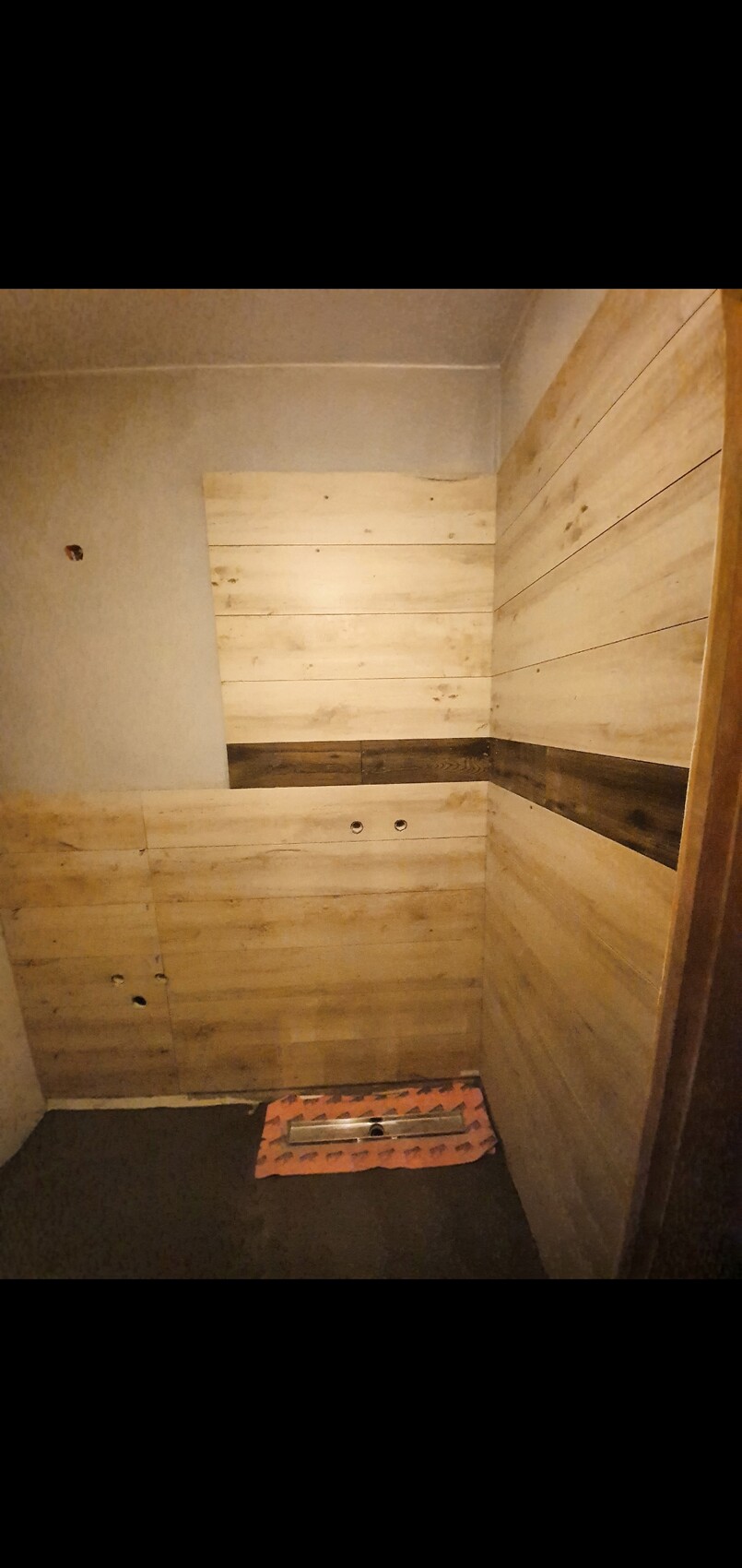
I hope to get some good advice here. Our tiler was supposed to install a level-access shower in our bathroom (a timber-framed house with only soil excavation underneath) that is fully tiled. Now he has finished, the channel and tiles are in place. However, the slope is not directed towards the drain but towards the bathroom door. I would like to find a practical solution to fix this.
We have considered several options: removing the bottom row of tiles, sealing everything, and installing a shallow tray. Or using a shower board made of polystyrene with a waterproof membrane already attached, placing it on the tiles, sealing it, and then creating a new screed. But I’m still not convinced if that will work. Do you have any advice on how to solve this properly, so I won’t have water issues later on?
Thanks for your help and best regards,
Rocco
C
chand198618 Apr 2021 10:10Complaining doesn’t solve problems.
Not anticipating this in advance is unprofessional. That it happened is also unprofessional. The professional, legally secure approach of complaining, returning, waiting, and adding work is not solution-oriented and can cause further issues. Identifying now what should have been done beforehand, to avoid having to think about it afterward, is the reason behind the saying “coulda, woulda, shoulda.”
We will have to wait for the original poster to report whether an issue like a small step will arise or not, whether the tiler will or will not proceed, and so on.
The simplest approach remains reaching an amicable agreement with the tradesperson (tiler) who is already on site. And how to approach this constructively has been nicely explained by [USER=46205]@hampshire. Theoretically, what else should have been done doesn’t really help at this point.
Not anticipating this in advance is unprofessional. That it happened is also unprofessional. The professional, legally secure approach of complaining, returning, waiting, and adding work is not solution-oriented and can cause further issues. Identifying now what should have been done beforehand, to avoid having to think about it afterward, is the reason behind the saying “coulda, woulda, shoulda.”
We will have to wait for the original poster to report whether an issue like a small step will arise or not, whether the tiler will or will not proceed, and so on.
The simplest approach remains reaching an amicable agreement with the tradesperson (tiler) who is already on site. And how to approach this constructively has been nicely explained by [USER=46205]@hampshire. Theoretically, what else should have been done doesn’t really help at this point.
I don’t understand and am completely lost, while everyone here seems to clearly see the slope in the photos :p 🙄
In the original post, you mentioned only one.
Xricky22x schrieb:Those are two (2)! showers!
Here is a picture of the current condition
In the original post, you mentioned only one.
H
hampshire18 Apr 2021 10:18Addendum: Asking "why" is not inherently bad—when it’s about reconstructing a sequence of events to learn from them, for example, it can be very effective. However, when it comes to solving an urgent problem, it is often less helpful.
In that sense, it is perfectly fine to ask "what if" questions—but these are better posed by the contractors themselves. The homeowner may not care what the contractor learns from the mistake in their house; they just want the problem fixed.
In that sense, it is perfectly fine to ask "what if" questions—but these are better posed by the contractors themselves. The homeowner may not care what the contractor learns from the mistake in their house; they just want the problem fixed.
X
Xricky22x19 Apr 2021 13:34Hello everyone, and thank you for your many clear comments.
The tiler now admits that the work was done incorrectly and that removing just one or two tiles is not enough. After having an expert inspect the site, it turns out the entire floor must be removed. A waterproof membrane needs to be installed underneath, and the entire shower must be taken apart, because achieving watertightness afterward is impossible.
He is now dismantling the entire bathroom, and it will have to be rebuilt.
And yes, there are two bathrooms, and the slope is wrong in both of them. :-(
Now the question is whether to switch to vinyl flooring or reinstall tiles, as a 2 cm (3/4 inch) edge will be unavoidable either way. :-(
Does anyone have experience with vinyl flooring in bathrooms?
Best regards
The tiler now admits that the work was done incorrectly and that removing just one or two tiles is not enough. After having an expert inspect the site, it turns out the entire floor must be removed. A waterproof membrane needs to be installed underneath, and the entire shower must be taken apart, because achieving watertightness afterward is impossible.
He is now dismantling the entire bathroom, and it will have to be rebuilt.
And yes, there are two bathrooms, and the slope is wrong in both of them. :-(
Now the question is whether to switch to vinyl flooring or reinstall tiles, as a 2 cm (3/4 inch) edge will be unavoidable either way. :-(
Does anyone have experience with vinyl flooring in bathrooms?
Best regards
P
pagoni202019 Apr 2021 13:39I can’t say anything about vinyl, but depending on the floor plan, you might also consider a deliberate step or level change. I have had that myself and found it comfortable and fitting. However, it only works depending on the floor plan.

We have tiles in the bathrooms and glued-down vinyl flooring in the other rooms.
So the edge isn’t really an issue – but it depends on the installation and how high it ends up being.
I would really avoid vinyl in the bathroom. I’m a big fan of vinyl, and when fully glued down, it’s also easy to clean. But in the bathroom, where water regularly gets on it and stands there? I wouldn’t trust it.
Between individual vinyl strips, which are also fully glued down, we occasionally have small grooves that are visible – I would worry that water could seep in there and cause damage over the years.
I absolutely can’t imagine using it as shower flooring, and otherwise, not really for the bathroom either.
So the edge isn’t really an issue – but it depends on the installation and how high it ends up being.
I would really avoid vinyl in the bathroom. I’m a big fan of vinyl, and when fully glued down, it’s also easy to clean. But in the bathroom, where water regularly gets on it and stands there? I wouldn’t trust it.
Between individual vinyl strips, which are also fully glued down, we occasionally have small grooves that are visible – I would worry that water could seep in there and cause damage over the years.
I absolutely can’t imagine using it as shower flooring, and otherwise, not really for the bathroom either.
Similar topics