
ᐅ Should underfloor heating in the basement be kept running continuously?
Created on: 23 Sep 2025 14:18
N
NilsHolgerssonN
NilsHolgersson23 Sep 2025 14:18Hello dear community,
We also have underfloor heating in the basement with individual room/heating circuit control. The flow rate or floor temperature is regulated based on the room temperature. This system is controlled in this room (about 30sqm (320 sqft)) by three small actuators (see photo). The room temperature is acceptable, but the basement floor still remains quite cold. This room is intended as a playroom for the small child, who enjoys sitting and playing on the floor there.
Our wish is to adjust the system so that the underfloor heating in this room simply runs continuously, keeping the floor warm. Our heating technician wrote the following to us:
“Regarding the underfloor heating control in the basement room, there is the following option, which however does not comply with energy-saving regulations: The actuators could be removed and replaced with so-called manual caps. This would allow the heating circuits to be kept partially open at all times, regardless of the room temperature.”
Questions:
1. Should we do this / is it worthwhile? The slightly higher heating costs are acceptable to us.
2. Is this replacement complex or time-consuming? Does anyone have experience with these manual caps?
Thank you very much!
Kind regards,
Nils
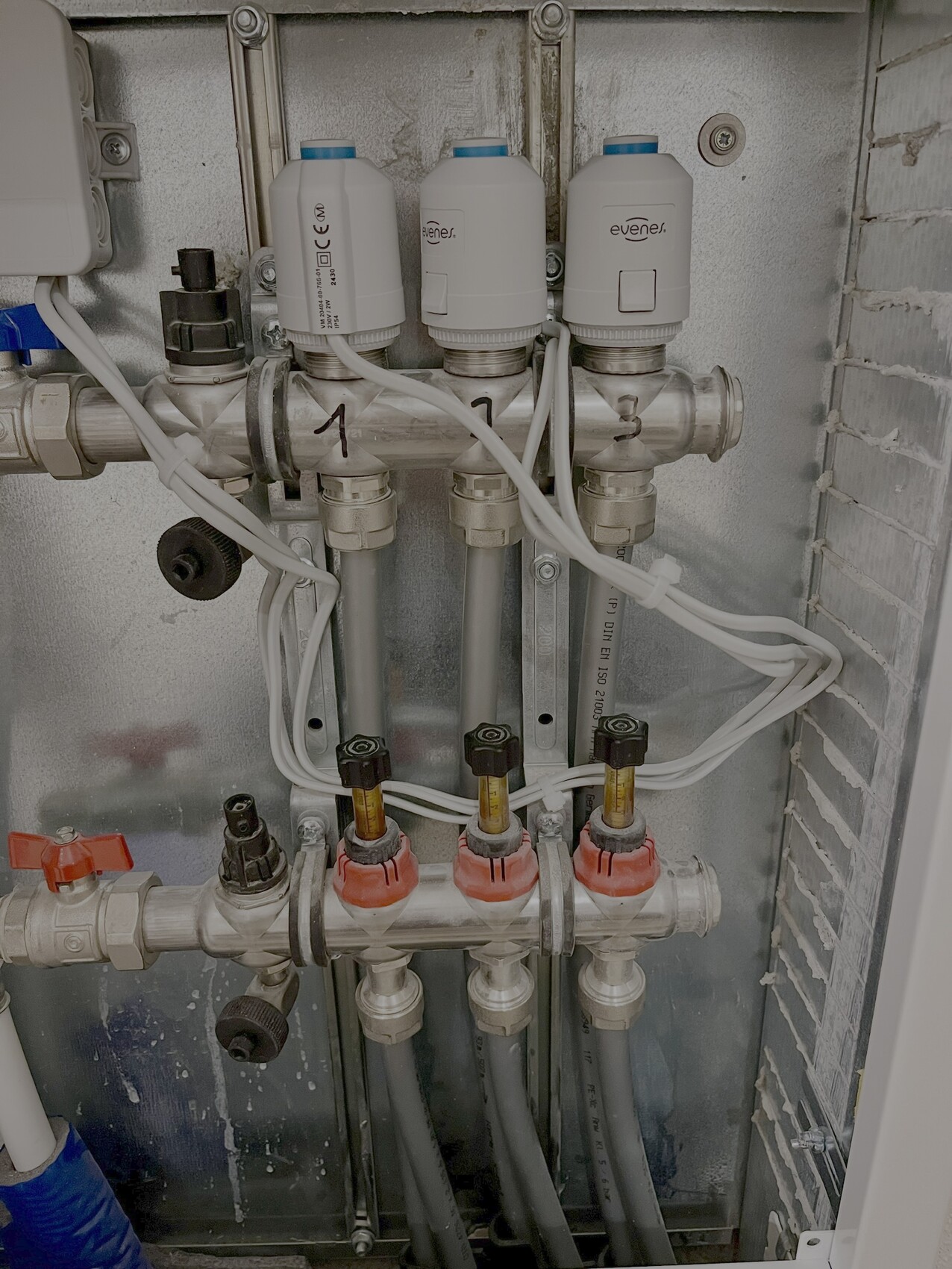
We also have underfloor heating in the basement with individual room/heating circuit control. The flow rate or floor temperature is regulated based on the room temperature. This system is controlled in this room (about 30sqm (320 sqft)) by three small actuators (see photo). The room temperature is acceptable, but the basement floor still remains quite cold. This room is intended as a playroom for the small child, who enjoys sitting and playing on the floor there.
Our wish is to adjust the system so that the underfloor heating in this room simply runs continuously, keeping the floor warm. Our heating technician wrote the following to us:
“Regarding the underfloor heating control in the basement room, there is the following option, which however does not comply with energy-saving regulations: The actuators could be removed and replaced with so-called manual caps. This would allow the heating circuits to be kept partially open at all times, regardless of the room temperature.”
Questions:
1. Should we do this / is it worthwhile? The slightly higher heating costs are acceptable to us.
2. Is this replacement complex or time-consuming? Does anyone have experience with these manual caps?
Thank you very much!
Kind regards,
Nils
N
nordanney23 Sep 2025 14:35NilsHolgersson schrieb:
The room temperature here is acceptable, but the basement floor still stays quite cold.This is normal in summer (and spring/autumn) when the heating is off. Otherwise, you would need to keep the heating running during summer – but then isolate the rest of the house by manually setting the flow to zero. Whether the flow is enough for the heat pump or if it shuts off automatically? No idea, depends on your model. NilsHolgersson schrieb:
“As for the underfloor heating control in the basement room, there is the following option, which, however, does not comply with energy saving regulations: the actuators could be removed and replaced with so-called manual caps. This would allow the heating circuits to remain slightly open regardless of the room temperature.”Sure, that would make sense for the whole house. I deliberately did not install actuators and only adjusted the flow according to hydraulic (and later thermal) balancing. Saves money and, to be honest, a heat pump should just keep running without controls in a modern house (which is legal if you apply for an exemption).NilsHolgersson schrieb:
Questions:
1. Should this be done / is it worthwhile? The slightly higher heating costs are acceptable for us.
2. Is this replacement complex or labor-intensive? Does anyone have experience with these manual caps?Answers:1. Definitely makes sense for the whole house and will result in LOWER heating costs if set correctly.
2. No. Many people do it that way.
My suggestion: Lay down a play rug, since you don’t want to turn the heating on during summer.
N
NilsHolgersson23 Sep 2025 15:00Thanks for the feedback 🙂
We actually have the actuators in all rooms. From experience during the previous winter (moved in 01/25), it was like the rooms were switched on and off alternately – meaning one room had a comfortably warm floor while another was cold, then after some time it switched, even though the room controllers (rotary dials near the light switches) were set to the highest level in all rooms. This was confusing because it didn’t make any logical sense. Our main goal is for all rooms to be evenly warm, especially with floors that are comfortably warm and not ice-cold.
Is it actually possible to simply disable these actuators – meaning that the circulation remains constant without them?
Why are these actuators installed at all if they don’t seem useful? Are there any advantages to having them?
If the whole house is converted to operate without actuators, is it just a matter of mechanically replacing the motors at their respective points, or does the entire system need to be modified – I mean balancing, etc.?
Regarding the carpet, we have also considered it – but it will be a large carpet and will get dirty quite quickly :p
We actually have the actuators in all rooms. From experience during the previous winter (moved in 01/25), it was like the rooms were switched on and off alternately – meaning one room had a comfortably warm floor while another was cold, then after some time it switched, even though the room controllers (rotary dials near the light switches) were set to the highest level in all rooms. This was confusing because it didn’t make any logical sense. Our main goal is for all rooms to be evenly warm, especially with floors that are comfortably warm and not ice-cold.
Is it actually possible to simply disable these actuators – meaning that the circulation remains constant without them?
Why are these actuators installed at all if they don’t seem useful? Are there any advantages to having them?
If the whole house is converted to operate without actuators, is it just a matter of mechanically replacing the motors at their respective points, or does the entire system need to be modified – I mean balancing, etc.?
Regarding the carpet, we have also considered it – but it will be a large carpet and will get dirty quite quickly :p
N
nordanney23 Sep 2025 16:54NilsHolgersson schrieb:
From experience with previous winters (move-in 01/25), the rooms were switched on and off alternately – so one room had a comfortably warm floor while the other was cold, and then after some time the situation was reversed, Someone made a mistake here. Controlling the system like that makes no sense. Actually having a comfortably warm floor is also questionable. In a new build with a properly adjusted heating system, you shouldn’t consciously notice the warmth from the floor.
NilsHolgersson schrieb:
We basically want all rooms to be evenly warm and especially the floors to be pleasantly warm, not freezing cold. Report this as a defect to the heating contractor, general contractor, or developer. Have the heating system adjusted correctly.
NilsHolgersson schrieb:
Is it actually possible to simply disable these actuators – meaning that the flow remains constant even without the actuators? It looks like that in your case. There were never actuators installed – only the blue caps. The flow can be adjusted directly on the pipes by turning them; you might need to remove the red caps first. This sets a fixed flow that cannot be changed automatically (obviously, it can be manually adjusted). If you just disconnect the actuators from power, you have to check what type you have. Some actuators fail open (which is good), while others fail closed (which is inconvenient because it doesn’t help you initially).
[ATTACH type="full" width="350px"]92973[/ATTACH]
NilsHolgersson schrieb:
Why are actuators installed then if they are rather pointless? Are there any advantages to them? Because it is required by law... that’s just how it is. The idea is to help users save heating energy (in theory, which is debatable for new builds).
NilsHolgersson schrieb:
If you convert the whole house to run without actuators, is it just a matter of mechanically replacing the motors at the respective points, or do you have to change the entire system – I mean in terms of balancing, etc.? You “only” need to set the correct flow according to the hydraulic balancing and then monitor how the heating system performs during winter. So, fine-tuning is necessary. Through the flow rate (per circuit and for the entire system) combined with the supply and return temperatures (and heating curve), you control the target temperature inside the house. Small temperature differences between rooms are possible. With a properly adjusted system, you won’t need to adjust the heating for years.
A
ajokr202523 Sep 2025 19:42NilsHolgersson schrieb:
Why do they make these actuators if they are mostly pointless? Are there any advantages? The heating installer earns money on every component they install for you, whether you really need it or not.
There is also a deluxe version with "smart" thermostats and home automation, which costs even more but offers little additional comfort.
Simply heating according to a heating curve from October to April is the most cost-effective solution.
Thermostats only make sense where sunlight heats individual rooms, while others remain shaded and do not benefit. Even then, underfloor heating reacts far too slowly.
In apartment buildings, the preferences of each tenant must, of course, be considered, but in that case, the tenants also pay the higher heating costs, not the property owner. That is why individual room controls are practical and often required.
N
nordanney23 Sep 2025 20:09ajokr2025 schrieb:
The heating technician profits from every component they install for you, whether you actually need it or not.The tradesperson does what is legally required. And thermostats are mandatory, unless you apply for an exemption. In this case, the costs are caused by the legislator; the tradesperson has nothing to do with it this time.Similar topics