
Hello everyone,
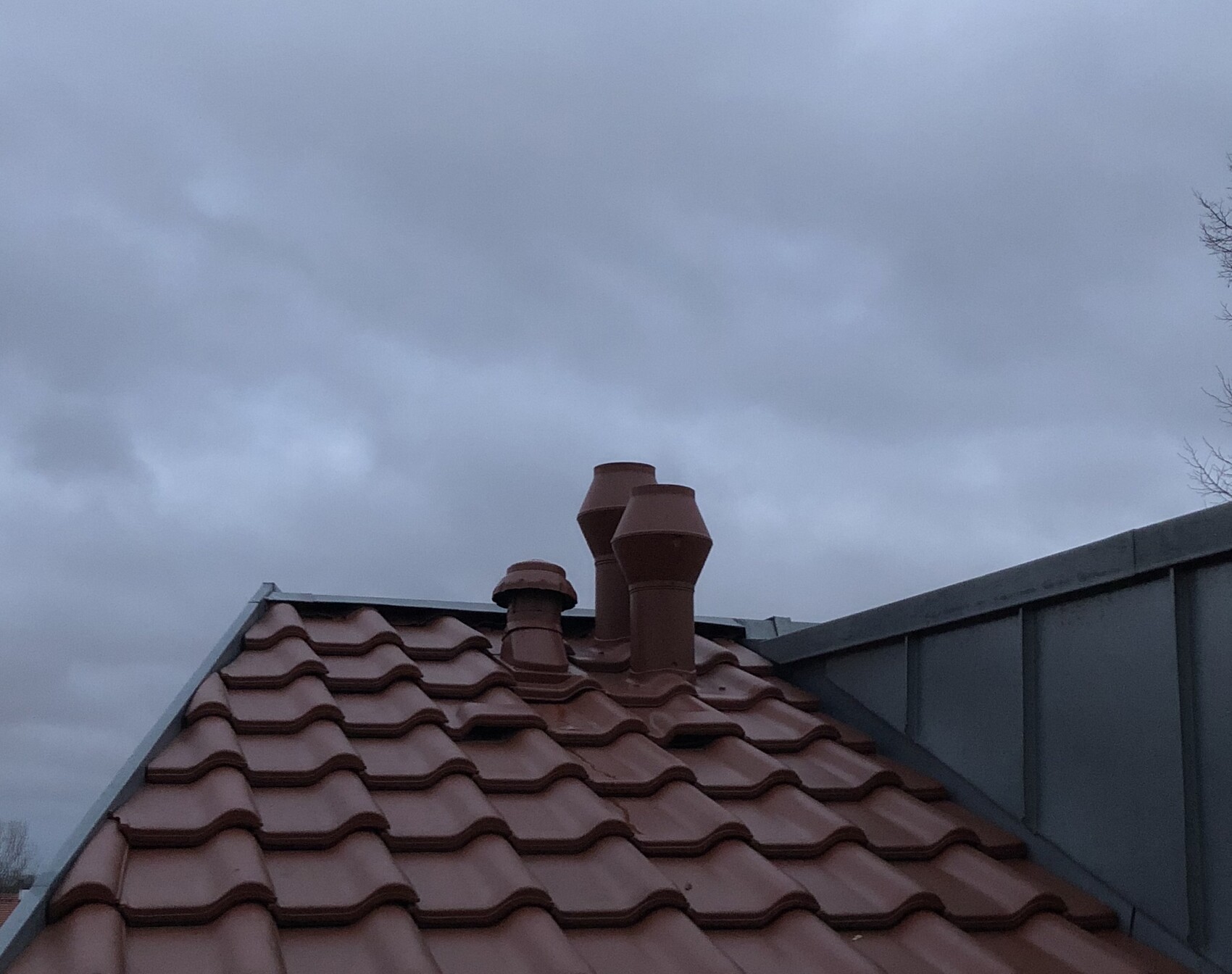
We recently moved into a newly built house equipped with a ventilation system from Zehnder. The problem is that the wastewater vent pipe is located right next to the supply and exhaust air ducts of the ventilation system on the roof, which occasionally causes a very unpleasant smell inside the house.
Does anyone have experience with this? How was it resolved? Would this be considered a construction defect (from a legal standpoint)?
Attached is a picture of the roof situation. Maybe someone has a simple solution for this.
Best regards,
bene1981
We recently moved into a newly built house equipped with a ventilation system from Zehnder. The problem is that the wastewater vent pipe is located right next to the supply and exhaust air ducts of the ventilation system on the roof, which occasionally causes a very unpleasant smell inside the house.
Does anyone have experience with this? How was it resolved? Would this be considered a construction defect (from a legal standpoint)?
Attached is a picture of the roof situation. Maybe someone has a simple solution for this.
Best regards,
bene1981
S
Steffen8019 Nov 2018 08:35Not even the supply air is allowed next to the exhaust air, especially next to wastewater exhaust? Someone really made a big mistake here! And the tradespeople who went along with this during installation should also be held accountable.
Steffen80 schrieb:
Not even the supply air is allowed next to the exhaust air...Oh, that’s interesting. Is there any standard for that?
C
chand198619 Nov 2018 08:51Even if there is no standard, common sense? One thing is supposed to bring fresh air into the house, the other to get rid of stale air. If I place them next to each other and create such a cycle, it makes no sense at all.
The planner must have been unconscious while working.
The planner must have been unconscious while working.
There are no prescribed minimum distances that apply specifically to residential buildings. However, the DIN EN 13779 standard "Ventilation of Non-Residential Buildings" does specify these distances:
1. When arranged vertically, with exhaust air at the top and outdoor air at the bottom: a clear distance of at least 2 m (6.5 ft)
2. When arranged vertically, with outdoor air at the top and exhaust air at the bottom: a clear distance of at least 4 m (13 ft)
3. When arranged side by side: a clear distance of at least 3 m (10 ft)
The VDI 6022 "Hygiene Requirements for HVAC Systems" also applies to residential buildings. Accordingly, the intake of exhaust air through the outdoor air intake, due to the position and orientation of the respective grilles, must be prevented in all cases.
Experts disagree on whether the DIN standard should also be applied to residential buildings. However, the air volume for a controlled residential ventilation system in a single-family house is much lower. Here, only a slight airflow occurs compared to full-scale HVAC systems.
1. When arranged vertically, with exhaust air at the top and outdoor air at the bottom: a clear distance of at least 2 m (6.5 ft)
2. When arranged vertically, with outdoor air at the top and exhaust air at the bottom: a clear distance of at least 4 m (13 ft)
3. When arranged side by side: a clear distance of at least 3 m (10 ft)
The VDI 6022 "Hygiene Requirements for HVAC Systems" also applies to residential buildings. Accordingly, the intake of exhaust air through the outdoor air intake, due to the position and orientation of the respective grilles, must be prevented in all cases.
Experts disagree on whether the DIN standard should also be applied to residential buildings. However, the air volume for a controlled residential ventilation system in a single-family house is much lower. Here, only a slight airflow occurs compared to full-scale HVAC systems.
Similar topics