
ᐅ Semi-detached house within a building plot measuring 8.5 m by 15 m (width x depth)
Created on: 20 May 2025 19:02
G
GregorBerger
Dear housebuilding forum,
After several years of searching, we have finally purchased a plot of land (with an existing building to be demolished) in our desired location. This also marks the end of my many years of purely passive participation in this forum. Since we were primarily looking for renovation projects rather than new builds, we naturally have some initial questions.
The plot, approximately 500 m² (5,400 sq ft), lies within the scope of a development plan that was last updated 20 years ago.
Basic data about the plot and development plan:
The development plan places no restrictions on, among other things:
The plan is to build a semi-detached house with another family. Both families have two children each and require two home offices, resulting in a need for six rooms per semi-detached unit. If we make progress here, I will create another thread in the floor plan forum and fill out the questionnaire.
Since the building envelope width of 8.5 meters (28 ft) is too narrow for semi-detached units side by side, they would have to be arranged one behind the other. Garden access and terraces would then be located on the narrow sides (one facing the street and one facing the main garden at the rear). This type of semi-detached house is quite rare. I have looked around in real life but have not found any examples. Only the Büdenbender semi-detached house Gemello SD 135 roughly corresponds to this layout (though not to the measurements).
I have had some informal discussions with an architect I know (who now only works on office buildings) and the building authority, without encountering any fundamental contradictions so far.
I have already applied the @11ant basement rule, according to which a basement seems obligatory because there is more than 2 meters (7 ft) of height difference within the building envelope. However, I do not understand how this relates to the “base (plinth)” restriction of max. 60 cm (24 in) in the development plan. My layperson assumption would be that one floor (the ground floor? the lowest residential floor? the lowest full floor?) may start a maximum of 60 cm (24 in) above street level.
My first questions for you:
Thank you in advance,
Gregor
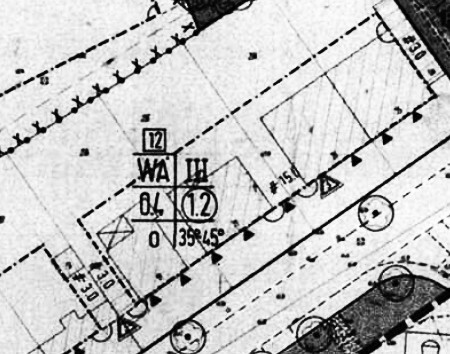
After several years of searching, we have finally purchased a plot of land (with an existing building to be demolished) in our desired location. This also marks the end of my many years of purely passive participation in this forum. Since we were primarily looking for renovation projects rather than new builds, we naturally have some initial questions.
The plot, approximately 500 m² (5,400 sq ft), lies within the scope of a development plan that was last updated 20 years ago.
Basic data about the plot and development plan:
- Building is permitted from 3 meters (10 ft) to 18 meters (59 ft) depth (so 15 m (49 ft) for the house)
- After deducting setback areas, a width of 8.5 meters (28 ft) is possible
- Slight slope across the building envelope with a rise of approximately 2.2 meters (7 ft)
- 3 full floors permitted
- Site occupancy index (ground coverage ratio) 0.4
- Floor area ratio 1.2 (cannot be fully utilized due to the aforementioned building envelope)
- Roof pitch 35–45°
- Knee wall (dormer wall) height 60 cm (24 in)
- Base (plinth) max. 60 cm (24 in) above the midpoint along the width of the access area, which is itself 30 cm (12 in) lower than the start of the building envelope
- General residential zone
- Open building style (detached buildings, no shared walls)
- Covered terraces allowed up to 1.5 meters (5 ft) outside the building boundary, provided the site occupancy index is not exceeded
- Roof indentations and structures permitted up to half the eaves length and at least 1 meter (3 ft) from the gable wall
- Fencing with native hedges. Along the street, an additional fence up to 1.2 meters (4 ft) high is permitted.
The development plan places no restrictions on, among other things:
- Building type
- Number of residential units per building
- Height limits
- Basements
- Parking spaces
The plan is to build a semi-detached house with another family. Both families have two children each and require two home offices, resulting in a need for six rooms per semi-detached unit. If we make progress here, I will create another thread in the floor plan forum and fill out the questionnaire.
Since the building envelope width of 8.5 meters (28 ft) is too narrow for semi-detached units side by side, they would have to be arranged one behind the other. Garden access and terraces would then be located on the narrow sides (one facing the street and one facing the main garden at the rear). This type of semi-detached house is quite rare. I have looked around in real life but have not found any examples. Only the Büdenbender semi-detached house Gemello SD 135 roughly corresponds to this layout (though not to the measurements).
I have had some informal discussions with an architect I know (who now only works on office buildings) and the building authority, without encountering any fundamental contradictions so far.
I have already applied the @11ant basement rule, according to which a basement seems obligatory because there is more than 2 meters (7 ft) of height difference within the building envelope. However, I do not understand how this relates to the “base (plinth)” restriction of max. 60 cm (24 in) in the development plan. My layperson assumption would be that one floor (the ground floor? the lowest residential floor? the lowest full floor?) may start a maximum of 60 cm (24 in) above street level.
My first questions for you:
- Are you familiar with similar houses, possibly with names for Googling or similar?
- Would you approach this topic differently?
- What does the rule about the base (plinth) mean?
Thank you in advance,
Gregor
G
GregorBerger20 May 2025 23:11Good evening,
wow. Really impressive how much feedback there already is. Thank you very much!
Which one of the three interpretations exactly?
Most houses on this street are positioned with the gable facing the street. The ridge direction is not specified.
Hm, is that a subtle hint to keep Büdenbender at a distance? Or do you mean that the specific house I mentioned does not work?
The other houses on the street (where there are two housing units) each have a single garage in each building recess and one parking space in front of it. This seems to be derived from the NRW parking regulations. These require 1 parking space per dwelling for buildings of building class 2, whereby one parking space in front of a garage counts. So there would be 4 parking spaces. For apartment buildings, these no longer count, which is evident by the apartments on the street having garages running the entire width of the basement level facing the slope.
Yes, that is correct. What does this actually mean for the classification as a full storey? When the property is virtually subdivided, is each half of the semi-detached house evaluated separately?
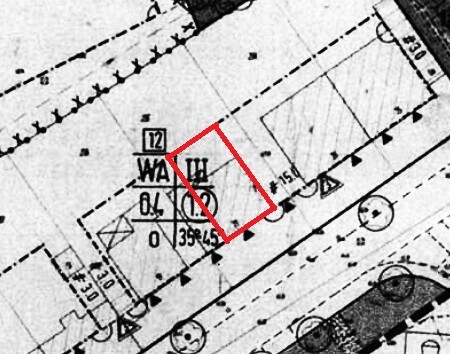
This is the official scan from the city administration. You can’t zoom in any further. There are no contour lines included anyway; I have those from TIM. As I said: across the entire building envelope it rises 2.2m (7 feet 3 inches), from the street towards the garden.
wow. Really impressive how much feedback there already is. Thank you very much!
GregorBerger schrieb:
this is how the “base” of max. 60cm (24 inches) is to be understood in the development plan. Naively, I would assume that one storey (the ground floor? The lowest residential floor? The lowest full storey) may begin a maximum of 60cm (24 inches) above street level.
11ant schrieb:
You seem to interpret the base correctly to me.
Which one of the three interpretations exactly?
11ant schrieb:
If you want to place an entire semi-detached house on only one of the four building plots in the building envelope, I don’t think that is feasible. At least I don’t read from the excerpt of the development plan that it is prohibited to orient the ensemble with the gable facing the street.
Most houses on this street are positioned with the gable facing the street. The ridge direction is not specified.
11ant schrieb:
A functioning semi-detached house (see among the “usual suspects,” Büdenbender does not count).
Hm, is that a subtle hint to keep Büdenbender at a distance? Or do you mean that the specific house I mentioned does not work?
11ant schrieb:
Where should/may the parking spaces go?
The other houses on the street (where there are two housing units) each have a single garage in each building recess and one parking space in front of it. This seems to be derived from the NRW parking regulations. These require 1 parking space per dwelling for buildings of building class 2, whereby one parking space in front of a garage counts. So there would be 4 parking spaces. For apartment buildings, these no longer count, which is evident by the apartments on the street having garages running the entire width of the basement level facing the slope.
kbt09 schrieb:
Placed lengthwise means that for the second house the basement is fully embedded into the slope, and in the front house the basement is a fully usable storey.
Yes, that is correct. What does this actually mean for the classification as a full storey? When the property is virtually subdivided, is each half of the semi-detached house evaluated separately?
11ant schrieb:
... and maybe a slightly better scan so the contour lines can be seen?
This is the official scan from the city administration. You can’t zoom in any further. There are no contour lines included anyway; I have those from TIM. As I said: across the entire building envelope it rises 2.2m (7 feet 3 inches), from the street towards the garden.
Hm, is there nothing else?
Is what you highlighted now the entire plot? Is the assumption by @ypg correct?
Are you aware that
of interior floor area per floor is available? This will be reduced by walls, stairs, etc.
Is what you highlighted now the entire plot? Is the assumption by @ypg correct?
ypg schrieb:
14.5 meters (48 feet) wide, so about 34 meters (112 feet) long
Are you aware that
ypg schrieb:
53 m² (570 ft²) per unit
of interior floor area per floor is available? This will be reduced by walls, stairs, etc.
G
GregorBerger20 May 2025 23:22ypg schrieb:
In our area, there is a very narrow plot that was developed like this:
At the top (north) is the street with parking spaces, on the east side the entrances, and on the west side the gardens. They are nice houses. The entrances are in the bay window, allowed by the regional building code, and on the west side there are two dormers per house for two bedrooms. The plot is flat. Very interesting!
ypg schrieb:
Fortunately, you can calculate something with the few parameters. 500 sqm (5382 sq ft), 8.5 m (28 ft) + 2x 3 m (10 ft) spacing equals 14.5 meters (48 ft) width, so about 34 meters (112 ft) in length. The building envelope is definitely 8.5 x 15 m (28 x 49 ft)... you can build up to 127.5 sqm (1372 sq ft). That is about 109 sqm (1173 sq ft) of living area with an exterior wall thickness of 40 cm (16 inches), so including the partition wall, about 53 sqm (570 sq ft) of living space per unit. (That’s basically our open plan area.) 53 sqm (570 sq ft) of living space doesn’t seem like a no-go to me. We’ve also looked at townhouses with even less space. And there are floor plans for houses with similar outer dimensions. Although not semi-detached, there are so-called “urban villas” for an 8 x 8 m (26 x 26 ft) building envelope available. Of course, these have windows on all sides and can only serve as rough inspiration.
ypg schrieb:
On the left and right sides (driveway/access and garden) there are 3 meters (10 ft) each. Question 1: where do you want to park? I explained that in my previous post above. We can exceed the parking space requirements by 100%. But we don’t have a car anyway (whether that will stay that way forever is another story). We thought we needed one when our first child was born, but it turned out to be unnecessary. For the second child, it really seemed necessary — then the €49 monthly ticket got in the way and made the cost gap between public transport and car so big that we didn’t go for a car for just 2000 km/year (1240 miles/year).
ypg schrieb:
Question 2: informal division of the plot, who gets the rear half, which is basically the luxury version despite the slope, because the front half is pretty limited (house plus 3 meters (10 ft) all around, although it’s almost certainly not possible to build a terrace in those 3 meters). What does the phrase in the development plan mean: "Covered terraces are permitted up to 1.5 m (5 ft) outside the building boundary"?
ypg schrieb:
Whoever pays more, gets the back.
Then you quickly reach the floor area ratio of 1.2 theoretically. Wait. That applies per plot, not per semi-detached unit, right?
ypg schrieb:
So: 3D modeling is not really necessary. Some calculations are enough. I would leave it as a semi-detached house, either way... it’s hard to be happy with that. I’ve been reading your posts for years and always got the impression you can make everything fit somehow. Do you have any ideas for our project?
G
GregorBerger20 May 2025 23:25kbt09 schrieb:
Is what you have marked now the entire plot? Is @ypg’s assumption correct? I have drawn in the building envelope. All the dimensions calculated by ypg are entirely accurate.
GregorBerger schrieb:
I’ve marked the building boundary. All the measurements calculated by ypg are correct.Phew, well estimated and calculated despite the time of day. GregorBerger schrieb:
I’ve been reading your posts for years and always had the impression that you can somehow make everything fit. Do you have any ideas for our task? Thank you. Yes, that’s true. Before leaving things as they are, I try to find possibilities. Thanks for the flattering attention. GregorBerger schrieb:
What does the phrase in the development plan mean: “Covered terraces are permitted up to 1.5m outside the building boundary”? Beyond the 15-meter (50 feet) building boundary, a covered terrace up to 1.5 meters (5 feet) is allowed, not 180cm (about 6 feet) or more. By contrast, an uncovered terrace can extend deeper beyond that. In your case, this would apply to the rear lot at a higher level, so on the upper floor.
GregorBerger schrieb:
The other houses on the street (if they have two dwelling units) each have a single garage within the building setback and a parking space in front. This seems to be derived from the NRW parking regulation. For buildings of building class 2, it requires 1 parking space per apartment, counting a space in front of a garage. So that would be 4 parking spaces total. For multi-family houses, these do not count anymore, which is why the multi-family house on the street uses garages across the entire width of the basement level. There is a contradiction here. Please note, this applies to every builder, whether intended or in between: draw this out for yourselves. Try to understand it one meter (foot) at a time. Try to understand the plot. Draw what is possible using standard dimensions. You can’t expect two families to block each other with their cars and for it to work smoothly. And where exactly are the four parking spaces supposed to be? You can’t line up four parking spaces one behind the other, especially with the slope. Again: beyond the building boundary, it’s finished!
However, you were also asked to show the plot. This is unknown to us. Therefore, no exact information can be given.
GregorBerger schrieb:
Very interesting! Could you please send me the address via private message so I can check it in Street View? No, of course not, since you have never been active and therefore do not have enough posts. Here is the Street View image:

GregorBerger schrieb:
Which of the three interpretations do you mean? :-) The top edge of the finished ground floor.
GregorBerger schrieb:
Hmm, is that a hidden message suggesting to keep Büdenbender at a distance? Or do you mean the specific house I mentioned doesn’t work? You can find the “usual suspects”—developers of semi-detached house projects—mentioned and listed in many of my posts. Their standard models resemble each other like the GDB soda bottle. Büdenbender is not among them, nor are other timber frame panel builders, and your example model also differs significantly from this building pattern (starting with the more square-shaped footprint of each unit, whereas I already gave you the typical dimensions of the usual suspects’ models).
https://www.instagram.com/11antgmxde/
https://www.linkedin.com/company/bauen-jetzt/