
ᐅ Semi-detached house within a building plot measuring 8.5 m by 15 m (width x depth)
Created on: 20 May 2025 19:02
G
GregorBerger
Dear housebuilding forum,
After several years of searching, we have finally purchased a plot of land (with an existing building to be demolished) in our desired location. This also marks the end of my many years of purely passive participation in this forum. Since we were primarily looking for renovation projects rather than new builds, we naturally have some initial questions.
The plot, approximately 500 m² (5,400 sq ft), lies within the scope of a development plan that was last updated 20 years ago.
Basic data about the plot and development plan:
The development plan places no restrictions on, among other things:
The plan is to build a semi-detached house with another family. Both families have two children each and require two home offices, resulting in a need for six rooms per semi-detached unit. If we make progress here, I will create another thread in the floor plan forum and fill out the questionnaire.
Since the building envelope width of 8.5 meters (28 ft) is too narrow for semi-detached units side by side, they would have to be arranged one behind the other. Garden access and terraces would then be located on the narrow sides (one facing the street and one facing the main garden at the rear). This type of semi-detached house is quite rare. I have looked around in real life but have not found any examples. Only the Büdenbender semi-detached house Gemello SD 135 roughly corresponds to this layout (though not to the measurements).
I have had some informal discussions with an architect I know (who now only works on office buildings) and the building authority, without encountering any fundamental contradictions so far.
I have already applied the @11ant basement rule, according to which a basement seems obligatory because there is more than 2 meters (7 ft) of height difference within the building envelope. However, I do not understand how this relates to the “base (plinth)” restriction of max. 60 cm (24 in) in the development plan. My layperson assumption would be that one floor (the ground floor? the lowest residential floor? the lowest full floor?) may start a maximum of 60 cm (24 in) above street level.
My first questions for you:
Thank you in advance,
Gregor
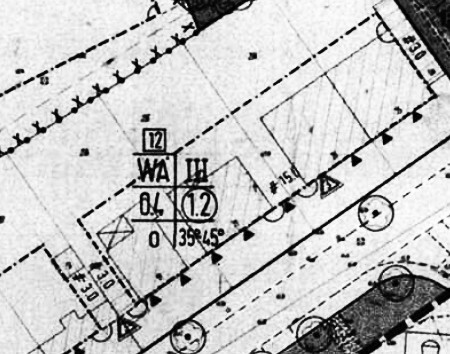
After several years of searching, we have finally purchased a plot of land (with an existing building to be demolished) in our desired location. This also marks the end of my many years of purely passive participation in this forum. Since we were primarily looking for renovation projects rather than new builds, we naturally have some initial questions.
The plot, approximately 500 m² (5,400 sq ft), lies within the scope of a development plan that was last updated 20 years ago.
Basic data about the plot and development plan:
- Building is permitted from 3 meters (10 ft) to 18 meters (59 ft) depth (so 15 m (49 ft) for the house)
- After deducting setback areas, a width of 8.5 meters (28 ft) is possible
- Slight slope across the building envelope with a rise of approximately 2.2 meters (7 ft)
- 3 full floors permitted
- Site occupancy index (ground coverage ratio) 0.4
- Floor area ratio 1.2 (cannot be fully utilized due to the aforementioned building envelope)
- Roof pitch 35–45°
- Knee wall (dormer wall) height 60 cm (24 in)
- Base (plinth) max. 60 cm (24 in) above the midpoint along the width of the access area, which is itself 30 cm (12 in) lower than the start of the building envelope
- General residential zone
- Open building style (detached buildings, no shared walls)
- Covered terraces allowed up to 1.5 meters (5 ft) outside the building boundary, provided the site occupancy index is not exceeded
- Roof indentations and structures permitted up to half the eaves length and at least 1 meter (3 ft) from the gable wall
- Fencing with native hedges. Along the street, an additional fence up to 1.2 meters (4 ft) high is permitted.
The development plan places no restrictions on, among other things:
- Building type
- Number of residential units per building
- Height limits
- Basements
- Parking spaces
The plan is to build a semi-detached house with another family. Both families have two children each and require two home offices, resulting in a need for six rooms per semi-detached unit. If we make progress here, I will create another thread in the floor plan forum and fill out the questionnaire.
Since the building envelope width of 8.5 meters (28 ft) is too narrow for semi-detached units side by side, they would have to be arranged one behind the other. Garden access and terraces would then be located on the narrow sides (one facing the street and one facing the main garden at the rear). This type of semi-detached house is quite rare. I have looked around in real life but have not found any examples. Only the Büdenbender semi-detached house Gemello SD 135 roughly corresponds to this layout (though not to the measurements).
I have had some informal discussions with an architect I know (who now only works on office buildings) and the building authority, without encountering any fundamental contradictions so far.
I have already applied the @11ant basement rule, according to which a basement seems obligatory because there is more than 2 meters (7 ft) of height difference within the building envelope. However, I do not understand how this relates to the “base (plinth)” restriction of max. 60 cm (24 in) in the development plan. My layperson assumption would be that one floor (the ground floor? the lowest residential floor? the lowest full floor?) may start a maximum of 60 cm (24 in) above street level.
My first questions for you:
- Are you familiar with similar houses, possibly with names for Googling or similar?
- Would you approach this topic differently?
- What does the rule about the base (plinth) mean?
Thank you in advance,
Gregor

GregorBerger schrieb:
I honestly didn’t expect you to join the choir of old building advocates... [...] What surprises me more is that historic preservation is a key reason for keeping a partly dilapidated house. What have you been smoking, and why do you portray me as someone who would otherwise be a quick, blind demolisher? Unlike you, I would never generally call a house from 1935 a wreck; on the contrary, that era of construction is much more solid than one twenty years younger. I’m actually known for always recommending a careful evaluation of at least the existing basement. The only thing I quickly tear up are model house plans.
What I still don’t understand is: why are you so stubbornly insisting on forcing a duplex onto this poor, clearly unsuitable plot of land—no matter what? Did the co-builder give you half the money for the land, and now, as the former chancellor would have said, it’s “without alternative,” meaning you have to get it done even if it costs you your last breath?
https://www.instagram.com/11antgmxde/
https://www.linkedin.com/company/bauen-jetzt/
G
GregorBerger20 Jun 2025 12:3811ant schrieb:
What have you been smoking, and why are you portraying me as someone who is usually a quick, blind demolition enthusiast? - Here I apologize. I did not intend to imply that about you. In the past, I had the impression that your posts leaned toward new builds. However, that probably referred more to people still searching for land rather than those facing the question of demolition versus renovation. But all is well—I understand now.
11ant schrieb:
Unlike you, I would never simply label a house from 1935 as junk; on the contrary, it’s a much more solid construction era than one twenty years younger. I am actually known for always recommending at least a thorough inspection of the existing basement. As a general guideline, the economic lifespan of a house is about 100 years. If you want to extend that, you need to invest regularly in maintenance—ideally continuously. In my case, that was mostly neglected.
Additionally, the house was explicitly marketed as a demolition property, which is why I bought the land (with the house) below the standard land value. Therefore, I barely focused on the house itself—neither during the viewing nor afterward.
ypg schrieb:
Excuse me: that reads as if you never actually visited the property after purchase or took a closer look at the old house to get a feel for it. That is actually true. But the reason is not negligence; it is lack of access. The notary advised the sellers not to hand over the keys to me until the purchase price was paid and the property registration was completed. The first two weeks after the appointment were spent waiting for the priority notice of transfer; now we have been waiting for several weeks for the municipality’s waiver of pre-emption rights. After that, it will likely take several more weeks until the land registry entry is completed. Until then, I cannot enter the house or the property (except the front garden, which is accessible).
Based on my perception from the forum’s many years of history, I see it like this: if an old house in poor condition is being preserved, there is usually at least one of the following reasons:
- Heritage protection / historic preservation
- Located in a protected outer area / green belt
- Especially beautiful (irreplaceable) architecture
- Mid-terrace house (and thus difficult to demolish)
None of these apply to my case. If your elephant memory turns up a thread discussing demolition versus renovation for a very old house without any of the above reasons, I would be very grateful for a link.
11ant schrieb:
What I still don’t understand is: what makes you so deeply committed to forcing a semi-detached house on this poor, typically unsuitable plot at all costs— ypg schrieb:
Oh dear, that’s quite odd. Take a look here:
GregorBerger schrieb:
Yes. With fallback options of a two-family house, multi-family house, or single-family house. But a single-family house would push us to the financial limit. Yes, the thread title says semi-detached house—and it would be a preferred solution. But I have pointed out several times that it is not mandatory if it’s not feasible or comes with major disadvantages.
ypg schrieb:
Photos, development plan, and so on. ypg schrieb:
I’m starting to wonder how old the existing building really is, and whether everything is really as you describe it. Many tend to ignore facts or don’t want to hear them, and in discussions, much relevant information is presented differently than it really is, simply because there is no alternative to Plan A. I wrote that the existing building is 90 years old. Which suppressed truths do you mean? That the existing building is somehow worthy of preservation—okay, I may have suppressed that (until the architects brought it up), but it is not yet a confirmed “truth.”
As soon as I regain access: which areas should I photograph? Critical points where you can assess the condition? I know this won’t replace an expert inspection, but what do you look for in photos?
GregorBerger schrieb:
The architect advised not to write off the existing structure immediately, let alone hastily demolish it. If it is incorporated, this would significantly increase the degrees of freedom in various areas, depending on the extent to which this is done, because the existing building's protective status could then be utilized. This is the crucial point why assessing and, if necessary, renovating the existing building can be worthwhile compared to the costs of new construction.
GregorBerger schrieb:
In the past, I had the impression that your posts suggest new construction. But that mostly applies to people still looking for land and less to those facing the choice between demolition or renovation. I warn people like you not to confuse developed plots with building plots (legally granted building rights, physically pristine meadow). And I know that—at least as a rule of thumb—a used property can only be rejuvenated up to half of its age before reaching the breakeven point in terms of new construction–equivalent building costs.
GregorBerger schrieb:
As a guideline, the economic lifespan of a house is about 100 years. If you want to extend it, you ideally have to invest continuously in maintenance. It’s more likely for a camel to pass through the eye of a needle than for a non-businessperson to understand the difference between tax-related and economic useful life.
GregorBerger schrieb:
Furthermore, the house was explicitly marketed as a demolition property, which is why I purchased the plot (with the house) below the land value benchmark. The former mainly relates to warranty reasons, and the more real the demolition readiness is, the more fair it is to factor in the development of the plot to a cleared state. The smartest way to handle that is something one of my lawyers can tell you after nearly seven barrels of wine.
GregorBerger schrieb:
If such an old house in poor condition is preserved, there is at least one of the following reasons: [...] None of these apply to me. Your existing building might be what in the car dealer world is called a "pigeon letter" in legal building terms, haha.
https://www.instagram.com/11antgmxde/
https://www.linkedin.com/company/bauen-jetzt/
GregorBerger schrieb:
Which hidden facts are you referring to? For example, slope, narrowness, parking spaces, emergency access, footprint.
GregorBerger schrieb:
Which areas exactly should be photographed? Well, to be honest, some photos of the plot taken from the street could have been shared. Also, the access roads of the neighboring properties or similar areas you describe here would be helpful. This can be done anonymously, so that neighbors are not clearly identifiable online.
Similar topics