
L
Limbrandi9 Oct 2023 09:51Dear Building Forum,
We have been ranked 19th in the points system (out of more than 40 building plots total).
In two weeks, we have the appointment where we can choose our building plot (from those available at that time).
The community's letter advises that we should pre-select 19 potential building plots, so that in the worst case, we still receive one of them.
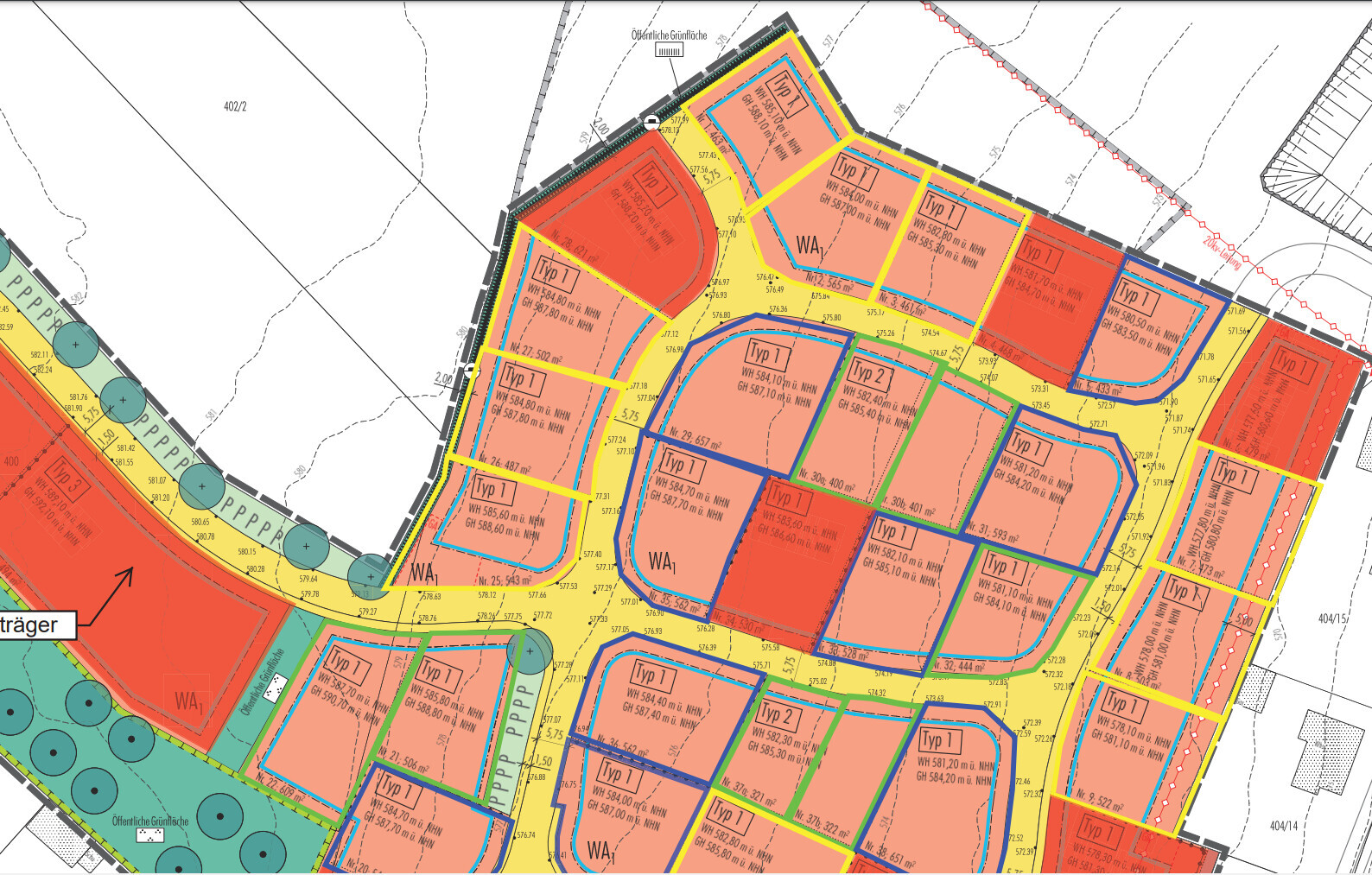
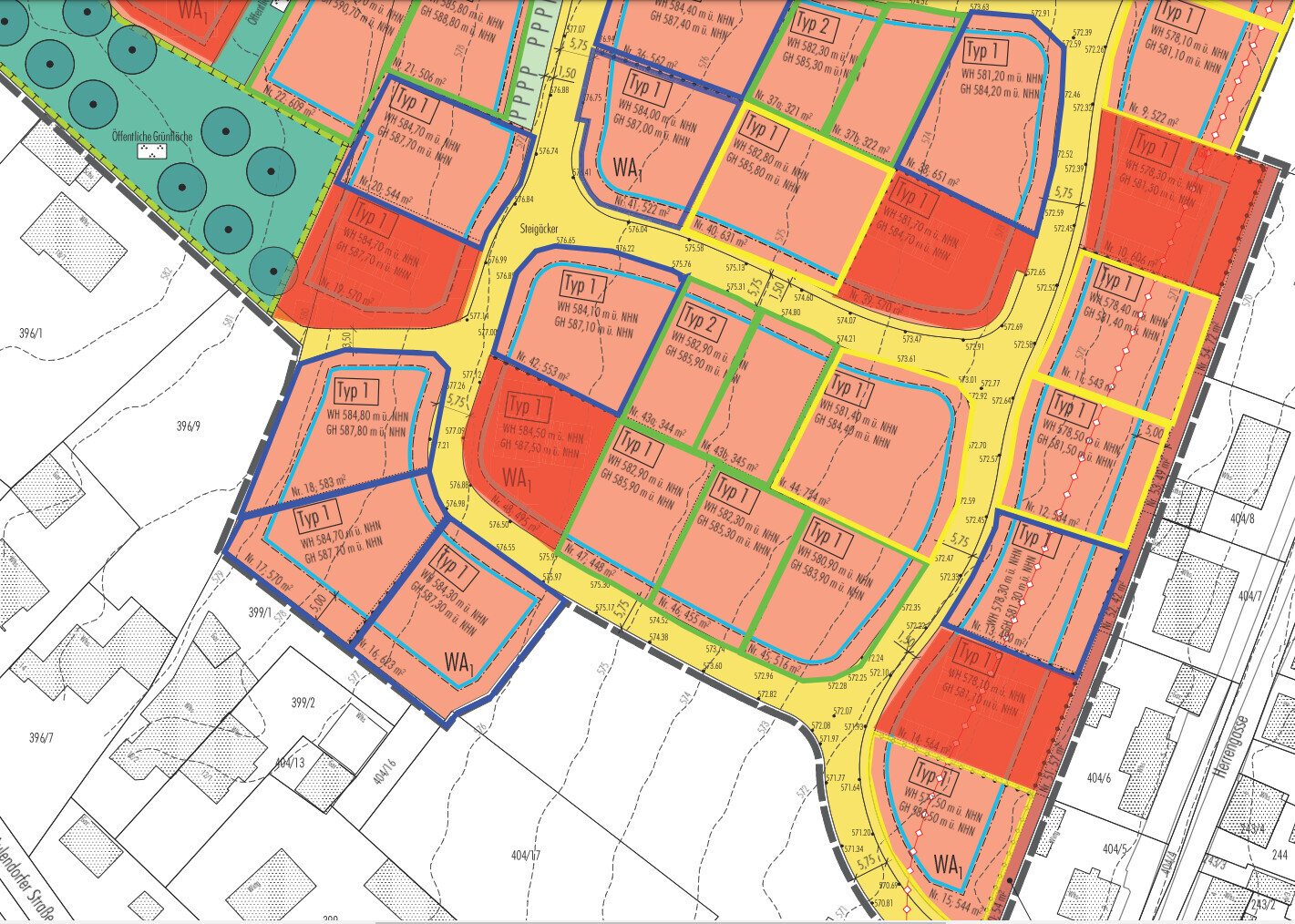
Unfortunately, we find it very difficult to identify good or less optimal locations on the site plan.
Also, the slope of up to 1.5m (5 feet) depending on the plot (if I understand it correctly) makes it hard for us to imagine its impact on the future house.
I have created two conceptual categories:
N/E Development = Plots 16–18 + 25–27 + 31 + 38 + 45
S/W Terrace possible without N/E Development = Plots 8–9 + 11–13 + 15
Plot size of about 550 sqm (6,000 sq ft) would be our preference.
Which plots would you favor and what are the respective pros and cons?
I look forward to your feedback.
Best regards,
Limbrandi
We have been ranked 19th in the points system (out of more than 40 building plots total).
In two weeks, we have the appointment where we can choose our building plot (from those available at that time).
The community's letter advises that we should pre-select 19 potential building plots, so that in the worst case, we still receive one of them.
Unfortunately, we find it very difficult to identify good or less optimal locations on the site plan.
Also, the slope of up to 1.5m (5 feet) depending on the plot (if I understand it correctly) makes it hard for us to imagine its impact on the future house.
I have created two conceptual categories:
N/E Development = Plots 16–18 + 25–27 + 31 + 38 + 45
S/W Terrace possible without N/E Development = Plots 8–9 + 11–13 + 15
Plot size of about 550 sqm (6,000 sq ft) would be our preference.
Which plots would you favor and what are the respective pros and cons?
I look forward to your feedback.
Best regards,
Limbrandi
W
WilderSueden9 Oct 2023 10:02Basically, I think it’s pointless to make a list of 19 locations. Make a list of 2-3 that you really like and think about which areas might be interesting.
Consider what is important to you – infrastructure, possible views, noise levels, etc.
What do all the different colors mean, and what is Type 1 and Type 2?
Consider what is important to you – infrastructure, possible views, noise levels, etc.
What do all the different colors mean, and what is Type 1 and Type 2?
L
Limbrandi9 Oct 2023 10:48First of all, thank you for the suggestions.
A terrace facing south is very important to us (southwest is also acceptable).
It seems that access from the northeast is ideal?
Friends of ours have their entrance facing northwest, with the living and dining area to the southeast, which gets good natural light.
We would really appreciate information on this and its implications.
I assume noise levels are related to the access roads?
Type 1 refers to single-family houses and Type 2 to semi-detached houses.
The colors represent land prices.
Green is the least expensive, blue is €30 more expensive, and yellow is another €30 more expensive per square meter (per square meter).
A terrace facing south is very important to us (southwest is also acceptable).
It seems that access from the northeast is ideal?
Friends of ours have their entrance facing northwest, with the living and dining area to the southeast, which gets good natural light.
We would really appreciate information on this and its implications.
I assume noise levels are related to the access roads?
Type 1 refers to single-family houses and Type 2 to semi-detached houses.
The colors represent land prices.
Green is the least expensive, blue is €30 more expensive, and yellow is another €30 more expensive per square meter (per square meter).

First of all, congratulations on having a planning-aware community. Clear, unambiguous height specifications (WH = wall height, also known as eaves height; GH = building height, also known as ridge height) combined with contour lines and a dense network of elevation points provide excellent foundations for planners.
Considering the praised quality of planning transparency mentioned above, I think it’s a good idea to try to secure a plot there (although I generally recommend waiting longer rather than compromising too much). For you, this appointment not only means competing among the lots to attract buyers, but also competing yourselves with other interested parties. In this sense, less attractive lots will be less contested and your chances increase if you bet on the underdogs. I wouldn’t recommend taking “bad” plots, but maybe the “second best” ones. With lottery numbers like 19 and those in the 40s, you potentially have the most shared winners. For you, this implies better chances for 11 than for 13 (because 13 has the more attractive price-performance ratio), and probably even better for 12. In this regard, 29 would be safer than 31, and 36 safer than 38.
That you consider “only” 14 instead of all 19 is already good; in a less planning-friendly area, I would even choose half as many. From your selection (with the modifications noted above), I would rank 25/26/27 first, followed by 11 to 13, and the others you mentioned as decent fallback options. As I said before, not aiming for all 19 is exactly right.
What matters most is the slope within the building envelope, followed by the slope along access paths to the front door and garage door, rather than the slope across the entire plot. Lots 11 to 13 have the slope from the street towards the garden side; 25 to 27 have the incline from the street towards the garden as well; for 29/31/36/38/45, it depends on the chosen house orientation. Lot 17 is the most challenging in this respect, with the slope running across almost every conceivable house axis.
https://www.instagram.com/11antgmxde/
https://www.linkedin.com/company/bauen-jetzt/
Limbrandi schrieb:
we have been ranked 19th in the points system (out of over 40 building lots in total).
In two weeks, we have the appointment when we can choose our building lot (from those available at that time).
Considering the praised quality of planning transparency mentioned above, I think it’s a good idea to try to secure a plot there (although I generally recommend waiting longer rather than compromising too much). For you, this appointment not only means competing among the lots to attract buyers, but also competing yourselves with other interested parties. In this sense, less attractive lots will be less contested and your chances increase if you bet on the underdogs. I wouldn’t recommend taking “bad” plots, but maybe the “second best” ones. With lottery numbers like 19 and those in the 40s, you potentially have the most shared winners. For you, this implies better chances for 11 than for 13 (because 13 has the more attractive price-performance ratio), and probably even better for 12. In this regard, 29 would be safer than 31, and 36 safer than 38.
Limbrandi schrieb:
The community’s letter suggests that we choose 19 potential building lots in advance. This is to ensure that in the worst case, we get at least one of them.
That you consider “only” 14 instead of all 19 is already good; in a less planning-friendly area, I would even choose half as many. From your selection (with the modifications noted above), I would rank 25/26/27 first, followed by 11 to 13, and the others you mentioned as decent fallback options. As I said before, not aiming for all 19 is exactly right.
Limbrandi schrieb:
The slope of up to 1.5m (5 feet) depending on the plot (if I interpret this correctly) makes it hard for us to imagine the impact on the future house.
What matters most is the slope within the building envelope, followed by the slope along access paths to the front door and garage door, rather than the slope across the entire plot. Lots 11 to 13 have the slope from the street towards the garden side; 25 to 27 have the incline from the street towards the garden as well; for 29/31/36/38/45, it depends on the chosen house orientation. Lot 17 is the most challenging in this respect, with the slope running across almost every conceivable house axis.
https://www.instagram.com/11antgmxde/
https://www.linkedin.com/company/bauen-jetzt/
What are you planning to build? Have you already considered your budget and other related factors? What about a basement? In that case, a sloped site might actually work to your advantage.
If your budget is tight, it might be better to choose something on flat ground.
(I haven’t looked at the plan yet regarding my question to you)
If your budget is tight, it might be better to choose something on flat ground.
(I haven’t looked at the plan yet regarding my question to you)
W
WilderSueden9 Oct 2023 14:58Usually, it is easier in terms of the floor plan to place the front door on the north-facing eaves side. Ideally, the driveway would also be from the north. However, this is not a must; there are also attractive floor plans with access from the south.
Regarding the slope, I consider about 1.5–2 meters (5–6.5 feet) across the property to be the most challenging case. It’s too much to simply ignore, but not enough to build a proper hillside house. You will still end up significantly higher than your neighbor, and the builder might not agree to set the house lower than the street level.
Regarding the slope, I consider about 1.5–2 meters (5–6.5 feet) across the property to be the most challenging case. It’s too much to simply ignore, but not enough to build a proper hillside house. You will still end up significantly higher than your neighbor, and the builder might not agree to set the house lower than the street level.
Similar topics