
ᐅ Sealing at the junction between the foundation slab and the wall against ground moisture
Created on: 1 Aug 2022 22:28
K
Kili1987
Hello team,
we are currently starting the exterior groundwork and have the following setup so far. Our entire house is covered on the outside with an ETICS (External Thermal Insulation Composite System). The concrete slab is coated with a waterproof slurry, and the transition from the slab to the insulation below is additionally sealed with a fillet (cove). We will be adding about 50cm (20 inches) of soil on top and will therefore extend at least the terrace up to the window sill.
My question: Is it sufficient here to install a standard dimpled membrane from the top edge of the terrace down to the insulation (forming an L shape) and then place the soil against it?
I have read that with ETICS or bitumen waterproofing, the dimples are usually faced outward and that a geotextile fabric is placed over the dimpled membrane?
Any opinions or recommendations specifically regarding the dimpled membrane?
Regards,
Kili1987
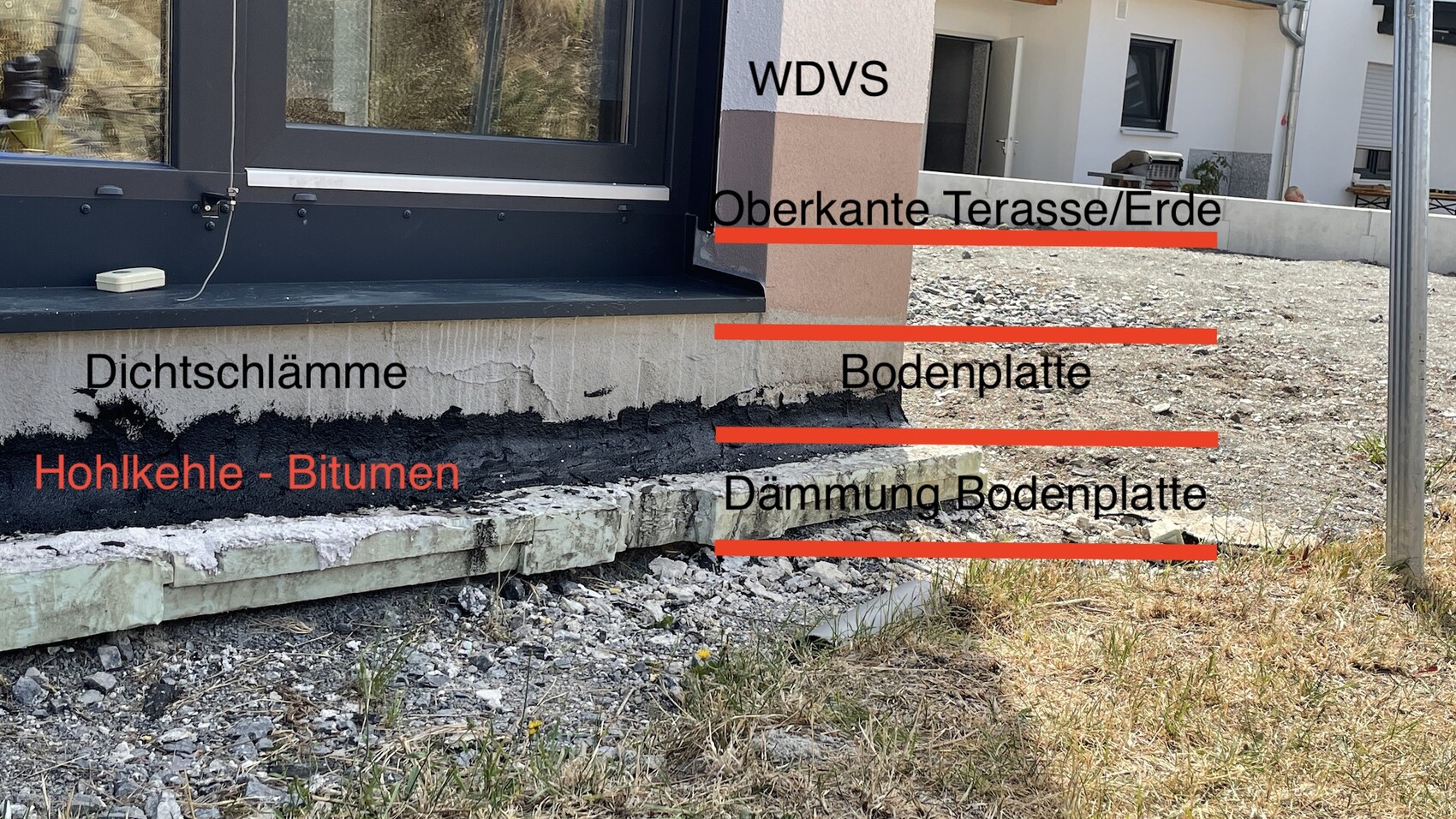
we are currently starting the exterior groundwork and have the following setup so far. Our entire house is covered on the outside with an ETICS (External Thermal Insulation Composite System). The concrete slab is coated with a waterproof slurry, and the transition from the slab to the insulation below is additionally sealed with a fillet (cove). We will be adding about 50cm (20 inches) of soil on top and will therefore extend at least the terrace up to the window sill.
My question: Is it sufficient here to install a standard dimpled membrane from the top edge of the terrace down to the insulation (forming an L shape) and then place the soil against it?
I have read that with ETICS or bitumen waterproofing, the dimples are usually faced outward and that a geotextile fabric is placed over the dimpled membrane?
Any opinions or recommendations specifically regarding the dimpled membrane?
Regards,
Kili1987

 bauenmk20203 Aug 2022 20:22
I also use a dimpled membrane with a fleece layer. The fleece is placed against the soil or backfilled material. The dimples face away from the structure, towards the soil.
I applied a black waterproofing layer on the surface of the building and then installed the dimpled membrane with fleece. After that, I backfilled the area. On the weather-exposed side, small channels will be installed at the level of the terrace. At the base of the terrace towards the lawn, I am planning a linear drainage system.
If you search for the brochure "AC* Master Drainage," you will find an image constructed similarly to yours.
I applied a black waterproofing layer on the surface of the building and then installed the dimpled membrane with fleece. After that, I backfilled the area. On the weather-exposed side, small channels will be installed at the level of the terrace. At the base of the terrace towards the lawn, I am planning a linear drainage system.
If you search for the brochure "AC* Master Drainage," you will find an image constructed similarly to yours.
Hello everyone,
I would like to revisit this topic to briefly discuss a fundamental issue.
Background:
We also have a building project without a basement. The soil is very clayey and does not allow water infiltration.
The slab foundation (depth about 80 cm (31.5 inches) + 6 cm (2.4 inches) insulation) includes perimeter insulation below; installing a drainage pipe combined with a dimpled membrane would be the builder’s own work.
The construction manager now believes that a drainage system might be disadvantageous because it could cause a water gradient. He also considers that watertight concrete (WU concrete) in the wet clay soil is not a problem.
I would like to get at least a second opinion because I want to ensure the most stable foundation possible in the long term.
Could a drainage system in clay soil be disadvantageous? Or would installing drainage around the slab foundation be generally beneficial?
Thanks in advance for your advice.
Best regards,
Thomas
I would like to revisit this topic to briefly discuss a fundamental issue.
Background:
We also have a building project without a basement. The soil is very clayey and does not allow water infiltration.
The slab foundation (depth about 80 cm (31.5 inches) + 6 cm (2.4 inches) insulation) includes perimeter insulation below; installing a drainage pipe combined with a dimpled membrane would be the builder’s own work.
The construction manager now believes that a drainage system might be disadvantageous because it could cause a water gradient. He also considers that watertight concrete (WU concrete) in the wet clay soil is not a problem.
I would like to get at least a second opinion because I want to ensure the most stable foundation possible in the long term.
Could a drainage system in clay soil be disadvantageous? Or would installing drainage around the slab foundation be generally beneficial?
Thanks in advance for your advice.
Best regards,
Thomas
Similar topics