
H
hannoverhans17 Jan 2023 19:22Hello dear forum members,
now that the house here is mostly completed, my partner and I would like to start working on the outdoor areas.
According to the original plan, we want to add some fill to the property. The landscaping contractor we hired would simply add fill after consultation and, if necessary, pave flush with the brick wall. However, I am unsure whether we should waterproof the exterior wall beforehand. It is a cavity wall construction with an air gap and insulation.
Different from the original plan, the landscaping contractor suggested paving the terrace at ground level. However, this would mean that the ventilation openings would be covered.
As you might have gathered from my explanation, I’m a complete beginner on this topic. But I’m concerned that we might be creating problems we want to avoid. Do you have any tips on what to watch out for and what to avoid at all costs? Would a layer of gravel help reduce the issue of covered ventilation openings? Is waterproofing the masonry necessary and, if so, in what form?
Many, many thanks in advance!
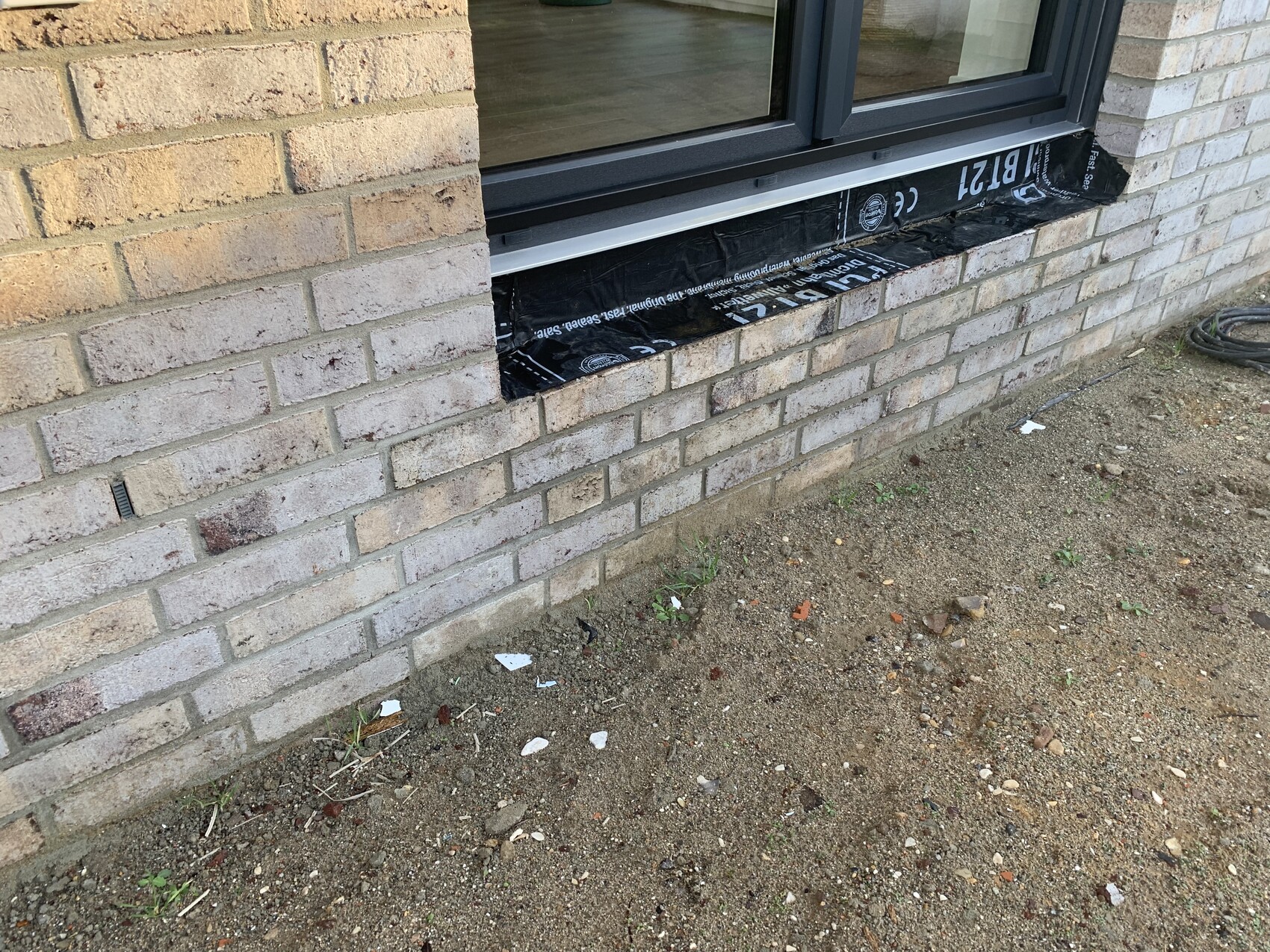
Ps: I have attached a picture of the future exits to the terrace. Hopefully, the ventilation openings are visible. The paving is planned to be flush with the ground, as described above.
now that the house here is mostly completed, my partner and I would like to start working on the outdoor areas.
According to the original plan, we want to add some fill to the property. The landscaping contractor we hired would simply add fill after consultation and, if necessary, pave flush with the brick wall. However, I am unsure whether we should waterproof the exterior wall beforehand. It is a cavity wall construction with an air gap and insulation.
Different from the original plan, the landscaping contractor suggested paving the terrace at ground level. However, this would mean that the ventilation openings would be covered.
As you might have gathered from my explanation, I’m a complete beginner on this topic. But I’m concerned that we might be creating problems we want to avoid. Do you have any tips on what to watch out for and what to avoid at all costs? Would a layer of gravel help reduce the issue of covered ventilation openings? Is waterproofing the masonry necessary and, if so, in what form?
Many, many thanks in advance!
Ps: I have attached a picture of the future exits to the terrace. Hopefully, the ventilation openings are visible. The paving is planned to be flush with the ground, as described above.

I am almost certain that you urgently need to consider the waterproofing at the shown location first.
If there is not a second waterproofing layer (which is naturally no longer visible in the picture) behind it, then in my layperson’s opinion the waterproofing shown in front of the brickwork is completely wrong and therefore not functioning properly.
Search for "The forgotten connection." This topic is covered extensively there, as it is a common but unfortunately serious mistake.
Otherwise, I would personally at least retrofit higher-positioned ventilation options (clean out joints) and have the paved strips around the house installed with a clear slope away from the building. Of course, there should also be a drainage membrane between the paving and the brickwork (which does not need to be visible...). As always, no guarantee for accuracy ;-)
If there is not a second waterproofing layer (which is naturally no longer visible in the picture) behind it, then in my layperson’s opinion the waterproofing shown in front of the brickwork is completely wrong and therefore not functioning properly.
Search for "The forgotten connection." This topic is covered extensively there, as it is a common but unfortunately serious mistake.
Otherwise, I would personally at least retrofit higher-positioned ventilation options (clean out joints) and have the paved strips around the house installed with a clear slope away from the building. Of course, there should also be a drainage membrane between the paving and the brickwork (which does not need to be visible...). As always, no guarantee for accuracy ;-)
H
hannoverhans17 Jan 2023 21:20Hello @i_b_n_a_n, thank you very much for your quick response. The waterproofing shown in the photo is indeed only the second layer; the actual waterproofing is behind it. I cannot say whether it was executed properly, but at least it was not criticized by the inspector at the time.
The other explanations are also very helpful, thank you. The father-in-law had already suggested installing a dimple membrane (also known as a drainage membrane), although with a bitumen coating, which others advise against. I will position the ventilation slots higher; I have read this a few times now, but I wasn’t sure if I could just do that without any issues.
The other explanations are also very helpful, thank you. The father-in-law had already suggested installing a dimple membrane (also known as a drainage membrane), although with a bitumen coating, which others advise against. I will position the ventilation slots higher; I have read this a few times now, but I wasn’t sure if I could just do that without any issues.
Similar topics