
ᐅ Sealing of Electrical/Telecom Service Entry – Was the Contractor Negligent?
Created on: 15 Jan 2019 20:06
R
Reini1234R
Reini123415 Jan 2019 20:06Hello,
I installed the multi-service entry product Doyma Quadro Secura Nova 1/wide as the house entry point. Today, a company commissioned by the electricity provider/telecom came to lay the respective cables and install the house connection box. I was only briefly on site; the company said they would get in touch when they finished.
Everything has now been installed, but the technician couldn’t slide the connector sleeve of the multi-service through his electricity and telecom cables (I assume he didn’t have any lubricant or soapy water on hand). Without consulting anyone, he simply sealed the holes with expanding foam. Now I wonder if this is sufficiently tight? I asked a civil engineer friend, who said it should be fine, but that the pipes are basically lost or blocked forever for any future installations. I now have the following questions:
- Is this really watertight compared to the connector sleeve? I read somewhere that it is much more important that the sealing is properly done on the inside.
- Is there some kind of protective conduit that I can add around the power cable afterward? I originally assumed the company would bring one.
- The telecom cable was cut just before the multi-service entry and will be connected with a sleeve this week. Would it make sense to pull a flexible conduit over it at this stage?
- How do I achieve optimal sealing at the basement wall myself?
- In general, a colleague recommended filling the entire trench in front of the house entry with sand, so that water has no chance to accumulate.
Power cable on the left, telecom on the right, water below (already laid in a flexible conduit and connected to the multi-service via a sleeve).
Interior view:
I installed the multi-service entry product Doyma Quadro Secura Nova 1/wide as the house entry point. Today, a company commissioned by the electricity provider/telecom came to lay the respective cables and install the house connection box. I was only briefly on site; the company said they would get in touch when they finished.
Everything has now been installed, but the technician couldn’t slide the connector sleeve of the multi-service through his electricity and telecom cables (I assume he didn’t have any lubricant or soapy water on hand). Without consulting anyone, he simply sealed the holes with expanding foam. Now I wonder if this is sufficiently tight? I asked a civil engineer friend, who said it should be fine, but that the pipes are basically lost or blocked forever for any future installations. I now have the following questions:
- Is this really watertight compared to the connector sleeve? I read somewhere that it is much more important that the sealing is properly done on the inside.
- Is there some kind of protective conduit that I can add around the power cable afterward? I originally assumed the company would bring one.
- The telecom cable was cut just before the multi-service entry and will be connected with a sleeve this week. Would it make sense to pull a flexible conduit over it at this stage?
- How do I achieve optimal sealing at the basement wall myself?
- In general, a colleague recommended filling the entire trench in front of the house entry with sand, so that water has no chance to accumulate.
Power cable on the left, telecom on the right, water below (already laid in a flexible conduit and connected to the multi-service via a sleeve).
Interior view:

R
Reini123416 Jan 2019 09:50What would you recommend I should do?
They should show up and fix the botched work.
Whether it remains watertight really depends on the water load. If there's rising or even pressurized water in that area, I wouldn’t trust the foam patch. With just ground moisture, it should stay sealed.
But: you have an expensive multi-utility setup to be able to access it again at any time. You could have just pushed the cable through a hole in the base slab and sealed it up.
Whether it remains watertight really depends on the water load. If there's rising or even pressurized water in that area, I wouldn’t trust the foam patch. With just ground moisture, it should stay sealed.
But: you have an expensive multi-utility setup to be able to access it again at any time. You could have just pushed the cable through a hole in the base slab and sealed it up.
R
Reini123416 Jan 2019 22:08I had a phone call today with the manufacturer of the multi-utility duct and the subcontractor who made the mistake.
It is just as I suspected: the missing sealing sleeve at this point has no waterproofing function, but only prevents dirt and similar. The actual sealing is done inside the multi-utility duct by rubber plugs. The technician sprayed foam about 10cm (4 inches) into the pipe, so it can be removed fairly easily.
My current consideration is as follows:
On the right side is the telecom cable. One end is in my technical room, while the other end is outside the picture, but it has NOT yet been connected to the cable at the property boundary.
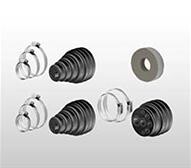
So I can completely remove the foam, slide the special sealing sleeve over it, and then backfill everything. This is shown at the bottom right in the attachment.
The sleeve must be punctured to match the corresponding diameter and will then seal perfectly. The downside is that if fiber optic cable needs to be installed later, excavation will be required again since the fiber cable will get stuck at the sealing point.
My idea:
Use 75mm (3 inch) Kabuflex pipe (as already used at the water line at the lower connection), connect it to the multi-utility duct with the sealing sleeve designed for water/electricity (shown at the bottom left and top left in the picture), so that in the future only excavation at the property boundary will be necessary.
What do you think about this? Or am I missing something?
It is just as I suspected: the missing sealing sleeve at this point has no waterproofing function, but only prevents dirt and similar. The actual sealing is done inside the multi-utility duct by rubber plugs. The technician sprayed foam about 10cm (4 inches) into the pipe, so it can be removed fairly easily.
My current consideration is as follows:
On the right side is the telecom cable. One end is in my technical room, while the other end is outside the picture, but it has NOT yet been connected to the cable at the property boundary.
So I can completely remove the foam, slide the special sealing sleeve over it, and then backfill everything. This is shown at the bottom right in the attachment.
The sleeve must be punctured to match the corresponding diameter and will then seal perfectly. The downside is that if fiber optic cable needs to be installed later, excavation will be required again since the fiber cable will get stuck at the sealing point.
My idea:
Use 75mm (3 inch) Kabuflex pipe (as already used at the water line at the lower connection), connect it to the multi-utility duct with the sealing sleeve designed for water/electricity (shown at the bottom left and top left in the picture), so that in the future only excavation at the property boundary will be necessary.
What do you think about this? Or am I missing something?
Similar topics