
Hello everyone.
According to the builder, our floor-to-ceiling windows have been properly sealed from the INSIDE.
The exterior sealing is supposedly our responsibility...
How would you go about doing this?
There will be a fully covered terrace in front of all the windows... but I still think everything should be sealed correctly.
Or am I worrying unnecessarily?
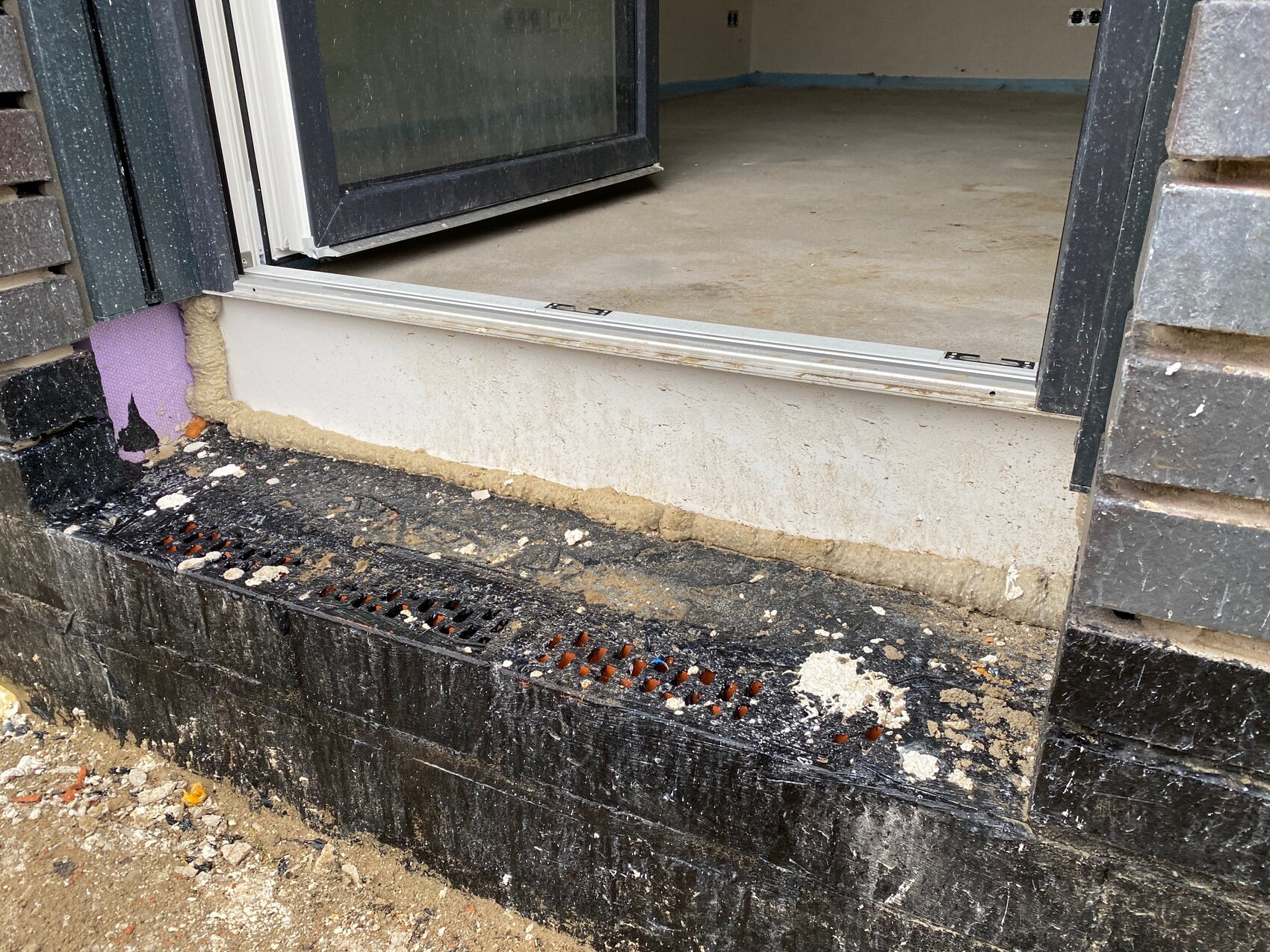
According to the builder, our floor-to-ceiling windows have been properly sealed from the INSIDE.
The exterior sealing is supposedly our responsibility...
How would you go about doing this?
There will be a fully covered terrace in front of all the windows... but I still think everything should be sealed correctly.
Or am I worrying unnecessarily?
Domski schrieb:
@Dr. Hix, isn’t the lower closure (at floor-to-ceiling elements at the base) supposed to be part of the RAL-compliant installation of window/door elements?Definitely not. For the window manufacturer, the installation only has to be airtight. Exterior sealing is not part of their scope of work.
Here is a response from my general contractor:
QUOTE:
An inspection report from TÜV Nord for one of our construction projects with TÜV supervision.
Quote:
During the walkthrough, it was noted that according to DIN 18195, Supplement 1, the flush-mounted windows must be sealed watertight to the external wall base waterproofing.
Since the base waterproofing of the external walls was extended inward into the window reveals, an internal waterproofing connection is possible and should be carried out according to the on-site arrangements.
The bonding must be watertight done. For this purpose, any contaminants within the overlapping area of the waterproofing must be removed.
End of quote
For data protection reasons, I can only provide the original report for your personal review.
I share your mixed feelings on this matter. However, in my opinion, this is a very good solution.
We have been using this approach for about 15 years.
The article “The forgotten connection” is well known here.
More details can be discussed in a personal meeting.
QUOTE:
An inspection report from TÜV Nord for one of our construction projects with TÜV supervision.
Quote:
During the walkthrough, it was noted that according to DIN 18195, Supplement 1, the flush-mounted windows must be sealed watertight to the external wall base waterproofing.
Since the base waterproofing of the external walls was extended inward into the window reveals, an internal waterproofing connection is possible and should be carried out according to the on-site arrangements.
The bonding must be watertight done. For this purpose, any contaminants within the overlapping area of the waterproofing must be removed.
End of quote
For data protection reasons, I can only provide the original report for your personal review.
I share your mixed feelings on this matter. However, in my opinion, this is a very good solution.
We have been using this approach for about 15 years.
The article “The forgotten connection” is well known here.
More details can be discussed in a personal meeting.

@Bookstar
That is not entirely correct in a general sense. Of course, the window manufacturer is fundamentally responsible for the external sealing as well. In this specific case, however, this is not possible if the necessary conditions are not provided to them. Creating these conditions afterwards is, of course, not the responsibility of the window manufacturer.
That is not entirely correct in a general sense. Of course, the window manufacturer is fundamentally responsible for the external sealing as well. In this specific case, however, this is not possible if the necessary conditions are not provided to them. Creating these conditions afterwards is, of course, not the responsibility of the window manufacturer.
Dr Hix schrieb:
@Bookstar
This is not generally correct. Of course, the window installer is fundamentally responsible for the external sealing as well. In this special case, however, this is only not possible if the necessary conditions are not provided to them. Creating these conditions afterwards is naturally not the responsibility of the window installer.Why should the window installer do this, where is that stated? In practice, the window installer does not do this. It is usually done by either the landscaper or the roofer.Please do not confuse the "external sealing" of the windows with the base sealing. The latter is usually done by the landscaper or roofer (in our case more the roofer). The external sealing of the windows mainly refers to protection against driving rain, which is the responsibility of the window installer. This is not achieved here with the use of open-cell foam.
In my opinion, the threshold should also include the connection to the (properly prepared) base sealing. After all, the tiler does not skip the last few centimeters above the shower tray just because the sealing tape from the plumber begins there.
Furthermore, the tradesperson is liable for defects, and a missing connection is undoubtedly one of them. If there is an intermediary planner involved, the tradesperson may possibly involve them as partly responsible, but they cannot simply avoid responsibility by referring to the planner. Also, if the window installer is unable to complete the connection due to poor or omitted work by other trades, they must notify this before proceeding and have the homeowner commission the necessary remedial work, or at least have the faulty execution officially acknowledged in writing.
I am not entirely certain here, but I would say such an official acknowledgment could also take the form of a contractual agreement stating something like "the lower sealing is explicitly not commissioned, as this is performed by the company Spengler GmbH."
However, this would probably not be the case with a general contractor (GC) providing a complete package.
If everything had been done correctly in this case, the base sealing would have included overlapping EPDM membranes to which the window installer could have easily connected their sealing tape, and everything would have been fine. Now it gets interesting.
In my opinion, the threshold should also include the connection to the (properly prepared) base sealing. After all, the tiler does not skip the last few centimeters above the shower tray just because the sealing tape from the plumber begins there.
Furthermore, the tradesperson is liable for defects, and a missing connection is undoubtedly one of them. If there is an intermediary planner involved, the tradesperson may possibly involve them as partly responsible, but they cannot simply avoid responsibility by referring to the planner. Also, if the window installer is unable to complete the connection due to poor or omitted work by other trades, they must notify this before proceeding and have the homeowner commission the necessary remedial work, or at least have the faulty execution officially acknowledged in writing.
I am not entirely certain here, but I would say such an official acknowledgment could also take the form of a contractual agreement stating something like "the lower sealing is explicitly not commissioned, as this is performed by the company Spengler GmbH."
However, this would probably not be the case with a general contractor (GC) providing a complete package.
If everything had been done correctly in this case, the base sealing would have included overlapping EPDM membranes to which the window installer could have easily connected their sealing tape, and everything would have been fine. Now it gets interesting.
Similar topics