
Hello everyone.
According to the builder, our floor-to-ceiling windows have been properly sealed from the INSIDE.
The exterior sealing is supposedly our responsibility...
How would you go about doing this?
There will be a fully covered terrace in front of all the windows... but I still think everything should be sealed correctly.
Or am I worrying unnecessarily?
According to the builder, our floor-to-ceiling windows have been properly sealed from the INSIDE.
The exterior sealing is supposedly our responsibility...
How would you go about doing this?
There will be a fully covered terrace in front of all the windows... but I still think everything should be sealed correctly.
Or am I worrying unnecessarily?
tumaa schrieb:
Cool ... how did you proceed? Pictures?Please send me a private message.
Hello experts!
Since this thread fits the topic and is a bit older, I hope it’s okay to use it for my own question!?
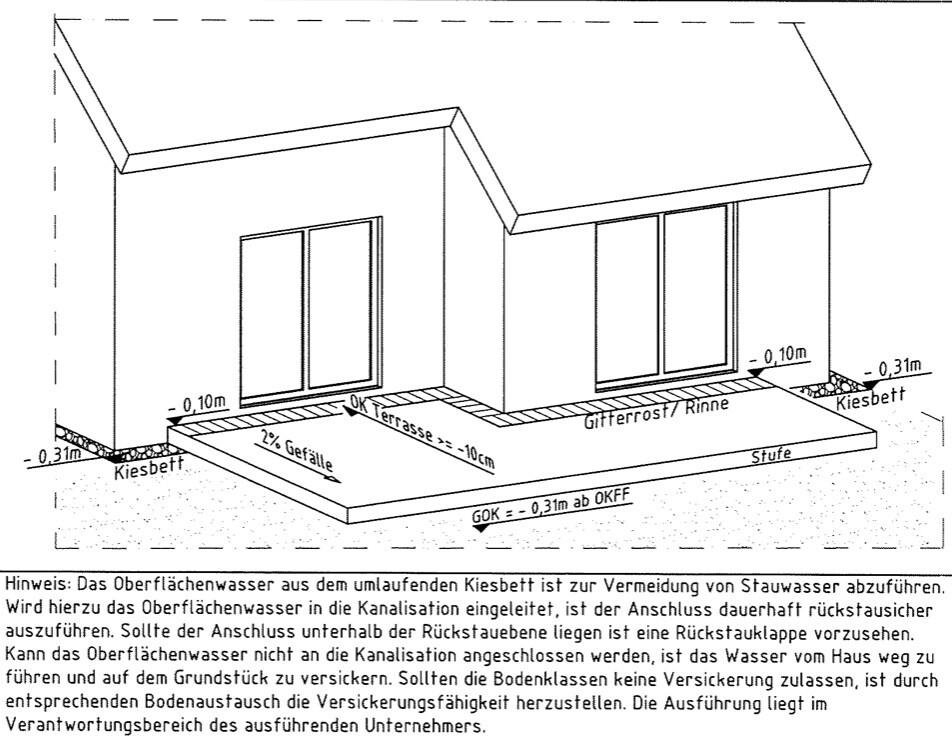
Our builder has brought our attention to the issue of "sealing the exterior walls" or rather "drainage in the terrace area." More precisely, we had to sign that we have been informed about this topic and commit to meeting the requirements (see attachment) during the on-site construction. Otherwise, the warranty will be void.
My main concern is the minimum height of 10 cm (4 inches) required here. We are not happy about that and originally imagined a threshold-free entrance/exit. So my question is: how relevant is this requirement in practice, if:
1. Drainage channels/drainage systems are installed in front of the terrace doors
2. The terrace is not paved but covered with decking boards
What could be the reason against a threshold-free design in this case!?
And what is the point of this "exemption from liability for damages" – when everyone talks about "barrier-free construction"...!?
Thanks in advance!

Since this thread fits the topic and is a bit older, I hope it’s okay to use it for my own question!?
Our builder has brought our attention to the issue of "sealing the exterior walls" or rather "drainage in the terrace area." More precisely, we had to sign that we have been informed about this topic and commit to meeting the requirements (see attachment) during the on-site construction. Otherwise, the warranty will be void.
My main concern is the minimum height of 10 cm (4 inches) required here. We are not happy about that and originally imagined a threshold-free entrance/exit. So my question is: how relevant is this requirement in practice, if:
1. Drainage channels/drainage systems are installed in front of the terrace doors
2. The terrace is not paved but covered with decking boards
What could be the reason against a threshold-free design in this case!?
And what is the point of this "exemption from liability for damages" – when everyone talks about "barrier-free construction"...!?
Thanks in advance!
With a drainage channel and a construction using wooden decking or pedestal supports, I would personally also reduce the minimum height, and I have already implemented this myself (finished floor = top edge of the terrace surface on pedestal supports, with only a few centimeters (inches) of height difference between inside and outside on the ground floor), so far without any problems.
Basically, this design carries a residual risk of unintentional flooding if snow accumulates heavily on the drainage channel, or during heavy rain combined with a clogged channel. In my opinion, this is a manageable risk as long as you are willing to clean the channel occasionally.
The general building guidelines thus define a safer version – the one with the unattractive 10cm (4 inches) height difference.
Basically, this design carries a residual risk of unintentional flooding if snow accumulates heavily on the drainage channel, or during heavy rain combined with a clogged channel. In my opinion, this is a manageable risk as long as you are willing to clean the channel occasionally.
The general building guidelines thus define a safer version – the one with the unattractive 10cm (4 inches) height difference.
P
Piotr198129 Nov 2020 10:01tumaa schrieb:
According to DIN standards it should be like that... but does it really have to follow DIN? The main thing is that it is waterproof.
Is there really no other good alternative?
Regards I have faced the same issue. Brickwork, etc. My site manager, who is also an expert, told me that the roofer can also use so-called zinc pockets for this. I would ask him about that. That’s how I plan to do it.
BobRoss schrieb:
With a drainage channel and a construction using wooden decking or pedestals, I would personally also reduce the minimum height requirement, and I have already implemented it that way (finished floor = top surface of the terrace deck on pedestals, on the ground floor with only a few centimeters height difference between inside and outside), so far without any problems.
Basically, this design carries a residual risk of unintentional flooding if snow piles up on the drainage channel or during heavy rain combined with a clogged channel. In my opinion, this is a manageable risk if you are willing to clean the channel occasionally.
The relevant standards therefore define a safer variant – the one with the unattractive 10 cm (4 inches) height difference.Thank you for your input, unfortunately I am only reading this now 🙁
For us, it is a matter of weighing whether to accept the "manageable risk" by installing a wide drainage channel and building without the 10 cm (4 inches) height difference, or whether to accept the height difference. As I understand it, the latter simply provides the builder with protection. This basically means: no installation according to the standard (height difference) = no warranty...
Personally, despite the timber frame and brick veneer, I also tend to build the terrace without the height difference. With WPC decking + drainage channel + an overall covered structure, the risk should be quite limited. Or am I overlooking something, especially concerning timber frame construction?
There should be a sensible solution, even considering the builder’s warranty conditions, especially since barrier-free construction is recommended almost everywhere nowadays!?
C
Coskun19076 Jul 2023 17:36Hello experts,
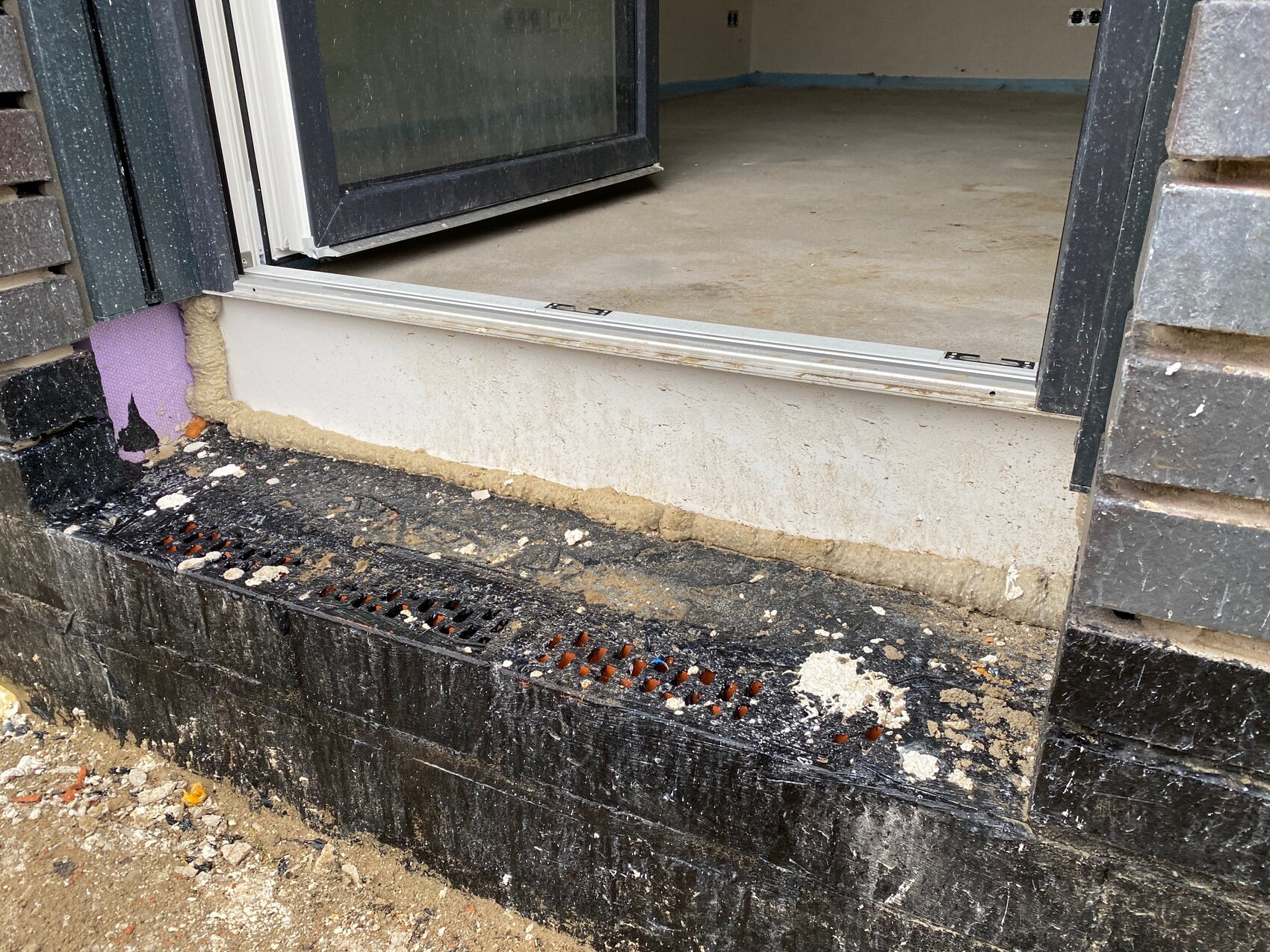
I need to revisit this topic. We are currently building the house ourselves and made a mistake with the base waterproofing and the connection to the floor-to-ceiling windows.
Current situation as shown in the photo. You can see the reactive coating on the inner wall.

We applied the base waterproofing as a reactive coating, but unfortunately forgot the tape for sealing to the window frames. The brick facade is already finished. How can we properly fix the waterproofing now with minimal effort?
Thank you very much for your advice.
I need to revisit this topic. We are currently building the house ourselves and made a mistake with the base waterproofing and the connection to the floor-to-ceiling windows.
Current situation as shown in the photo. You can see the reactive coating on the inner wall.
We applied the base waterproofing as a reactive coating, but unfortunately forgot the tape for sealing to the window frames. The brick facade is already finished. How can we properly fix the waterproofing now with minimal effort?
Thank you very much for your advice.
Similar topics