
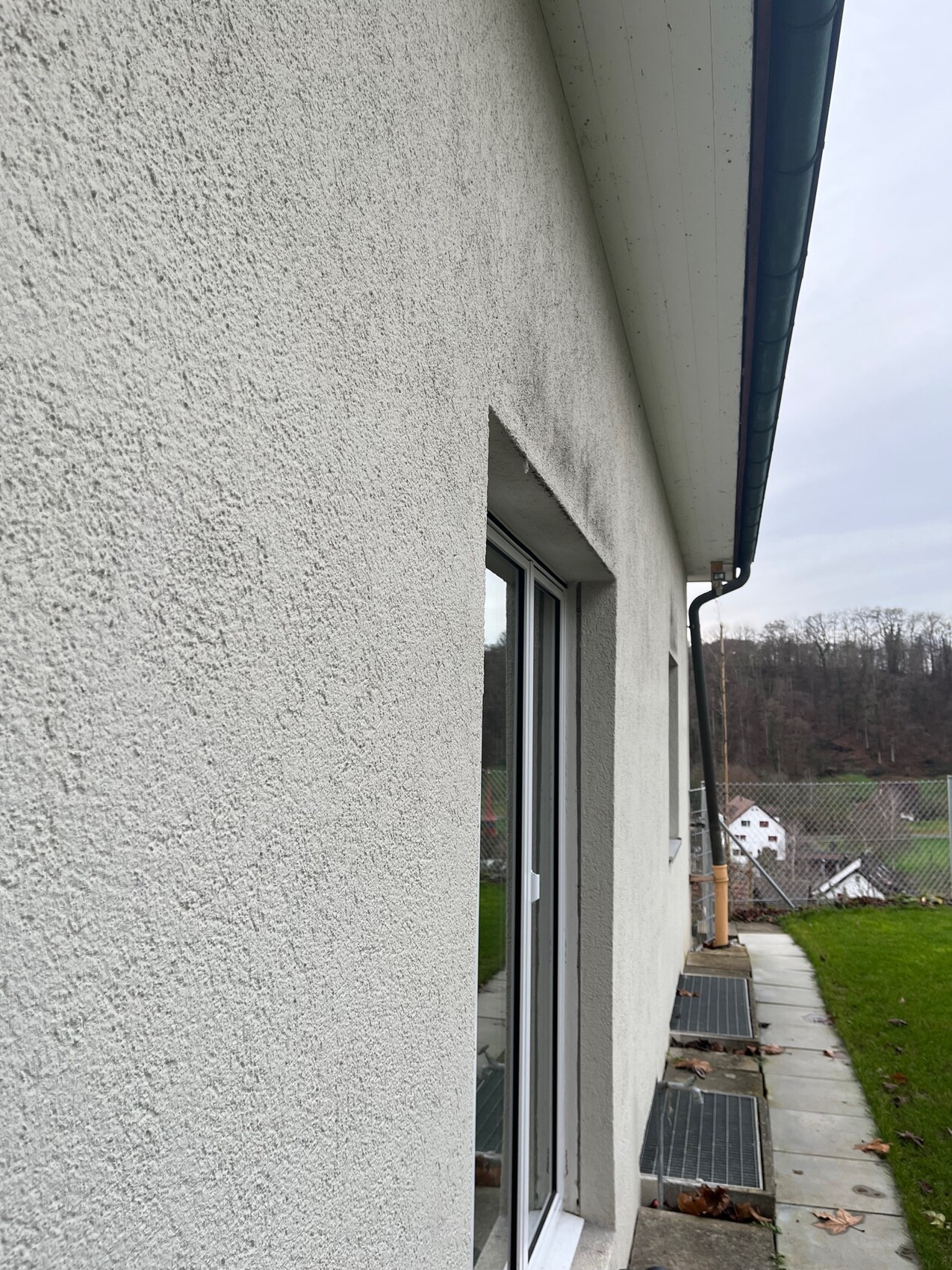
Hello everyone, I would like to do some of the work myself (preparation for façade renovation) by removing my old 5 cm (2 inch) EPS insulation, which is plastered and embedded in an old "Hasen?" metal mesh. Has anyone done something like this before? Which tools are best suited for this? The wall underneath is brick, so I find an angle grinder or rotary hammer too risky. Maybe an angle grinder with a steel or wire brush? Thanks and best regards
B
Bausparfuchs18 Mar 2023 21:44You’ll manage to get it down. A wide chipping hammer will make the stuff fly off—like the adhesive mortar and so on.
Using a wire brush takes a very long time, but that’s not the main problem.
Have you thought about disposal yet? EPS styrofoam with residues is extremely expensive to dispose of. It can basically only be burned in an incineration plant, which is obviously very harmful to health.
You occasionally read about disposal costs of 6000 euros per ton (1.1 US tons). Putting everything in the yellow recycling bin won’t work.
With a house like this, quite a lot of material adds up. And I consider it impossible to completely separate the reinforcing plaster from the styrofoam without residue.
So it’s very problematic. Disposal of drywall is also twice as expensive as buying it new at the hardware store, even though it’s completely environmentally safe.
Using a wire brush takes a very long time, but that’s not the main problem.
Have you thought about disposal yet? EPS styrofoam with residues is extremely expensive to dispose of. It can basically only be burned in an incineration plant, which is obviously very harmful to health.
You occasionally read about disposal costs of 6000 euros per ton (1.1 US tons). Putting everything in the yellow recycling bin won’t work.
With a house like this, quite a lot of material adds up. And I consider it impossible to completely separate the reinforcing plaster from the styrofoam without residue.
So it’s very problematic. Disposal of drywall is also twice as expensive as buying it new at the hardware store, even though it’s completely environmentally safe.
Thank you for the suggestions. Let’s please put the EPS disposal discussion to rest, as I have an official, affordable solution—the material is collected from me in big packs.
I am a bit concerned about the brick wall underneath, which must not be damaged since the facade will be mounted on it—ventilated facade system (VHF) with wooden battens.
For SDS, I have found the typical flat chisels that are usually used (by me as well) for removing tiles or plaster from concrete. Won’t the bricks break even if I work with the small 3 kg (6.6 lbs) Bosch hammer?
What do you think about using something like a spatula chisel, or is that nonsense?
I am a bit concerned about the brick wall underneath, which must not be damaged since the facade will be mounted on it—ventilated facade system (VHF) with wooden battens.
For SDS, I have found the typical flat chisels that are usually used (by me as well) for removing tiles or plaster from concrete. Won’t the bricks break even if I work with the small 3 kg (6.6 lbs) Bosch hammer?
What do you think about using something like a spatula chisel, or is that nonsense?
We removed the plaster by scoring it lengthwise in about a 1m (3 ft) wide strip using a plasterer’s axe and then stripping it off from the top. This resulted in very little EPS (expanded polystyrene) residue, which was then disposed of as construction waste.
Afterwards, using a type of scraper with a long handle (commonly known as a "joint scraper"), we scraped off the panels from the side one by one. This method even worked well through the plastic anchors.
Afterwards, using a type of scraper with a long handle (commonly known as a "joint scraper"), we scraped off the panels from the side one by one. This method even worked well through the plastic anchors.
S
Schorsch_baut19 Mar 2023 16:29Better check again with the responsible building or environmental department about how to secure the construction site against Styrofoam debris being blown around. In our street, a contractor simply removed old insulation without securing the site. The entire neighborhood looked like a snow globe, and it apparently ended up costing the company a lot.
Thank you very much. I wasn’t familiar with these tools before – plasterer’s hatchet and raking chisel – I will report back with photos.
One additional question. What should I do with the "bare" brick walls? I will only remove small sections where necessary, for example above the porch where it will be cut away and replaced. Is it possible to paint brick with acrylic-latex paint (it should be vapor-permeable but water-repellent)? It needs to last for about 2-3 months. One area above the porch is about 2m² (22ft²) but is on the rainy side. Covering it with plastic sheeting or bitumen panels is a bit impractical, as they tend to blow away.
One additional question. What should I do with the "bare" brick walls? I will only remove small sections where necessary, for example above the porch where it will be cut away and replaced. Is it possible to paint brick with acrylic-latex paint (it should be vapor-permeable but water-repellent)? It needs to last for about 2-3 months. One area above the porch is about 2m² (22ft²) but is on the rainy side. Covering it with plastic sheeting or bitumen panels is a bit impractical, as they tend to blow away.
Similar topics