
Hello everyone,
Finally, my floor plans are ready. Only our basement living area is missing, but I still need some information from the architect. The plan includes a laundry room, the heating room, a storage room, an office, and a large hobby room with a bathroom and a small kitchenette.
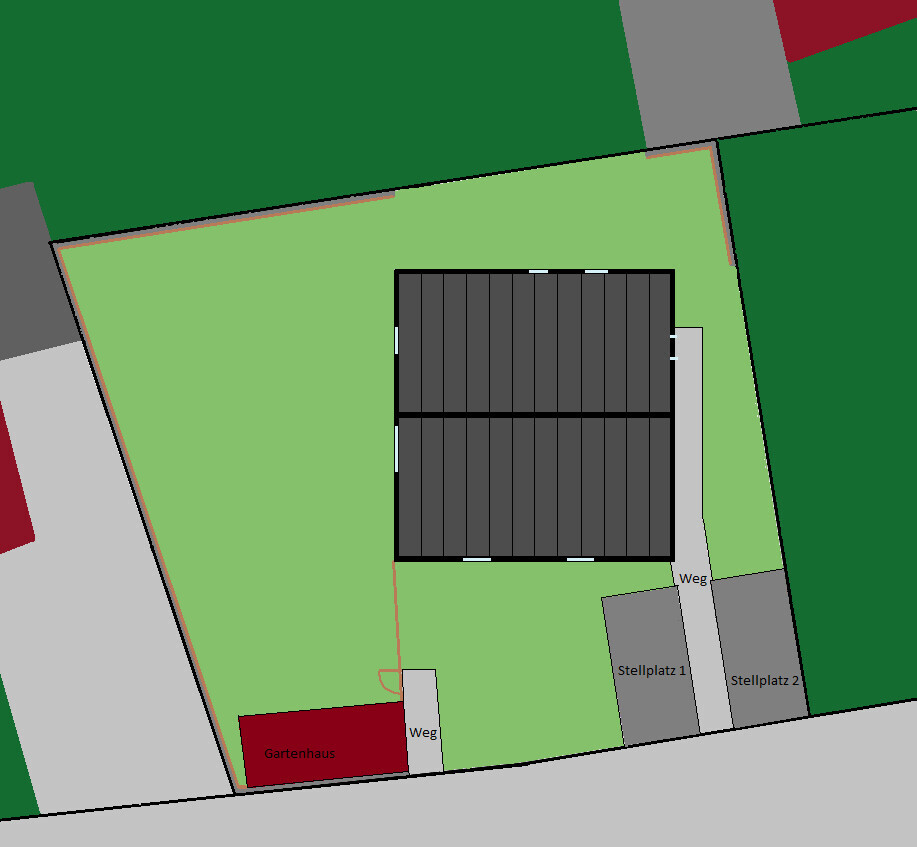
Attached is the site plan. It was provided by our architect and has been approved by the building authority regarding setback distances and parking spaces. I only added privacy fences and a garden shed. The positions are based on local neighborhood regulations. To the north, there is a garden plot (not buildable), to the east another new building is being constructed, to the south is the street (30 km/h (18.6 mph) zone) and across from it a house with a garden. To the west, directly adjacent to our property, there is a driveway and a garage, with another house next to it.
I’m trying to provide as much information as possible:
Development plan / restrictions
Plot size: 412.5 sqm (4,440 sq ft)
Slope: no
Site coverage ratio: 0.25
Floor area ratio: 0.50
Number of parking spaces: 2 free parking spaces
Number of stories: 2 floors (attic counts as 2nd floor due to knee wall) + basement living area
Roof type: gable roof, 25 degrees, knee wall 160 cm (63 inches)
Client requirements
Number of people: 2 adults (eventually + 2 children), ages 28 and 34
Office: home office in the basement living area
Kitchen: closed kitchen with a kitchen island pushed against the wall
Number of dining seats: 4, extendable to 6
Fireplace: no
Additional wishes
- The garden should be completely shielded from views (hence the privacy fence)
- We did not plan any garages, as we never had one and have never missed it. For strollers, garden furniture, etc., I have planned a garden shed, which also serves as a privacy screen
- We want a closed kitchen, no open kitchen. We don’t like that look.
- On the ground floor, we need a small niche for the vacuum cleaner, ironing board, water crates, etc.
- A walk-in closet is a must
- As well as a walk-in, built-in shower
I’m really looking forward to your opinions!
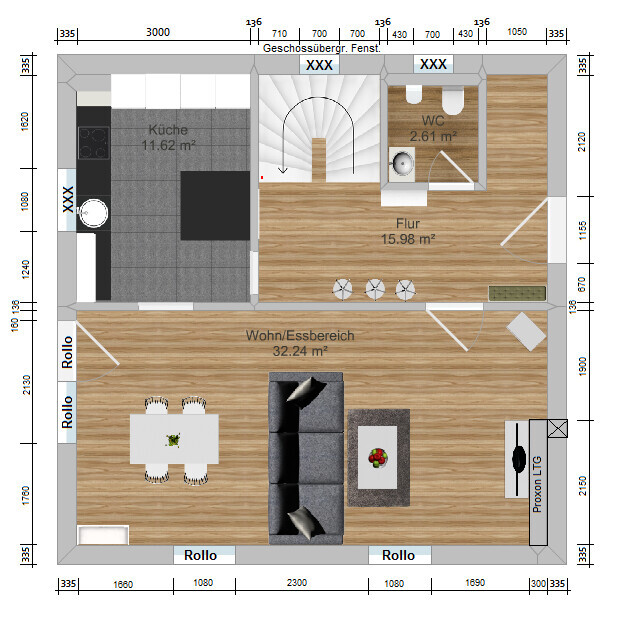
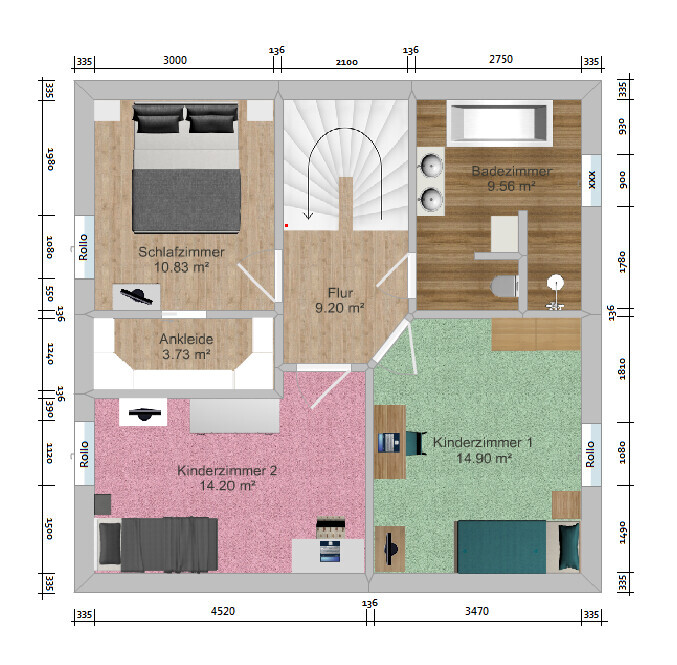
Finally, my floor plans are ready. Only our basement living area is missing, but I still need some information from the architect. The plan includes a laundry room, the heating room, a storage room, an office, and a large hobby room with a bathroom and a small kitchenette.
Attached is the site plan. It was provided by our architect and has been approved by the building authority regarding setback distances and parking spaces. I only added privacy fences and a garden shed. The positions are based on local neighborhood regulations. To the north, there is a garden plot (not buildable), to the east another new building is being constructed, to the south is the street (30 km/h (18.6 mph) zone) and across from it a house with a garden. To the west, directly adjacent to our property, there is a driveway and a garage, with another house next to it.
I’m trying to provide as much information as possible:
Development plan / restrictions
Plot size: 412.5 sqm (4,440 sq ft)
Slope: no
Site coverage ratio: 0.25
Floor area ratio: 0.50
Number of parking spaces: 2 free parking spaces
Number of stories: 2 floors (attic counts as 2nd floor due to knee wall) + basement living area
Roof type: gable roof, 25 degrees, knee wall 160 cm (63 inches)
Client requirements
Number of people: 2 adults (eventually + 2 children), ages 28 and 34
Office: home office in the basement living area
Kitchen: closed kitchen with a kitchen island pushed against the wall
Number of dining seats: 4, extendable to 6
Fireplace: no
Additional wishes
- The garden should be completely shielded from views (hence the privacy fence)
- We did not plan any garages, as we never had one and have never missed it. For strollers, garden furniture, etc., I have planned a garden shed, which also serves as a privacy screen
- We want a closed kitchen, no open kitchen. We don’t like that look.
- On the ground floor, we need a small niche for the vacuum cleaner, ironing board, water crates, etc.
- A walk-in closet is a must
- As well as a walk-in, built-in shower
I’m really looking forward to your opinions!
S
Schnuckline3 Apr 2017 16:55@apokolok The architect is already working with Bien-Zenker, but she is not employed there; she is from an architectural firm. That’s what I meant. I have no idea how it works since this is my first time building. I assume they award her the contract, and then she comes out. Our meeting also took place in the show home.
@RobsonMKK That’s what the city says. Not to forget, the floor area ratio also includes roof overhangs, pathways, parking spaces, and terraces—at least in our case. I’m not sure if this is regulated differently in other regions. I know the development plan by heart. We are actually already slightly over the floor area ratio and have applied for an exemption.
@RobsonMKK That’s what the city says. Not to forget, the floor area ratio also includes roof overhangs, pathways, parking spaces, and terraces—at least in our case. I’m not sure if this is regulated differently in other regions. I know the development plan by heart. We are actually already slightly over the floor area ratio and have applied for an exemption.

T
toxicmolotof3 Apr 2017 18:49You have every right to be frustrated. And you’re not an architect. Or do you want to transplant a kidney for me? Or take over my bank’s risk assessment?
You can’t really expect that to work.
You’re comparing apples and oranges with the apartment, or do you have two children’s bedrooms, a large bathroom, and a 32m (105ft) living room?
The standard floor plans are usually at least well-tested, aren’t they?
You can’t really expect that to work.
You’re comparing apples and oranges with the apartment, or do you have two children’s bedrooms, a large bathroom, and a 32m (105ft) living room?
The standard floor plans are usually at least well-tested, aren’t they?
Since the architect cannot work miracles and the floor area ratio is fully utilized, there is no way around reviewing the requirements specification. The house simply has a fixed area. If you try to fit everything into 125 square meters (1345 square feet) that would normally be in 160-square-meter (1722 square feet) houses, you will inevitably end up with a dollhouse. I seriously ask: what is a must-have and what is nice-to-have. Karsten
Schnuckline schrieb:
She may be the expert, but no one who will never live in the house can plan it as thoughtfully, thoroughly, and lovingly as I can myself.Schnuckline schrieb:
I think if I walked into any other architect’s office, we’d end up with the same result. He or she can’t read my mind or understand what I want and what my requirements are. We’d just end up sitting there saying things like, “Wall Y please move 30cm (12 inches) to the left,” “Wall Z a bit more slanted and not quite as long.” It’s simpler if I sketch it out beforehand. That wasn’t even her idea—I insisted on it and rejected further drafts from her.That’s why you write down your space requirements for the architect, such as “a walk-in closet would be nice,” “two children’s rooms of equal size,” “separate kitchen,” hobby room, privacy screen for the terrace, etc. Then you let the architect do their work. Professionals don’t make mistakes like placing a toilet directly in front of the bathroom entrance, visible to everyone in the hallway. They have studied and can accommodate all needs, whether for an elderly couple or a family of four. Later on, you can consider moving a wall.
This thread reads like a madhouse!
From your loving planning, a housing disaster is emerging. This is because, although you handle the details with care, you lack experience. Please don’t take this the wrong way, but after countless posts about various planning mistakes, you should take the advice and let the architect plan if you’re paying them anyway.
Stay away from the planning if you lack life experience. People have been amused by your questions about privacy screens, but honestly: you’re putting the cart before the horse in your naivety, thinking you’re the only client with standards for living.
A fence always comes after the building phase — at least, that should be the priority. Errors in house design cannot be as easily fixed as a fence, which can be altered on a whim at night or in the wind.
- On a 412sqm (4430 sqft) lot, a house with about 103sqm (1108 sqft) fits — roof overhangs are included if they extend more than 50cm (20 inches). The terrace is included in the 103sqm, but you plan it as 8sqm (86 sqft) with the option to extend later. Exceeding the limit by 5-10% is possible if the architect has a good explanation and the building authority is cooperative.
An additional 50% is usually allowed for secondary structures, paths, and parking spaces. However, this may be a special case for you where it does not apply.
- If you only have around 65sqm (700 sqft) of usable floor area, you’ll have to do without many highlights and nice-to-haves that take up a lot of space: kitchen islands, T-shaped bathrooms, walk-in closets, walk-in showers. There’s little room for debate unless you move living spaces to the attic or basement.
Cramping is not comfortable in the medium term, and the house feels cramped.
Furniture is mostly placed against walls to save open space that would otherwise be broken up. For example: in the kitchen you could move freely without an island, but not with one. In the bathroom: slalom pathways instead of open floor area.
- Doors:
A door swings into the room, meaning you enter the room and don’t bump into a wall. You don’t want to have to immediately turn around on your own axis when you want to use or pass through the room.
No work or living surfaces (kitchen counters) should be planned where a door is located.
A door can hide minor clutter (storage room, wardrobe).
Kitchen: you don’t need 120cm (47 inches) distance to face each other while prepping; 90cm (35 inches), or at a pinch 80cm (31 inches), is enough.
Bathroom: basically, it doesn’t matter if there is one or two washbasins, the width is what counts. For a household of four people, there should be an alternative option. Consider converting the urinal into a shower — your partner shouldn’t be so selfish.
Toilet directly in front of the door… sorry, but you can walk a couple more steps. How should that work with four of you? Do you want to visit each other on the throne or slam the door on each other’s foreheads during the session? A privacy screen is exactly for shielding the view from the entrance.
Bedroom/walk-in closet: do the same with the 45-50cm (18-20 inches) space on the sides of the bed as you did with the tape. But please make sure there is a wall in front of you. The same goes for the walk-in closet. Sit on the virtual bed (a chair against the wall) and put your arms on your knees... or simulate a foot or knee operation.
My brief suggestion:
Swap children’s room 1 with the bedroom/walk-in closet, and/or plan the bedroom with walk-in closet in the basement, so that the office or hobby room ends up upstairs. It’s better anyway if both children’s rooms face west.
Take half of the hallway storage space for the bathroom and install a shower in the niche. The remaining niche gets two doors and becomes a built-in wardrobe for coats: no one wants to see winter jackets on a rack in summer. And no one wants to clutter with small furniture: eventually a fourth shoe cabinet will appear.
Move the living room door, possibly place the sofa against the central wall, and the TV on the south wall.
S
Schnuckline3 Apr 2017 21:58You are all very kind, thank you for your support. I’m already looking forward to showing you the result we create together someday.
For now, I’ve just sent my ideas to the architect. Let’s see what changes she makes. Maybe it will finally click for me. I’m not sure what’s better:
- Not building at all
- Building something that I don’t really like
- Trying to squeeze everything in, which will probably become unsatisfactory sooner or later
@ypg wow, so detailed
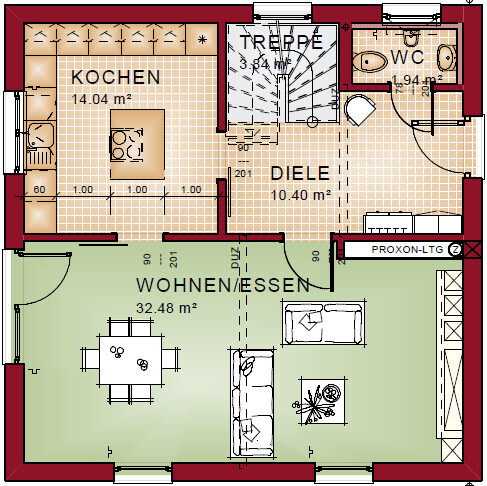
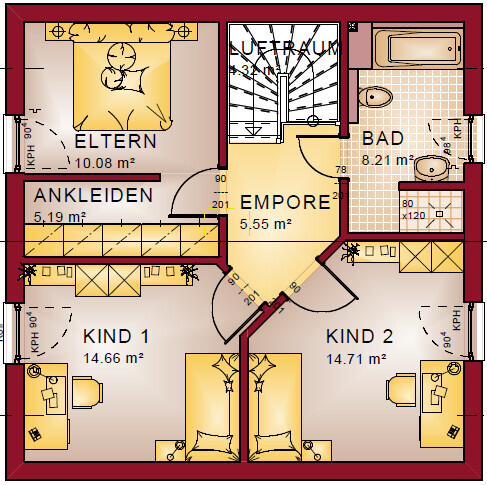
I’m sharing the drafts I received from the architect. Maybe you can tell me what you think of them. The plans made me unhappy and somewhat confused because the furniture is drawn so tiny that it no longer reflects reality.
We’ve now decided that we definitely want a guest bathroom (since the hobby room also serves as a guest room) in the basement. I think that means a shower on the ground floor might no longer be necessary, what do you think?
I always get really confused when you talk about other people being in the bathroom while someone is on the toilet. I’ve learned since childhood that when you enter the bathroom, you lock the door and no one else comes in under any circumstances.
I’ll probably do a lot of experimenting with the masking tape... I find that really helpful.
And a big thank you for your suggestions. I don’t want to sound ungrateful at all, but I somehow can’t imagine it. Swapping the kids’ room and the master bedroom somehow doesn’t free up any space, and moving the hobby room to the attic or putting the master bedroom in the basement somehow makes things worse. It would be strange if my partner plays poker loudly in the hobby room with friends while the kids sleep in the next rooms. That’s why I’m first creating the hobby room in the basement, so it’s possible to have fun there without disturbing others in the living areas.
I think I’m just too stuck right now for your (really great) tips to take effect. I need to talk to the architect and then continue planning.
I’m attaching the architect’s plans anyway.
For now, I’ve just sent my ideas to the architect. Let’s see what changes she makes. Maybe it will finally click for me. I’m not sure what’s better:
- Not building at all
- Building something that I don’t really like
- Trying to squeeze everything in, which will probably become unsatisfactory sooner or later
@ypg wow, so detailed
I’m sharing the drafts I received from the architect. Maybe you can tell me what you think of them. The plans made me unhappy and somewhat confused because the furniture is drawn so tiny that it no longer reflects reality.
We’ve now decided that we definitely want a guest bathroom (since the hobby room also serves as a guest room) in the basement. I think that means a shower on the ground floor might no longer be necessary, what do you think?
I always get really confused when you talk about other people being in the bathroom while someone is on the toilet. I’ve learned since childhood that when you enter the bathroom, you lock the door and no one else comes in under any circumstances.
I’ll probably do a lot of experimenting with the masking tape... I find that really helpful.
And a big thank you for your suggestions. I don’t want to sound ungrateful at all, but I somehow can’t imagine it. Swapping the kids’ room and the master bedroom somehow doesn’t free up any space, and moving the hobby room to the attic or putting the master bedroom in the basement somehow makes things worse. It would be strange if my partner plays poker loudly in the hobby room with friends while the kids sleep in the next rooms. That’s why I’m first creating the hobby room in the basement, so it’s possible to have fun there without disturbing others in the living areas.
I think I’m just too stuck right now for your (really great) tips to take effect. I need to talk to the architect and then continue planning.
I’m attaching the architect’s plans anyway.
Similar topics