
Hello everyone,
Finally, my floor plans are ready. Only our basement living area is missing, but I still need some information from the architect. The plan includes a laundry room, the heating room, a storage room, an office, and a large hobby room with a bathroom and a small kitchenette.
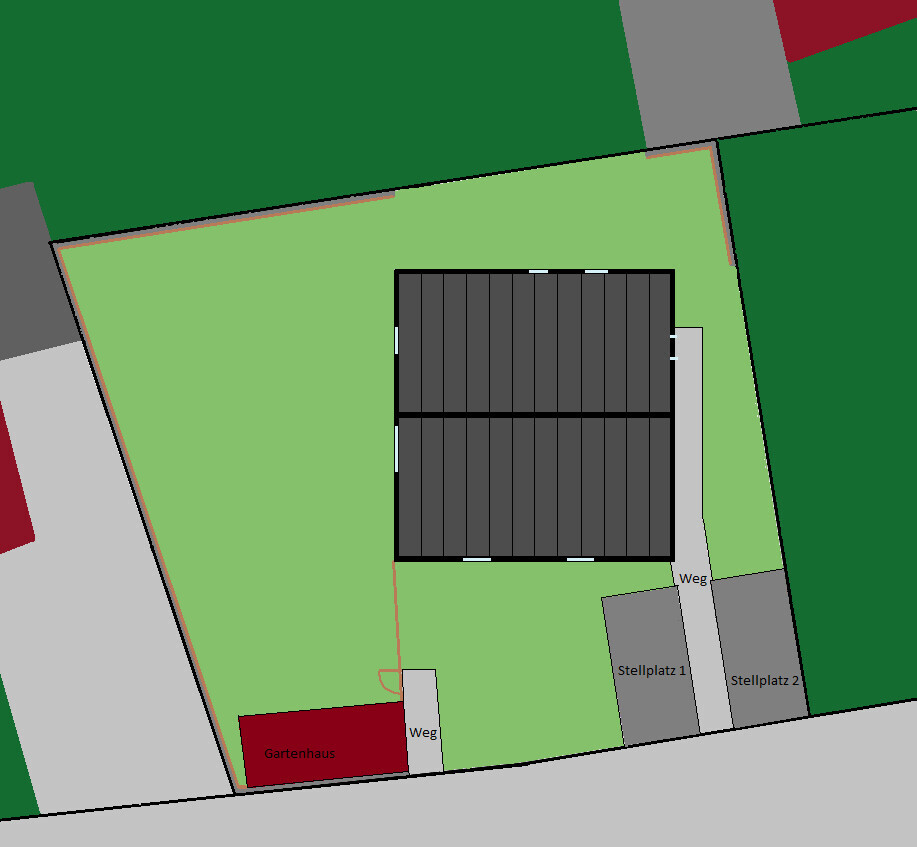
Attached is the site plan. It was provided by our architect and has been approved by the building authority regarding setback distances and parking spaces. I only added privacy fences and a garden shed. The positions are based on local neighborhood regulations. To the north, there is a garden plot (not buildable), to the east another new building is being constructed, to the south is the street (30 km/h (18.6 mph) zone) and across from it a house with a garden. To the west, directly adjacent to our property, there is a driveway and a garage, with another house next to it.
I’m trying to provide as much information as possible:
Development plan / restrictions
Plot size: 412.5 sqm (4,440 sq ft)
Slope: no
Site coverage ratio: 0.25
Floor area ratio: 0.50
Number of parking spaces: 2 free parking spaces
Number of stories: 2 floors (attic counts as 2nd floor due to knee wall) + basement living area
Roof type: gable roof, 25 degrees, knee wall 160 cm (63 inches)
Client requirements
Number of people: 2 adults (eventually + 2 children), ages 28 and 34
Office: home office in the basement living area
Kitchen: closed kitchen with a kitchen island pushed against the wall
Number of dining seats: 4, extendable to 6
Fireplace: no
Additional wishes
- The garden should be completely shielded from views (hence the privacy fence)
- We did not plan any garages, as we never had one and have never missed it. For strollers, garden furniture, etc., I have planned a garden shed, which also serves as a privacy screen
- We want a closed kitchen, no open kitchen. We don’t like that look.
- On the ground floor, we need a small niche for the vacuum cleaner, ironing board, water crates, etc.
- A walk-in closet is a must
- As well as a walk-in, built-in shower
I’m really looking forward to your opinions!
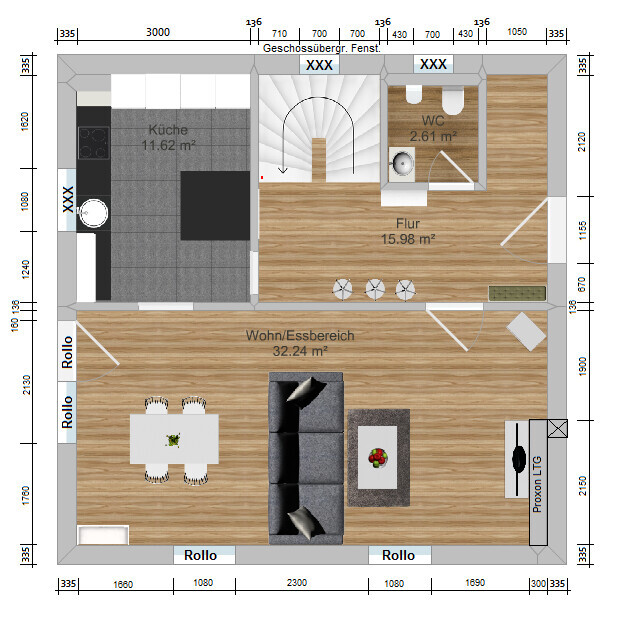
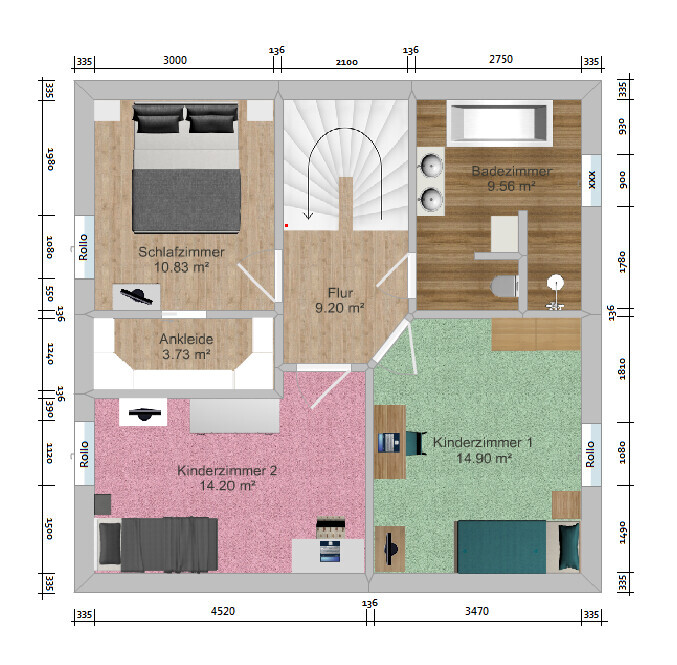
Finally, my floor plans are ready. Only our basement living area is missing, but I still need some information from the architect. The plan includes a laundry room, the heating room, a storage room, an office, and a large hobby room with a bathroom and a small kitchenette.
Attached is the site plan. It was provided by our architect and has been approved by the building authority regarding setback distances and parking spaces. I only added privacy fences and a garden shed. The positions are based on local neighborhood regulations. To the north, there is a garden plot (not buildable), to the east another new building is being constructed, to the south is the street (30 km/h (18.6 mph) zone) and across from it a house with a garden. To the west, directly adjacent to our property, there is a driveway and a garage, with another house next to it.
I’m trying to provide as much information as possible:
Development plan / restrictions
Plot size: 412.5 sqm (4,440 sq ft)
Slope: no
Site coverage ratio: 0.25
Floor area ratio: 0.50
Number of parking spaces: 2 free parking spaces
Number of stories: 2 floors (attic counts as 2nd floor due to knee wall) + basement living area
Roof type: gable roof, 25 degrees, knee wall 160 cm (63 inches)
Client requirements
Number of people: 2 adults (eventually + 2 children), ages 28 and 34
Office: home office in the basement living area
Kitchen: closed kitchen with a kitchen island pushed against the wall
Number of dining seats: 4, extendable to 6
Fireplace: no
Additional wishes
- The garden should be completely shielded from views (hence the privacy fence)
- We did not plan any garages, as we never had one and have never missed it. For strollers, garden furniture, etc., I have planned a garden shed, which also serves as a privacy screen
- We want a closed kitchen, no open kitchen. We don’t like that look.
- On the ground floor, we need a small niche for the vacuum cleaner, ironing board, water crates, etc.
- A walk-in closet is a must
- As well as a walk-in, built-in shower
I’m really looking forward to your opinions!
My opinion: downstairs, there are too few windows, or they are too small. It feels too dark. Remove the kitchen island. This will create more space to move around in the kitchen. Possibly add a small foldable table with three slender chairs. IKEA offers something like that.
The hallway is fine as is. That’s sufficient. I find the storage alcove acceptable.
Upstairs: the bathroom layout is problematic. Why have two sinks? Is this a hostel? Suggestion: place the bathtub on the east side. Above it to the north, the toilet. Shower on the west side.
Sink on the south side. Dressing room: skip it. Otherwise, you end up standing in front of the closet in the room. Who do you want to hide from while getting dressed? Just close the door and that’s fine.
Also upstairs: add more window area. Avoid floor-to-ceiling windows. Why? Use a window size fitting 110mm (4.3 inch) masonry openings. That will give you window dimensions you can dress up with standard IKEA blinds or similar.
Are doors opening the wrong way? That makes no sense. It doesn’t matter whether a door is opened with the left or right hand. It just needs to be wide enough. Because of the kitchen island, the kitchen door is too narrow. A door should be around 89cm (35 inches) wide. Anything less feels cramped. Sometimes, for a guest WC, you need narrower doors. But please not for kitchen doors. Karsten
The hallway is fine as is. That’s sufficient. I find the storage alcove acceptable.
Upstairs: the bathroom layout is problematic. Why have two sinks? Is this a hostel? Suggestion: place the bathtub on the east side. Above it to the north, the toilet. Shower on the west side.
Sink on the south side. Dressing room: skip it. Otherwise, you end up standing in front of the closet in the room. Who do you want to hide from while getting dressed? Just close the door and that’s fine.
Also upstairs: add more window area. Avoid floor-to-ceiling windows. Why? Use a window size fitting 110mm (4.3 inch) masonry openings. That will give you window dimensions you can dress up with standard IKEA blinds or similar.
Are doors opening the wrong way? That makes no sense. It doesn’t matter whether a door is opened with the left or right hand. It just needs to be wide enough. Because of the kitchen island, the kitchen door is too narrow. A door should be around 89cm (35 inches) wide. Anything less feels cramped. Sometimes, for a guest WC, you need narrower doors. But please not for kitchen doors. Karsten

S
Schnuckline3 Apr 2017 13:32haydee schrieb:
Before the second sink is removed, I would skip the urinal. One sink for four people who want to get ready at the same time is too little. You misunderstood me. Upstairs, the vanity will be smaller. Instead of a double sink, there will be a longer single sink. There is no urinal in that bathroom. That one is downstairs on the ground floor. The sink there will, of course, remain.
I'm starting to get really frustrated. If I make the bedroom wider, the bathroom becomes narrower, which is already too narrow. And the same goes for the ground floor. The kitchen will be wider, although I don’t really need it to be wider, and the entrance area will be narrower, which I would actually like to have bigger. Ahhhhhhh, this is so difficult! I just sent the plans with improvement notes to the architect. Let’s see what she says. I’ll gladly share them here again as soon as she gets back to me.
S
Schnuckline3 Apr 2017 13:59@Nordlys I still really need to work on the windows. I’m discussing with the architect what makes more sense: wider existing windows or additional ones alongside the current ones. Thanks for the tip about the kitchen doors. The door from the living room to the kitchen is planned to be 94 cm (37 inches) wide, and the one from the hallway to the kitchen is 73 cm (29 inches). I will plan to make those bigger accordingly.
Regarding the bathroom: I have now removed the double sink and replaced it with a wide single sink. The issue in the bathroom is that the north side has a sloping roof (knee wall 1.60 m (5 ft 3 in)). So I can’t install a toilet or start the shower there. And I somehow have to keep the entrance on the west side clear—so tricky.
We chose the floor-to-ceiling windows because they are included and basically standard. Of course, you can redesign and plan two smaller windows side by side instead of one floor-to-ceiling window. Dormers or gables for the kids’ rooms are still under discussion.
@RobsonMKK Sorry if this sounds silly, but I still don’t understand why that would be wrong. Why shouldn’t the door in the living room open into the room towards the right? I could also swing it the other way, but my concern was that the door would constantly hit the wardrobe. Although opening it inward might be nicer when entering. Hmm… I need to think about that more. And why shouldn’t the bathroom door open outwards? There’s plenty of space there.
Regarding the bathroom: I have now removed the double sink and replaced it with a wide single sink. The issue in the bathroom is that the north side has a sloping roof (knee wall 1.60 m (5 ft 3 in)). So I can’t install a toilet or start the shower there. And I somehow have to keep the entrance on the west side clear—so tricky.
We chose the floor-to-ceiling windows because they are included and basically standard. Of course, you can redesign and plan two smaller windows side by side instead of one floor-to-ceiling window. Dormers or gables for the kids’ rooms are still under discussion.
@RobsonMKK Sorry if this sounds silly, but I still don’t understand why that would be wrong. Why shouldn’t the door in the living room open into the room towards the right? I could also swing it the other way, but my concern was that the door would constantly hit the wardrobe. Although opening it inward might be nicer when entering. Hmm… I need to think about that more. And why shouldn’t the bathroom door open outwards? There’s plenty of space there.
The simple answer is that it’s generally avoided.
Living room: there is always the risk of accidentally hitting someone hard with the door. This is especially dangerous with small children. Also, the door can rarely be left open.
Bathroom: typically, all doors are designed to open in the same direction because it looks better visually. There is a similar safety concern here, as the door can easily hit someone in the head. The exception is a small guest toilet where it might not be possible to do otherwise.
Wow, what made you come up with that idea? Carrying groceries alone through a 73cm (29 inch) door is no fun, and even less so if you have a child in your arms. But you’re planning to change it anyway.
It’s doable, actually quite easy to arrange.
Living room: there is always the risk of accidentally hitting someone hard with the door. This is especially dangerous with small children. Also, the door can rarely be left open.
Bathroom: typically, all doors are designed to open in the same direction because it looks better visually. There is a similar safety concern here, as the door can easily hit someone in the head. The exception is a small guest toilet where it might not be possible to do otherwise.
Schnuckline schrieb:
die vom Flur in die Küche 73 cm
Wow, what made you come up with that idea? Carrying groceries alone through a 73cm (29 inch) door is no fun, and even less so if you have a child in your arms. But you’re planning to change it anyway.
Schnuckline schrieb:
Dachschräge (Kniestock 1,60) besteht. Da kann ich also keine Toilette
It’s doable, actually quite easy to arrange.
S
Schnuckline3 Apr 2017 14:13@RobsonMKK Okay, thank you very much for the explanation. That actually makes sense for the living room. I will implement it that way.
Similar topics