
Hello,
our electricity bill was much too high last month! Now we want to save some electricity and hope you can help us. We’ve already checked around the sockets and found a few tips, but there must be more. So how do you save electricity??? Is there maybe something related to this topic at IKEA? Perhaps lamps that use very little power or something like that? Does anyone here have experience with this?
It would be really great if you could share some tips with us, thanks 🙂
No advertising for external sites, please.
our electricity bill was much too high last month! Now we want to save some electricity and hope you can help us. We’ve already checked around the sockets and found a few tips, but there must be more. So how do you save electricity??? Is there maybe something related to this topic at IKEA? Perhaps lamps that use very little power or something like that? Does anyone here have experience with this?
It would be really great if you could share some tips with us, thanks 🙂
No advertising for external sites, please.
F
fotokatze27 Jan 2012 00:23Hello FredeS!
LED, LED, LED, and more LED.
Nowadays, there are 240V LED bulbs available for many applications, with E14 and E27 bases. The LED replacement bulbs for 240V halogen lamps also work well. In general, you still need to compare the light colors. I recently replaced the 4 x 40W E14 candle bulbs in my living room with Toshiba E14 LED candles, each 6W. The light is more pleasant, and instead of 160W, only 24W is used. With 4 hours of daily use, that saves about 200 kWh per year or around €50 annually. In the bathroom, I replaced the 4 x 50W 240V halogen spotlights with 4 x 3W 240V LED bulbs. That saves another €35 per year with about 1 hour of use daily. This example could go on for a long time.
Of course, LED bulbs are significantly more expensive, but they last 10 to 20 years...
Another major energy consumer is microwaves—not when they are running, but because of the unavoidable clock inside. Our Siemens microwave actually uses 60W in standby mode, without even drying a cat inside. That’s nearly 1.5 kWh per day, just for the clock, or about €125 per year. I have now installed a remote switch that cuts power completely to the microwave when it’s not needed.
In the kitchen, I installed IKEA Dioder LED lights generously in the cabinets and under the upper cupboards.
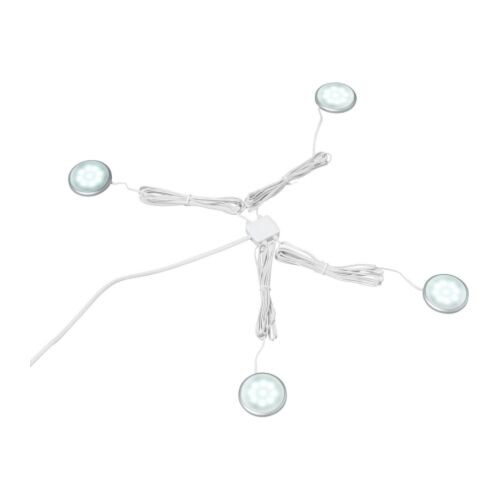
They produce very nice light and use almost no power. With a bit of skill, you can connect up to 12 of these lights to one power supply. This significantly reduces cable clutter compared to using a 5W power supply for every four lights. By the way, these lights have become about 50% cheaper. Last year they cost nearly €40, now they are available for just under €20.
I have also switched to the Tegernsee hydropower plants. A small energy provider with real, personal contacts who offer good advice, and the electricity can be ordered as 100% hydropower. With a price guarantee until the end of 2012!
Good savings and have a nice evening! Fotokatze.
LED, LED, LED, and more LED.
Nowadays, there are 240V LED bulbs available for many applications, with E14 and E27 bases. The LED replacement bulbs for 240V halogen lamps also work well. In general, you still need to compare the light colors. I recently replaced the 4 x 40W E14 candle bulbs in my living room with Toshiba E14 LED candles, each 6W. The light is more pleasant, and instead of 160W, only 24W is used. With 4 hours of daily use, that saves about 200 kWh per year or around €50 annually. In the bathroom, I replaced the 4 x 50W 240V halogen spotlights with 4 x 3W 240V LED bulbs. That saves another €35 per year with about 1 hour of use daily. This example could go on for a long time.
Of course, LED bulbs are significantly more expensive, but they last 10 to 20 years...
Another major energy consumer is microwaves—not when they are running, but because of the unavoidable clock inside. Our Siemens microwave actually uses 60W in standby mode, without even drying a cat inside. That’s nearly 1.5 kWh per day, just for the clock, or about €125 per year. I have now installed a remote switch that cuts power completely to the microwave when it’s not needed.
In the kitchen, I installed IKEA Dioder LED lights generously in the cabinets and under the upper cupboards.
They produce very nice light and use almost no power. With a bit of skill, you can connect up to 12 of these lights to one power supply. This significantly reduces cable clutter compared to using a 5W power supply for every four lights. By the way, these lights have become about 50% cheaper. Last year they cost nearly €40, now they are available for just under €20.
I have also switched to the Tegernsee hydropower plants. A small energy provider with real, personal contacts who offer good advice, and the electricity can be ordered as 100% hydropower. With a price guarantee until the end of 2012!
Good savings and have a nice evening! Fotokatze.
Similar topics