
S
SenorRaul78 Jun 2019 12:51Hi. I have no knowledge about satellite dishes and electrical work, so I will have a professional install the dish soon.
Right now, I am in the process of ordering the "materials." The dish will be mounted on the roof. We have already received the special roof tile from the construction company. The antenna cables will be routed and connected in the attic and then distributed to the rooms from there.
I had chosen the following dish:
DUR-line Select 85cm/90cm (33in/35in) Anthracite Satellite Dish - 3 x Test + Very Good + Aluminum Satellite Reflector
Along with this LNB + multiband switch:
DUR-line Ultra Quattro LNB - only for multiswitch, black - with LTE filter
DUR-line MS 5/8 Blue eco power-saving multiswitch - for 8 satellite users/TVs - no power supply needed - 0 Watt standby multiswitch [Digital, HDTV, FullHD, 4K, UHD]
Questions:
1. If I understand the dish description and questions in the reviews correctly, no roof mast or rafter mount is included. So I would need those separately, right? How about this one:
PremiumX Basic X120-48 Satellite TV rafter mount with 120cm (47in) galvanized steel mast, rafter bracket for satellite antenna satellite dish | Cable entry mast cap 10 coax cables
2. And I would also need cable and a grounding block, correct?
50m (164ft) PremiumX Deluxe PRO coaxial cable BLACK 135dB 5-fold shielded, pure copper satellite antenna cable 50m (164ft) 135dB 10x F connectors gold-plated 8.0mm (0.31in)
DUR-line grounding block DEB 9-way made of high-quality cast - shielding > 90 dB - SAT/cable/FM/DVB-T
3. Do people still need an antenna for radio reception nowadays? Doesn’t everything run mostly over the internet now? If yes, what type of antenna should I get and what else should I consider?
Right now, I am in the process of ordering the "materials." The dish will be mounted on the roof. We have already received the special roof tile from the construction company. The antenna cables will be routed and connected in the attic and then distributed to the rooms from there.
I had chosen the following dish:
DUR-line Select 85cm/90cm (33in/35in) Anthracite Satellite Dish - 3 x Test + Very Good + Aluminum Satellite Reflector
Along with this LNB + multiband switch:
DUR-line Ultra Quattro LNB - only for multiswitch, black - with LTE filter
DUR-line MS 5/8 Blue eco power-saving multiswitch - for 8 satellite users/TVs - no power supply needed - 0 Watt standby multiswitch [Digital, HDTV, FullHD, 4K, UHD]
Questions:
1. If I understand the dish description and questions in the reviews correctly, no roof mast or rafter mount is included. So I would need those separately, right? How about this one:
PremiumX Basic X120-48 Satellite TV rafter mount with 120cm (47in) galvanized steel mast, rafter bracket for satellite antenna satellite dish | Cable entry mast cap 10 coax cables
2. And I would also need cable and a grounding block, correct?
50m (164ft) PremiumX Deluxe PRO coaxial cable BLACK 135dB 5-fold shielded, pure copper satellite antenna cable 50m (164ft) 135dB 10x F connectors gold-plated 8.0mm (0.31in)
DUR-line grounding block DEB 9-way made of high-quality cast - shielding > 90 dB - SAT/cable/FM/DVB-T
3. Do people still need an antenna for radio reception nowadays? Doesn’t everything run mostly over the internet now? If yes, what type of antenna should I get and what else should I consider?

1. Use the Hercules rafter bracket. These basic parts are not suitable.
2. You need not only the grounding block but also the cable for equipotential bonding and a grounding conductor. This conductor must not consist of many strands but should be solid, meaning one or a few strands. Cross-section 16mm² (0.025in²). The setup should be as shown in the picture.
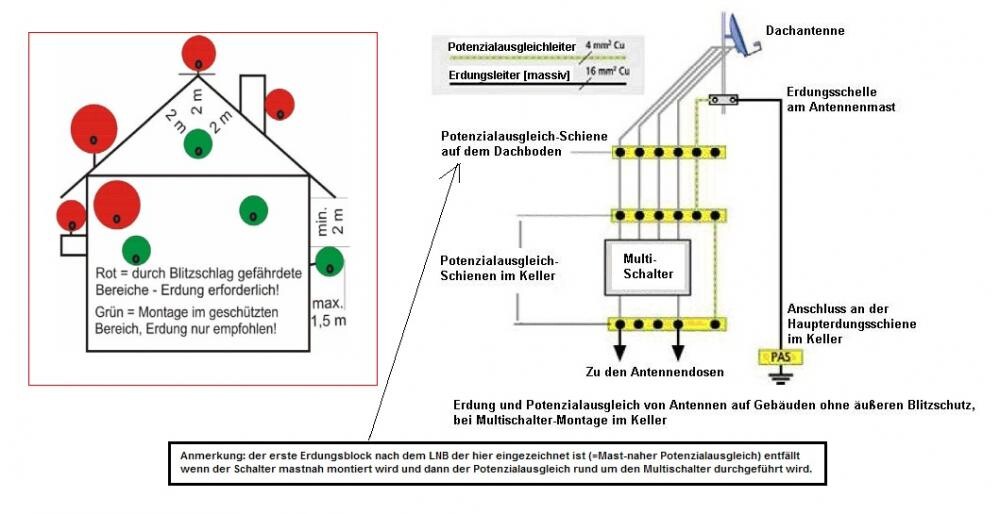
2. You need not only the grounding block but also the cable for equipotential bonding and a grounding conductor. This conductor must not consist of many strands but should be solid, meaning one or a few strands. Cross-section 16mm² (0.025in²). The setup should be as shown in the picture.
G
Gartenfreund10 Jun 2019 06:13Why black and white cables? You can just use cables all in the same color.
Why use such a heavily shielded cable? A simple one has worked fine for me for decades. It’s also much cheaper.
There are different opinions on whether F-connectors need to be gold-plated. I believe that’s not necessary.
With satellite, you can receive a lot of radio stations, so you don’t necessarily need an additional radio antenna—unless you want to listen to a local station.
If you install two LNBs, you can receive not only Astra but also Hotbird. Whether this is interesting for you is something you need to decide yourself. However, you would need a different multiswitch then.
Why use such a heavily shielded cable? A simple one has worked fine for me for decades. It’s also much cheaper.
There are different opinions on whether F-connectors need to be gold-plated. I believe that’s not necessary.
With satellite, you can receive a lot of radio stations, so you don’t necessarily need an additional radio antenna—unless you want to listen to a local station.
If you install two LNBs, you can receive not only Astra but also Hotbird. Whether this is interesting for you is something you need to decide yourself. However, you would need a different multiswitch then.
H
hampshire10 Jun 2019 09:22SenorRaul7 schrieb:
I have no knowledge of satellite dishes and electrical work, so I’m planning to have a professional install a dish soon.
Right now, I’m in the process of ordering the "materials." The professional installs components ordered by the client, who admits to having no knowledge. ops:
Mycraft schrieb:
2. You need not only the grounding block but also the cable for equipotential bonding and an earth conductor. This must not be a stranded conductor but should be solid or consist of only a few strands. Cross-section 16 mm² (0.025 in²). Execution as shown in the picture.One, two, many? Fine-stranded and multi-stranded conductors are more suitable for lightning currents due to the skin effect, but solid conductors are easier to secure against the electrodynamic forces of LEMPs (Lightning Electromagnetic Pulses). Fine-stranded connection cables used in high-voltage laboratories and fine-stranded equipotential bonding straps with manufacturer-prepared cable lugs are common in lightning protection construction, but they are prohibited in antenna construction for corrosion protection reasons.
A cross-section of 16 mm² (0.025 in²) for grounding conductors assumes the material to be copper. Alternatively, 25 mm² (0.039 in²) aluminum or 50 mm² (0.077 in²) lightning conductor wire is allowed. All of these, subject to clamps designed for them, can withstand even rare extreme LEMPs of 250 kA without damage, according to table D.3 of IEC 62305-1.
Everyone knows that a chain is only as strong as its weakest link. However, in antenna grounding this common wisdom is ignored by both do-it-yourselfers and electricians, who install connection materials of questionable lightning current carrying capacity without knowledge of test standards.
CONCLUSION: If the rail renamed from PAS to HES and the connection to the antenna support are certified as Class H = 100 kA, multi-stranded conductors (e.g., 16 mm² Cu with 7 x 1.7 mm strands) are also permitted. Solid single conductors, which are easier to secure, may only be connected to certified Class H clamps and HES for lightning protection equipotential bonding.
The right-hand diagram shows an equipotential bonding conductor that is included exclusively in a "loop-free" manner via the grounded antenna support. Since hardly anyone unplugs their devices during thunderstorms—closing the loop—and because loop freedom is impossible to achieve when roof antennas require grounding and are combined with cable or telecom networks, the equipotential bonding conductor according to current IEC and DIN EN 60728-11 (VDE 0855-1):2019-02 may additionally be connected to the HES or a PE conductor.
Below is an example image of how this will appear, with or without my comment, in the next IEC 60728-11:
In new construction, the lead-out of a separate lightning rod or a grounding conductor should ideally be routed externally without dangerous proximities and connected to a dedicated terminal of the foundation/ring earth electrode. The additional supporting earth electrodes of type A, shown in the example images in the standards, are optional for deep-set HES and can be omitted in well-designed grounding systems for new buildings.
Buildings grounded in compliance with DIN 18014:2014-03 are as rare as antenna grounding systems that conform to standards with certified Class H connectors. Therefore, try googling Who+may+install+foundation+earthing, it’s probably too late again.
I advise against cheap cables with tinned copper inner conductors or five-layer pointless shielding with fragile and interference-prone aluminum braid. The claimed 135 dB shielding attenuation of such cables is usually unreliable "peak-oriented" voodoo values.
Similar topics