

Hello,
Summary: In a double ventilation system, how is the air at the ridge vented from the inner layer? Are there ventilation vents for this, or is there simply a gap left in the profile wood?
More information: I understand that adding insulation and a complex double ventilation system to a garden shed might be overkill for some. But that’s not an issue since I have both the materials and the motivation and time to do it this way. However, I want to do it properly and avoid any mold growth. I’m not a professional, just an interested amateur.
So far, my roof looks like most wooden garden sheds: rafters with nailed-on profile wood and roofing felt as the finish. The walls are timber frame with a wind protection membrane, then battens for ventilation, and a wooden cladding as the outer finish.
Next, I want to install a metal roof with a wooden substructure on top. However, I also plan to insulate from the inside between the rafters and inside the frame. To prevent rot, I want to continue the ventilation space behind the wooden cladding of the wall up to the roof between the planned insulation and the profile wood. But the air has to escape at the top of the building, meaning there must be an opening in the profile wood. How is this usually done? Or should I approach this differently, for example by insulating directly under the metal roof?
I made a plan with Ubakus and Photoshop showing how I imagine the roof structure, in case my explanation is unclear (as I mentioned, I’m a layperson).
Thank you for your help!
Robin
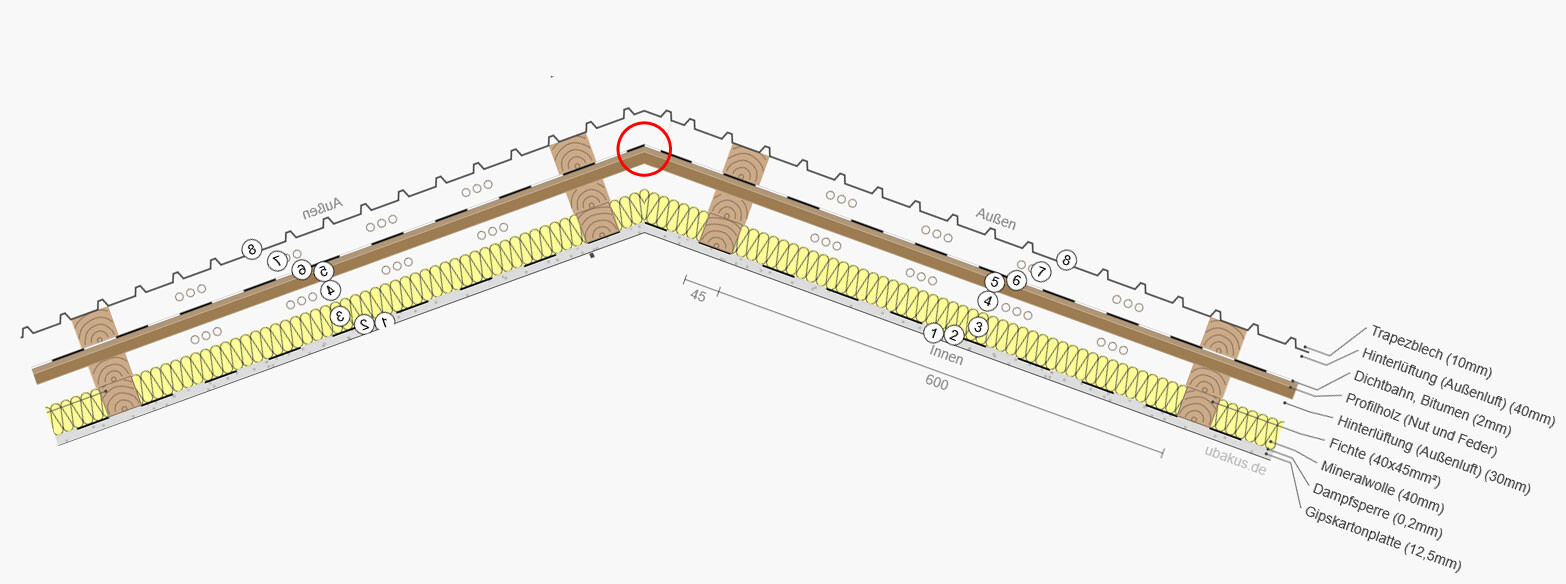
Summary: In a double ventilation system, how is the air at the ridge vented from the inner layer? Are there ventilation vents for this, or is there simply a gap left in the profile wood?
More information: I understand that adding insulation and a complex double ventilation system to a garden shed might be overkill for some. But that’s not an issue since I have both the materials and the motivation and time to do it this way. However, I want to do it properly and avoid any mold growth. I’m not a professional, just an interested amateur.
So far, my roof looks like most wooden garden sheds: rafters with nailed-on profile wood and roofing felt as the finish. The walls are timber frame with a wind protection membrane, then battens for ventilation, and a wooden cladding as the outer finish.
Next, I want to install a metal roof with a wooden substructure on top. However, I also plan to insulate from the inside between the rafters and inside the frame. To prevent rot, I want to continue the ventilation space behind the wooden cladding of the wall up to the roof between the planned insulation and the profile wood. But the air has to escape at the top of the building, meaning there must be an opening in the profile wood. How is this usually done? Or should I approach this differently, for example by insulating directly under the metal roof?
I made a plan with Ubakus and Photoshop showing how I imagine the roof structure, in case my explanation is unclear (as I mentioned, I’m a layperson).
Thank you for your help!
Robin
Hi Robin,
You can easily vent the exhaust air from the inner ventilated layer at the ridge through a continuous open gap between the profiled wood and the ridge board. You don’t necessarily need a classic ventilation tile for this, but the gap should ensure that no moisture can penetrate. A ridge ventilation membrane or a perforated ridge flashing is a common solution to provide a clearly defined air outlet while protecting against insects. Simply leaving a slot is sufficient, as long as it remains permanently open and protected.
If you make the insulation vapor-permeable toward the air layer, you are basically on the right track. An important point: How do you plan to supply fresh air at the bottom for both ventilation layers? This is often underestimated.
Good luck!
You can easily vent the exhaust air from the inner ventilated layer at the ridge through a continuous open gap between the profiled wood and the ridge board. You don’t necessarily need a classic ventilation tile for this, but the gap should ensure that no moisture can penetrate. A ridge ventilation membrane or a perforated ridge flashing is a common solution to provide a clearly defined air outlet while protecting against insects. Simply leaving a slot is sufficient, as long as it remains permanently open and protected.
If you make the insulation vapor-permeable toward the air layer, you are basically on the right track. An important point: How do you plan to supply fresh air at the bottom for both ventilation layers? This is often underestimated.
Good luck!
I planned to continue the ventilation gap of the wooden cladding on the wall up to under the roof.
I had the ridge ventilation strip in mind for the edge of the metal roof under the roof ridge (metal). But of course, I could also stick it onto the gap of my profile timber so that nothing can get in there. The gap should be 3 cm (1.2 inches), right?
I had the ridge ventilation strip in mind for the edge of the metal roof under the roof ridge (metal). But of course, I could also stick it onto the gap of my profile timber so that nothing can get in there. The gap should be 3 cm (1.2 inches), right?
A 3cm (1.2 inches) wide slot is generally sufficient to ensure proper air circulation, provided that air can also flow freely from below and there is no “bottleneck” on the way up. In your case, the ridge ventilation strip is definitely useful. It actually prevents insects and driving rain from entering the ventilation cavity, which can otherwise become an issue with a gap width of around 2cm (0.8 inches).

bvb09 schrieb:
I created a plan using Ubakus and Photoshop to show how I imagine the roof, in case my written description isn’t clear (as I mentioned, I’m a layperson). Your difficulty understanding your own visualization might be because you put together a rather unusual drawing, where the roof structure is rotated by 90°. The timbers in the drawing you used as inspiration are actually rafters, not battens, and the trapezoidal sheet metal is placed at the verge rather than parallel to the ridge as in your drawing!
So this is probably a classic case of self-misleading.
https://www.instagram.com/11antgmxde/
https://www.linkedin.com/company/bauen-jetzt/
Similar topics