
ᐅ Reinforced concrete ring beam with recess or bearing support for structural beams
Created on: 5 May 2026 17:18
M
MarkusbaHello Experts,
I have a question about the best way to solve the following problem:
The ring beam (24x24cm (9.5x9.5 inches)) runs around the top edge of the wall and carries the tensile forces, so it should be continuous and cast with reinforcement (e.g., 4x10mm (4x0.39 inch) rebar).
Due to the roof construction, a wooden beam (W/H: 20x28cm (7.9x11 inches)) must be supported on the wall (approximately 20cm (8 inches) deep), which means the ring beam will be interrupted (wall thickness 24cm (9.5 inches)).
Therefore, I am considering embedding anchor plates (Anchor Plate APL | www.pfeifer.info) in the ring beam for load transfer — it would need to be about 1 meter (3.3 feet) long, with roughly 40cm (16 inches) on each side of the beam.
The support load is approximately 30 kN (6,740 lbf) from the roof.
What do you think about this approach, or do you know of other solutions?
It would be great if there were a bracket similar to those from Halfen (https://www.halfen.com/de_CH/produktbereiche/beton/bewehrungssysteme/stahlbauanschluesse-und-stahlkonsolen, https://www.halfen.com/PDF-Dateien/Druckschriften/Technische%20Produktinformationen/HUC_Leviat_16-1.pdf), but as a “shoe” type.
Or is there a solution using threaded rod supports?
Thanks in advance,
Markus
I have a question about the best way to solve the following problem:
The ring beam (24x24cm (9.5x9.5 inches)) runs around the top edge of the wall and carries the tensile forces, so it should be continuous and cast with reinforcement (e.g., 4x10mm (4x0.39 inch) rebar).
Due to the roof construction, a wooden beam (W/H: 20x28cm (7.9x11 inches)) must be supported on the wall (approximately 20cm (8 inches) deep), which means the ring beam will be interrupted (wall thickness 24cm (9.5 inches)).
Therefore, I am considering embedding anchor plates (Anchor Plate APL | www.pfeifer.info) in the ring beam for load transfer — it would need to be about 1 meter (3.3 feet) long, with roughly 40cm (16 inches) on each side of the beam.
The support load is approximately 30 kN (6,740 lbf) from the roof.
What do you think about this approach, or do you know of other solutions?
It would be great if there were a bracket similar to those from Halfen (https://www.halfen.com/de_CH/produktbereiche/beton/bewehrungssysteme/stahlbauanschluesse-und-stahlkonsolen, https://www.halfen.com/PDF-Dateien/Druckschriften/Technische%20Produktinformationen/HUC_Leviat_16-1.pdf), but as a “shoe” type.
Or is there a solution using threaded rod supports?
Thanks in advance,
Markus
N
Nichtganz5 May 2026 22:20The interruption of the ring beam is structurally critical, even though the 30 kN (6,744 pounds) may seem manageable at first. The idea of using anchor plates can work, but it requires precise design and, above all, a secure anchorage length; otherwise, you lose the continuous tensile force that the ring beam is supposed to provide. In practice, this is often underestimated, especially with a wall thickness of only 24 cm (9.5 inches).
In my opinion, it is more practical to run the reinforcement bars around the support on the side with sufficient overlap so that the tensile forces can continue to circulate uninterrupted. This is usually easier to construct and reduces installation errors, even if it does not look as “solid” at first glance.
I am rather critical of threaded rod solutions because they lead to concentrated load transfers, which are not ideal for masonry. A bracket can work but must be precisely tailored to the loads and boundary conditions; economically, this is often borderline in residential construction.
In my opinion, it is more practical to run the reinforcement bars around the support on the side with sufficient overlap so that the tensile forces can continue to circulate uninterrupted. This is usually easier to construct and reduces installation errors, even if it does not look as “solid” at first glance.
I am rather critical of threaded rod solutions because they lead to concentrated load transfers, which are not ideal for masonry. A bracket can work but must be precisely tailored to the loads and boundary conditions; economically, this is often borderline in residential construction.
Hi,
not quite, thanks for the information, I had thought something along those lines.
The console can bear and also transfer the force (112kN); of course, a moment will be applied to the column, but the ring beam is also taken into account.
In this case, the ring beam would be continuous and the column with the bracket would carry the load.
Of course, I still need a structural engineer, but your opinion on the general solution would be important to me.
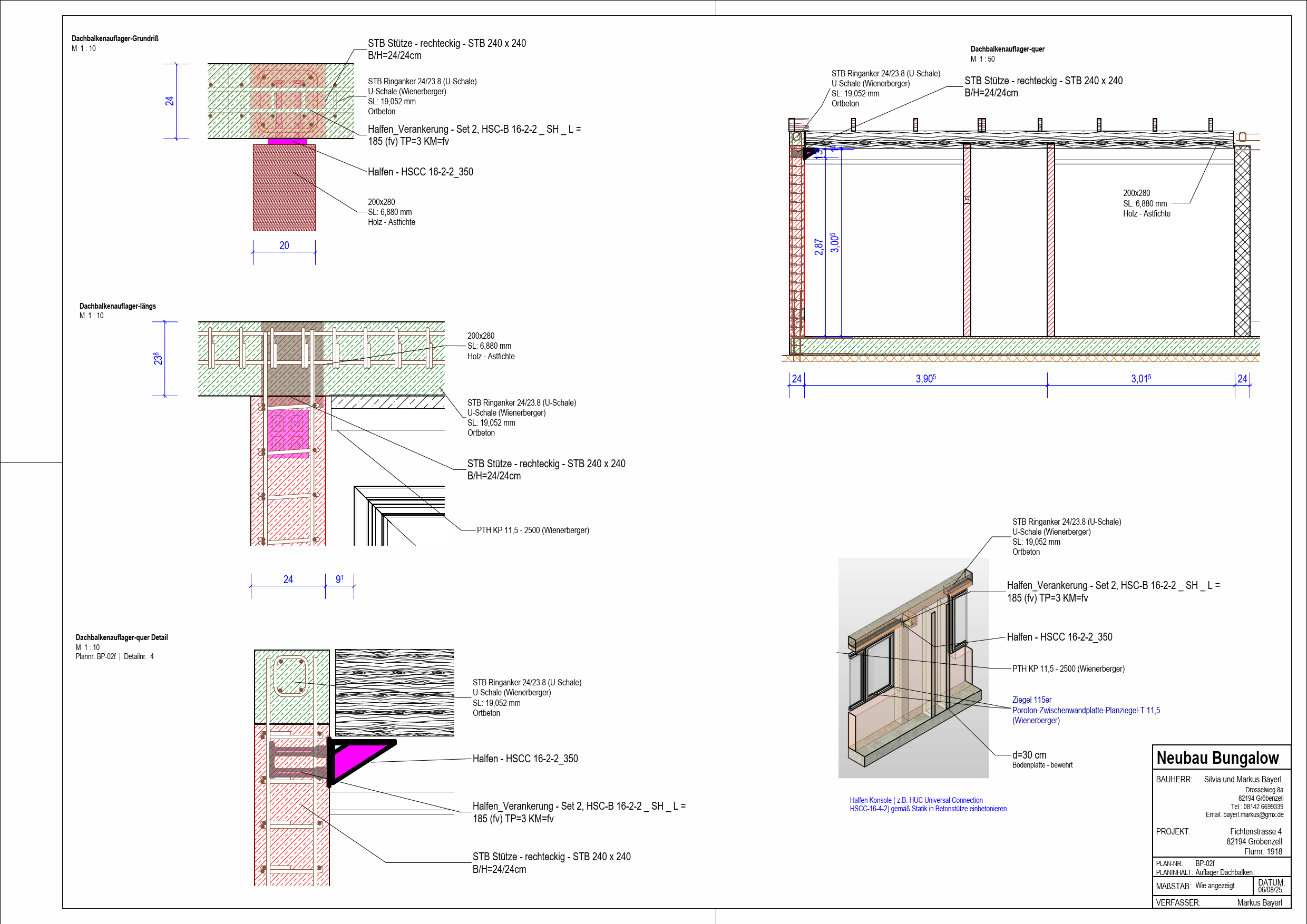
not quite, thanks for the information, I had thought something along those lines.
The console can bear and also transfer the force (112kN); of course, a moment will be applied to the column, but the ring beam is also taken into account.
In this case, the ring beam would be continuous and the column with the bracket would carry the load.
Of course, I still need a structural engineer, but your opinion on the general solution would be important to me.
H
hanghaus20238 May 2026 20:16The brackets don’t bother you? I would cast a T-piece into the ring beam, slot the beam, and then slide it in.
Isn’t such a beam usually placed on top?
Isn’t such a beam usually placed on top?
Hm, also a good idea.
The nail plate trusses lie on top. Since this is an L-shaped bungalow and there are no load-bearing walls at that spot, a wooden beam support must be installed. On one side, it rests simply on the wall, but on the other side, it extends to the exterior wall and should align with the top edge of the ring beam.
Thank you
The nail plate trusses lie on top. Since this is an L-shaped bungalow and there are no load-bearing walls at that spot, a wooden beam support must be installed. On one side, it rests simply on the wall, but on the other side, it extends to the exterior wall and should align with the top edge of the ring beam.
Thank you