
Hello,
The on-site quality inspector noticed that the ring beam only has 5cm (2 inches) of insulation. He said this creates a thermal bridge.
I have attached a picture for you to see.
The suggestion was now to increase it to 8cm (3 inches) and use insulation with a higher thermal conductivity class. I communicated this to the general contractor, who wanted to discuss it with the structural engineer.
I would never have noticed this myself, and if it is true, then the quality inspection has already paid off.
What do you think?
Thanks for your feedback.
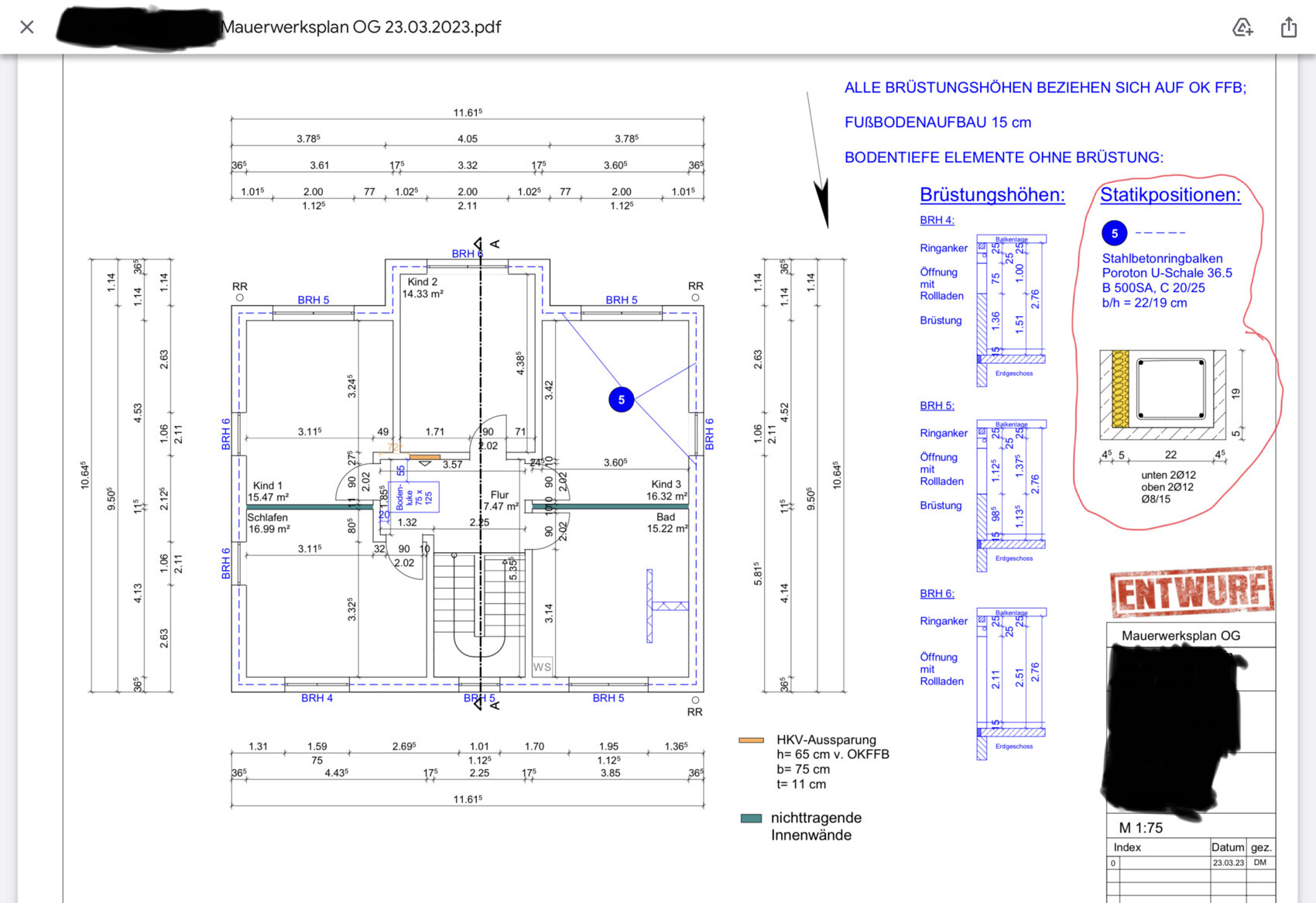
The on-site quality inspector noticed that the ring beam only has 5cm (2 inches) of insulation. He said this creates a thermal bridge.
I have attached a picture for you to see.
The suggestion was now to increase it to 8cm (3 inches) and use insulation with a higher thermal conductivity class. I communicated this to the general contractor, who wanted to discuss it with the structural engineer.
I would never have noticed this myself, and if it is true, then the quality inspection has already paid off.
What do you think?
Thanks for your feedback.
 In der Ruine27 May 2023 21:54
Is the ring beam already completed, or are you still in the preparation phase?
The insulation value of the ring beam consists of 2 layers of Poroton, 1 layer of insulation, and 1 layer of reinforced concrete.
In both versions, I have only included 5cm (2 inches) of insulation.
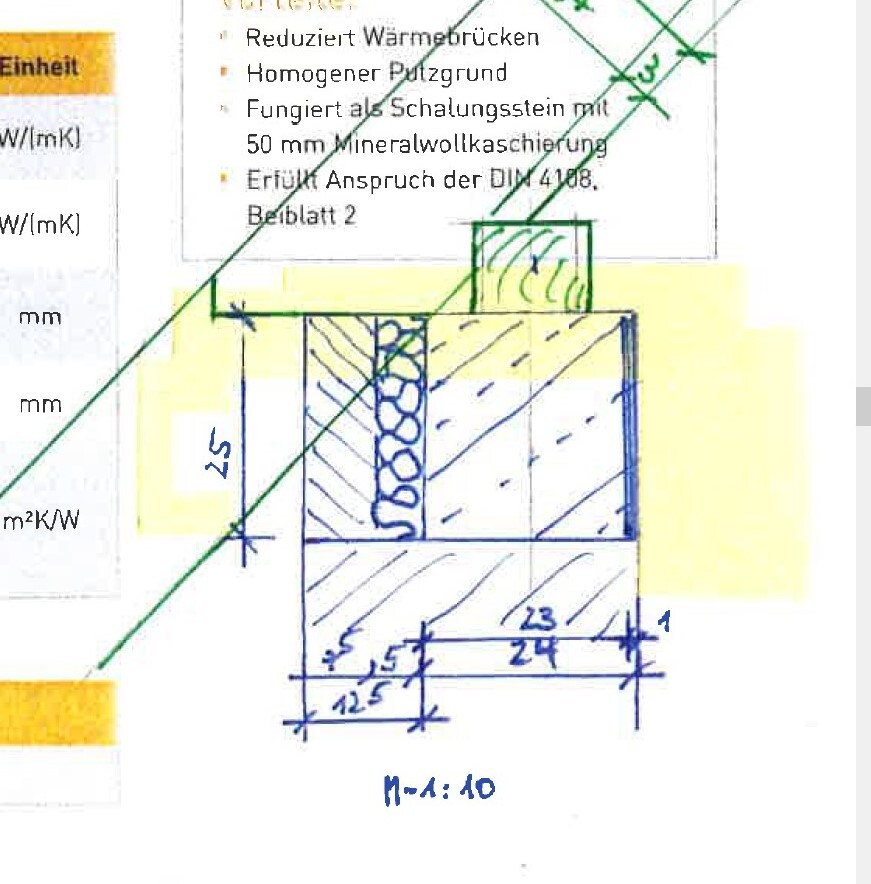
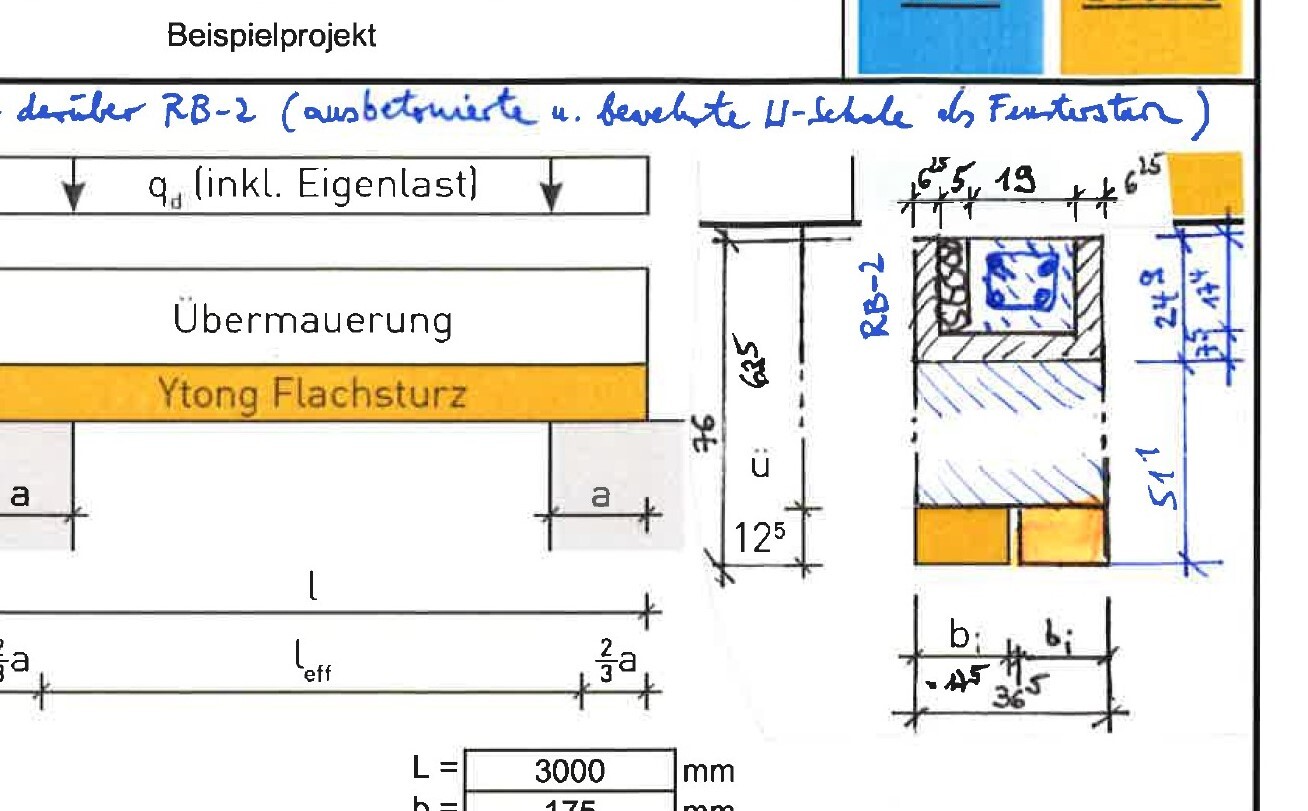
The insulation value of the ring beam consists of 2 layers of Poroton, 1 layer of insulation, and 1 layer of reinforced concrete.
In both versions, I have only included 5cm (2 inches) of insulation.
In der Ruine28 May 2023 22:20Gregor_K schrieb:
@In der Ruine We haven't signed the construction contract yet, so it can still be adjusted. Would you say you have a thermal bridge?
I really can't assess how good reinforced concrete insulation is.No idea if that will be a thermal bridge. I don’t think so. Probably not an optimal U-value, but condensation likely won’t occur.And yes, reinforced concrete does have some insulation value. Poor, but it’s there. Even the prefabricated buildings from the former GDR were made with only 20cm (8 inches) of concrete. Plus, with your insulation and the porous clay block, you won’t be overheating the environment.
Gregor_K schrieb:
Would you say that you have a thermal bridge?
As for how well reinforced concrete insulates, I really cannot judge. In der Ruine schrieb:
And yes, reinforced concrete does have an insulation value. Poor, but it exists. Reinforced concrete has a lambda value of approximately 2.1 W/mK, so it can almost be considered "over-measured" when calculating thermal protection.
In der Ruine schrieb:
Prefabricated panel buildings from the former GDR also consisted of only 20cm (8 inches) of concrete. The prefabricated panel buildings from the 1960s to 1990s were largely made of concrete, but specifically aerated concrete, and the insulation value of this component was actually not bad. Other elements were more problematic.
What @WilderSueden is correct about is that 5cm (2 inches) of insulation (thermal conductivity group 035) is not uncommon, and for the overall thermal protection at this point, the inner and outer Poroton shell must also be taken into account. Your general contractor, if they prepared such a drawing, should also have performed a calculation from which the U-value for this component can be derived.
Without changing the structural design, the thermal conductivity of the insulation material or the insulation itself can be changed, since it does not serve a load-bearing function—this role is taken over by the ring beam.
The highest insulation performance permitted for installation at this location would be achieved with resol rigid foam boards (thermal conductivity group 022), although they are somewhat more expensive.
But even with the typically used XPS boards with WLG 035 or 036, you should not experience any issues with condensation at this point.
Purely in terms of calculation, you would do better with resol boards and 8cm (3 inches), but from my perspective, especially regarding insulation thickness, a sufficiently oversized ring beam is more important.
In der Ruine30 May 2023 11:30dertill schrieb:
The prefabricated panel buildings from the 1960s to the 1990s were largely made of concrete, but also of aerated concrete, and the insulation value of this component was actually quite good. I have lived in various panel buildings for 20 years and drilled into exterior walls as well. I have never come across anything like aerated concrete there. Are you sure?
Similar topics