
ᐅ Retaining wall for the retaining wall!? Do you have any ideas?
Created on: 14 Mar 2023 09:06
H
Hausbau75
Good morning everyone,
First of all, a friendly hello! This is my first post here, and I hope I’m in the right place.
Last week, we had our “greenfield” meeting on the property, which means the civil engineer, basement builder, and house builder were all present. Unfortunately, we discovered that the elevation level relative to the neighbors’ retaining walls is not quite as it was supposed to be in theory. We are closer to the walls and not as high as expected. You could wonder how this happened, but that won’t help—I need solutions because the situation is what it is.

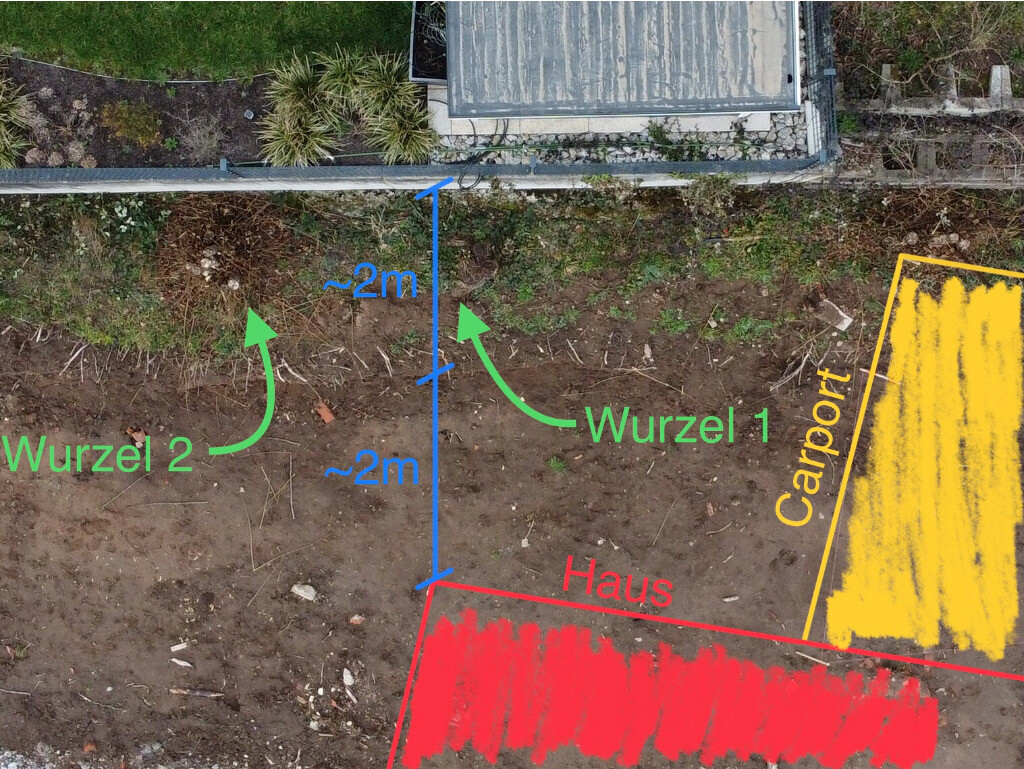
I’ve uploaded two pictures that clearly show what it’s about. I also made some colored markings to get a better overview.
Regarding the issue:
We bought the house together with a rather large carport that serves as a porch roof and storage area (the building permit / planning permission has been approved, and the house is already scheduled for production, so no changes are possible anymore). Above the carport, there is a wall made of planter stones (visible on the right side of the first picture). Along the entire length, the civil engineer will now build a retaining wall, ensuring that neither the carport nor the existing wall will be affected—essentially a retaining wall for the retaining wall. This will be done before the house and carport are built, otherwise it wouldn’t make sense.
On the left side of the picture, you can see a retaining wall made of L-shaped concrete blocks about 2m (6.5 feet) high. You can see from the photos that the civil engineer has already excavated earth up to about 2m (6.5 feet) before this wall. He hasn’t dared to go closer yet. Another problem in this area is two large roots that almost certainly extend beneath the foundation of the L-block wall.
The civil engineer is now understandably worried that if he works closer to the wall and cuts these roots (he does not want to remove them because he and we believe they extend under the L-blocks), the roots will die, which could eventually cause the L-blocks to settle.
As you can see, we definitely need more maneuvering space to be able to get a vehicle under the carport and also back out again. Currently, there is about 2m (6.5 feet) to the edge of the house, which is definitely too little space. Leaving it as is would also waste too much space on the property. While we want to plant something along the wall, a 2m (6.5 feet) wide strip is too much.
Now we need your advice. Do you have any ideas on how to support this L-block wall if these two roots need to be removed?
We have time to proceed this way—the house construction will take the entire year and certainly the driveway won’t be paved immediately after that, probably not even next year. Nevertheless, I would appreciate your opinions and ideas because it is important to us to do this correctly, well, and safely. Money is naturally tighter than it might have been a few years ago, so we are also interested in your cost-effective suggestions.
Thank you very much for any ideas…
Best regards,
Paul
First of all, a friendly hello! This is my first post here, and I hope I’m in the right place.
Last week, we had our “greenfield” meeting on the property, which means the civil engineer, basement builder, and house builder were all present. Unfortunately, we discovered that the elevation level relative to the neighbors’ retaining walls is not quite as it was supposed to be in theory. We are closer to the walls and not as high as expected. You could wonder how this happened, but that won’t help—I need solutions because the situation is what it is.
I’ve uploaded two pictures that clearly show what it’s about. I also made some colored markings to get a better overview.
Regarding the issue:
We bought the house together with a rather large carport that serves as a porch roof and storage area (the building permit / planning permission has been approved, and the house is already scheduled for production, so no changes are possible anymore). Above the carport, there is a wall made of planter stones (visible on the right side of the first picture). Along the entire length, the civil engineer will now build a retaining wall, ensuring that neither the carport nor the existing wall will be affected—essentially a retaining wall for the retaining wall. This will be done before the house and carport are built, otherwise it wouldn’t make sense.
On the left side of the picture, you can see a retaining wall made of L-shaped concrete blocks about 2m (6.5 feet) high. You can see from the photos that the civil engineer has already excavated earth up to about 2m (6.5 feet) before this wall. He hasn’t dared to go closer yet. Another problem in this area is two large roots that almost certainly extend beneath the foundation of the L-block wall.
The civil engineer is now understandably worried that if he works closer to the wall and cuts these roots (he does not want to remove them because he and we believe they extend under the L-blocks), the roots will die, which could eventually cause the L-blocks to settle.
As you can see, we definitely need more maneuvering space to be able to get a vehicle under the carport and also back out again. Currently, there is about 2m (6.5 feet) to the edge of the house, which is definitely too little space. Leaving it as is would also waste too much space on the property. While we want to plant something along the wall, a 2m (6.5 feet) wide strip is too much.
Now we need your advice. Do you have any ideas on how to support this L-block wall if these two roots need to be removed?
We have time to proceed this way—the house construction will take the entire year and certainly the driveway won’t be paved immediately after that, probably not even next year. Nevertheless, I would appreciate your opinions and ideas because it is important to us to do this correctly, well, and safely. Money is naturally tighter than it might have been a few years ago, so we are also interested in your cost-effective suggestions.
Thank you very much for any ideas…
Best regards,
Paul
H
Hausbau7514 Mar 2023 10:55Why do you think it will be more expensive later on? All of that is quite far away from the house, isn’t it?

Hausbau75 schrieb:
Why do you think it will be more expensive later? That is quite a distance from the house, after all? Because the excavation contractor can now use heavy machinery "through" your house and has space to work.
Once the house is built, they can only work with smaller equipment, have no area to store materials, and have to carry everything around the house.
H
Hausbau7514 Mar 2023 11:10Oh man, I really need to schedule an appointment with the groundworks contractor right away...
THANK YOU ALL!!!!
THANK YOU ALL!!!!
C
Costruttrice14 Mar 2023 11:11Hausbau75 schrieb:
Why do you think it will be more expensive later? That is quite far away from the house, isn’t it?I can't tell how far it is from the house; I can only share our experience. We wanted it done first, but the builder didn’t agree. He didn’t see any problem with it. There were no plans available for the structure that needed securing, only a test excavation. When the time came, there were quite a few surprises. The process turned out to be more complicated and extensive than initially expected. Especially since other work was already underway nearby, which had to be stopped immediately, it was overall more difficult than working on a completely clear area. The excavations had to be properly secured, and no vibrations were allowed during that time. This took about 3–4 weeks until everything was completed.H
hanghaus202314 Mar 2023 11:13Hausbau75 schrieb:
Why do you think it will be more expensive later? That’s all quite far from the house, isn’t it? How are we supposed to know how far it really is?
Because likely only mini excavators and small tools can be used, and the house will also need to be protected. Then you end up with a separate crew that can only work a few hours at a time. In advance, this can run parallel with excavation, foundation, basement, etc.
First, your neighbor will immediately stop the construction as soon as you do anything near the property boundary. Judging by the photo, the house is only a few decimeters from the site boundary. The first thing I would do is have a condition survey done of the neighboring houses. Otherwise, you might later be charged for every small crack that may have already existed before.
Costruttrice schrieb:
This is how it was done for us after consultation between the civil engineer and the structural engineer. Unfortunately, I don’t have any photos that clearly show it. But if you search for “underpinning,” you can find examples—I quickly attached a photo from the internet that illustrates the principle. As @haydee describes, the wall to be secured is divided into individual sections. The first and third sections are excavated, while the middle section is left in place. Then the first and third sections are concreted (or built up with masonry, depending on the situation) up to the existing wall. Once that has cured, the middle section is excavated, and the process continues in this way. Exactly, except that for us sections 2 and 3 were left standing, and only section 4 was excavated afterwards.
And yes, it was not inexpensive.