
Hello,
I wanted to give a brief, ongoing report on the renovation of our old farmstead. Basically, a little diary for ourselves – with maybe some added value for others with similar projects. Our budget: 340,000 EUR including everything, plus ongoing expenses covered from salary, for: modernization of the attic, renovation of the ground floor, with a total of around 190 m² (2,045 sq ft) of living space.
I'll start at the beginning:
We searched for a suitable plot for a long time; there are one or two posts about this in the forum. Unfortunately, plots are also scarce in our area. The older new development areas are sold out, except for the less desirable plots; the “new” development area, which was supposed to come to market 1.5 years ago, is still delayed. The city administration can’t agree on a developer [...]
A great plot that we wanted was unfortunately bought by a competitor. Then our wish list changed: we now wanted two adjacent plots (or one large one that could be divided): one for my parents, one for us. We hoped for certain advantages if Grandma and Grandpa later lived next door. Also, we could better support them in old age. The new development area continued to be delayed. My mom’s and sister’s horses fell ill with lead poisoning where they were kept, so my mom wanted to bring the horses to her place. We then searched in the rural zone for a large plot either close to a stable or ideally with permission to build one. Ha! If only it were that simple...
Although, despite good contacts with the building authority and mayor through my parents, we experienced a fairly reasonable approach to public law (though maybe the contacts didn’t even affect that), nothing really fit. In the end, I expanded my search to old farmsteads that, judging by their layout, could be divided into two living units or were already divided in part. That also took time. Sometimes we hesitated too long. I come from the real estate industry and had difficulty committing to a property immediately without a building surveyor (technical due diligence, as we say) involved.
Then we found our current farmstead, and it fit the bill: just under 400 m² (4,306 sq ft) of living space on paper, realistically a bit less; about 6,200 m² (1.53 acres) plot; a small stable/shed in the outdoor area; carport for 5 cars; division into two theoretical semi-detached units possible or partly already done; DSL 200 Mbps available (! – rare in rural areas here); well-developed road access. What was missing was pasture/land for the horses. What didn’t fully meet our wishes was the state road running along the property with a speed limit of 100 km/h (62 mph) and a large number of crows. But – we liked the house immediately; it had that certain something. My mom agreed spontaneously. No negotiation on the purchase price, which hurt our budget, but that way no one else saw the house and the risk of wild bargaining was eliminated. This does happen here now, especially when wealthy people from the south look for vacation homes on the Baltic coast.
To-dos:
Subdivision of the floor plan into two semi-detached units
Decide who gets the fully renovated semi-detached unit and who still has to renovate
Division of purchase price and incidental costs
Pasture
Outdoor facilities, etc.
TBC
Fun fact: We later learned the hairdresser of my husband’s used to live here with her parents. Our village is small.
I wanted to give a brief, ongoing report on the renovation of our old farmstead. Basically, a little diary for ourselves – with maybe some added value for others with similar projects. Our budget: 340,000 EUR including everything, plus ongoing expenses covered from salary, for: modernization of the attic, renovation of the ground floor, with a total of around 190 m² (2,045 sq ft) of living space.
I'll start at the beginning:
We searched for a suitable plot for a long time; there are one or two posts about this in the forum. Unfortunately, plots are also scarce in our area. The older new development areas are sold out, except for the less desirable plots; the “new” development area, which was supposed to come to market 1.5 years ago, is still delayed. The city administration can’t agree on a developer [...]
A great plot that we wanted was unfortunately bought by a competitor. Then our wish list changed: we now wanted two adjacent plots (or one large one that could be divided): one for my parents, one for us. We hoped for certain advantages if Grandma and Grandpa later lived next door. Also, we could better support them in old age. The new development area continued to be delayed. My mom’s and sister’s horses fell ill with lead poisoning where they were kept, so my mom wanted to bring the horses to her place. We then searched in the rural zone for a large plot either close to a stable or ideally with permission to build one. Ha! If only it were that simple...
Although, despite good contacts with the building authority and mayor through my parents, we experienced a fairly reasonable approach to public law (though maybe the contacts didn’t even affect that), nothing really fit. In the end, I expanded my search to old farmsteads that, judging by their layout, could be divided into two living units or were already divided in part. That also took time. Sometimes we hesitated too long. I come from the real estate industry and had difficulty committing to a property immediately without a building surveyor (technical due diligence, as we say) involved.
Then we found our current farmstead, and it fit the bill: just under 400 m² (4,306 sq ft) of living space on paper, realistically a bit less; about 6,200 m² (1.53 acres) plot; a small stable/shed in the outdoor area; carport for 5 cars; division into two theoretical semi-detached units possible or partly already done; DSL 200 Mbps available (! – rare in rural areas here); well-developed road access. What was missing was pasture/land for the horses. What didn’t fully meet our wishes was the state road running along the property with a speed limit of 100 km/h (62 mph) and a large number of crows. But – we liked the house immediately; it had that certain something. My mom agreed spontaneously. No negotiation on the purchase price, which hurt our budget, but that way no one else saw the house and the risk of wild bargaining was eliminated. This does happen here now, especially when wealthy people from the south look for vacation homes on the Baltic coast.
To-dos:
Subdivision of the floor plan into two semi-detached units
Decide who gets the fully renovated semi-detached unit and who still has to renovate
Division of purchase price and incidental costs
Pasture
Outdoor facilities, etc.
TBC
Fun fact: We later learned the hairdresser of my husband’s used to live here with her parents. Our village is small.
 Winniefred26 Jan 2022 15:54
I don’t have strong opinions about interior insulation. Our house has exterior insulation from the 1990s, which is still in excellent condition. However, we previously lived in a renovated 19th-century building with interior insulation. A few months after moving in, mold appeared in several places on the interior side of the exterior walls. That house, however, was renovated very quickly and on a tight budget, with insufficient drying time, among other issues. I also don’t know exactly what type of insulation was used. I do know that fastening anything to the exterior walls was only allowed with special anchors, as stated in the rental agreement.

@Winniefred Yes, that’s true. There are more new build experts in this forum 😉 But it’s nice to have found a few like-minded enthusiasts/fellow sufferers. To be honest, after the baby was born, we would have liked to subcontract more work to professionals, but it just wasn’t possible. On the other hand, we can say that we completed a good part of the interior work ourselves 🙂
Oh, please share your experience with renovation plaster, we also want to cover an interior wall with it. At first, we considered sacrificial plaster, but we don’t have the patience/time to later chisel it off and re-plaster.
By the way, I need to correct myself. The offer said double-layer with an air gap. However, the mason and the energy consultant agreed on cavity insulation with cavity insulation boards. That explains the 1–2 cm (0.4–0.8 inches). I’m taking a deep breath now and trusting the mason and energy consultant.
Oh, please share your experience with renovation plaster, we also want to cover an interior wall with it. At first, we considered sacrificial plaster, but we don’t have the patience/time to later chisel it off and re-plaster.
By the way, I need to correct myself. The offer said double-layer with an air gap. However, the mason and the energy consultant agreed on cavity insulation with cavity insulation boards. That explains the 1–2 cm (0.4–0.8 inches). I’m taking a deep breath now and trusting the mason and energy consultant.
Winniefred26 Jan 2022 20:51There’s not much to tell. Our basement is a bit damp on two walls (the ones deep underground) since it’s an old building. For drying it out, we’re now considering renovating plaster and basically applying it the same way we have with other interior plasters so far. We applied a thickness of about 20-25mm (about 1 inch) by hand. I think it should last a good 10 years. Eventually, we want to dig around the house to waterproof it from the outside, but that’s not planned at the moment.
In terms of application, I find it comparable to lime-cement plaster. It naturally dries much slower down there, which is why we can only float it the next day. Then a friend who’s an electrician will do some expansion of the surface-mounted electrical work, and after that, we plan to tile the area. Oh, and I want to paint the renovating plaster with silicate paint. This project isn’t very spectacular. And since it’s in the basement, we’re not in a hurry, and the mess is minimal. Definitely a nice winter project.^^
In terms of application, I find it comparable to lime-cement plaster. It naturally dries much slower down there, which is why we can only float it the next day. Then a friend who’s an electrician will do some expansion of the surface-mounted electrical work, and after that, we plan to tile the area. Oh, and I want to paint the renovating plaster with silicate paint. This project isn’t very spectacular. And since it’s in the basement, we’re not in a hurry, and the mess is minimal. Definitely a nice winter project.^^
A
alterego13427 Jan 2022 11:48Winniefred schrieb:
There isn’t much to say. Our basement is a bit damp on two walls (the ones that are deep underground), but it’s an older building. We’ve been considering using a renovation plaster for drying out and are basically applying it the same way as other interior plasters we’ve used so far. We applied a layer about 20-25mm (about 1 inch) thick by hand. I believe it will last a good 10 years. Eventually, we want to excavate around the entire house and waterproof from the outside, but that’s not planned at the moment.
In terms of application, I find it comparable to lime cement plaster. It obviously dries much slower down there, so we could only smooth it out the next day. Then we’ll add some electrical work on the surface (done by a friend who’s an electrician), and after that we want to tile. Oh, and I plan to paint the renovation plaster with silicate paint. This project is nothing spectacular. And since it’s in the basement, we’re in no rush and the mess is manageable. Definitely a nice winter project ^^. Sounds like a great project to get creative with in the basement!
Do you really plan to excavate and waterproof from the outside later on? For a workshop or storage space, that might be more than necessary, no? Of course, I don’t know your house…
Winniefred27 Jan 2022 12:03alterego134 schrieb:
Sounds like a great project where you can really let loose in the basement!
Do you actually plan to excavate and waterproof the outside later on? For a workshop or storage room, that might be a bit much, don’t you think? Of course, I don’t know your house...It’s certainly not absolutely necessary. However, it would definitely benefit the masonry. Our house is built on a slope, so the basement is almost completely underground in the front (where the exterior walls are also damp) and almost fully exposed at the back, which is dry. We would do this when we redo the paving and driveway, since we’ll be opening everything up around the house anyway—then we could dig deeper and take care of it at the same time. But it’s not urgent and doesn’t make sense as a standalone measure. It’s a damp basement and was built as such, originally meant for storing food with surprisingly constant temperatures of 10-14°C (50-57°F) and higher humidity.
More than a year later, here’s an update 🤨
Short and sweet:
1. We have stayed true to ourselves and are again far behind schedule
2. Additional financing of around 50,000 EUR (so far, there’s more to come 😀 )
3. Despite everything, we’re very happy; it’s turning out pretty much exactly as we imagined
4. …but we’re fed up now 😉
Long version:
The interior insulation is finished and so far it looks solid. However, the ground floor is not heated yet and we’re not living downstairs yet. So the interior insulation remains a test until the first inhabited winter regarding moisture issues. On the bright side, we can say after more than two years: no water is coming in from the outside—neither from above, below, nor from the sides. So far, so good.
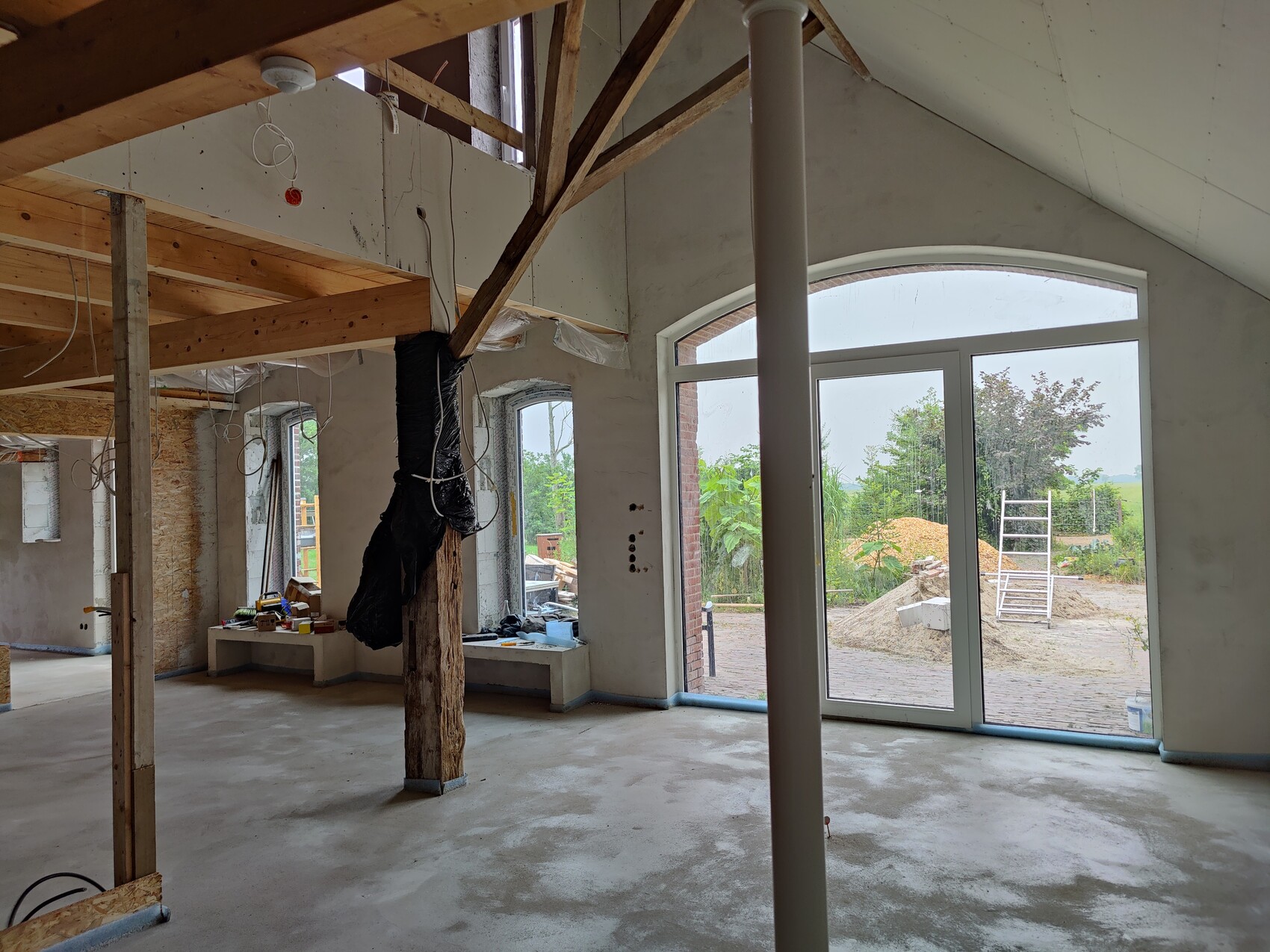
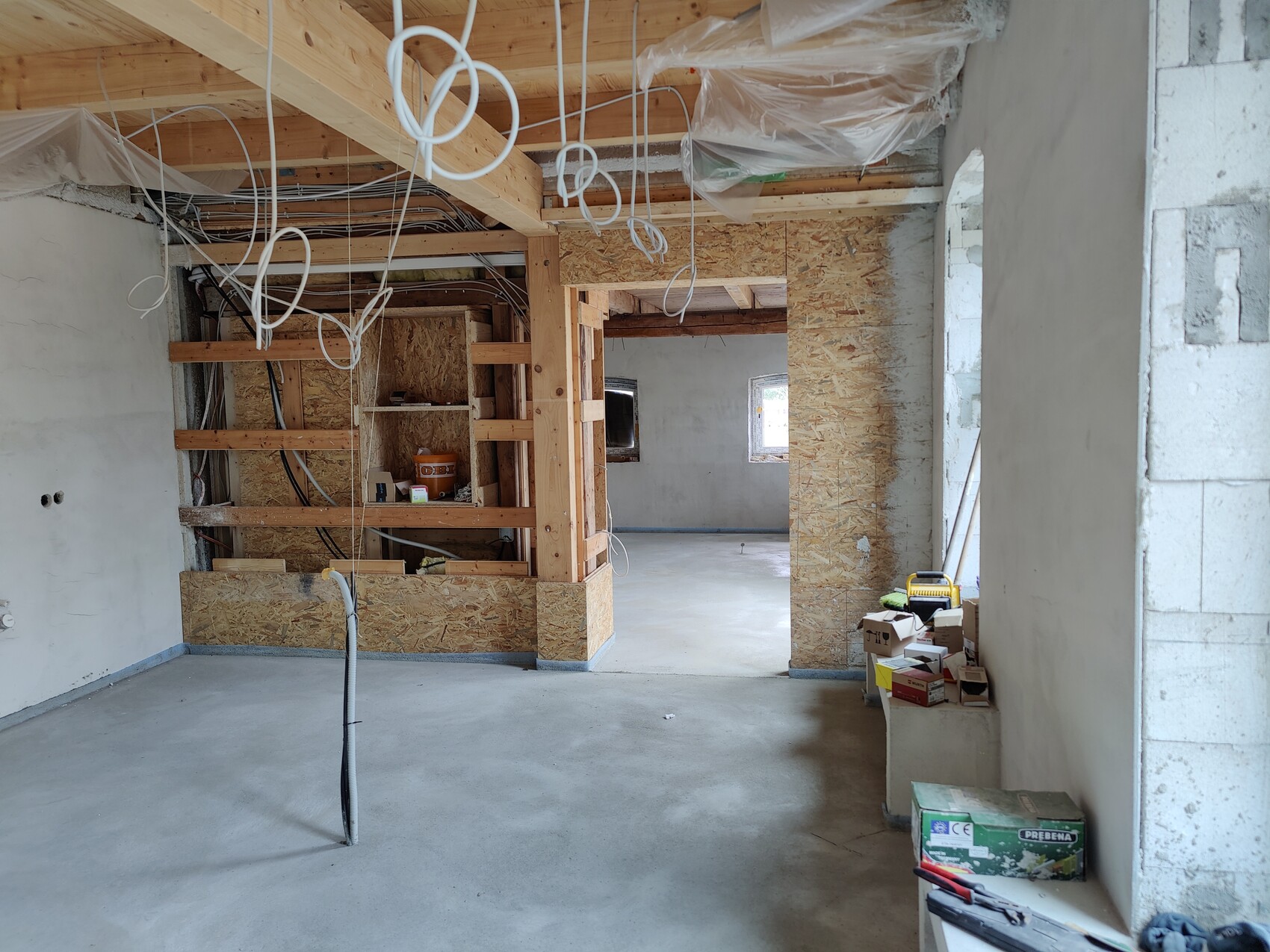
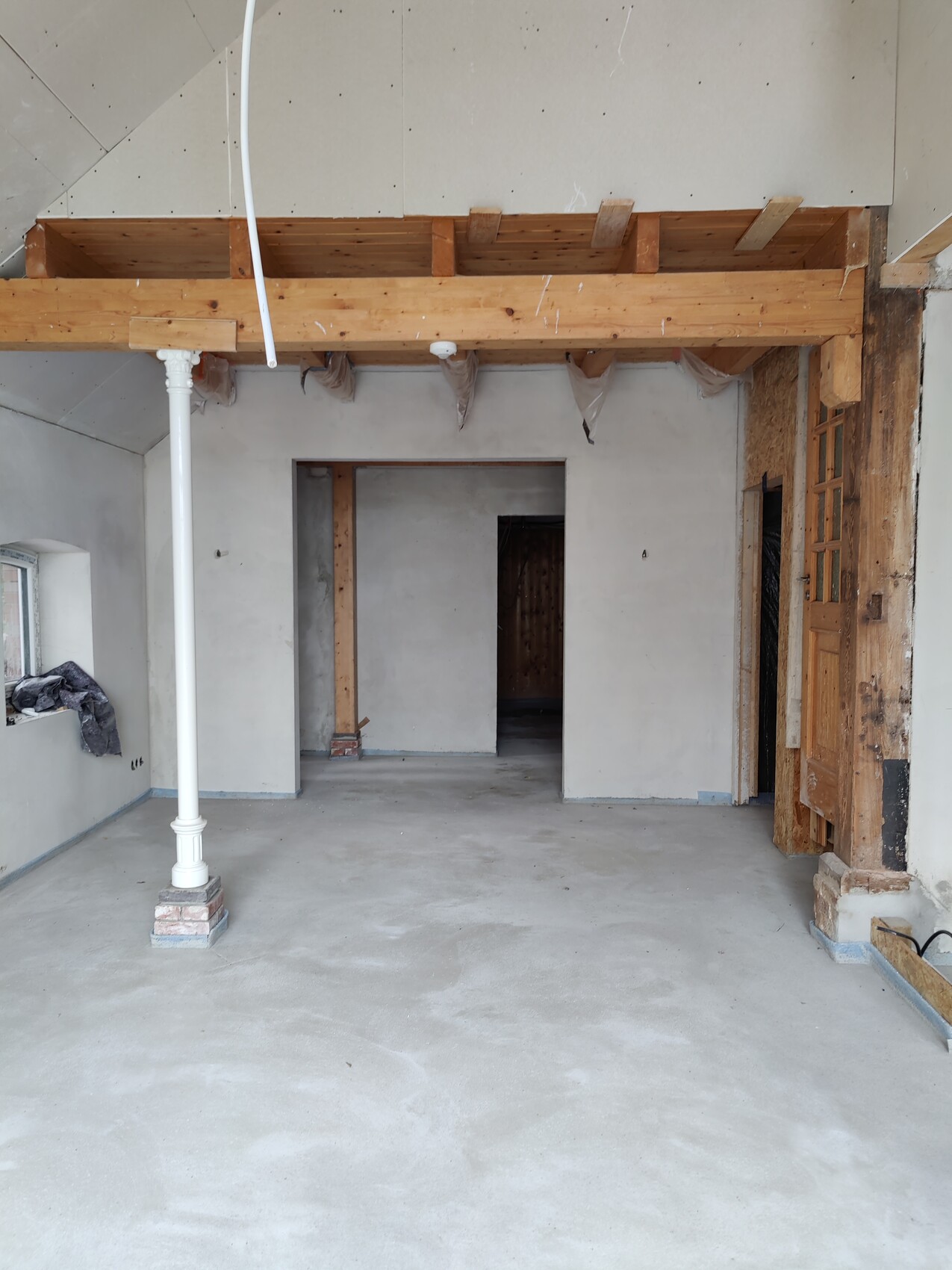
The electrical work is complete enough to allow the plasterer to come. The roof is insulated, the windows are installed, the underfloor heating has been laid, and the screed was poured a few days ago. The bases for the oak support posts were renewed, and various small tasks were completed.
Due to higher construction costs, a misaligned exterior wall, and “upgrades” (e.g., technical building aspects like the horizontal damp-proof course in the masonry, as well as aesthetic upgrades like real wood floorboards), we had to secure an additional 50,000 EUR in financing. Unfortunately, this isn’t the end—we will actually take out a loan from our in-laws.
We thought about it for a long time whether this was the right step for us, but we’d like to have everything “finished” rather than always saying: we’ll do x in 3 years and y in 5 years. The additional financing isn’t ideal, but since our incomes have increased quite well, it’s manageable. Although we knew that hitting the budget perfectly in a renovation/extension project is tough, especially with a rather tight budget, we still hoped for it 😉
In two weeks, the masons will carry out some remaining work and repairs, and we will install dry screed in the office (attic) and then continue with the remaining drywall work. The plumbers will come again soon to connect the underfloor heating. The painter is theoretically scheduled to complete the plaster finish by Q4 in September and will also paint the ceilings for us. Afterwards, we will do the rest of the painting and install the wooden flooring ourselves. Then the tiler can do their part. In between, hopefully the chimney builder and stair builder will stop by.
We hope to move in before Christmas—ideally before our holiday in early November. But with our time management, it’s not entirely certain.
At the moment, I’m really enjoying the outdoor area, especially our vegetable and fruit beds. Next year, three more beds will be added, and then I hope we can mainly live off the fruits and vegetables from our garden during the “summer” half of the year and won’t need to buy as much.
By the way: Sometimes I wonder if, because of the strong rise in construction prices, it might have been cheaper if we had contracted everything directly and the general contractor had completed it within a year.
And a quick question for the building experts: The plaster on the second picture on the left side is quite cracked. Behind it is an old stone wall, and the plaster had to be applied quite thickly to even it out. Does the plasterer need to fix this? I might take a better picture. The other walls have noticeably fewer or no cracks. The plaster was applied in May.
Short and sweet:
1. We have stayed true to ourselves and are again far behind schedule
2. Additional financing of around 50,000 EUR (so far, there’s more to come 😀 )
3. Despite everything, we’re very happy; it’s turning out pretty much exactly as we imagined
4. …but we’re fed up now 😉
Long version:
The interior insulation is finished and so far it looks solid. However, the ground floor is not heated yet and we’re not living downstairs yet. So the interior insulation remains a test until the first inhabited winter regarding moisture issues. On the bright side, we can say after more than two years: no water is coming in from the outside—neither from above, below, nor from the sides. So far, so good.
The electrical work is complete enough to allow the plasterer to come. The roof is insulated, the windows are installed, the underfloor heating has been laid, and the screed was poured a few days ago. The bases for the oak support posts were renewed, and various small tasks were completed.
Due to higher construction costs, a misaligned exterior wall, and “upgrades” (e.g., technical building aspects like the horizontal damp-proof course in the masonry, as well as aesthetic upgrades like real wood floorboards), we had to secure an additional 50,000 EUR in financing. Unfortunately, this isn’t the end—we will actually take out a loan from our in-laws.
We thought about it for a long time whether this was the right step for us, but we’d like to have everything “finished” rather than always saying: we’ll do x in 3 years and y in 5 years. The additional financing isn’t ideal, but since our incomes have increased quite well, it’s manageable. Although we knew that hitting the budget perfectly in a renovation/extension project is tough, especially with a rather tight budget, we still hoped for it 😉
In two weeks, the masons will carry out some remaining work and repairs, and we will install dry screed in the office (attic) and then continue with the remaining drywall work. The plumbers will come again soon to connect the underfloor heating. The painter is theoretically scheduled to complete the plaster finish by Q4 in September and will also paint the ceilings for us. Afterwards, we will do the rest of the painting and install the wooden flooring ourselves. Then the tiler can do their part. In between, hopefully the chimney builder and stair builder will stop by.
We hope to move in before Christmas—ideally before our holiday in early November. But with our time management, it’s not entirely certain.
At the moment, I’m really enjoying the outdoor area, especially our vegetable and fruit beds. Next year, three more beds will be added, and then I hope we can mainly live off the fruits and vegetables from our garden during the “summer” half of the year and won’t need to buy as much.
By the way: Sometimes I wonder if, because of the strong rise in construction prices, it might have been cheaper if we had contracted everything directly and the general contractor had completed it within a year.
And a quick question for the building experts: The plaster on the second picture on the left side is quite cracked. Behind it is an old stone wall, and the plaster had to be applied quite thickly to even it out. Does the plasterer need to fix this? I might take a better picture. The other walls have noticeably fewer or no cracks. The plaster was applied in May.
Similar topics