
Hello,
I wanted to give a brief, ongoing report on the renovation of our old farmstead. Basically, a little diary for ourselves – with maybe some added value for others with similar projects. Our budget: 340,000 EUR including everything, plus ongoing expenses covered from salary, for: modernization of the attic, renovation of the ground floor, with a total of around 190 m² (2,045 sq ft) of living space.
I'll start at the beginning:
We searched for a suitable plot for a long time; there are one or two posts about this in the forum. Unfortunately, plots are also scarce in our area. The older new development areas are sold out, except for the less desirable plots; the “new” development area, which was supposed to come to market 1.5 years ago, is still delayed. The city administration can’t agree on a developer [...]
A great plot that we wanted was unfortunately bought by a competitor. Then our wish list changed: we now wanted two adjacent plots (or one large one that could be divided): one for my parents, one for us. We hoped for certain advantages if Grandma and Grandpa later lived next door. Also, we could better support them in old age. The new development area continued to be delayed. My mom’s and sister’s horses fell ill with lead poisoning where they were kept, so my mom wanted to bring the horses to her place. We then searched in the rural zone for a large plot either close to a stable or ideally with permission to build one. Ha! If only it were that simple...
Although, despite good contacts with the building authority and mayor through my parents, we experienced a fairly reasonable approach to public law (though maybe the contacts didn’t even affect that), nothing really fit. In the end, I expanded my search to old farmsteads that, judging by their layout, could be divided into two living units or were already divided in part. That also took time. Sometimes we hesitated too long. I come from the real estate industry and had difficulty committing to a property immediately without a building surveyor (technical due diligence, as we say) involved.
Then we found our current farmstead, and it fit the bill: just under 400 m² (4,306 sq ft) of living space on paper, realistically a bit less; about 6,200 m² (1.53 acres) plot; a small stable/shed in the outdoor area; carport for 5 cars; division into two theoretical semi-detached units possible or partly already done; DSL 200 Mbps available (! – rare in rural areas here); well-developed road access. What was missing was pasture/land for the horses. What didn’t fully meet our wishes was the state road running along the property with a speed limit of 100 km/h (62 mph) and a large number of crows. But – we liked the house immediately; it had that certain something. My mom agreed spontaneously. No negotiation on the purchase price, which hurt our budget, but that way no one else saw the house and the risk of wild bargaining was eliminated. This does happen here now, especially when wealthy people from the south look for vacation homes on the Baltic coast.
To-dos:
Subdivision of the floor plan into two semi-detached units
Decide who gets the fully renovated semi-detached unit and who still has to renovate
Division of purchase price and incidental costs
Pasture
Outdoor facilities, etc.
TBC
Fun fact: We later learned the hairdresser of my husband’s used to live here with her parents. Our village is small.
I wanted to give a brief, ongoing report on the renovation of our old farmstead. Basically, a little diary for ourselves – with maybe some added value for others with similar projects. Our budget: 340,000 EUR including everything, plus ongoing expenses covered from salary, for: modernization of the attic, renovation of the ground floor, with a total of around 190 m² (2,045 sq ft) of living space.
I'll start at the beginning:
We searched for a suitable plot for a long time; there are one or two posts about this in the forum. Unfortunately, plots are also scarce in our area. The older new development areas are sold out, except for the less desirable plots; the “new” development area, which was supposed to come to market 1.5 years ago, is still delayed. The city administration can’t agree on a developer [...]
A great plot that we wanted was unfortunately bought by a competitor. Then our wish list changed: we now wanted two adjacent plots (or one large one that could be divided): one for my parents, one for us. We hoped for certain advantages if Grandma and Grandpa later lived next door. Also, we could better support them in old age. The new development area continued to be delayed. My mom’s and sister’s horses fell ill with lead poisoning where they were kept, so my mom wanted to bring the horses to her place. We then searched in the rural zone for a large plot either close to a stable or ideally with permission to build one. Ha! If only it were that simple...
Although, despite good contacts with the building authority and mayor through my parents, we experienced a fairly reasonable approach to public law (though maybe the contacts didn’t even affect that), nothing really fit. In the end, I expanded my search to old farmsteads that, judging by their layout, could be divided into two living units or were already divided in part. That also took time. Sometimes we hesitated too long. I come from the real estate industry and had difficulty committing to a property immediately without a building surveyor (technical due diligence, as we say) involved.
Then we found our current farmstead, and it fit the bill: just under 400 m² (4,306 sq ft) of living space on paper, realistically a bit less; about 6,200 m² (1.53 acres) plot; a small stable/shed in the outdoor area; carport for 5 cars; division into two theoretical semi-detached units possible or partly already done; DSL 200 Mbps available (! – rare in rural areas here); well-developed road access. What was missing was pasture/land for the horses. What didn’t fully meet our wishes was the state road running along the property with a speed limit of 100 km/h (62 mph) and a large number of crows. But – we liked the house immediately; it had that certain something. My mom agreed spontaneously. No negotiation on the purchase price, which hurt our budget, but that way no one else saw the house and the risk of wild bargaining was eliminated. This does happen here now, especially when wealthy people from the south look for vacation homes on the Baltic coast.
To-dos:
Subdivision of the floor plan into two semi-detached units
Decide who gets the fully renovated semi-detached unit and who still has to renovate
Division of purchase price and incidental costs
Pasture
Outdoor facilities, etc.
TBC
Fun fact: We later learned the hairdresser of my husband’s used to live here with her parents. Our village is small.

Why actually "on a budget"? I don’t think that really came across in my original post. Or rather, I simply wrote it wrongly.
We have 340,000 EUR plus ongoing expenses.
This is divided as follows:
200,000 EUR for our share of the land/house including all additional costs
140,000 EUR for the modernization in the attic and the renovation on the ground floor
We have already spent about 35,000 EUR of that.
In the upper floor still missing:
Raising the ceiling height of the ground floor (about 20 m² (215 sq ft)) because it is too low in the kitchen area (here, all the ceilings are amusingly and unevenly different heights [...]), installing lightweight partition walls to create two children’s rooms upstairs, or initially just one—the remaining part will be a gallery/library for now
On the ground floor:
everything is still missing except for the gutting. Erm. It was considered living space, but the floor slab is too thin and not sealed against rising moisture. There is no horizontal damp-proof course at the outer wall. The interior insulation was done like this: two rows of bricks, silo foil (!), then aerated concrete. Ouch. So, new interior insulation is needed as well. New windows are also required on the ground floor.
The floor plan will remain relatively the same. Only one or two new interior walls are needed, and the staircase will be moved to the other side of the load-bearing wall. Water connections are practically already where we need them and with the right dimensions. We will update the electrical system.
What remains untouched: the roof is in good condition, as is the roof insulation, the gas heating system from 2005, the hot water tank is adequately sized, and a solar system additionally helps to heat the water. The upper floor windows are sufficient for now (double-glazed, partly wood, partly uPVC). We already live in the upper floor (an open living-dining area with kitchen, bedroom, office, two full bathrooms, two storage rooms).
The most expensive items rank as follows: 1. new windows, 2. bathroom renovation, and 3. kitchen including the floor slab.
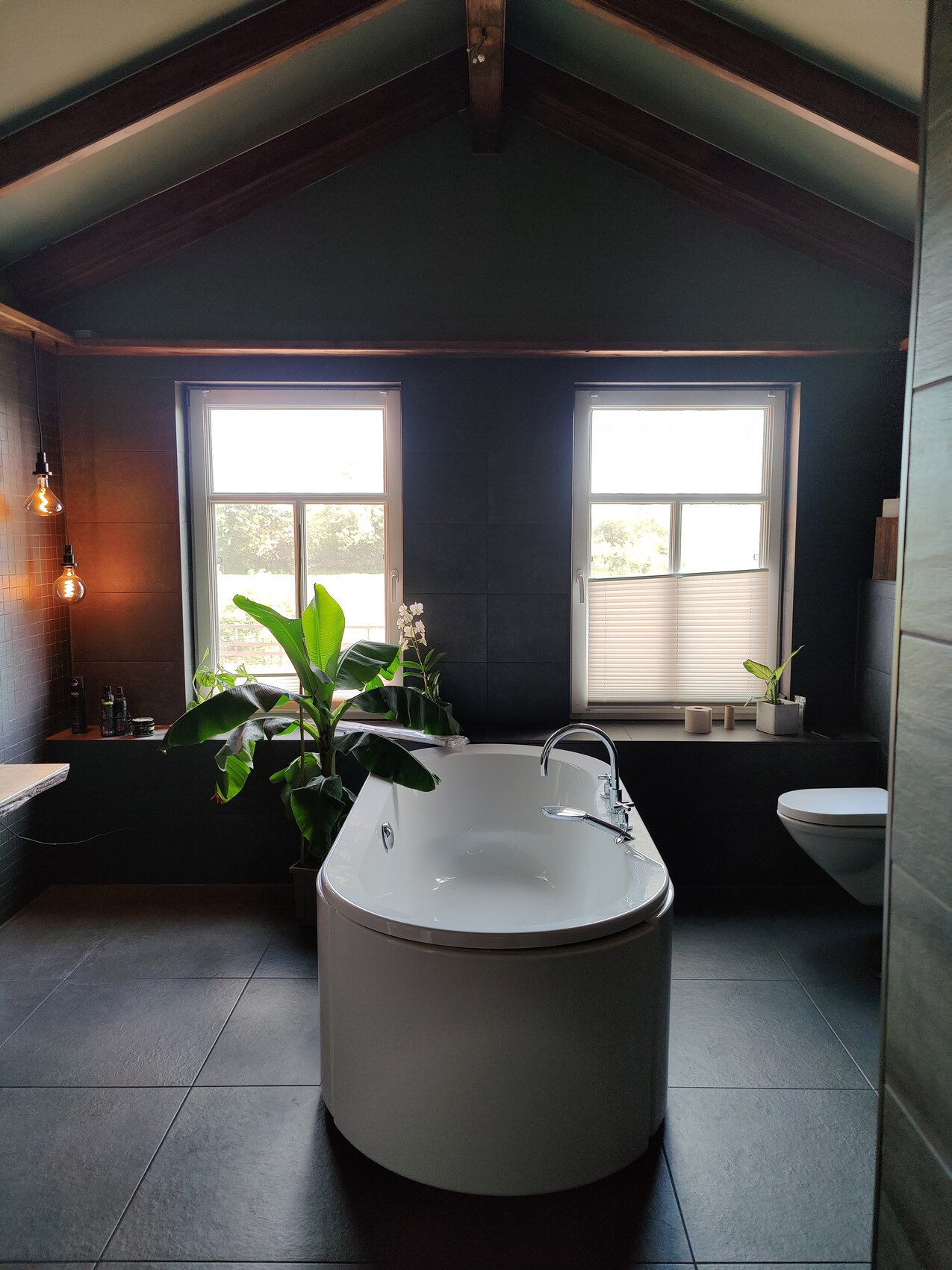
At least the bathroom is finished and the kitchen is also paid for.
Honestly, it’s enough to make you want to run away, and I’m sure some people already picture us on “The Bargain Houses,” followed by Peter Zwegat sitting on our sofa. I can understand that thought process well. But we are optimistic about managing this project—we know what the floor slab, insulation, and new windows will cost. Good friends of ours have already completed a similar project with 110,000 EUR for a full renovation/extension and much more space. However, there were fewer changes to the actual floor plan. They even had enough left over for a new terrace.
Still, those people were basically on site every day, and key tradespeople were within the family (master carpenter, electrician, plumber). It really takes a lot of energy and time. No one should underestimate that. When I was juggling the house project, a 39-hour workweek, and a rather intensive training course, I was really exhausted during exam time. We want to be finished by December 2021. Then we’ll see if we were dreamers.
Edit: a few more pictures of the shower.
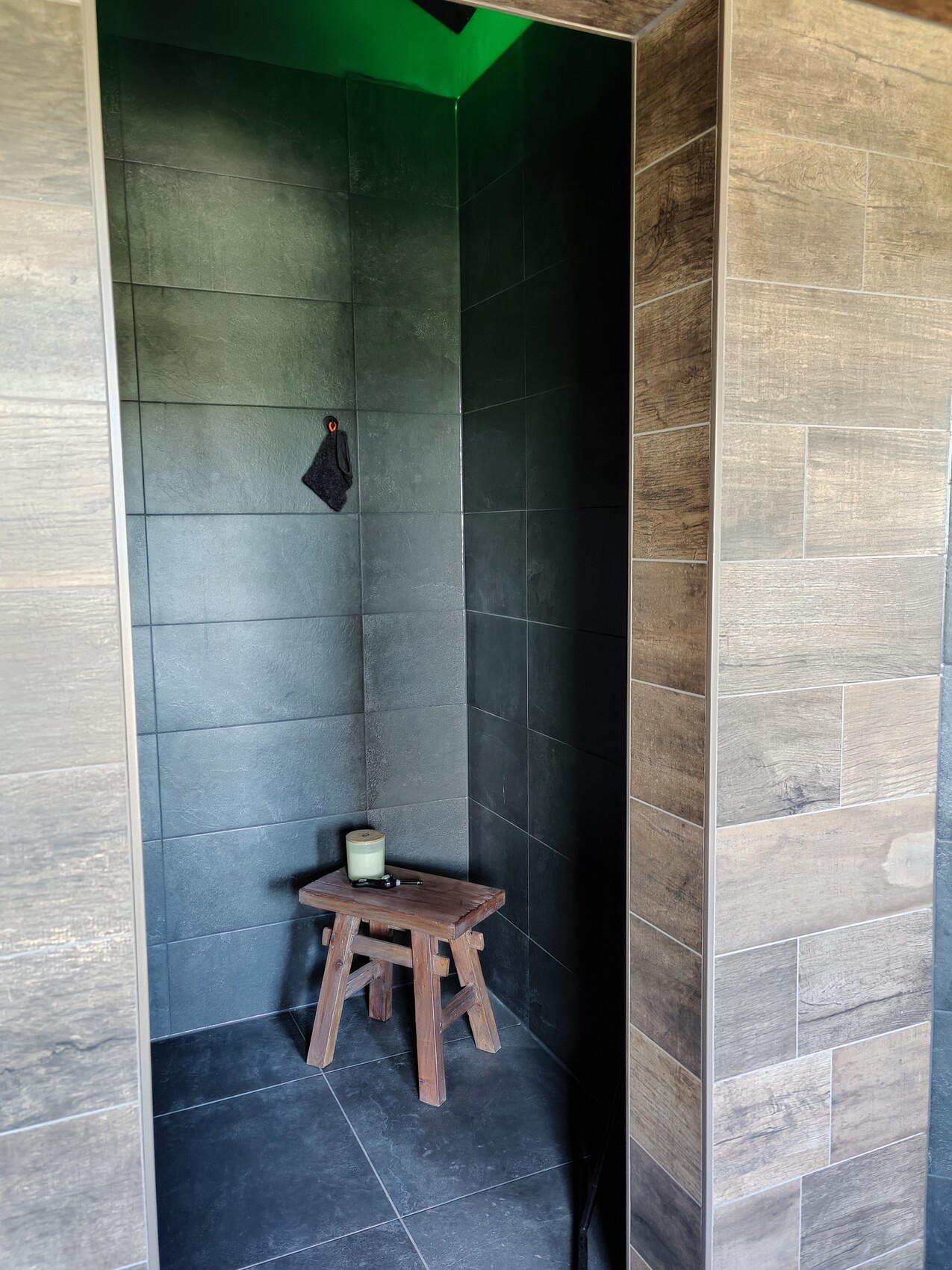
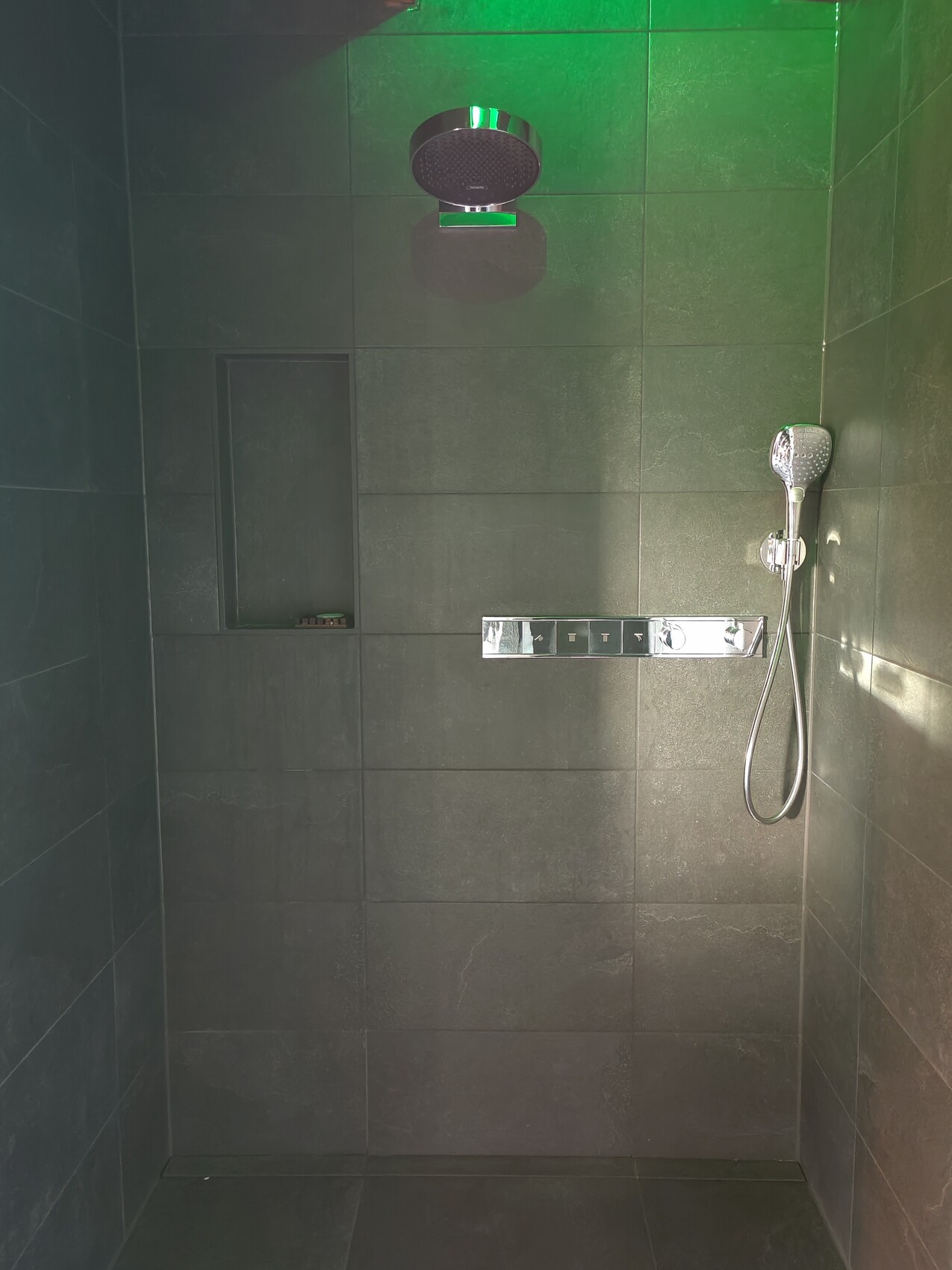
We have 340,000 EUR plus ongoing expenses.
This is divided as follows:
200,000 EUR for our share of the land/house including all additional costs
140,000 EUR for the modernization in the attic and the renovation on the ground floor
We have already spent about 35,000 EUR of that.
In the upper floor still missing:
Raising the ceiling height of the ground floor (about 20 m² (215 sq ft)) because it is too low in the kitchen area (here, all the ceilings are amusingly and unevenly different heights [...]), installing lightweight partition walls to create two children’s rooms upstairs, or initially just one—the remaining part will be a gallery/library for now
On the ground floor:
everything is still missing except for the gutting. Erm. It was considered living space, but the floor slab is too thin and not sealed against rising moisture. There is no horizontal damp-proof course at the outer wall. The interior insulation was done like this: two rows of bricks, silo foil (!), then aerated concrete. Ouch. So, new interior insulation is needed as well. New windows are also required on the ground floor.
The floor plan will remain relatively the same. Only one or two new interior walls are needed, and the staircase will be moved to the other side of the load-bearing wall. Water connections are practically already where we need them and with the right dimensions. We will update the electrical system.
What remains untouched: the roof is in good condition, as is the roof insulation, the gas heating system from 2005, the hot water tank is adequately sized, and a solar system additionally helps to heat the water. The upper floor windows are sufficient for now (double-glazed, partly wood, partly uPVC). We already live in the upper floor (an open living-dining area with kitchen, bedroom, office, two full bathrooms, two storage rooms).
The most expensive items rank as follows: 1. new windows, 2. bathroom renovation, and 3. kitchen including the floor slab.
At least the bathroom is finished and the kitchen is also paid for.
Honestly, it’s enough to make you want to run away, and I’m sure some people already picture us on “The Bargain Houses,” followed by Peter Zwegat sitting on our sofa. I can understand that thought process well. But we are optimistic about managing this project—we know what the floor slab, insulation, and new windows will cost. Good friends of ours have already completed a similar project with 110,000 EUR for a full renovation/extension and much more space. However, there were fewer changes to the actual floor plan. They even had enough left over for a new terrace.
Still, those people were basically on site every day, and key tradespeople were within the family (master carpenter, electrician, plumber). It really takes a lot of energy and time. No one should underestimate that. When I was juggling the house project, a 39-hour workweek, and a rather intensive training course, I was really exhausted during exam time. We want to be finished by December 2021. Then we’ll see if we were dreamers.
Edit: a few more pictures of the shower.
It doesn’t sound unrealistic. Of course, money is not unlimited as is the case for most people. However, you are not facing a six-figure difference between your wishes and budget.
You are also aware that the “little” amount of self-work cannot be completed in just a few weekends.
Looking forward to more pictures.
You are also aware that the “little” amount of self-work cannot be completed in just a few weekends.
Looking forward to more pictures.

@haydee Thank you very much for the encouraging words. However, I can completely understand if someone else might see it differently. I must admit, in some (weak) moments, I’ve even thought that maybe we are a bit naive.
@Climbee Yes, I pretty much have to agree with you. No normal person would do that. But unfortunately, I can’t overcome my inner perfectionist, who simply preferred the long plank look much more than the small-piece parquet. It would also make much more sense in terms of cost and time savings. Oh well.
At the moment, there’s nothing particularly exciting to report. We recently re-landscaped the lawn area, which looked like a crater landscape before. A friend who works in consulting for farmers helped us get the type of grass she recommended at wholesale. She reassured us that if we don’t want an English lawn, we don’t need to completely remove the old turf first. We had soil delivered, and my cousin distributed it with, I quote, "the smallest excavator we have," and has already partially leveled it. Due to two somewhat larger apple trees, he couldn’t reach all areas. So, we shoveled and raked quite a bit. Then we worked in some soil activator, sowed the grass seed, rolled it, and soon we’ll apply lawn fertilizer.
We have also disposed of a lot of waste and still have more to take away — it’s incredible how much tree debris accumulates. Certainly not very environmentally friendly. Soon we will start the probably most important project: the concrete slab. We are supported here by an architect and a structural engineer, whom we pay hourly. The construction proceeds as shown in the picture, which can be roughly made out:
1. Geotextile on the ground, along the foundation of the walls, folded up on top
2. Foam glass gravel compacted in between, denser towards the top
3. Protective foil
4. Concrete slab with reinforcement (mesh, rebar)
5. Insulation
Due to structural requirements, we have to work in sections. Five sections in total; the previous section needs to be dry and stable before starting the next. This, of course, prolongs the process and does not make the rental of the mini excavator any cheaper. But well, it is what it is.
Have a nice evening everyone.
Oh, in case it causes confusion: my cousin was removing the root of an old yew tree there, not distributing soil.
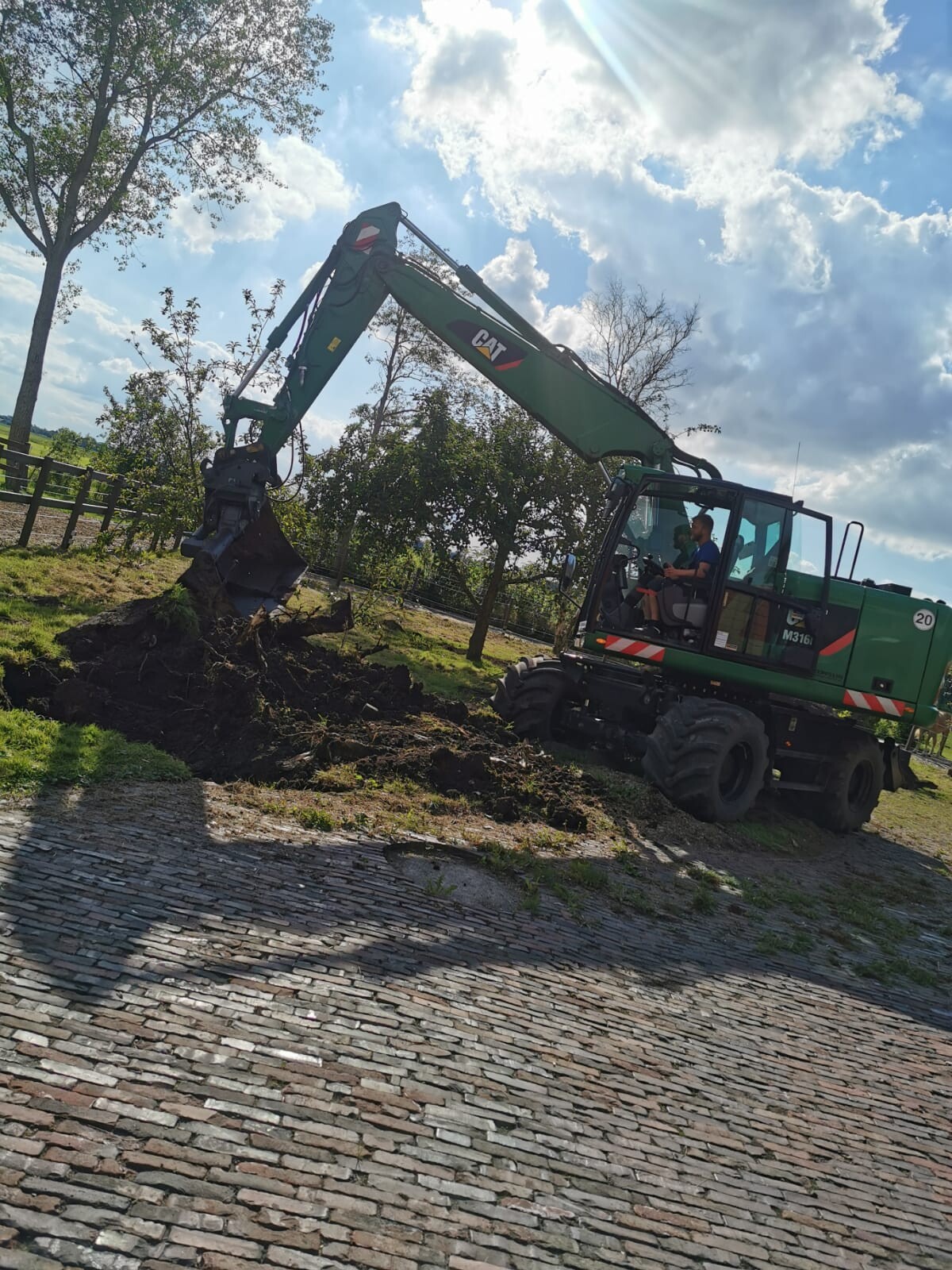

@Climbee Yes, I pretty much have to agree with you. No normal person would do that. But unfortunately, I can’t overcome my inner perfectionist, who simply preferred the long plank look much more than the small-piece parquet. It would also make much more sense in terms of cost and time savings. Oh well.
At the moment, there’s nothing particularly exciting to report. We recently re-landscaped the lawn area, which looked like a crater landscape before. A friend who works in consulting for farmers helped us get the type of grass she recommended at wholesale. She reassured us that if we don’t want an English lawn, we don’t need to completely remove the old turf first. We had soil delivered, and my cousin distributed it with, I quote, "the smallest excavator we have," and has already partially leveled it. Due to two somewhat larger apple trees, he couldn’t reach all areas. So, we shoveled and raked quite a bit. Then we worked in some soil activator, sowed the grass seed, rolled it, and soon we’ll apply lawn fertilizer.
We have also disposed of a lot of waste and still have more to take away — it’s incredible how much tree debris accumulates. Certainly not very environmentally friendly. Soon we will start the probably most important project: the concrete slab. We are supported here by an architect and a structural engineer, whom we pay hourly. The construction proceeds as shown in the picture, which can be roughly made out:
1. Geotextile on the ground, along the foundation of the walls, folded up on top
2. Foam glass gravel compacted in between, denser towards the top
3. Protective foil
4. Concrete slab with reinforcement (mesh, rebar)
5. Insulation
Due to structural requirements, we have to work in sections. Five sections in total; the previous section needs to be dry and stable before starting the next. This, of course, prolongs the process and does not make the rental of the mini excavator any cheaper. But well, it is what it is.
Have a nice evening everyone.
Oh, in case it causes confusion: my cousin was removing the root of an old yew tree there, not distributing soil.
Yes, in two to three weeks there will likely be a new, more detailed update. The fact is, we are currently running “slightly” behind schedule and therefore don’t have much new to report. But maybe that is exactly the main point: things often turn out differently than planned 😀
We have now decided to hire a company for the excavation and pouring of the foundation slab. This will probably not cost us much more than if we had continued renting and transporting the necessary construction machinery (excavators, etc.) ourselves. Unfortunately, the company’s start date has been significantly delayed (about 1.5 months) due to reported COVID cases, and it took us around a month to find someone willing to construct the foundation slab in about 8 sections (previously planned as 5). At the moment, nobody is particularly eager to take on this task. So far, we have mostly removed the old concrete ourselves, laid geotextile fabric, backfilled with crushed glass aggregate, and compacted it. Once the next section is finished, we will relocate the old staircase. After that, I’ll post some pictures and describe one or two things in detail. 🙂
Overall, we hope to stay on schedule. Since we are also expecting a new addition to the family, the plan is to complete the foundation slab, interior insulation, and masonry work by mid-June, as well as have the new windows installed. Ideally, the electrical work downstairs will also be finished by then. We’ll see how things develop.
We have now decided to hire a company for the excavation and pouring of the foundation slab. This will probably not cost us much more than if we had continued renting and transporting the necessary construction machinery (excavators, etc.) ourselves. Unfortunately, the company’s start date has been significantly delayed (about 1.5 months) due to reported COVID cases, and it took us around a month to find someone willing to construct the foundation slab in about 8 sections (previously planned as 5). At the moment, nobody is particularly eager to take on this task. So far, we have mostly removed the old concrete ourselves, laid geotextile fabric, backfilled with crushed glass aggregate, and compacted it. Once the next section is finished, we will relocate the old staircase. After that, I’ll post some pictures and describe one or two things in detail. 🙂
Overall, we hope to stay on schedule. Since we are also expecting a new addition to the family, the plan is to complete the foundation slab, interior insulation, and masonry work by mid-June, as well as have the new windows installed. Ideally, the electrical work downstairs will also be finished by then. We’ll see how things develop.
Similar topics