
ᐅ Floor plan for a single-family house replacement build next to a timber-framed house under historic preservation
Created on: 31 Dec 2025 18:23
S
skuddel
Hello dear forum members,
We are a young family ready to take on the adventure of building a house. Over the course of the year, we managed to purchase a plot of land. It is located in a rural area near a large city in eastern Germany and measures almost 3000sqm (0.74 acres), bordering a forest. Currently, there are several buildings on the property. One of these is a listed half-timbered house from the 19th century, with its gable facing the street. Slightly offset is a single-family house built in 1966 (building no. 32 on the layout plan), which we plan to dismantle and replace with a new building on the same site, oriented in the same direction. Our vision is for the new building to create the appearance of a two-sided courtyard. From the street side, the new build should look like a converted barn. In discussions with our architect and through shared considerations, we have developed the following floor plan:
Development Plan / Restrictions
There is no formal development plan; building must comply with §34BauGB (German building code), meaning the building footprint is roughly aligned with the sightline of neighboring houses. According to the building authority, various house types are possible (bungalow, two stories, etc.) since these exist in the area. However, due to the listed building, the conservation authority has imposed an environmental protection requirement, meaning the new building must harmonize with the local streetscape. A modern cubic house would not be suitable. This is also why we aim for the two-sided courtyard style. The ridge height is key for our case officer: the new building must not be significantly taller than the old farmhouse (the farmhouse’s ridge height is 7.9m (26 ft)).
Plot size: 3000sqm (0.74 acres)
Slope: slight downhill from the street to the house
Floor area ratio
Gross floor area ratio
Building envelope, building line and boundary
Edge development
Number of parking spaces:
Number of storeys:
Roof shape:
Architectural style:
Orientation:
Maximum heights / limits:
Client Requirements
Style, roof type, building type: 1.5 storeys, gable roof with 40-45° pitch, no basement
Number and age of residents: currently 4 persons (34+34+7+3, possibly 1 more child)
Space requirements: Ground floor with kitchen, living room, dining area, bathroom with shower, utility room (laundry/storage); upper floor with 2 children’s rooms, 1 bedroom, 1 dressing room (planned as a third children’s room if needed); bathroom with bathtub
Office/guest room: no home office, occasional guests about once every two months, 2 persons for several days—accommodated in the farmhouse
Open or closed architecture: closed
Conservative, rather enclosed construction
Number of dining seats: fixed for 5 people, extendable to 8-10
Fireplace: tiled stove
Music/stereo wall: no
Balcony, roof terrace: no
Garage, carport: carport planned as boundary building with NW neighbor
Utility garden, greenhouse: yes, currently two greenhouses exist; plans for sheep and chickens
Additional Wishes / Special Features / Daily Routine:
Window shutters, window sizes preferably uniform (differences between upper and lower floor are acceptable but shape should remain similar)
Access to the terrace from kitchen and dining area; currently, the driveway is on the SE side next to the farmhouse. To protect the listed building and due to a lack of space for two cars, and because there is a second curb cut, we will move the driveway to the NW side and place a carport there along the street side. This will shorten the path to the kitchen for unloading groceries, etc. The main entrance will remain on the SE side, as it offers a shorter route to the outbuildings/farmhouse/heating room/bike shed, etc.
In coordination with the builder and heating/plumbing experts, we plan to integrate the heating room into an existing outbuilding so that the utility room inside the house can be used solely for laundry/storage.
The façade on the street side might feature a terrace door/floor-to-ceiling window possibly with a sliding wooden gate to evoke a barn-like appearance.
Initially, the gable room on the upper floor was intended as a dressing room, but since it offers the best garden view, we swapped it with the room currently labeled as dressing room on the plan; this room could be used as a third children’s room if needed. We prefer the luxury of having only a bed in the bedroom and no wardrobes, but in case of a third child, a wardrobe could be placed in the gable room.
We want to implement a half-landing staircase also considering aging; we also plan a laundry hatch at the half-landing to avoid carrying laundry across the whole house.
Natural light from two directions on the upper floor was important to us, so each room also has a skylight. The fixed children’s rooms face west towards the street, and each has one window to the north and one to the south.
For the main living areas—the kitchen and dining room—it was important to have a view and access to the garden. The living room has been moved to the north/northwest since it is less important to us; we expect to spend a lot of time outdoors. With the floor-to-ceiling window/terrace door in the living room, we want to capture light even in autumn and winter.
House Design
Designed by:
- DIY and architect
What do you particularly like? Why? Appearance; on the ground floor, separation of “dirty area” from
What do you dislike? Why?
Price estimate according to architect/planner:
Personal price limit for the house including fixtures:
Preferred heating technology: combination of heat pump and gas heating (for the farmhouse)
If you had to give up something, which details/extensions
- Could you give up? We would like to reduce some square meters, especially on the upper floor, but aren’t sure how or where. We are open to ideas to make the floor plan a bit more compact, especially considering the children moving out in the distant future.
- Could not give up:
Why did the design turn out as it did? For example:
We like the architecture of settlement houses or country houses in Brandenburg. We also tried to consider sightlines inside the house. We prefer a straightforward style and want something rather traditional in view of the listed farmhouse.
We are unsure if the kitchen layout will work. It is not yet fully furnished. However, we like the idea of a peninsula with a view of the garden. We also plan to add a bench at the peninsula (with the window/door behind it) so people can chat or kids can quickly eat something.
Unfortunately, I was not able to add a compass to the floor plans. The bay window faces the garden, i.e., east.
If I forgot something, please feel free to ask and I will try to answer.
Overall, we look forward to your comments. Until then, we wish you a pleasant last day of 2025.
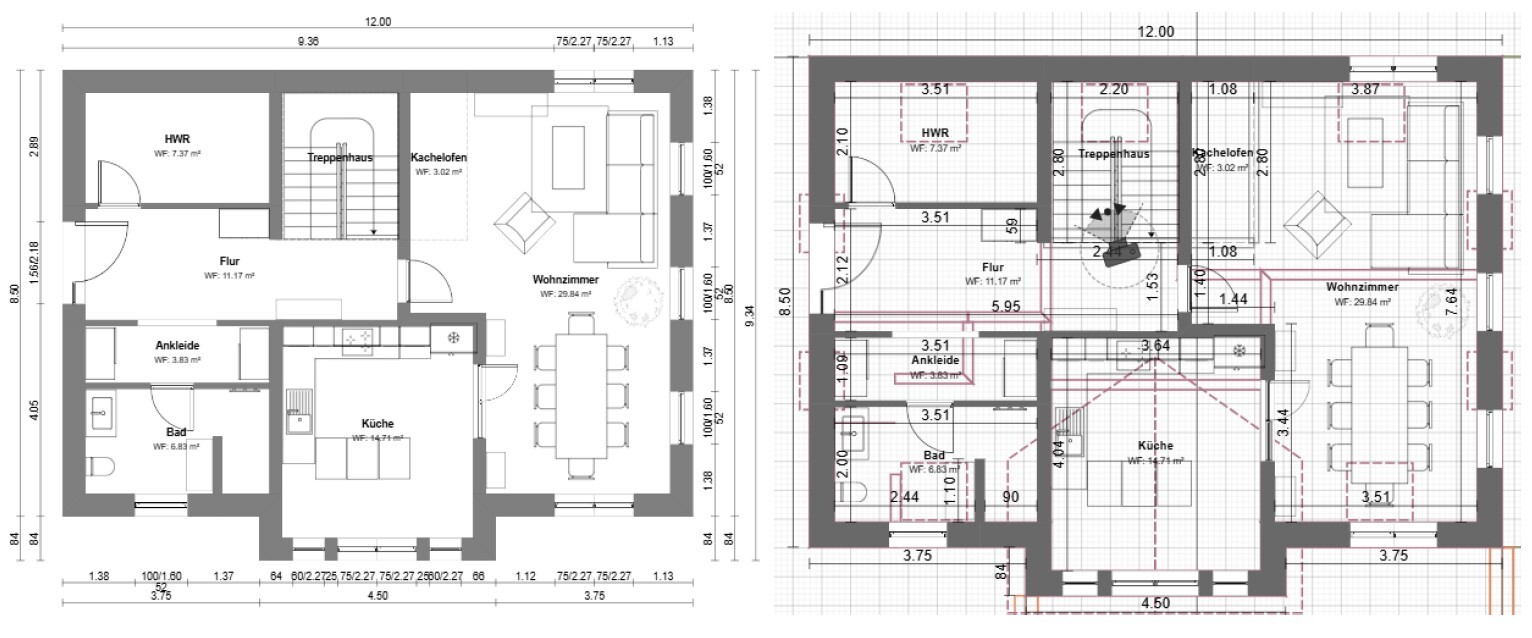
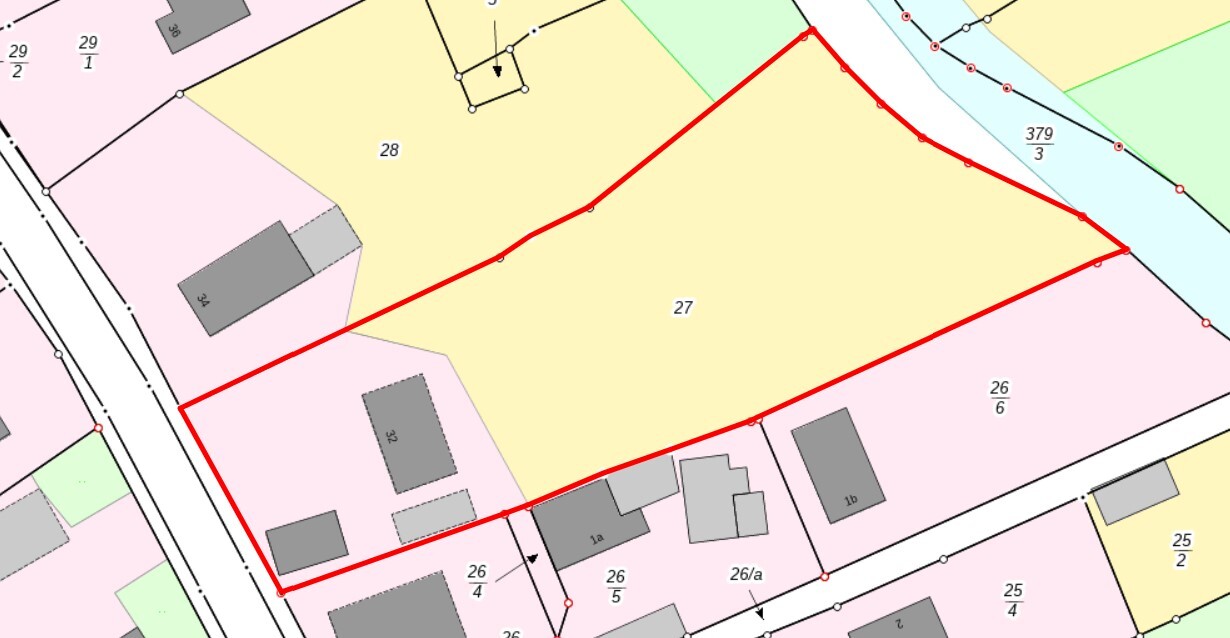
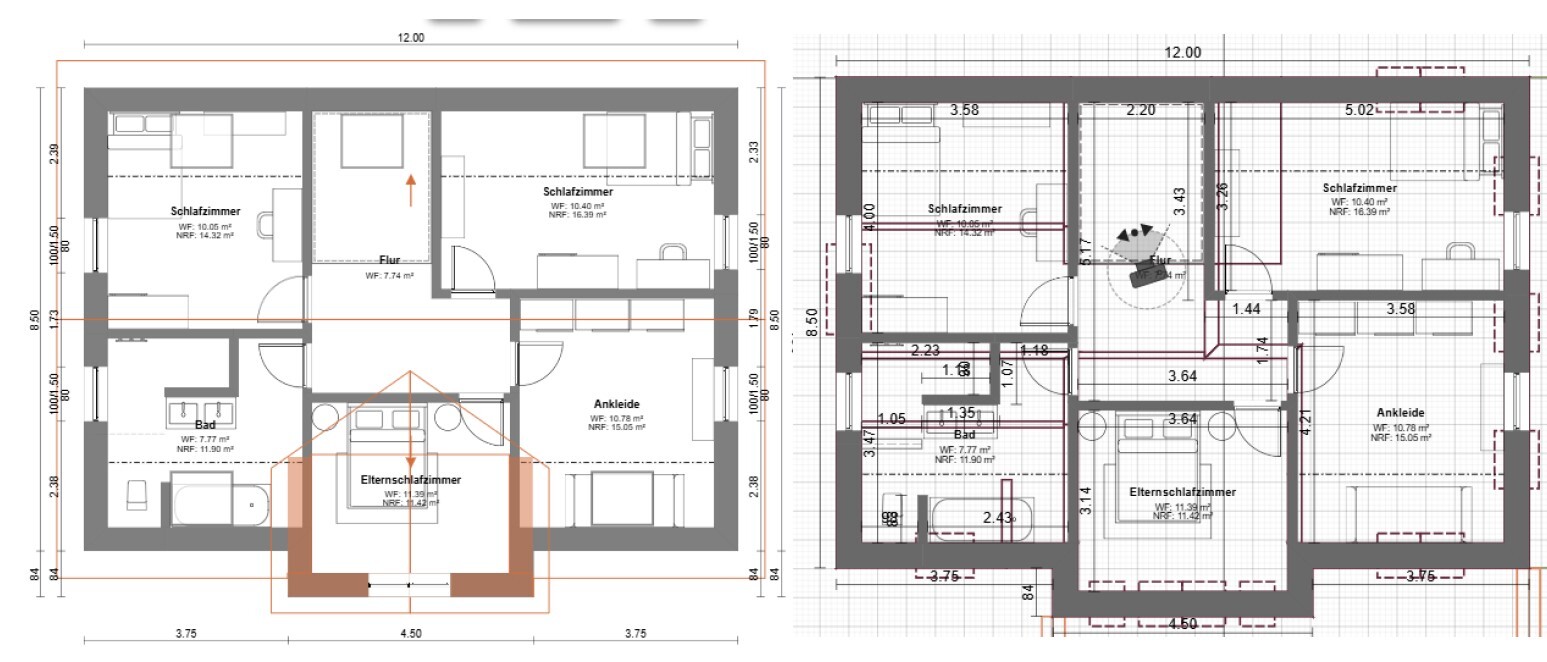
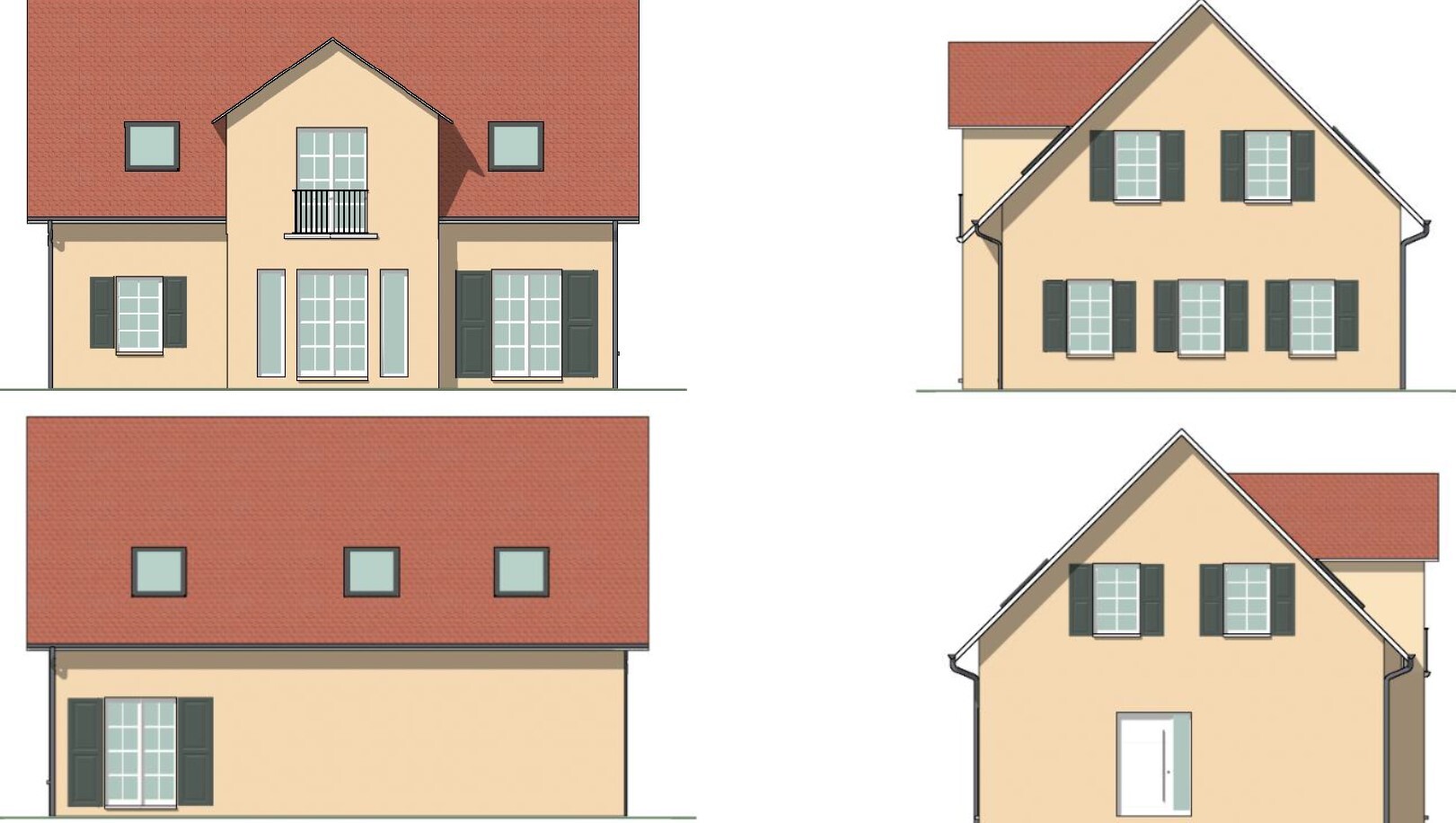
We are a young family ready to take on the adventure of building a house. Over the course of the year, we managed to purchase a plot of land. It is located in a rural area near a large city in eastern Germany and measures almost 3000sqm (0.74 acres), bordering a forest. Currently, there are several buildings on the property. One of these is a listed half-timbered house from the 19th century, with its gable facing the street. Slightly offset is a single-family house built in 1966 (building no. 32 on the layout plan), which we plan to dismantle and replace with a new building on the same site, oriented in the same direction. Our vision is for the new building to create the appearance of a two-sided courtyard. From the street side, the new build should look like a converted barn. In discussions with our architect and through shared considerations, we have developed the following floor plan:
Development Plan / Restrictions
There is no formal development plan; building must comply with §34BauGB (German building code), meaning the building footprint is roughly aligned with the sightline of neighboring houses. According to the building authority, various house types are possible (bungalow, two stories, etc.) since these exist in the area. However, due to the listed building, the conservation authority has imposed an environmental protection requirement, meaning the new building must harmonize with the local streetscape. A modern cubic house would not be suitable. This is also why we aim for the two-sided courtyard style. The ridge height is key for our case officer: the new building must not be significantly taller than the old farmhouse (the farmhouse’s ridge height is 7.9m (26 ft)).
Plot size: 3000sqm (0.74 acres)
Slope: slight downhill from the street to the house
Floor area ratio
Gross floor area ratio
Building envelope, building line and boundary
Edge development
Number of parking spaces:
Number of storeys:
Roof shape:
Architectural style:
Orientation:
Maximum heights / limits:
Client Requirements
Style, roof type, building type: 1.5 storeys, gable roof with 40-45° pitch, no basement
Number and age of residents: currently 4 persons (34+34+7+3, possibly 1 more child)
Space requirements: Ground floor with kitchen, living room, dining area, bathroom with shower, utility room (laundry/storage); upper floor with 2 children’s rooms, 1 bedroom, 1 dressing room (planned as a third children’s room if needed); bathroom with bathtub
Office/guest room: no home office, occasional guests about once every two months, 2 persons for several days—accommodated in the farmhouse
Open or closed architecture: closed
Conservative, rather enclosed construction
Number of dining seats: fixed for 5 people, extendable to 8-10
Fireplace: tiled stove
Music/stereo wall: no
Balcony, roof terrace: no
Garage, carport: carport planned as boundary building with NW neighbor
Utility garden, greenhouse: yes, currently two greenhouses exist; plans for sheep and chickens
Additional Wishes / Special Features / Daily Routine:
Window shutters, window sizes preferably uniform (differences between upper and lower floor are acceptable but shape should remain similar)
Access to the terrace from kitchen and dining area; currently, the driveway is on the SE side next to the farmhouse. To protect the listed building and due to a lack of space for two cars, and because there is a second curb cut, we will move the driveway to the NW side and place a carport there along the street side. This will shorten the path to the kitchen for unloading groceries, etc. The main entrance will remain on the SE side, as it offers a shorter route to the outbuildings/farmhouse/heating room/bike shed, etc.
In coordination with the builder and heating/plumbing experts, we plan to integrate the heating room into an existing outbuilding so that the utility room inside the house can be used solely for laundry/storage.
The façade on the street side might feature a terrace door/floor-to-ceiling window possibly with a sliding wooden gate to evoke a barn-like appearance.
Initially, the gable room on the upper floor was intended as a dressing room, but since it offers the best garden view, we swapped it with the room currently labeled as dressing room on the plan; this room could be used as a third children’s room if needed. We prefer the luxury of having only a bed in the bedroom and no wardrobes, but in case of a third child, a wardrobe could be placed in the gable room.
We want to implement a half-landing staircase also considering aging; we also plan a laundry hatch at the half-landing to avoid carrying laundry across the whole house.
Natural light from two directions on the upper floor was important to us, so each room also has a skylight. The fixed children’s rooms face west towards the street, and each has one window to the north and one to the south.
For the main living areas—the kitchen and dining room—it was important to have a view and access to the garden. The living room has been moved to the north/northwest since it is less important to us; we expect to spend a lot of time outdoors. With the floor-to-ceiling window/terrace door in the living room, we want to capture light even in autumn and winter.
House Design
Designed by:
- DIY and architect
What do you particularly like? Why? Appearance; on the ground floor, separation of “dirty area” from
What do you dislike? Why?
Price estimate according to architect/planner:
Personal price limit for the house including fixtures:
Preferred heating technology: combination of heat pump and gas heating (for the farmhouse)
If you had to give up something, which details/extensions
- Could you give up? We would like to reduce some square meters, especially on the upper floor, but aren’t sure how or where. We are open to ideas to make the floor plan a bit more compact, especially considering the children moving out in the distant future.
- Could not give up:
Why did the design turn out as it did? For example:
We like the architecture of settlement houses or country houses in Brandenburg. We also tried to consider sightlines inside the house. We prefer a straightforward style and want something rather traditional in view of the listed farmhouse.
We are unsure if the kitchen layout will work. It is not yet fully furnished. However, we like the idea of a peninsula with a view of the garden. We also plan to add a bench at the peninsula (with the window/door behind it) so people can chat or kids can quickly eat something.
Unfortunately, I was not able to add a compass to the floor plans. The bay window faces the garden, i.e., east.
If I forgot something, please feel free to ask and I will try to answer.
Overall, we look forward to your comments. Until then, we wish you a pleasant last day of 2025.
@ypg ... I prefer the placement of the house better. The question is whether it fits well with the "integration into the surroundings."
@skuddel .. is there a site plan of the plot with some measurements?
That doesn’t fit and is actually one of the biggest issues.
I generally consider it difficult to relocate the technical room like that.
@skuddel .. is there a site plan of the plot with some measurements?
skuddel schrieb:
Slightly offset stands a single-family house built in 1966 (building no. 32 on the floor plan), which we will dismantle and want to build a replacement on the same spot with the same orientation.
That doesn’t fit and is actually one of the biggest issues.
skuddel schrieb:
In consultation with the builder and heating/plumbing specialists, we plan to integrate the utility room into an existing outbuilding,
I generally consider it difficult to relocate the technical room like that.
Good evening everyone,
Thank you very much for the responses.
I thought my description was fairly accurate, but it seems some information was still missing to make it fully clear.
We have indeed spent a great deal of time considering light/sun position, room layout and space requirements, and have also reflected on the role aesthetics play for us.
Attached is the plot excerpt with the building envelope and planned new construction to clarify the orientation. I cropped the rest of the property as it is not relevant to the question at hand. The dimensions are approximately 28 m x 96 m (92 ft x 315 ft), with the plot widening toward the rear to about 45 m (148 ft) in width.
The house orientation is theoretically open. Thanks to your critical questions, we were able to thoroughly explore a gable-end orientation and can actually imagine it to a limited extent. Also to consider is that with a gable-end design, two facades of the house might be subject to heritage listing.
A roof-ridge side orientation supports better garden privacy: it creates a well-protected rear area, hardly visible from the street. This is important to us as a living and recreational space. Furthermore, we don’t want to fully pave the front area of the house. We find the current large front garden very pleasant and want to preserve this quality. A decorative tree is also planned there.
Although it may seem obvious today to place the entrance directly at the driveway or parking spaces, we do not see this as absolutely necessary. The entrance on the south/east side makes more sense for us considering internal circulation to the outbuilding and other uses on the property, and it feels more natural for everyday life.
The suggested layout with the living areas facing south toward the outbuilding is only partially feasible for us. The outbuilding in question is two stories, currently only about 2.5 m (8 ft) from the existing house, and does not offer an attractive view in its present state (aka "shabby shed of shame"). Certainly, it could be greened or clad, but if we can choose, this is not the view we would prefer. The new building might be shifted slightly toward the northern neighbor to increase the distance.
We also reviewed the suggested thread and find the approach understandable and helpful, but encountered some limits adapting it to our specific situation: First, the upstairs bathroom would need to be moved to the northeast with the guest bathroom below it, which would bring the living and dining area closer to the "shed of shame." Second, one of the children’s rooms would no longer be on the west side. On the ground floor, the living room would again be oriented toward the shabby shed.
Dividing the ground floor into “dirty” and living areas, and having only one south-facing window on the ground floor (utility room), was intentional. The south side cannot be viewed well from a distance since the shabby shed is directly next to it and the passage width is only about 2.5 m (8 ft).
We have really thought a lot about the lighting and were uncertain if the lighting situation with a northeast orientation for the living and dining area would be sufficient. Our neighbors’ living situation gave us food for thought: with a terrace facing south, it is hardly used for most of the summer and the windows are shaded almost all day. We would find it unfavorable to sit in a hopefully cool house during summer in the dark. We prefer natural light while accepting it may be less bright in winter. It is also questionable how much the two-story shed might significantly shade the house.
One more thing concerning the street view: this is heritage-relevant. We were told, at least verbally, that the window dimensions must correspond to the farmhouse style, i.e., rather small, multi-pane windows. This was one reason we initially planned to reduce the number of windows on the street side and designed the façade to resemble a barn with a barn door. With the kitchen on the west side and smaller kitchen windows, this could also be realized well. The street-facing side was not our primary aesthetic concern. The most attractive view should be from the garden, as this is where we will see the house most closely.
Regarding the upstairs bathroom and the "wall you run into": the idea was to visually separate the shower area so you don’t look directly into the shower when entering the room.
Thanks for the info about the towel warmer!
kbt already mentioned this as well, but I wonder what you do in a U- or L-shaped kitchen in a 14 sqm (150 sq ft) room with all the free space?
As you can see, with the conditions — including the shabby shed of shame and our clear desire for views both from inside to the garden and from the garden to the house — it is not easy to implement the suggested ideas one on one. Nevertheless, we would appreciate any suggestions on the following points:
Thank you very much, and best regards.
P.S. Attached again are the floor plans with hopefully improved measurements.
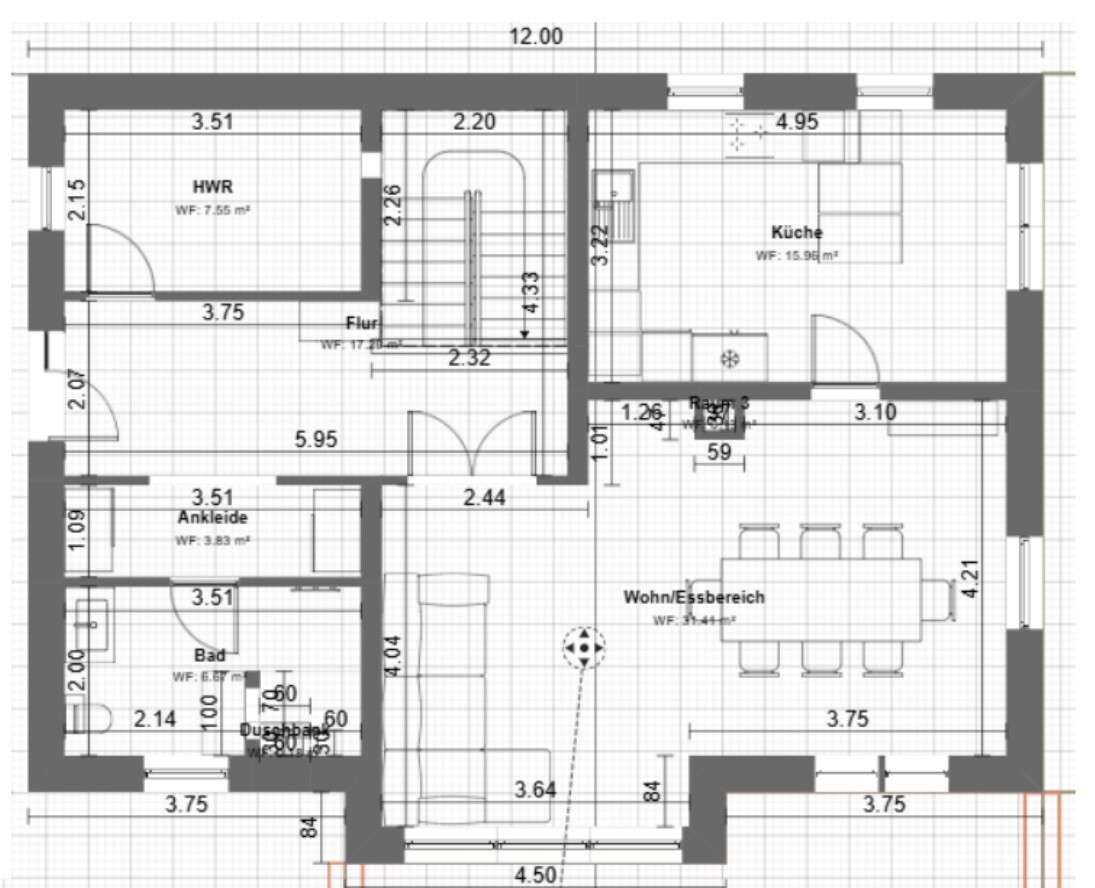
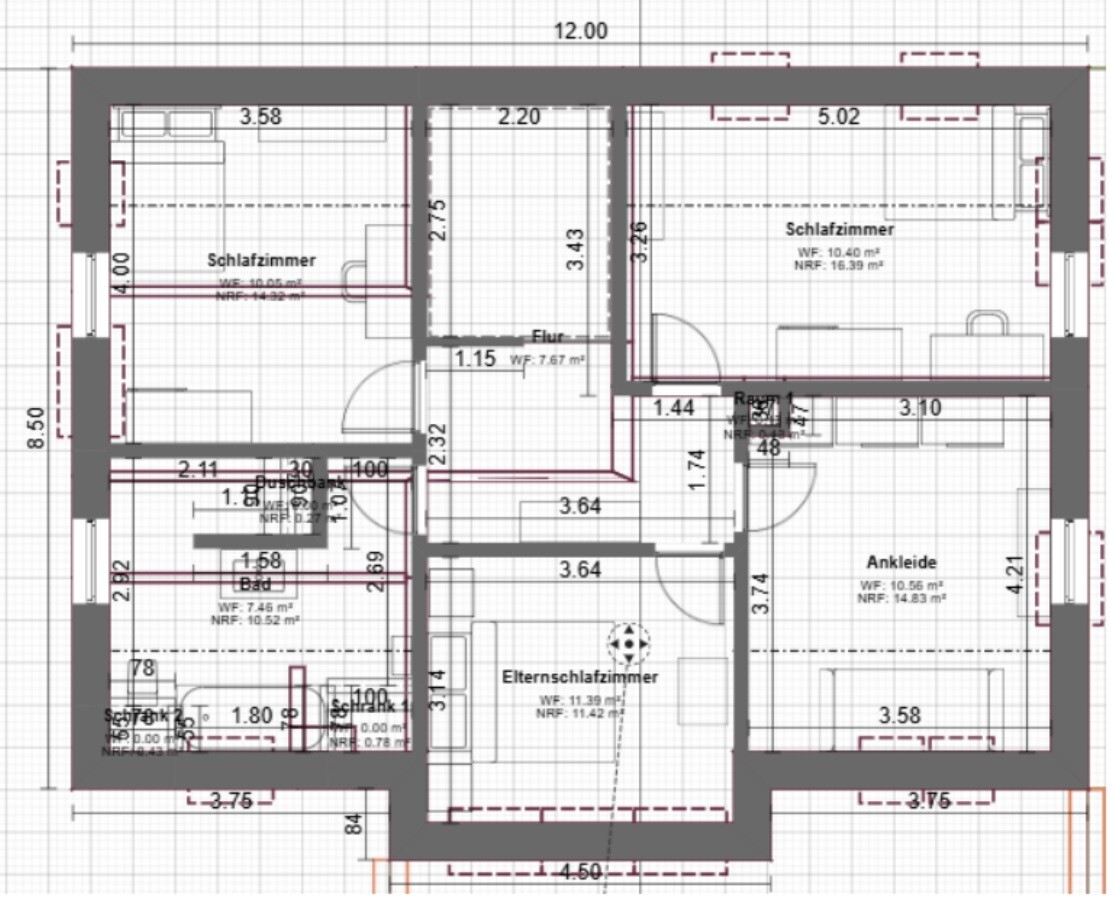
Thank you very much for the responses.
I thought my description was fairly accurate, but it seems some information was still missing to make it fully clear.
We have indeed spent a great deal of time considering light/sun position, room layout and space requirements, and have also reflected on the role aesthetics play for us.
Attached is the plot excerpt with the building envelope and planned new construction to clarify the orientation. I cropped the rest of the property as it is not relevant to the question at hand. The dimensions are approximately 28 m x 96 m (92 ft x 315 ft), with the plot widening toward the rear to about 45 m (148 ft) in width.
ypg schrieb:
I see it the same way.
Without looking at the floor plan, but only the house itself (which was probably chosen because it appeals to them), I would locate the entrance on the north side, toward the planned parking spaces. I would then arrange the living rooms so that they create two terraces: one facing the forest for quiet and relaxation in the garden at the back, and one at the front facing the yard for activity, with a pleasant rustic dining terrace.
Then this can be read:
and apparently it is not determined which direction the gable faces. The historic listed house has its gable facing forward.
The house orientation is theoretically open. Thanks to your critical questions, we were able to thoroughly explore a gable-end orientation and can actually imagine it to a limited extent. Also to consider is that with a gable-end design, two facades of the house might be subject to heritage listing.
A roof-ridge side orientation supports better garden privacy: it creates a well-protected rear area, hardly visible from the street. This is important to us as a living and recreational space. Furthermore, we don’t want to fully pave the front area of the house. We find the current large front garden very pleasant and want to preserve this quality. A decorative tree is also planned there.
Although it may seem obvious today to place the entrance directly at the driveway or parking spaces, we do not see this as absolutely necessary. The entrance on the south/east side makes more sense for us considering internal circulation to the outbuilding and other uses on the property, and it feels more natural for everyday life.
The suggested layout with the living areas facing south toward the outbuilding is only partially feasible for us. The outbuilding in question is two stories, currently only about 2.5 m (8 ft) from the existing house, and does not offer an attractive view in its present state (aka "shabby shed of shame"). Certainly, it could be greened or clad, but if we can choose, this is not the view we would prefer. The new building might be shifted slightly toward the northern neighbor to increase the distance.
ypg schrieb:
I would create a counterpart to the listed house, set a bit further back to form a courtyard. Possibly spruce up the outbuildings a bit and then have a protected terrace between the buildings.
Sketched here, of course without dimensions because none were known for the property.
We also reviewed the suggested thread and find the approach understandable and helpful, but encountered some limits adapting it to our specific situation: First, the upstairs bathroom would need to be moved to the northeast with the guest bathroom below it, which would bring the living and dining area closer to the "shed of shame." Second, one of the children’s rooms would no longer be on the west side. On the ground floor, the living room would again be oriented toward the shabby shed.
Papierturm schrieb:
The house also seems very divided. For example, only one window on the west side on the ground floor, and only one on the south side on the ground floor.
Orienting living rooms to the northeast can be done, but it significantly affects light. And there can be good reasons to do this anyway. I don’t know the property and can’t say if this is really a good idea. In the second plan, the living rooms on the ground floor will be quite dark in the afternoon, staying permanently in the shade – direct sunlight only in the early morning.
Dividing the ground floor into “dirty” and living areas, and having only one south-facing window on the ground floor (utility room), was intentional. The south side cannot be viewed well from a distance since the shabby shed is directly next to it and the passage width is only about 2.5 m (8 ft).
We have really thought a lot about the lighting and were uncertain if the lighting situation with a northeast orientation for the living and dining area would be sufficient. Our neighbors’ living situation gave us food for thought: with a terrace facing south, it is hardly used for most of the summer and the windows are shaded almost all day. We would find it unfavorable to sit in a hopefully cool house during summer in the dark. We prefer natural light while accepting it may be less bright in winter. It is also questionable how much the two-story shed might significantly shade the house.
One more thing concerning the street view: this is heritage-relevant. We were told, at least verbally, that the window dimensions must correspond to the farmhouse style, i.e., rather small, multi-pane windows. This was one reason we initially planned to reduce the number of windows on the street side and designed the façade to resemble a barn with a barn door. With the kitchen on the west side and smaller kitchen windows, this could also be realized well. The street-facing side was not our primary aesthetic concern. The most attractive view should be from the garden, as this is where we will see the house most closely.
Papierturm schrieb:
- Upstairs bathroom: You first run into a wall.
- Both bathrooms: Dimensions are missing, but I assume the towel warmers are located where water might occasionally splash. If they are electric, this could be an issue to keep in mind.
Regarding the upstairs bathroom and the "wall you run into": the idea was to visually separate the shower area so you don’t look directly into the shower when entering the room.
Thanks for the info about the towel warmer!
ypg schrieb:
I don’t think the island in a closed room works well. It just takes up space. It’s just as good to look outside if the countertop is in front of a window. The kids don’t care where they eat, as long as the food tastes good and they have company.
kbt already mentioned this as well, but I wonder what you do in a U- or L-shaped kitchen in a 14 sqm (150 sq ft) room with all the free space?
As you can see, with the conditions — including the shabby shed of shame and our clear desire for views both from inside to the garden and from the garden to the house — it is not easy to implement the suggested ideas one on one. Nevertheless, we would appreciate any suggestions on the following points:
- Ideas on how to reduce the feeling of the living room as a passage area without significantly enlarging the house.
- Tips for better kitchen planning.
- Suggestions for simple floor plan adjustments that might make everyday life easier that we may have overlooked so far.
Thank you very much, and best regards.
P.S. Attached again are the floor plans with hopefully improved measurements.

Why does the boundary line between the residential area (pink) and the hinterland or even the outer area (also at the neighbor’s property) have this bend?
The reddish-brown dashed lines in the upper floor plan apparently represent the window positions of the ground floor. These, let’s say, “inconsistencies” should certainly be noticeable if they are drawn in. Some of the walls are also thicker than those below. I cannot associate the orange lines with anything.
https://www.instagram.com/11antgmxde/
https://www.linkedin.com/company/bauen-jetzt/
The reddish-brown dashed lines in the upper floor plan apparently represent the window positions of the ground floor. These, let’s say, “inconsistencies” should certainly be noticeable if they are drawn in. Some of the walls are also thicker than those below. I cannot associate the orange lines with anything.
https://www.instagram.com/11antgmxde/
https://www.linkedin.com/company/bauen-jetzt/
skuddel schrieb:
Suggestions for simple floor plan adjustments that could make everyday life easier and that we may have overlooked so far. I can’t do that in this case. Even if you have reasons for your decisions, I can’t understand those reasons. Simply put:
- If I have an ugly shed close to the new building, I would either tear it down or integrate it with the new construction—that is, make it look nice.
- If there is a second building in the foreground, I would also adapt roof pitch, style, or facade accordingly.
- I cannot understand the preference for darkness in winter over generally bright rooms. To me, the arguments sound too much like casual talk from the pub.
- The same goes for having a main entrance opposite planned parking spaces.
While reading, the saying “all show in the front, a mess in the back” came to mind... and then I read that you value the rear part. We probably live completely different lives shaped by different priorities.
Regarding your further questions:
skuddel schrieb:
What do you do with a U- or L-shaped kitchen in a 14sqm (150 sq ft) room with so much free space remaining? skuddel schrieb:
Ideas on how to reduce the through-traffic feel of the living room without significantly enlarging the house. skuddel schrieb:
Tips for better kitchen planning. Regardless of my opinion above: good spatial planning does not arise by simply drawing some walls on paper and stopping there. Especially from your questions and follow-ups, it’s clear you have no real process of spatial planning underway.
But that is exactly what you—or any house—needs: development. I would recommend consulting an architect after this forum and giving them a written list of your room requirements, then giving them free rein.
Similar topics