
Hello everyone,
We bought a two-family house from 1936 in June. More about the financing can be found in this thread. We are still very happy that we bought it. Our baby is due in December, and once our second child needs their own bedroom, the apartment will become too small. We have also visited the property quite often since then and are very pleased with the location. Everything from daycare to high school is within walking distance, along with plenty of sports clubs, and more.
Since the purchase, quite a bit has happened. Our financing was based on equity and a bank loan for the purchase alone. For the renovation, we planned to use capital from the sale of another property. The sale has now been completed and brought in slightly more than our optimistic estimate (365,000€ vs. 350,000€ optimistic expectation vs. 300,000€ minimum expectation). I have to say that selling caused me more headaches than buying the new house—even though it involved significantly less money. Especially the news about falling prices everywhere unsettled us and made us worry that the buyer might pull out. We did have multiple offers, including two in the same range, but the second highest bidder reacted quite badly to being rejected. That would have meant relisting, which, due to the increased costs of living since the agreement and the age of the house, probably would have led to a lower sale price. Once the notarized contract was signed, we were able to breathe a sigh of relief.
Now the work begins. We already have an architect who we have been consulting with over the past two years while looking at houses. She has so far done all the appointments and planning free of charge and invested a lot of time. We have already met on-site with a heating engineer, electrician, and flooring specialist. All have praised the structural condition and potential of the house so far, which is very reassuring.
Here is a picture of the current exterior from the garden side:
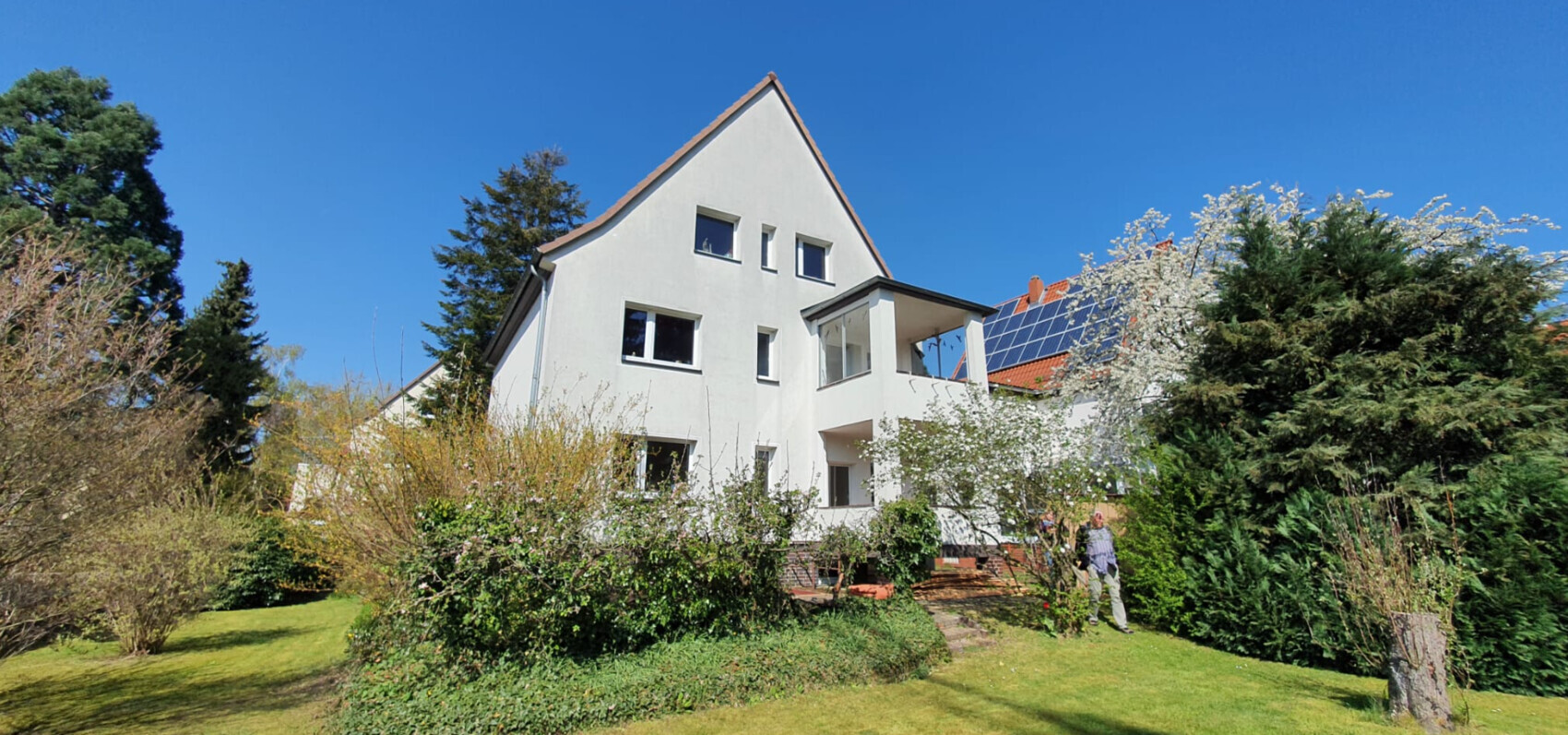
The house was insulated on the outside with 8cm (3 inches) of external thermal insulation composite system (ETICS) in 1996—but unfortunately, no major energy upgrades have been made since then. According to the energy certificate, the current demand is about 220 kWh/m²/a, which for 187 m² (2,013 sq ft) of living space would mean around 41,000 kWh per year. According to gas bills, however, the consumption in 2020 (the last year it was occupied) was only around 22,000 kWh for two households living there separately. That is still a lot, and of course, we want to modernize it. During the recent heatwave, it was actually cooler in the two full floors than in our already quite cool old apartment, which I see as a good sign. The house itself has cavity solid walls.
This means the following for us:
- Insulation of the top-floor ceiling: The attic has a huge footprint and covers roughly 80% of the developed attic space. Therefore, we decided to insulate the attic floor at first, which is more cost-effective than insulating the entire roof, since we won’t need that space anytime soon.
- Insulation of the basement ceiling
- Elimination of some thermal bridges
- Completely new windows and exterior doors throughout the house
Before buying, the architect said that should reduce the demand to around 150 kWh/m²/a or less, and further optimizations might no longer be cost-effective. Since then, energy costs have changed quite a bit… so we’ll see if we address anything else (would you, for example, recommend adding cavity insulation between the two masonry layers as well? Or would that not work well with the ETICS?). What’s your realistic assessment? I would obviously like to reduce it further, but I would prefer to avoid completely rebuilding the roof.
In addition:
- Replace pipes and wiring throughout the whole house
- New radiators
- Heat pump, if it makes sense / if the house can be heated properly with one
- If heat pump: photovoltaic system (the left side of the roof in the picture faces directly south)
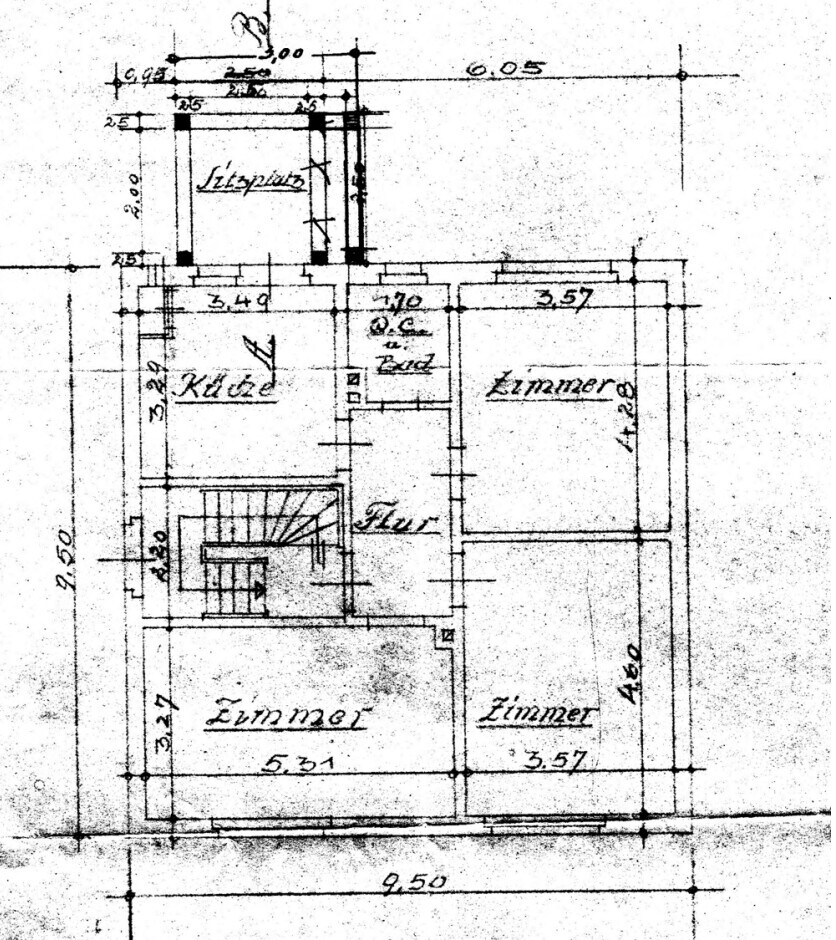
That’s the energy-related part. Several other works are planned as well. This is the current floor plan—the ground floor and first floor are almost identical, but both floors have a nice passage between the two right-side rooms with a sliding door that needs to be preserved:
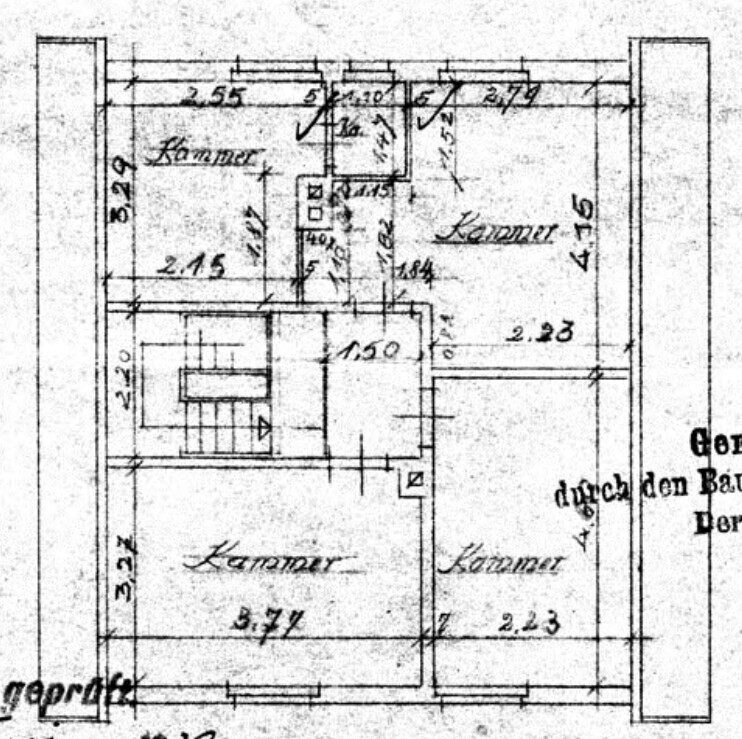
And the attic floor plan:
The rough plan is as follows:
Ground Floor:
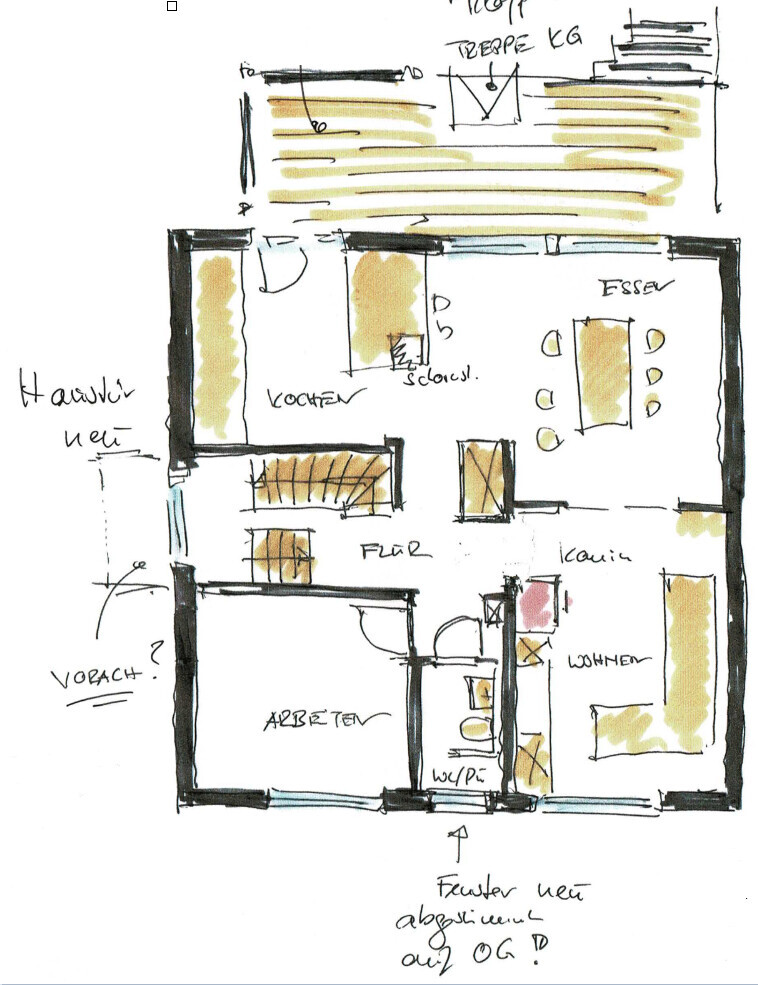
First Floor:
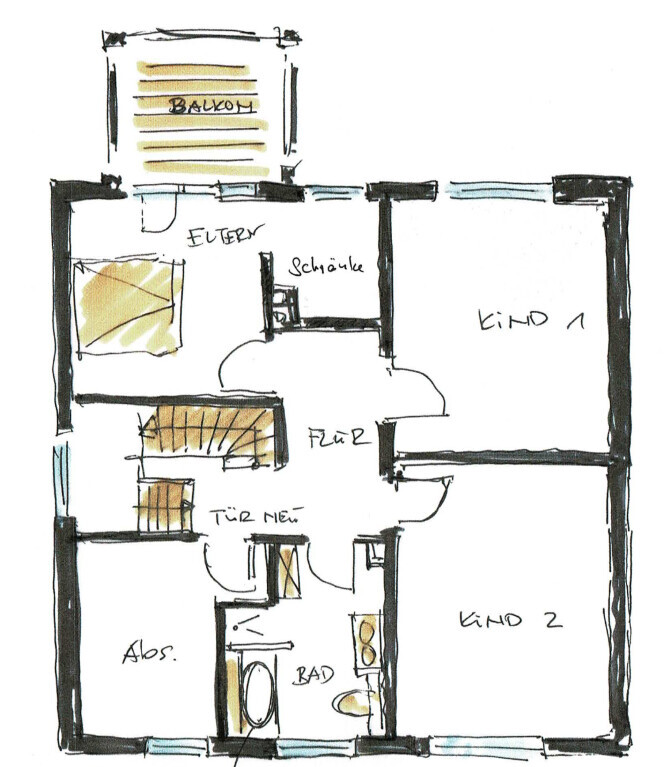
Since both bathrooms need renewing anyway (photos from inside will follow later), we are moving them to the front, facing the street. This will free up space downstairs to open up the kitchen/dining area and allow a slightly larger bathroom upstairs than currently exists. Right now, we live with a 3 m² (32 sq ft) bathroom—it works for three people but is definitely not very comfortable 😀
I work almost 100% from home, so the office is on the ground floor. The attic layout will remain as is. It will include my partner’s craft/workroom, a guest room, and we have one extra room that is still undecided 🙂. The nice thing is that due to the steep roof, we even have higher ceilings on the attic floor (>2.60 m / 8.5 ft) than on the ground and first floors (2.55 m / 8.4 ft), with very little sloping (photos to follow).
Throughout the house, there are old wooden floorboards hidden under several layers of flooring. Fortunately, none are glued down but simply laid loose, so we already looked underneath with the flooring specialist and found the condition to be good. These floors will be restored rather than replaced! This is also a reason why we don’t want to install underfloor heating—the floorboards are too thick, probably fragile for removal, and underfloor heating would cause a chain reaction: the doors (which we also just want to restore/paint), the frames, and so on, would no longer fit. However, underfloor heating will probably be installed in the bathroom upstairs. The indoor staircase is another beautiful old wooden staircase that was hidden under carpet and will also only be restored as needed.
The architect’s first cost estimate is around 270,000€ for all measures (excluding photovoltaics). The three tradespeople who have been on site have more or less confirmed her rough calculation. Statics engineer and window fitter will visit next week—we’re excited 🙂
Current concerns:
- Can we achieve an energy level that makes a heat pump reasonably economical (we do have a lot of roof space for photovoltaics)?
- Is the rest of the cost estimate realistic?
- What surprises might still be waiting for us?
- When will it be completed? Target is early summer next year...
We look forward to your feedback!
We bought a two-family house from 1936 in June. More about the financing can be found in this thread. We are still very happy that we bought it. Our baby is due in December, and once our second child needs their own bedroom, the apartment will become too small. We have also visited the property quite often since then and are very pleased with the location. Everything from daycare to high school is within walking distance, along with plenty of sports clubs, and more.
Since the purchase, quite a bit has happened. Our financing was based on equity and a bank loan for the purchase alone. For the renovation, we planned to use capital from the sale of another property. The sale has now been completed and brought in slightly more than our optimistic estimate (365,000€ vs. 350,000€ optimistic expectation vs. 300,000€ minimum expectation). I have to say that selling caused me more headaches than buying the new house—even though it involved significantly less money. Especially the news about falling prices everywhere unsettled us and made us worry that the buyer might pull out. We did have multiple offers, including two in the same range, but the second highest bidder reacted quite badly to being rejected. That would have meant relisting, which, due to the increased costs of living since the agreement and the age of the house, probably would have led to a lower sale price. Once the notarized contract was signed, we were able to breathe a sigh of relief.
Now the work begins. We already have an architect who we have been consulting with over the past two years while looking at houses. She has so far done all the appointments and planning free of charge and invested a lot of time. We have already met on-site with a heating engineer, electrician, and flooring specialist. All have praised the structural condition and potential of the house so far, which is very reassuring.
Here is a picture of the current exterior from the garden side:
The house was insulated on the outside with 8cm (3 inches) of external thermal insulation composite system (ETICS) in 1996—but unfortunately, no major energy upgrades have been made since then. According to the energy certificate, the current demand is about 220 kWh/m²/a, which for 187 m² (2,013 sq ft) of living space would mean around 41,000 kWh per year. According to gas bills, however, the consumption in 2020 (the last year it was occupied) was only around 22,000 kWh for two households living there separately. That is still a lot, and of course, we want to modernize it. During the recent heatwave, it was actually cooler in the two full floors than in our already quite cool old apartment, which I see as a good sign. The house itself has cavity solid walls.
This means the following for us:
- Insulation of the top-floor ceiling: The attic has a huge footprint and covers roughly 80% of the developed attic space. Therefore, we decided to insulate the attic floor at first, which is more cost-effective than insulating the entire roof, since we won’t need that space anytime soon.
- Insulation of the basement ceiling
- Elimination of some thermal bridges
- Completely new windows and exterior doors throughout the house
Before buying, the architect said that should reduce the demand to around 150 kWh/m²/a or less, and further optimizations might no longer be cost-effective. Since then, energy costs have changed quite a bit… so we’ll see if we address anything else (would you, for example, recommend adding cavity insulation between the two masonry layers as well? Or would that not work well with the ETICS?). What’s your realistic assessment? I would obviously like to reduce it further, but I would prefer to avoid completely rebuilding the roof.
In addition:
- Replace pipes and wiring throughout the whole house
- New radiators
- Heat pump, if it makes sense / if the house can be heated properly with one
- If heat pump: photovoltaic system (the left side of the roof in the picture faces directly south)
That’s the energy-related part. Several other works are planned as well. This is the current floor plan—the ground floor and first floor are almost identical, but both floors have a nice passage between the two right-side rooms with a sliding door that needs to be preserved:
And the attic floor plan:
The rough plan is as follows:
Ground Floor:
First Floor:
Since both bathrooms need renewing anyway (photos from inside will follow later), we are moving them to the front, facing the street. This will free up space downstairs to open up the kitchen/dining area and allow a slightly larger bathroom upstairs than currently exists. Right now, we live with a 3 m² (32 sq ft) bathroom—it works for three people but is definitely not very comfortable 😀
I work almost 100% from home, so the office is on the ground floor. The attic layout will remain as is. It will include my partner’s craft/workroom, a guest room, and we have one extra room that is still undecided 🙂. The nice thing is that due to the steep roof, we even have higher ceilings on the attic floor (>2.60 m / 8.5 ft) than on the ground and first floors (2.55 m / 8.4 ft), with very little sloping (photos to follow).
Throughout the house, there are old wooden floorboards hidden under several layers of flooring. Fortunately, none are glued down but simply laid loose, so we already looked underneath with the flooring specialist and found the condition to be good. These floors will be restored rather than replaced! This is also a reason why we don’t want to install underfloor heating—the floorboards are too thick, probably fragile for removal, and underfloor heating would cause a chain reaction: the doors (which we also just want to restore/paint), the frames, and so on, would no longer fit. However, underfloor heating will probably be installed in the bathroom upstairs. The indoor staircase is another beautiful old wooden staircase that was hidden under carpet and will also only be restored as needed.
The architect’s first cost estimate is around 270,000€ for all measures (excluding photovoltaics). The three tradespeople who have been on site have more or less confirmed her rough calculation. Statics engineer and window fitter will visit next week—we’re excited 🙂
Current concerns:
- Can we achieve an energy level that makes a heat pump reasonably economical (we do have a lot of roof space for photovoltaics)?
- Is the rest of the cost estimate realistic?
- What surprises might still be waiting for us?
- When will it be completed? Target is early summer next year...
We look forward to your feedback!
Thursday and Friday brought quite a bit of progress:
The shell builder has finished and has now also prepared the exterior wall for the patio door! Additionally, the first windows are installed, and we really like the look and feel 🙂
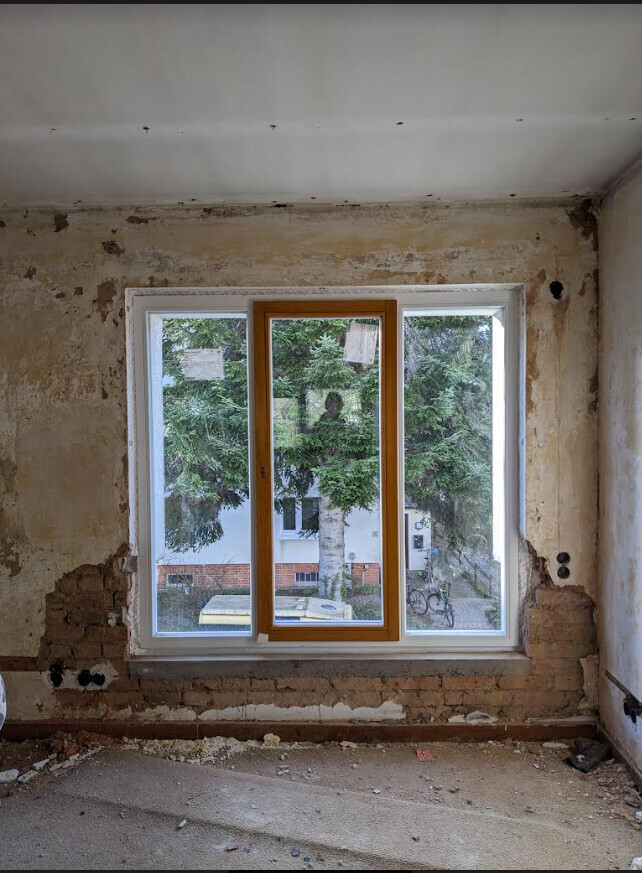
Here is the 1.8 x 1.8 m (6 x 6 ft) window in one of the children's rooms:
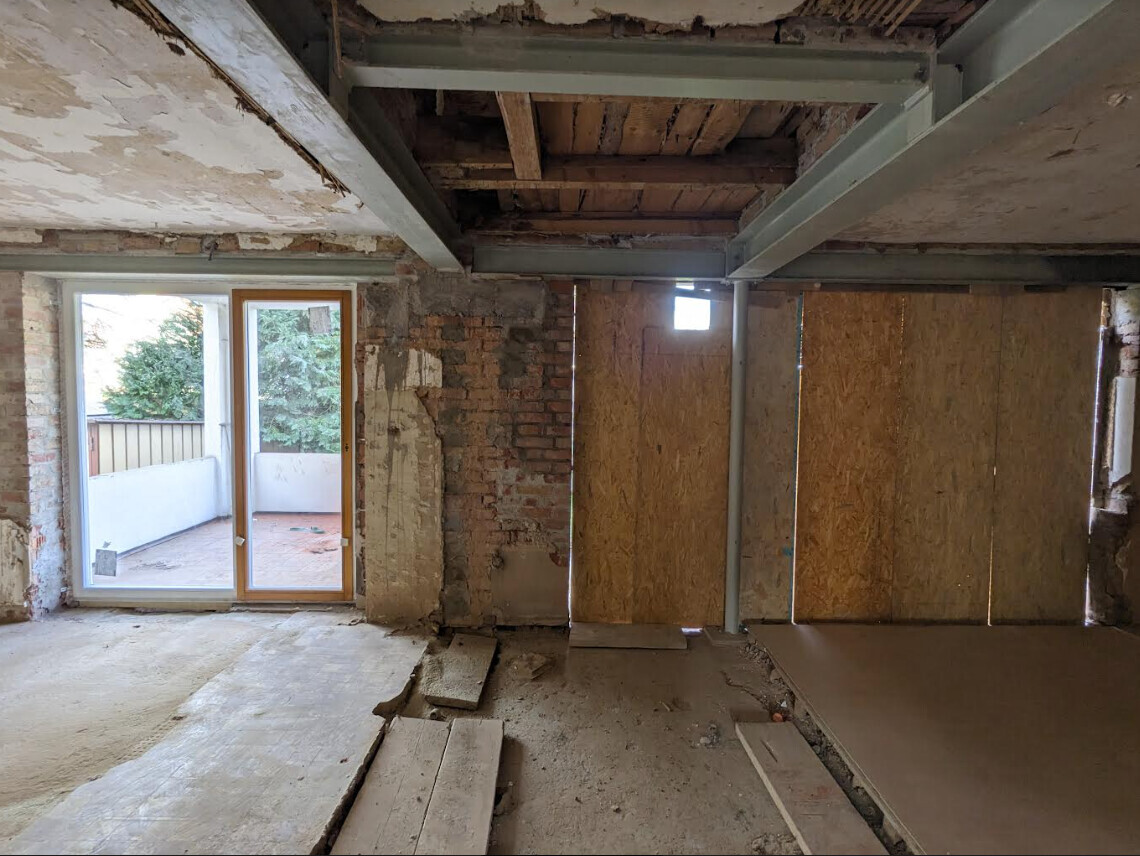
And downstairs on the ground floor, the kitchen door and the barricaded opening for the lift-and-slide door:
Except for the front door and the mentioned patio door, I think all the windows will be installed tomorrow – so we have probably passed the lowest point in the appearance of the construction site, hopefully for good! 🙂
The shell builder has finished and has now also prepared the exterior wall for the patio door! Additionally, the first windows are installed, and we really like the look and feel 🙂
Here is the 1.8 x 1.8 m (6 x 6 ft) window in one of the children's rooms:
And downstairs on the ground floor, the kitchen door and the barricaded opening for the lift-and-slide door:
Except for the front door and the mentioned patio door, I think all the windows will be installed tomorrow – so we have probably passed the lowest point in the appearance of the construction site, hopefully for good! 🙂

leschaf schrieb:
- So we have most likely, and hopefully, passed the lowest point in terms of the construction site’s appearance! 🙂But only from the outside, it seems to me. 😉 😀 🙂Just wait and see how the electricians or plumbers work.
When they want to, they can create a lot of mess.
What will happen to all the interior plaster? Does it need to be removed, or will they simply work over it? Will the old plaster even hold, considering how much has already chipped off?
When they want to, they can create a lot of mess.
What will happen to all the interior plaster? Does it need to be removed, or will they simply work over it? Will the old plaster even hold, considering how much has already chipped off?
At least the electrician has been quite neat so far :P
We’re still not entirely sure about the plastering. On the ground floor, there isn’t much old plaster left anyway, so it will definitely be completely replaced. I’m not really upset about that, since the tenant smoked a lot down there, and the smell definitely needs to be removed.
In the attic and upper floor, most of the old plaster is actually in good condition and stayed intact when the wallpaper was removed. My hope is that we only need to repair around the windows and installation channels, then apply a skim coat over it. There was no smoking up there. But we’ll see how it looks in the end.
We’re still not entirely sure about the plastering. On the ground floor, there isn’t much old plaster left anyway, so it will definitely be completely replaced. I’m not really upset about that, since the tenant smoked a lot down there, and the smell definitely needs to be removed.
In the attic and upper floor, most of the old plaster is actually in good condition and stayed intact when the wallpaper was removed. My hope is that we only need to repair around the windows and installation channels, then apply a skim coat over it. There was no smoking up there. But we’ll see how it looks in the end.
The heating technician finally ordered a heat pump today. The architect persuaded him a bit, and he switched from Nibe (12+ months delivery time) to Wolf, with delivery expected in September/October. Very good news, if it goes as planned. Additionally, the heat pump is about 3,000 euros cheaper (according to the heating load calculation, we only need 9 kW instead of the planned 12 kW) and, unlike the NIBE, uses R290 refrigerant, which adds another 5% to the overall installation efficiency (so again several thousand euros saved). Good day 🙂
Tomorrow the drywall contractor will come and start work next week. The electrician will also return then (there were some absences in recent weeks due to illness).
All the windows are installed, and there was only one mistake (the window fitter measured one window 2 cm (1 inch) off — now the living room has 2 cm (1 inch) more window width and 2 cm (1 inch) less sill height; the pre-cast concrete part had to be chiseled out again). Also, two non-symmetrical windows in the attic were initially installed mirrored, but that was quickly corrected. The sliding patio door will arrive in two weeks.
Tomorrow the drywall contractor will come and start work next week. The electrician will also return then (there were some absences in recent weeks due to illness).
All the windows are installed, and there was only one mistake (the window fitter measured one window 2 cm (1 inch) off — now the living room has 2 cm (1 inch) more window width and 2 cm (1 inch) less sill height; the pre-cast concrete part had to be chiseled out again). Also, two non-symmetrical windows in the attic were initially installed mirrored, but that was quickly corrected. The sliding patio door will arrive in two weeks.
Similar topics