
Hello everyone,
We bought a two-family house from 1936 in June. More about the financing can be found in this thread. We are still very happy that we bought it. Our baby is due in December, and once our second child needs their own bedroom, the apartment will become too small. We have also visited the property quite often since then and are very pleased with the location. Everything from daycare to high school is within walking distance, along with plenty of sports clubs, and more.
Since the purchase, quite a bit has happened. Our financing was based on equity and a bank loan for the purchase alone. For the renovation, we planned to use capital from the sale of another property. The sale has now been completed and brought in slightly more than our optimistic estimate (365,000€ vs. 350,000€ optimistic expectation vs. 300,000€ minimum expectation). I have to say that selling caused me more headaches than buying the new house—even though it involved significantly less money. Especially the news about falling prices everywhere unsettled us and made us worry that the buyer might pull out. We did have multiple offers, including two in the same range, but the second highest bidder reacted quite badly to being rejected. That would have meant relisting, which, due to the increased costs of living since the agreement and the age of the house, probably would have led to a lower sale price. Once the notarized contract was signed, we were able to breathe a sigh of relief.
Now the work begins. We already have an architect who we have been consulting with over the past two years while looking at houses. She has so far done all the appointments and planning free of charge and invested a lot of time. We have already met on-site with a heating engineer, electrician, and flooring specialist. All have praised the structural condition and potential of the house so far, which is very reassuring.
Here is a picture of the current exterior from the garden side:
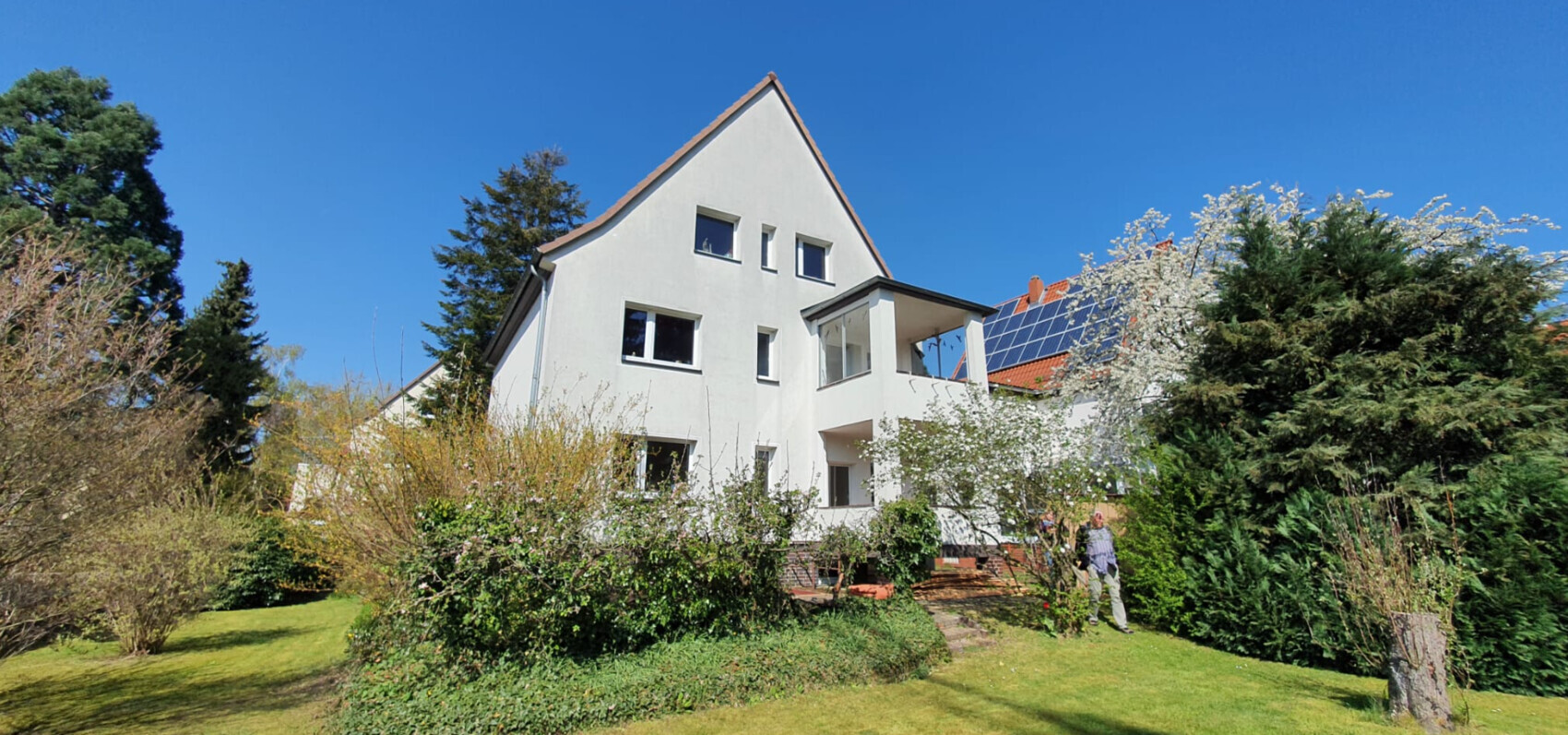
The house was insulated on the outside with 8cm (3 inches) of external thermal insulation composite system (ETICS) in 1996—but unfortunately, no major energy upgrades have been made since then. According to the energy certificate, the current demand is about 220 kWh/m²/a, which for 187 m² (2,013 sq ft) of living space would mean around 41,000 kWh per year. According to gas bills, however, the consumption in 2020 (the last year it was occupied) was only around 22,000 kWh for two households living there separately. That is still a lot, and of course, we want to modernize it. During the recent heatwave, it was actually cooler in the two full floors than in our already quite cool old apartment, which I see as a good sign. The house itself has cavity solid walls.
This means the following for us:
- Insulation of the top-floor ceiling: The attic has a huge footprint and covers roughly 80% of the developed attic space. Therefore, we decided to insulate the attic floor at first, which is more cost-effective than insulating the entire roof, since we won’t need that space anytime soon.
- Insulation of the basement ceiling
- Elimination of some thermal bridges
- Completely new windows and exterior doors throughout the house
Before buying, the architect said that should reduce the demand to around 150 kWh/m²/a or less, and further optimizations might no longer be cost-effective. Since then, energy costs have changed quite a bit… so we’ll see if we address anything else (would you, for example, recommend adding cavity insulation between the two masonry layers as well? Or would that not work well with the ETICS?). What’s your realistic assessment? I would obviously like to reduce it further, but I would prefer to avoid completely rebuilding the roof.
In addition:
- Replace pipes and wiring throughout the whole house
- New radiators
- Heat pump, if it makes sense / if the house can be heated properly with one
- If heat pump: photovoltaic system (the left side of the roof in the picture faces directly south)
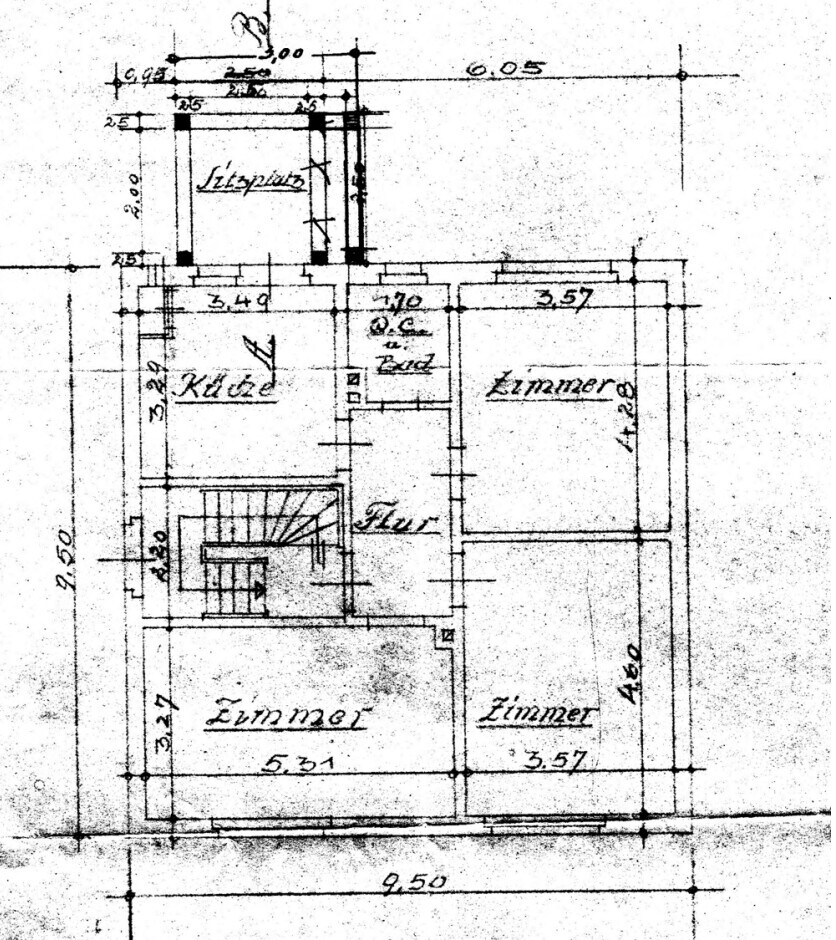
That’s the energy-related part. Several other works are planned as well. This is the current floor plan—the ground floor and first floor are almost identical, but both floors have a nice passage between the two right-side rooms with a sliding door that needs to be preserved:
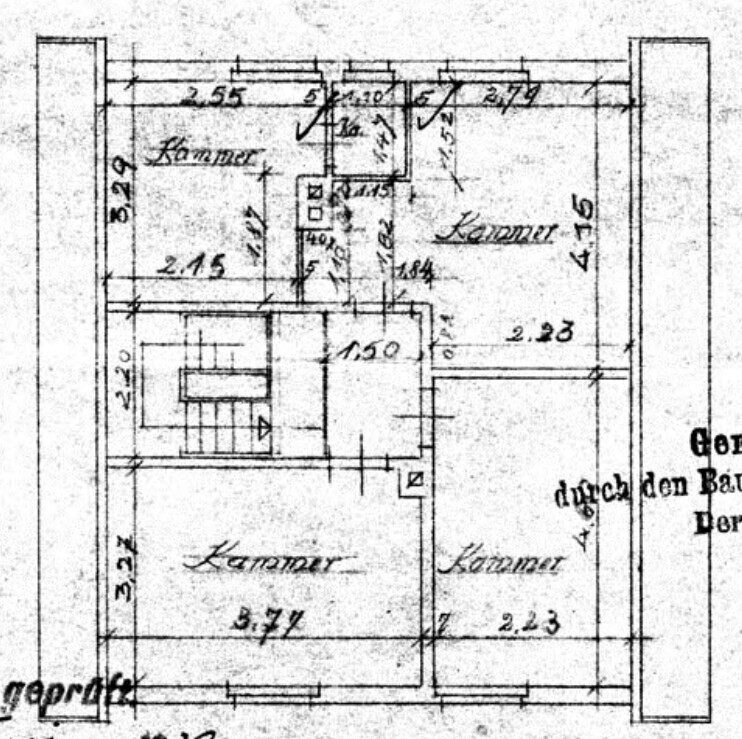
And the attic floor plan:
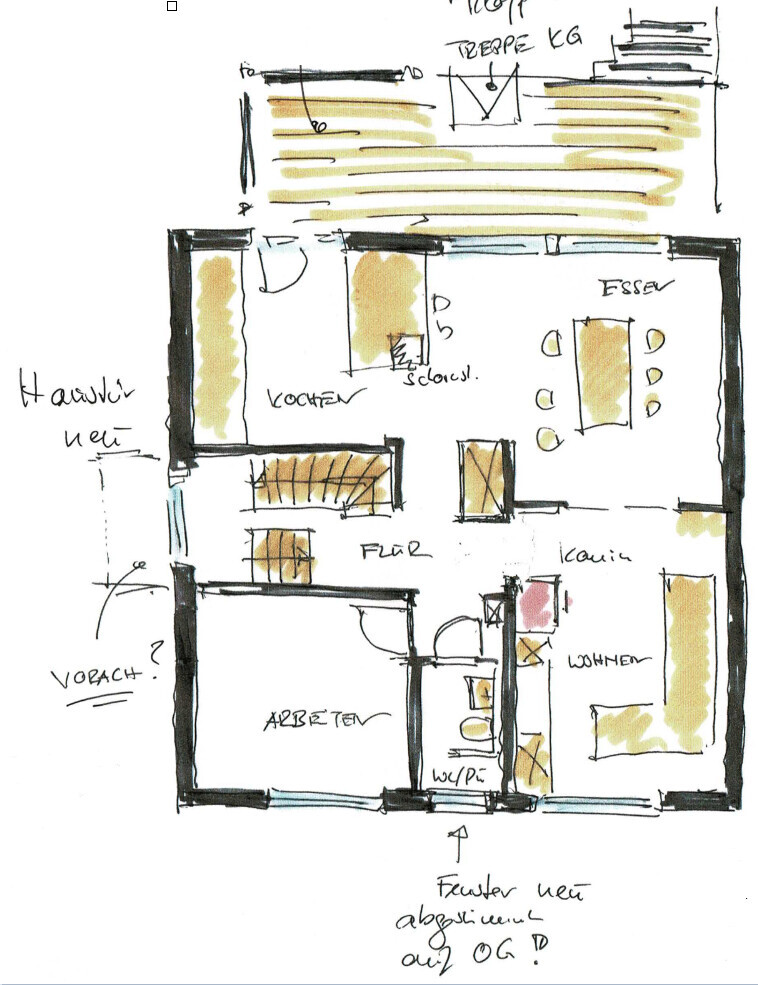
The rough plan is as follows:
Ground Floor:
First Floor:
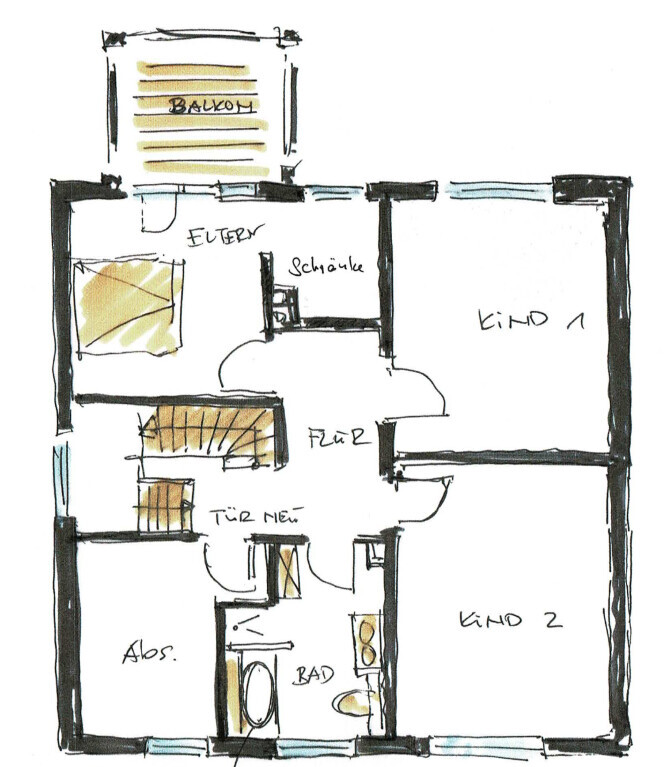
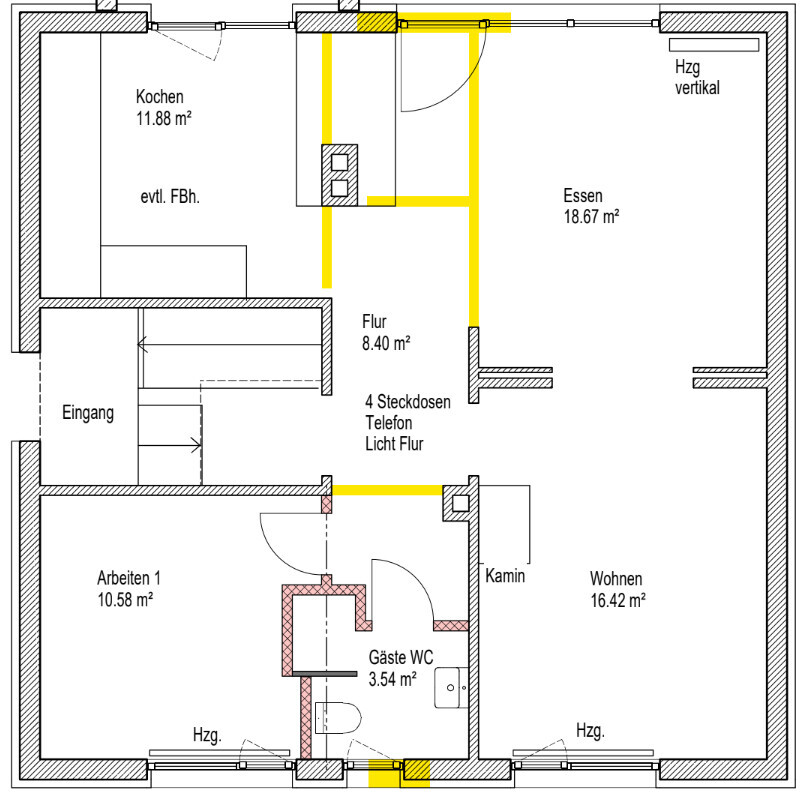
Since both bathrooms need renewing anyway (photos from inside will follow later), we are moving them to the front, facing the street. This will free up space downstairs to open up the kitchen/dining area and allow a slightly larger bathroom upstairs than currently exists. Right now, we live with a 3 m² (32 sq ft) bathroom—it works for three people but is definitely not very comfortable 😀
I work almost 100% from home, so the office is on the ground floor. The attic layout will remain as is. It will include my partner’s craft/workroom, a guest room, and we have one extra room that is still undecided 🙂. The nice thing is that due to the steep roof, we even have higher ceilings on the attic floor (>2.60 m / 8.5 ft) than on the ground and first floors (2.55 m / 8.4 ft), with very little sloping (photos to follow).
Throughout the house, there are old wooden floorboards hidden under several layers of flooring. Fortunately, none are glued down but simply laid loose, so we already looked underneath with the flooring specialist and found the condition to be good. These floors will be restored rather than replaced! This is also a reason why we don’t want to install underfloor heating—the floorboards are too thick, probably fragile for removal, and underfloor heating would cause a chain reaction: the doors (which we also just want to restore/paint), the frames, and so on, would no longer fit. However, underfloor heating will probably be installed in the bathroom upstairs. The indoor staircase is another beautiful old wooden staircase that was hidden under carpet and will also only be restored as needed.
The architect’s first cost estimate is around 270,000€ for all measures (excluding photovoltaics). The three tradespeople who have been on site have more or less confirmed her rough calculation. Statics engineer and window fitter will visit next week—we’re excited 🙂
Current concerns:
- Can we achieve an energy level that makes a heat pump reasonably economical (we do have a lot of roof space for photovoltaics)?
- Is the rest of the cost estimate realistic?
- What surprises might still be waiting for us?
- When will it be completed? Target is early summer next year...
We look forward to your feedback!
We bought a two-family house from 1936 in June. More about the financing can be found in this thread. We are still very happy that we bought it. Our baby is due in December, and once our second child needs their own bedroom, the apartment will become too small. We have also visited the property quite often since then and are very pleased with the location. Everything from daycare to high school is within walking distance, along with plenty of sports clubs, and more.
Since the purchase, quite a bit has happened. Our financing was based on equity and a bank loan for the purchase alone. For the renovation, we planned to use capital from the sale of another property. The sale has now been completed and brought in slightly more than our optimistic estimate (365,000€ vs. 350,000€ optimistic expectation vs. 300,000€ minimum expectation). I have to say that selling caused me more headaches than buying the new house—even though it involved significantly less money. Especially the news about falling prices everywhere unsettled us and made us worry that the buyer might pull out. We did have multiple offers, including two in the same range, but the second highest bidder reacted quite badly to being rejected. That would have meant relisting, which, due to the increased costs of living since the agreement and the age of the house, probably would have led to a lower sale price. Once the notarized contract was signed, we were able to breathe a sigh of relief.
Now the work begins. We already have an architect who we have been consulting with over the past two years while looking at houses. She has so far done all the appointments and planning free of charge and invested a lot of time. We have already met on-site with a heating engineer, electrician, and flooring specialist. All have praised the structural condition and potential of the house so far, which is very reassuring.
Here is a picture of the current exterior from the garden side:
The house was insulated on the outside with 8cm (3 inches) of external thermal insulation composite system (ETICS) in 1996—but unfortunately, no major energy upgrades have been made since then. According to the energy certificate, the current demand is about 220 kWh/m²/a, which for 187 m² (2,013 sq ft) of living space would mean around 41,000 kWh per year. According to gas bills, however, the consumption in 2020 (the last year it was occupied) was only around 22,000 kWh for two households living there separately. That is still a lot, and of course, we want to modernize it. During the recent heatwave, it was actually cooler in the two full floors than in our already quite cool old apartment, which I see as a good sign. The house itself has cavity solid walls.
This means the following for us:
- Insulation of the top-floor ceiling: The attic has a huge footprint and covers roughly 80% of the developed attic space. Therefore, we decided to insulate the attic floor at first, which is more cost-effective than insulating the entire roof, since we won’t need that space anytime soon.
- Insulation of the basement ceiling
- Elimination of some thermal bridges
- Completely new windows and exterior doors throughout the house
Before buying, the architect said that should reduce the demand to around 150 kWh/m²/a or less, and further optimizations might no longer be cost-effective. Since then, energy costs have changed quite a bit… so we’ll see if we address anything else (would you, for example, recommend adding cavity insulation between the two masonry layers as well? Or would that not work well with the ETICS?). What’s your realistic assessment? I would obviously like to reduce it further, but I would prefer to avoid completely rebuilding the roof.
In addition:
- Replace pipes and wiring throughout the whole house
- New radiators
- Heat pump, if it makes sense / if the house can be heated properly with one
- If heat pump: photovoltaic system (the left side of the roof in the picture faces directly south)
That’s the energy-related part. Several other works are planned as well. This is the current floor plan—the ground floor and first floor are almost identical, but both floors have a nice passage between the two right-side rooms with a sliding door that needs to be preserved:
And the attic floor plan:
The rough plan is as follows:
Ground Floor:
First Floor:
Since both bathrooms need renewing anyway (photos from inside will follow later), we are moving them to the front, facing the street. This will free up space downstairs to open up the kitchen/dining area and allow a slightly larger bathroom upstairs than currently exists. Right now, we live with a 3 m² (32 sq ft) bathroom—it works for three people but is definitely not very comfortable 😀
I work almost 100% from home, so the office is on the ground floor. The attic layout will remain as is. It will include my partner’s craft/workroom, a guest room, and we have one extra room that is still undecided 🙂. The nice thing is that due to the steep roof, we even have higher ceilings on the attic floor (>2.60 m / 8.5 ft) than on the ground and first floors (2.55 m / 8.4 ft), with very little sloping (photos to follow).
Throughout the house, there are old wooden floorboards hidden under several layers of flooring. Fortunately, none are glued down but simply laid loose, so we already looked underneath with the flooring specialist and found the condition to be good. These floors will be restored rather than replaced! This is also a reason why we don’t want to install underfloor heating—the floorboards are too thick, probably fragile for removal, and underfloor heating would cause a chain reaction: the doors (which we also just want to restore/paint), the frames, and so on, would no longer fit. However, underfloor heating will probably be installed in the bathroom upstairs. The indoor staircase is another beautiful old wooden staircase that was hidden under carpet and will also only be restored as needed.
The architect’s first cost estimate is around 270,000€ for all measures (excluding photovoltaics). The three tradespeople who have been on site have more or less confirmed her rough calculation. Statics engineer and window fitter will visit next week—we’re excited 🙂
Current concerns:
- Can we achieve an energy level that makes a heat pump reasonably economical (we do have a lot of roof space for photovoltaics)?
- Is the rest of the cost estimate realistic?
- What surprises might still be waiting for us?
- When will it be completed? Target is early summer next year...
We look forward to your feedback!
K a t j a schrieb:
A nice project!
Relocating the bathrooms makes sense, but is there a sewer pipe nearby?
I have some doubts about the structural aspects in the kitchen. Removing that thick wall—I’m curious to hear what the structural engineer will say.
I also see the issue with the wardrobe and wouldn’t underestimate it, especially since child number 2 is on the way. Sewer pipe: I assume it will be newly routed through the basement to connect to the existing line. I will check again.
The structural engineer has unofficially given the go-ahead on site—we will divide the sliding door on the exterior wall into three sections and install a steel support in one of the sections; he said that should work. I’m also curious to see if this will still hold up in his calculations.
I like the idea with the wardrobe. A 30cm (12 inches) deep Pax from Ikea definitely fits next to the chimney—we actually use it as a shoe cabinet in our current apartment.
Climbee schrieb:
It breaks my heart; in the Borstei in Munich, something like this is cared for with great attention. It’s actually quite a clever idea and could definitely be adapted into modern standards.
The unit was intentionally built, as 11ant already mentioned, as a non-electric refrigerator, and it works very well! Nowadays, it’s insulated towards the living space and provides excellent storage for food that needs to be kept cool but not too cold (potatoes, carrots, fruit…).
But that’s history now… unfortunately. I briefly thought about integrating something like that as well. But we also have a large basement for such storage, and since the kitchen isn’t very big, I prefer kitchen cabinets with storage space for other items.
Just a question for everyone: We currently have the double flue chimney (about 100x50cm (39x20 inches)) that comes down at the end near the kitchen island. We still need to decide whether to keep the chimney or remove it. We don’t actually need it— the fireplace will use the other single flue chimney near the bathrooms in the new design.
Pros of keeping it:
- costs nothing 🙂
- cables, for example for photovoltaic systems, can be routed through it
Pros of removing it:
- more space in the kitchen and in the closet area of the master bedroom
- no thermal bridge at that spot anymore
Basically, I think it would only really bother us on the ground floor, and the thermal bridge issue is unpleasant on all floors anyway. Do you have any idea:
1) how much the whole thing might roughly cost— $5,000, $10,000?
2) if it might be cheaper to remove the chimney only on the ground floor (or ground floor and first floor) and somehow support it further up?
Pros of keeping it:
- costs nothing 🙂
- cables, for example for photovoltaic systems, can be routed through it
Pros of removing it:
- more space in the kitchen and in the closet area of the master bedroom
- no thermal bridge at that spot anymore
Basically, I think it would only really bother us on the ground floor, and the thermal bridge issue is unpleasant on all floors anyway. Do you have any idea:
1) how much the whole thing might roughly cost— $5,000, $10,000?
2) if it might be cheaper to remove the chimney only on the ground floor (or ground floor and first floor) and somehow support it further up?
Yesterday we had a more detailed planning session at the architect’s office. We now have scale-accurate plans of the new layout and the option to convert the floor plan anytime into a 3D PDF, where you can even turn the lights on and off, and so on. I didn’t know something like that existed before 😱
Unfortunately, it turned out that the window reveals are not insulated, but only have an 8cm (3 inches) rebate. These will now be removed and replaced with insulation, which probably won’t be cheap. Additionally, we have decided to add insulation between the rafters in the attic where the loft is not insulated, which will cost another approximately 10,000–15,000€.
On the plus side, we received a quote for the installation of wiring and related work that is below our budget estimate. An electrician also came by and will send us a quote in two weeks.
The wardrobe situation was resolved by the architect like this — between the chimney and the guest WC there is now about 120 x 40cm (47 x 16 inches), which fits our current narrow PAX wardrobe almost perfectly (100 x 37 x 236cm / 39 x 15 x 93 inches). This also allows the window lintel for the study window to remain. She also suggested placing the shower and toilet on the study side, since it’s better to have those noises there rather than in the living room in the evening. We agreed to that (I’m not too bothered by noise while working, I’m used to open-plan offices and usually wear headphones anyway).
There isn’t much new on the upper floor:
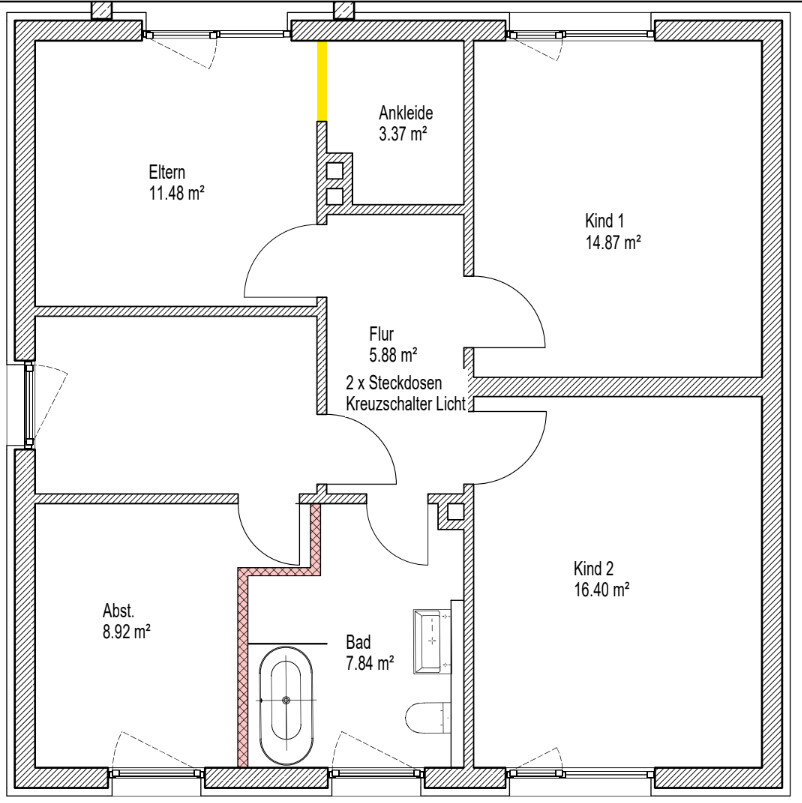
We have now been asked to consider over the weekend how deep we want the window sills to be in the living room, study, and the two children’s rooms for the thermal insulation certificate.
The idea is to have floor-to-ceiling windows in the study and living room on the ground floor, but I’m finding it difficult to position the desk properly that way. Besides files (max. 10), we also want storage space for the vacuum cleaner and such, so we plan to have two large PAX wardrobes. I sketched how it might look:
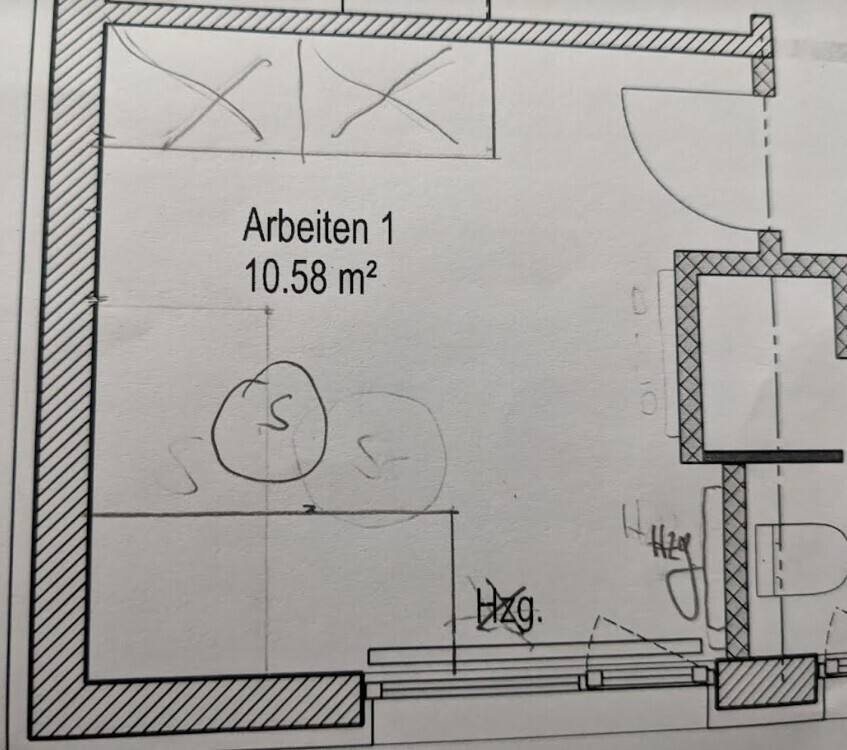
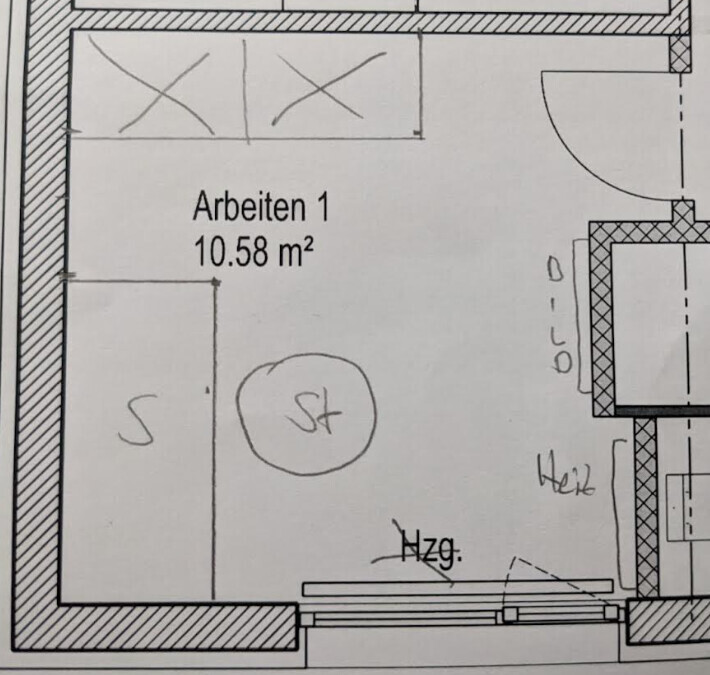
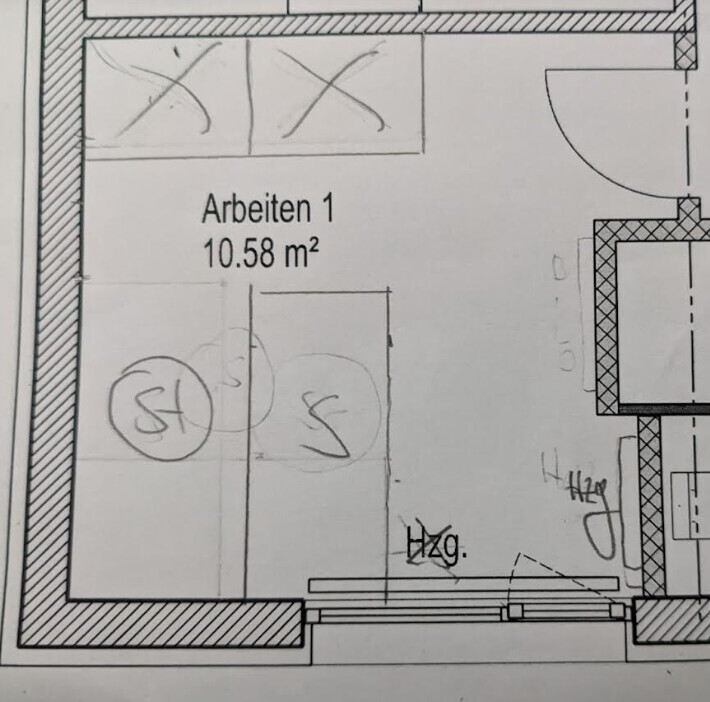
I actually like the third option best — but in that case, the desk would extend halfway into the floor-to-ceiling window. Do you have any experience with this or suggestions for improvement?
In the living room, the sofa we still have to buy would also extend about 40cm (depending on which one we end up choosing) into the window, but I wouldn’t mind that since it is quite deep. Alternatively, a window seat could be made here. The living room is rather small and can get tight for seating when we have guests — and in general, that could also be a nice spot. What do you think?
In the children’s rooms, that could also be an option:
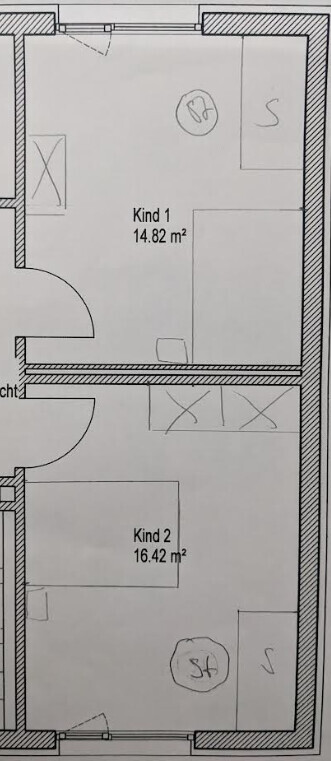
This is currently drawn with a 160 x 80cm (63 x 31 inches) desk, a 140 x 200cm (55 x 79 inches) bed, and a 100 x 60cm (39 x 24 inches) wardrobe.
The alternative would be to leave the sill as it is (about 85cm / 33 inches) and place the desk in front of the window. What do you think about this?
Unfortunately, it turned out that the window reveals are not insulated, but only have an 8cm (3 inches) rebate. These will now be removed and replaced with insulation, which probably won’t be cheap. Additionally, we have decided to add insulation between the rafters in the attic where the loft is not insulated, which will cost another approximately 10,000–15,000€.
On the plus side, we received a quote for the installation of wiring and related work that is below our budget estimate. An electrician also came by and will send us a quote in two weeks.
The wardrobe situation was resolved by the architect like this — between the chimney and the guest WC there is now about 120 x 40cm (47 x 16 inches), which fits our current narrow PAX wardrobe almost perfectly (100 x 37 x 236cm / 39 x 15 x 93 inches). This also allows the window lintel for the study window to remain. She also suggested placing the shower and toilet on the study side, since it’s better to have those noises there rather than in the living room in the evening. We agreed to that (I’m not too bothered by noise while working, I’m used to open-plan offices and usually wear headphones anyway).
There isn’t much new on the upper floor:
We have now been asked to consider over the weekend how deep we want the window sills to be in the living room, study, and the two children’s rooms for the thermal insulation certificate.
The idea is to have floor-to-ceiling windows in the study and living room on the ground floor, but I’m finding it difficult to position the desk properly that way. Besides files (max. 10), we also want storage space for the vacuum cleaner and such, so we plan to have two large PAX wardrobes. I sketched how it might look:
I actually like the third option best — but in that case, the desk would extend halfway into the floor-to-ceiling window. Do you have any experience with this or suggestions for improvement?
In the living room, the sofa we still have to buy would also extend about 40cm (depending on which one we end up choosing) into the window, but I wouldn’t mind that since it is quite deep. Alternatively, a window seat could be made here. The living room is rather small and can get tight for seating when we have guests — and in general, that could also be a nice spot. What do you think?
In the children’s rooms, that could also be an option:
This is currently drawn with a 160 x 80cm (63 x 31 inches) desk, a 140 x 200cm (55 x 79 inches) bed, and a 100 x 60cm (39 x 24 inches) wardrobe.
The alternative would be to leave the sill as it is (about 85cm / 33 inches) and place the desk in front of the window. What do you think about this?

leschaf schrieb:
She also suggested placing the shower and toilet on the home office side, since it’s better to have noise there than in the living room in the evening. We followed that idea as well (I’m not too bothered by noise while working, I’m used to open-plan offices and usually wear headphones anyway).
What are the exact dimensions of the shower? The entrance and overall size look quite small on the plan. I wouldn’t go below 66cm (26 inches) for doorways and not smaller than 90 x 90cm (35 x 35 inches) for showers. It would also be good to ask about the dimensions of the shower and bathtub in the main bathroom.
Similar topics