
Hello everyone,
We bought a two-family house from 1936 in June. More about the financing can be found in this thread. We are still very happy that we bought it. Our baby is due in December, and once our second child needs their own bedroom, the apartment will become too small. We have also visited the property quite often since then and are very pleased with the location. Everything from daycare to high school is within walking distance, along with plenty of sports clubs, and more.
Since the purchase, quite a bit has happened. Our financing was based on equity and a bank loan for the purchase alone. For the renovation, we planned to use capital from the sale of another property. The sale has now been completed and brought in slightly more than our optimistic estimate (365,000€ vs. 350,000€ optimistic expectation vs. 300,000€ minimum expectation). I have to say that selling caused me more headaches than buying the new house—even though it involved significantly less money. Especially the news about falling prices everywhere unsettled us and made us worry that the buyer might pull out. We did have multiple offers, including two in the same range, but the second highest bidder reacted quite badly to being rejected. That would have meant relisting, which, due to the increased costs of living since the agreement and the age of the house, probably would have led to a lower sale price. Once the notarized contract was signed, we were able to breathe a sigh of relief.
Now the work begins. We already have an architect who we have been consulting with over the past two years while looking at houses. She has so far done all the appointments and planning free of charge and invested a lot of time. We have already met on-site with a heating engineer, electrician, and flooring specialist. All have praised the structural condition and potential of the house so far, which is very reassuring.
Here is a picture of the current exterior from the garden side:
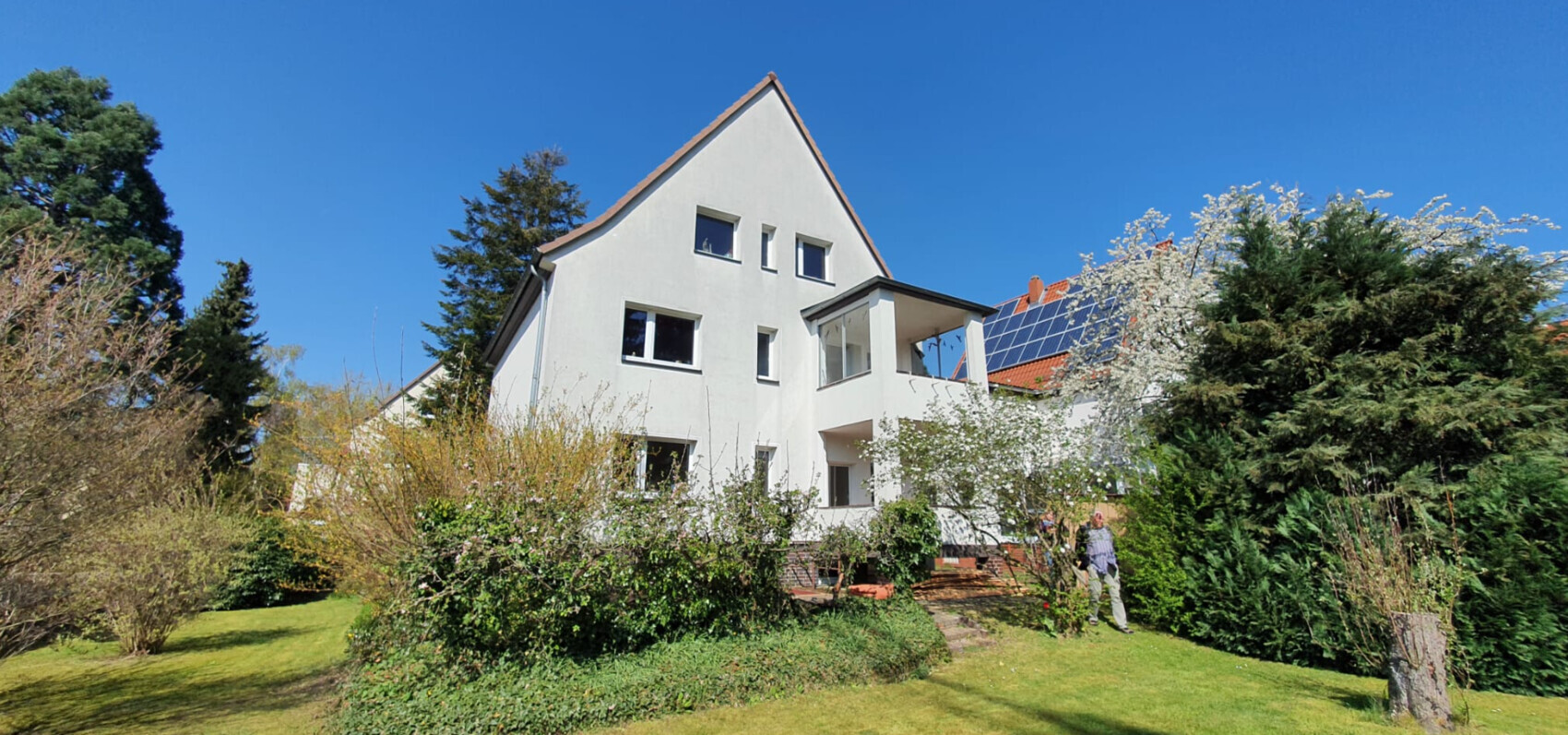
The house was insulated on the outside with 8cm (3 inches) of external thermal insulation composite system (ETICS) in 1996—but unfortunately, no major energy upgrades have been made since then. According to the energy certificate, the current demand is about 220 kWh/m²/a, which for 187 m² (2,013 sq ft) of living space would mean around 41,000 kWh per year. According to gas bills, however, the consumption in 2020 (the last year it was occupied) was only around 22,000 kWh for two households living there separately. That is still a lot, and of course, we want to modernize it. During the recent heatwave, it was actually cooler in the two full floors than in our already quite cool old apartment, which I see as a good sign. The house itself has cavity solid walls.
This means the following for us:
- Insulation of the top-floor ceiling: The attic has a huge footprint and covers roughly 80% of the developed attic space. Therefore, we decided to insulate the attic floor at first, which is more cost-effective than insulating the entire roof, since we won’t need that space anytime soon.
- Insulation of the basement ceiling
- Elimination of some thermal bridges
- Completely new windows and exterior doors throughout the house
Before buying, the architect said that should reduce the demand to around 150 kWh/m²/a or less, and further optimizations might no longer be cost-effective. Since then, energy costs have changed quite a bit… so we’ll see if we address anything else (would you, for example, recommend adding cavity insulation between the two masonry layers as well? Or would that not work well with the ETICS?). What’s your realistic assessment? I would obviously like to reduce it further, but I would prefer to avoid completely rebuilding the roof.
In addition:
- Replace pipes and wiring throughout the whole house
- New radiators
- Heat pump, if it makes sense / if the house can be heated properly with one
- If heat pump: photovoltaic system (the left side of the roof in the picture faces directly south)
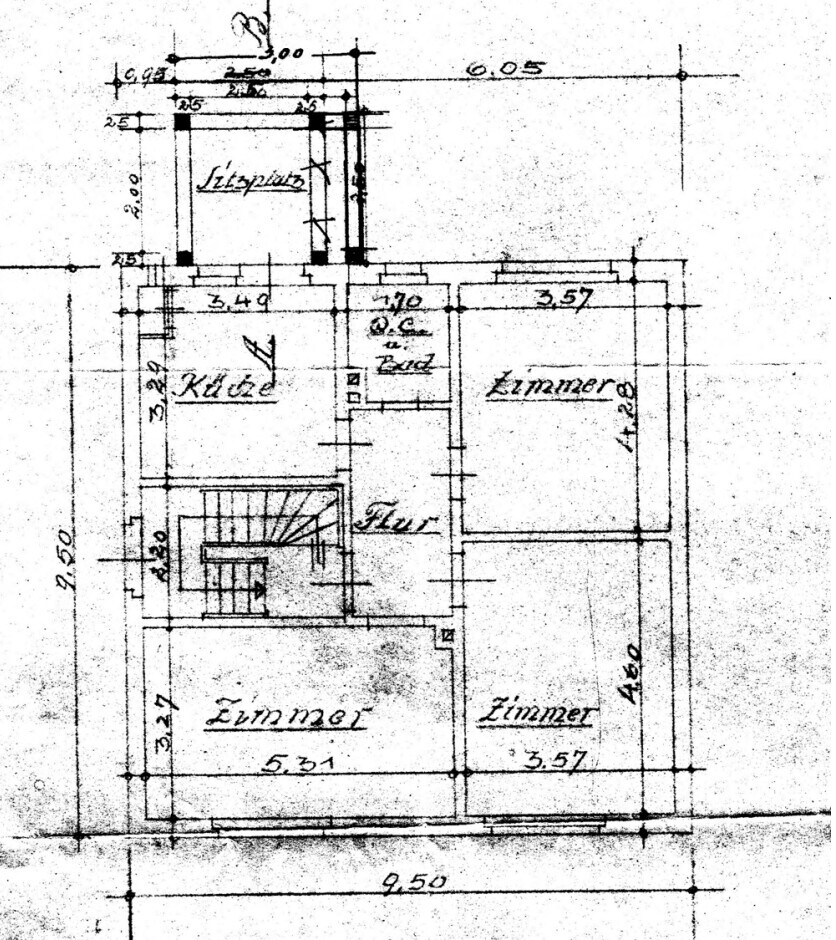
That’s the energy-related part. Several other works are planned as well. This is the current floor plan—the ground floor and first floor are almost identical, but both floors have a nice passage between the two right-side rooms with a sliding door that needs to be preserved:
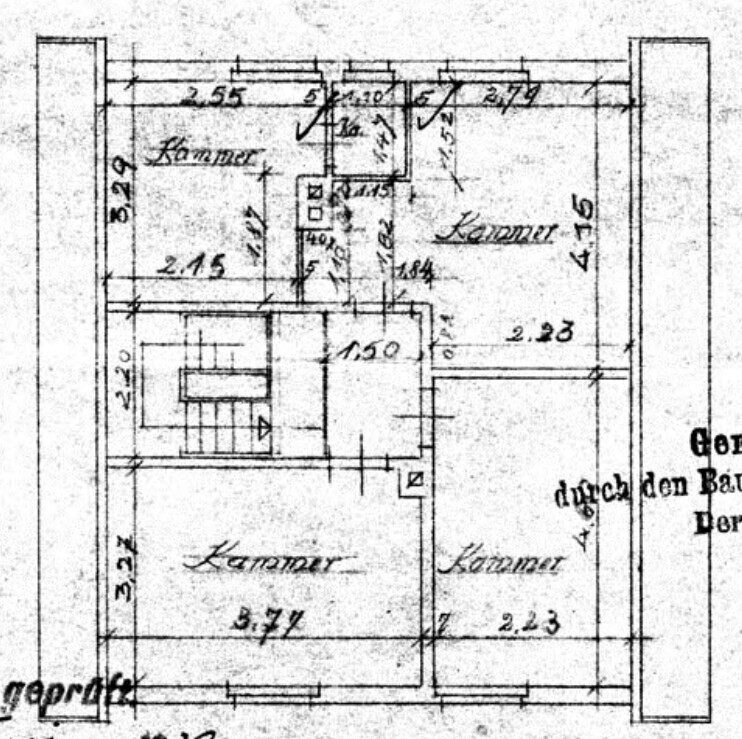
And the attic floor plan:
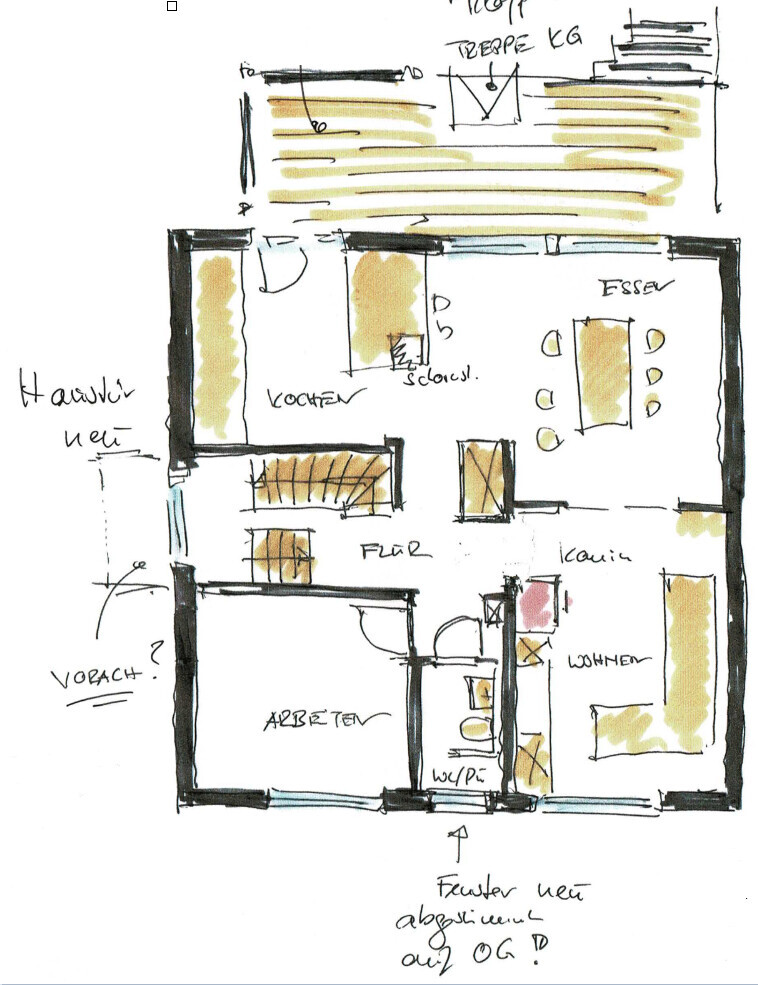
The rough plan is as follows:
Ground Floor:
First Floor:
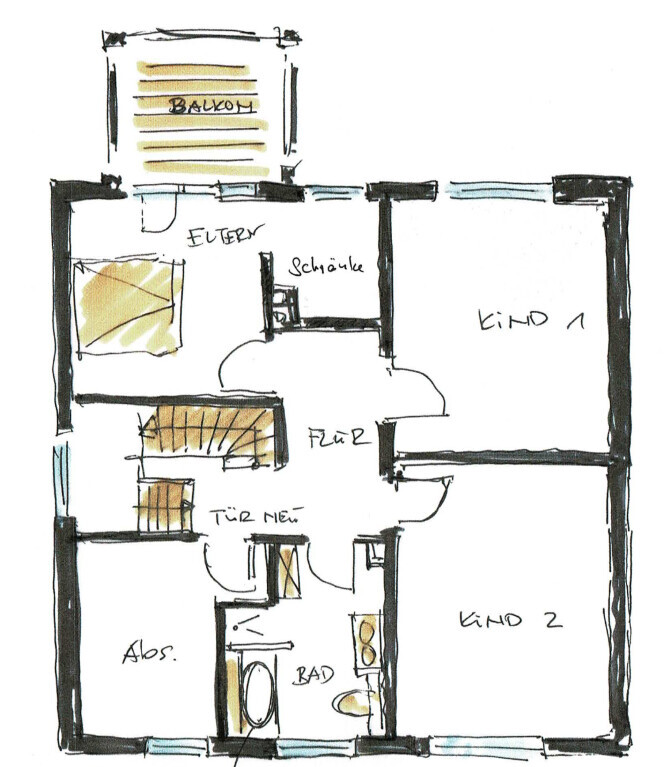
Since both bathrooms need renewing anyway (photos from inside will follow later), we are moving them to the front, facing the street. This will free up space downstairs to open up the kitchen/dining area and allow a slightly larger bathroom upstairs than currently exists. Right now, we live with a 3 m² (32 sq ft) bathroom—it works for three people but is definitely not very comfortable 😀
I work almost 100% from home, so the office is on the ground floor. The attic layout will remain as is. It will include my partner’s craft/workroom, a guest room, and we have one extra room that is still undecided 🙂. The nice thing is that due to the steep roof, we even have higher ceilings on the attic floor (>2.60 m / 8.5 ft) than on the ground and first floors (2.55 m / 8.4 ft), with very little sloping (photos to follow).
Throughout the house, there are old wooden floorboards hidden under several layers of flooring. Fortunately, none are glued down but simply laid loose, so we already looked underneath with the flooring specialist and found the condition to be good. These floors will be restored rather than replaced! This is also a reason why we don’t want to install underfloor heating—the floorboards are too thick, probably fragile for removal, and underfloor heating would cause a chain reaction: the doors (which we also just want to restore/paint), the frames, and so on, would no longer fit. However, underfloor heating will probably be installed in the bathroom upstairs. The indoor staircase is another beautiful old wooden staircase that was hidden under carpet and will also only be restored as needed.
The architect’s first cost estimate is around 270,000€ for all measures (excluding photovoltaics). The three tradespeople who have been on site have more or less confirmed her rough calculation. Statics engineer and window fitter will visit next week—we’re excited 🙂
Current concerns:
- Can we achieve an energy level that makes a heat pump reasonably economical (we do have a lot of roof space for photovoltaics)?
- Is the rest of the cost estimate realistic?
- What surprises might still be waiting for us?
- When will it be completed? Target is early summer next year...
We look forward to your feedback!
We bought a two-family house from 1936 in June. More about the financing can be found in this thread. We are still very happy that we bought it. Our baby is due in December, and once our second child needs their own bedroom, the apartment will become too small. We have also visited the property quite often since then and are very pleased with the location. Everything from daycare to high school is within walking distance, along with plenty of sports clubs, and more.
Since the purchase, quite a bit has happened. Our financing was based on equity and a bank loan for the purchase alone. For the renovation, we planned to use capital from the sale of another property. The sale has now been completed and brought in slightly more than our optimistic estimate (365,000€ vs. 350,000€ optimistic expectation vs. 300,000€ minimum expectation). I have to say that selling caused me more headaches than buying the new house—even though it involved significantly less money. Especially the news about falling prices everywhere unsettled us and made us worry that the buyer might pull out. We did have multiple offers, including two in the same range, but the second highest bidder reacted quite badly to being rejected. That would have meant relisting, which, due to the increased costs of living since the agreement and the age of the house, probably would have led to a lower sale price. Once the notarized contract was signed, we were able to breathe a sigh of relief.
Now the work begins. We already have an architect who we have been consulting with over the past two years while looking at houses. She has so far done all the appointments and planning free of charge and invested a lot of time. We have already met on-site with a heating engineer, electrician, and flooring specialist. All have praised the structural condition and potential of the house so far, which is very reassuring.
Here is a picture of the current exterior from the garden side:
The house was insulated on the outside with 8cm (3 inches) of external thermal insulation composite system (ETICS) in 1996—but unfortunately, no major energy upgrades have been made since then. According to the energy certificate, the current demand is about 220 kWh/m²/a, which for 187 m² (2,013 sq ft) of living space would mean around 41,000 kWh per year. According to gas bills, however, the consumption in 2020 (the last year it was occupied) was only around 22,000 kWh for two households living there separately. That is still a lot, and of course, we want to modernize it. During the recent heatwave, it was actually cooler in the two full floors than in our already quite cool old apartment, which I see as a good sign. The house itself has cavity solid walls.
This means the following for us:
- Insulation of the top-floor ceiling: The attic has a huge footprint and covers roughly 80% of the developed attic space. Therefore, we decided to insulate the attic floor at first, which is more cost-effective than insulating the entire roof, since we won’t need that space anytime soon.
- Insulation of the basement ceiling
- Elimination of some thermal bridges
- Completely new windows and exterior doors throughout the house
Before buying, the architect said that should reduce the demand to around 150 kWh/m²/a or less, and further optimizations might no longer be cost-effective. Since then, energy costs have changed quite a bit… so we’ll see if we address anything else (would you, for example, recommend adding cavity insulation between the two masonry layers as well? Or would that not work well with the ETICS?). What’s your realistic assessment? I would obviously like to reduce it further, but I would prefer to avoid completely rebuilding the roof.
In addition:
- Replace pipes and wiring throughout the whole house
- New radiators
- Heat pump, if it makes sense / if the house can be heated properly with one
- If heat pump: photovoltaic system (the left side of the roof in the picture faces directly south)
That’s the energy-related part. Several other works are planned as well. This is the current floor plan—the ground floor and first floor are almost identical, but both floors have a nice passage between the two right-side rooms with a sliding door that needs to be preserved:
And the attic floor plan:
The rough plan is as follows:
Ground Floor:
First Floor:
Since both bathrooms need renewing anyway (photos from inside will follow later), we are moving them to the front, facing the street. This will free up space downstairs to open up the kitchen/dining area and allow a slightly larger bathroom upstairs than currently exists. Right now, we live with a 3 m² (32 sq ft) bathroom—it works for three people but is definitely not very comfortable 😀
I work almost 100% from home, so the office is on the ground floor. The attic layout will remain as is. It will include my partner’s craft/workroom, a guest room, and we have one extra room that is still undecided 🙂. The nice thing is that due to the steep roof, we even have higher ceilings on the attic floor (>2.60 m / 8.5 ft) than on the ground and first floors (2.55 m / 8.4 ft), with very little sloping (photos to follow).
Throughout the house, there are old wooden floorboards hidden under several layers of flooring. Fortunately, none are glued down but simply laid loose, so we already looked underneath with the flooring specialist and found the condition to be good. These floors will be restored rather than replaced! This is also a reason why we don’t want to install underfloor heating—the floorboards are too thick, probably fragile for removal, and underfloor heating would cause a chain reaction: the doors (which we also just want to restore/paint), the frames, and so on, would no longer fit. However, underfloor heating will probably be installed in the bathroom upstairs. The indoor staircase is another beautiful old wooden staircase that was hidden under carpet and will also only be restored as needed.
The architect’s first cost estimate is around 270,000€ for all measures (excluding photovoltaics). The three tradespeople who have been on site have more or less confirmed her rough calculation. Statics engineer and window fitter will visit next week—we’re excited 🙂
Current concerns:
- Can we achieve an energy level that makes a heat pump reasonably economical (we do have a lot of roof space for photovoltaics)?
- Is the rest of the cost estimate realistic?
- What surprises might still be waiting for us?
- When will it be completed? Target is early summer next year...
We look forward to your feedback!
leschaf schrieb:
Yes – and it will also become a bit brighter. The new windows will be somewhat larger (if the price is reasonable), extending downward with a lower but still code-compliant sill height.That is our plan as well. What sill height is required to avoid the need for fall protection? I’m still confused, as I find different information in search engines...
According to our architect, it depends on the federal state, and here in Lower Saxony it is 80cm (31.5 inches):
"According to § 4 para. 3 sentence 1 of the implementing regulation of the Lower Saxony building code, window sills [B]must be at least 0.80 m (31.5 inches) high for fall heights from 1.00 m (39.4 inches) up to 12.00 m (39.4 feet), and at least 0.90 m (35.4 inches) high for fall heights above 12.00 m (39.4 feet)."[/B]
The calculation is apparently made from the upper edge of the window frame, so the actual sill can be somewhat lower (if desired – we are still unsure about this with two small children).
"According to § 4 para. 3 sentence 1 of the implementing regulation of the Lower Saxony building code, window sills [B]must be at least 0.80 m (31.5 inches) high for fall heights from 1.00 m (39.4 inches) up to 12.00 m (39.4 feet), and at least 0.90 m (35.4 inches) high for fall heights above 12.00 m (39.4 feet)."[/B]
The calculation is apparently made from the upper edge of the window frame, so the actual sill can be somewhat lower (if desired – we are still unsure about this with two small children).

leschaf schrieb:
In the kitchen on the ground floor, there was this nice built-in pantry:
[IMG width="487px" alt="1663159803803.png"]https://www.hausbau-forum.de/attachments/1663159803803-png.74931/[/IMG]That really hurts my heart; in the Borstei area of Munich, something like this is carefully preserved. It’s actually a clever idea and could definitely be adapted for modern homes. This unit was specially built, as 11ant already mentioned, as a non-electric refrigerator, and it works very well! Nowadays, you would insulate it towards the living space and have a brilliant storage solution for food that needs to stay cool but not cold (potatoes, carrots, fruit...).
But that’s history now... unfortunately.

A great project!
Moving the bathrooms makes sense, but is there a wastewater pipe nearby?
I have some doubts about the structural integrity in the kitchen. Removing that thick wall—I’m curious to hear what the structural engineer will say.
I also see the issue with the cloakroom and wouldn’t underestimate it, especially since you’re expecting child number two now.
Measure whether you still have enough depth in the small hallway forming behind the chimney (or whatever that is). If it’s more than 45cm (18 inches), I would plan like this:
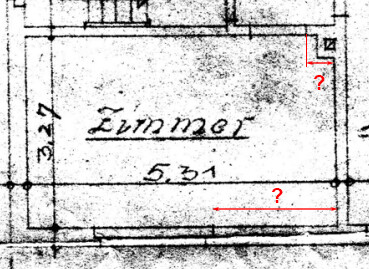
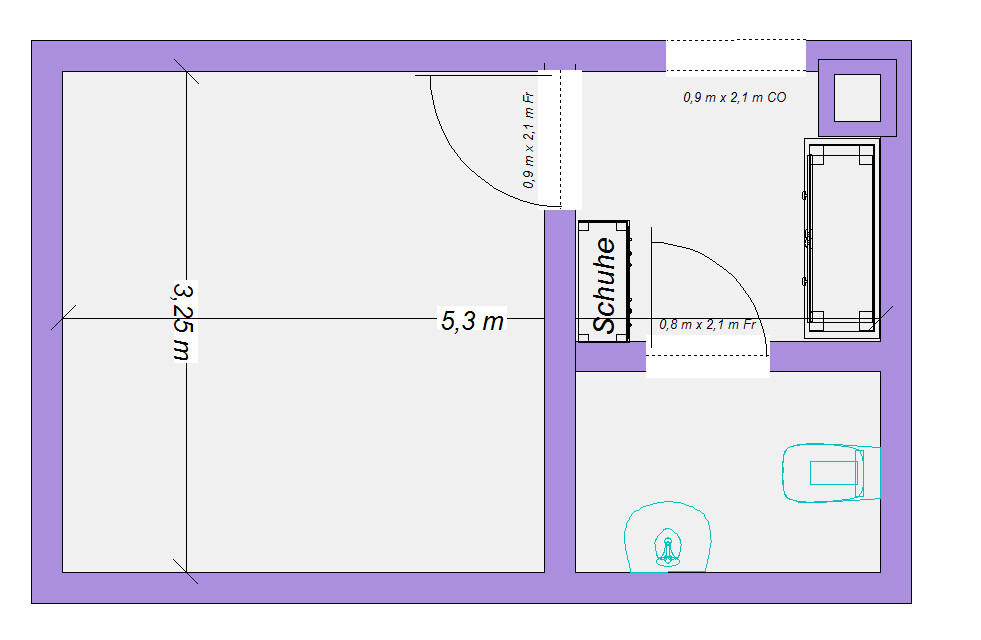
The shown cabinet is 130cm x 50cm (51 inches x 20 inches)—not huge, but every centimeter counts here. The shoe cabinet is 80cm x 35cm (31 inches x 14 inches). In the draft, some walls have been removed quite generously. You could also move the passage there. But in reality, it will probably look different. More detailed sketches would be useful now, since you’re already well underway with the work. 🙂
Moving the bathrooms makes sense, but is there a wastewater pipe nearby?
I have some doubts about the structural integrity in the kitchen. Removing that thick wall—I’m curious to hear what the structural engineer will say.
I also see the issue with the cloakroom and wouldn’t underestimate it, especially since you’re expecting child number two now.
Measure whether you still have enough depth in the small hallway forming behind the chimney (or whatever that is). If it’s more than 45cm (18 inches), I would plan like this:
The shown cabinet is 130cm x 50cm (51 inches x 20 inches)—not huge, but every centimeter counts here. The shoe cabinet is 80cm x 35cm (31 inches x 14 inches). In the draft, some walls have been removed quite generously. You could also move the passage there. But in reality, it will probably look different. More detailed sketches would be useful now, since you’re already well underway with the work. 🙂
 Winniefred21 Oct 2022 09:41
Very nice project! From the pictures, it reminds me of our renovation. You are very lucky that the house hasn’t been completely modernized yet. The original doors are worth a lot (unfortunately, we didn’t have any left). The structure actually looks solid. Nice staircase. We also restored ours by removing old layers, sanding, and applying a new stain. And the walls, yes, they look terrible at the moment, but that’s only temporary.
The floorboards will surely look great once they’re finished. Ours are still there as well, but unfortunately they are simple, laid in small sections, and stained with ox blood, so even if restored, they wouldn’t look nice. So you can count yourselves lucky!
The floorboards will surely look great once they’re finished. Ours are still there as well, but unfortunately they are simple, laid in small sections, and stained with ox blood, so even if restored, they wouldn’t look nice. So you can count yourselves lucky!
Similar topics