
Hi everyone,
you probably all know this classic challenge of renovating an old building—there's always another surprise around every corner 🙂 I’m a bit puzzled right now and hope you can help.
As mentioned, we are currently renovating a house from 1935. Today, we examined the construction of the wooden beam ceiling on the first floor. The structure itself is fairly typical. On the underside, there is a plastered layer of reed matting attached to the wood joists with cross battens; above that is the subfloor, and on top of the wooden beams are the wooden floorboards (see picture). Inside and above the subfloor, there is a filling made of construction debris. The subfloor timbers are not nailed to the edges of the wooden beams but are just loosely resting. The wooden floorboards will not be our final flooring, but for energy efficiency reasons, we would like to insulate the floor. We are currently discussing how to proceed and I have the following questions and would be very grateful for your help.
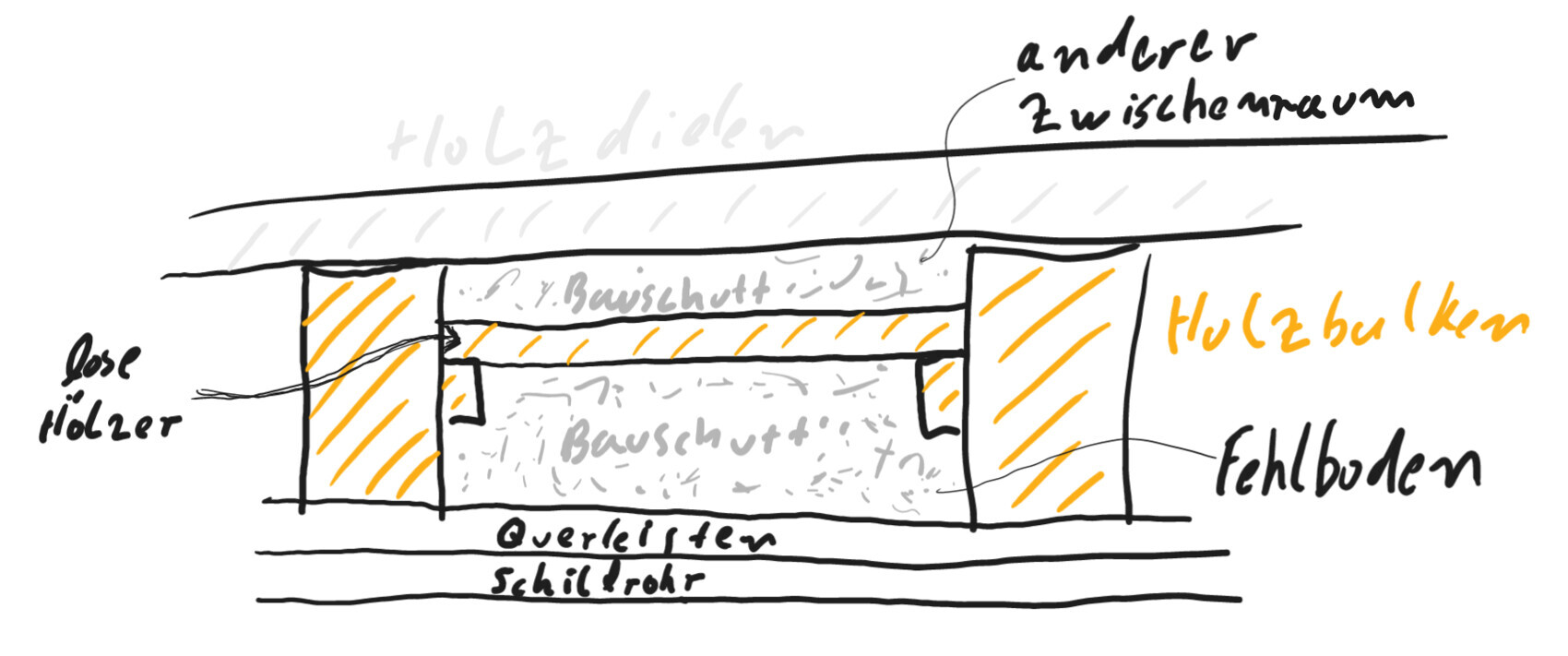
1. Should both the space above the subfloor and the subfloor itself be insulated for optimal thermal performance, for example with mineral wool/Rockwool/etc., or is something heavier like rubble necessary to achieve adequate impact sound insulation? Should a different type of fill be used in the subfloor cavity compared to the space above? If so, which materials would you recommend for the subfloor and the other cavity?
2. If everything should be insulated, we would remove the rubble by pulling out the reed matting from below. I’m afraid this will make an enormous mess. Since new windows have already been installed on the lower floor, I’d like to avoid that if possible. If a subfloor with rubble is acceptable, would it be sufficient to remove the floorboards, take out the rubble resting on the loose timbers (and empty it into the subfloor, which is not completely filled), and then insulate the space under the current floorboards with mineral wool?
3. If it is sufficient to only fill the "other" cavity under the current floorboards with mineral wool, we would remove the floorboards and insulate “from above.” What should we replace the floorboards with? OSB panels and dry screed? Or would OSB panels alone be sufficient (structure: joist spacing approx. 70cm (27.5 inches)) to support the impact sound insulation and the flooring?
Sorry for the long post, many thanks in advance!
Best regards
you probably all know this classic challenge of renovating an old building—there's always another surprise around every corner 🙂 I’m a bit puzzled right now and hope you can help.
As mentioned, we are currently renovating a house from 1935. Today, we examined the construction of the wooden beam ceiling on the first floor. The structure itself is fairly typical. On the underside, there is a plastered layer of reed matting attached to the wood joists with cross battens; above that is the subfloor, and on top of the wooden beams are the wooden floorboards (see picture). Inside and above the subfloor, there is a filling made of construction debris. The subfloor timbers are not nailed to the edges of the wooden beams but are just loosely resting. The wooden floorboards will not be our final flooring, but for energy efficiency reasons, we would like to insulate the floor. We are currently discussing how to proceed and I have the following questions and would be very grateful for your help.
1. Should both the space above the subfloor and the subfloor itself be insulated for optimal thermal performance, for example with mineral wool/Rockwool/etc., or is something heavier like rubble necessary to achieve adequate impact sound insulation? Should a different type of fill be used in the subfloor cavity compared to the space above? If so, which materials would you recommend for the subfloor and the other cavity?
2. If everything should be insulated, we would remove the rubble by pulling out the reed matting from below. I’m afraid this will make an enormous mess. Since new windows have already been installed on the lower floor, I’d like to avoid that if possible. If a subfloor with rubble is acceptable, would it be sufficient to remove the floorboards, take out the rubble resting on the loose timbers (and empty it into the subfloor, which is not completely filled), and then insulate the space under the current floorboards with mineral wool?
3. If it is sufficient to only fill the "other" cavity under the current floorboards with mineral wool, we would remove the floorboards and insulate “from above.” What should we replace the floorboards with? OSB panels and dry screed? Or would OSB panels alone be sufficient (structure: joist spacing approx. 70cm (27.5 inches)) to support the impact sound insulation and the flooring?
Sorry for the long post, many thanks in advance!
Best regards
S
Sir_Batman15 Jan 2023 11:43I have done the same in several rooms as well.
Construction from bottom to top as follows:
old:
Plaster, reed mats, nailed boards, loose fill, air gap, plank flooring
new:
Suspended ceiling, old plaster, reed, nailed boards, Rockwool friction-fit insulation, new secondary floor structure, layer of quartz sand, then dry fill (messy), 24mm (1 inch) OSB, 20mm (¾ inch) dry screed, tiles or parquet
Sound insulation is quite good. Not perfect, but basically you don’t hear anything, especially from the bathroom.
Reason for the new secondary floor: I wanted to add weight between the joists, which probably wouldn’t have held before since the boards were only nailed from below. Probably just for peace of mind, but it was a nice project.
If I had higher ceilings, I would have suspended the ceiling differently. As it is, there probably isn’t a significant positive sound effect.
Construction from bottom to top as follows:
old:
Plaster, reed mats, nailed boards, loose fill, air gap, plank flooring
new:
Suspended ceiling, old plaster, reed, nailed boards, Rockwool friction-fit insulation, new secondary floor structure, layer of quartz sand, then dry fill (messy), 24mm (1 inch) OSB, 20mm (¾ inch) dry screed, tiles or parquet
Sound insulation is quite good. Not perfect, but basically you don’t hear anything, especially from the bathroom.
Reason for the new secondary floor: I wanted to add weight between the joists, which probably wouldn’t have held before since the boards were only nailed from below. Probably just for peace of mind, but it was a nice project.
If I had higher ceilings, I would have suspended the ceiling differently. As it is, there probably isn’t a significant positive sound effect.
S
Sir_Batman15 Jan 2023 11:45Finch039 schrieb:
I’m currently facing exactly the same issue. The original plan was to remove the old infill, install new infill, and then lay OSB panels on top.
When I explained this at the home improvement store and showed photos, I was immediately advised to keep the old infill (construction debris, etc., relatively heavy material) and top it up flush with heavy infill from the store. First, remove the old infill, install a dust barrier, then add old plus new infill on top. Finally, install 20mm (0.8 inch) floating dry screed panels (glued and screwed together). Optionally, add an 8mm (0.3 inch) wood fiber mat under the panels, or at least insulation strips on the wooden joists.
Main arguments against OSB / in favor of dry screed: better sound insulation due to higher mass, no screws into the joists, thus decoupling the floor. I’m willing to pay the extra three euros per square meter for that.Can the lower nailed plank layer support a heavier infill? That didn’t work for me, so I installed a second subfloor instead.Sir_Batman schrieb:
Does the bottom nailed plank layer support a heavier loose fill? It didn’t work for me, so I installed a second subfloor.Yes, it does support it... above the subfloor there is a clay screed in most places. In some areas, I removed it to check the condition of the planks (mine are not nailed, just laid loosely) – everything looks good so far. The old loose fill also weighs quite a bit; I’m basically just topping it up (for the dry screed and to improve sound insulation a bit).
This is how it looks now in the first room (before / after).
However, I might have been a bit hasty. The plumber still needs to run heating pipes from below through the ceiling. I’ll have to figure out tomorrow how to handle that.
Similar topics