
Hello everyone,
In the property we purchased, the floor in an extension has settled, or rather a row of chipboard panels has bent downward by about 1–1.5 cm (0.4–0.6 inches) under the weight of two night storage heaters, each weighing 300 kg (660 lbs). The night storage heaters have already been removed as we switched to a conventional gas condensing boiler. Such a load is not expected again in the same spot.
I was able to inspect the construction from the basement and ruled out any cracks in the chipboard or even in the joists.
My plan is to remove the existing parquet flooring in the affected areas, fill the low spots with a good flexible tile adhesive, level remaining unevenness with a self-leveling compound, and then reinstall the parquet. The new parquet is probably necessary due to burns, likely caused by the night storage heaters.
I’m always grateful for advice—if you spot any mistakes in my plan, please let me know 🙂
Now to the issues:
The mosaic parquet measures 156 x 156 x 8 mm (6.1 x 6.1 x 0.3 inches) and consists of 7 strips. So far, I have only found 160 x 160 x 8 mm (6.3 x 6.3 x 0.3 inches) sizes online and in specialist stores.
The previous owners left some spare parquet for the necessary area, but unfortunately only for about 50% of the surface, and the material was exposed to dirt and moisture, untreated.
Due to my oversight, I have already bought parquet for the damaged area in the 160 x 160 x 8 mm size.
Here are my questions:
- Does it make sense to still use the worn old parquet, or are discolorations likely to remain even after sanding, filling, and oiling?
- Is it conceivable to integrate parquet with the wrong dimensions in such a way that the difference is hardly noticeable in everyday use? A sideboard and a tall cabinet will later be placed in that area. However, the furniture won’t completely hide the issue.
- Where else could I source parquet in the required dimensions? (I’ve already checked eBay 🙂)
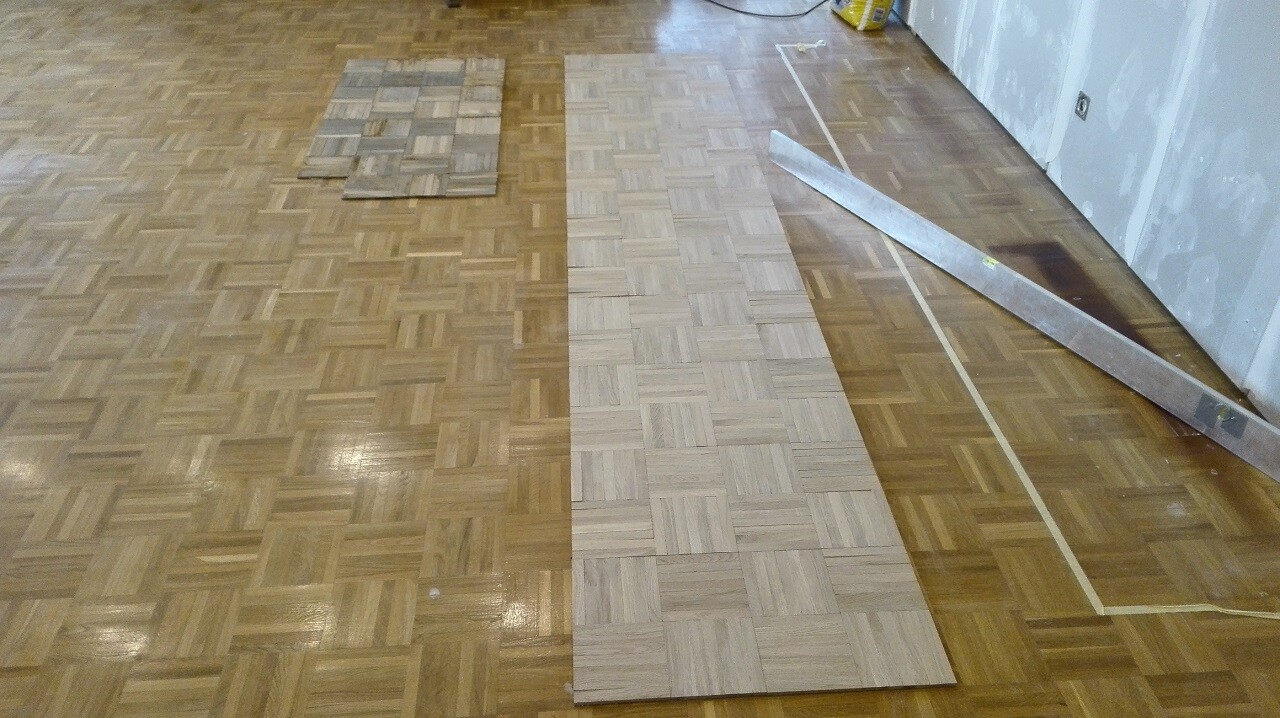
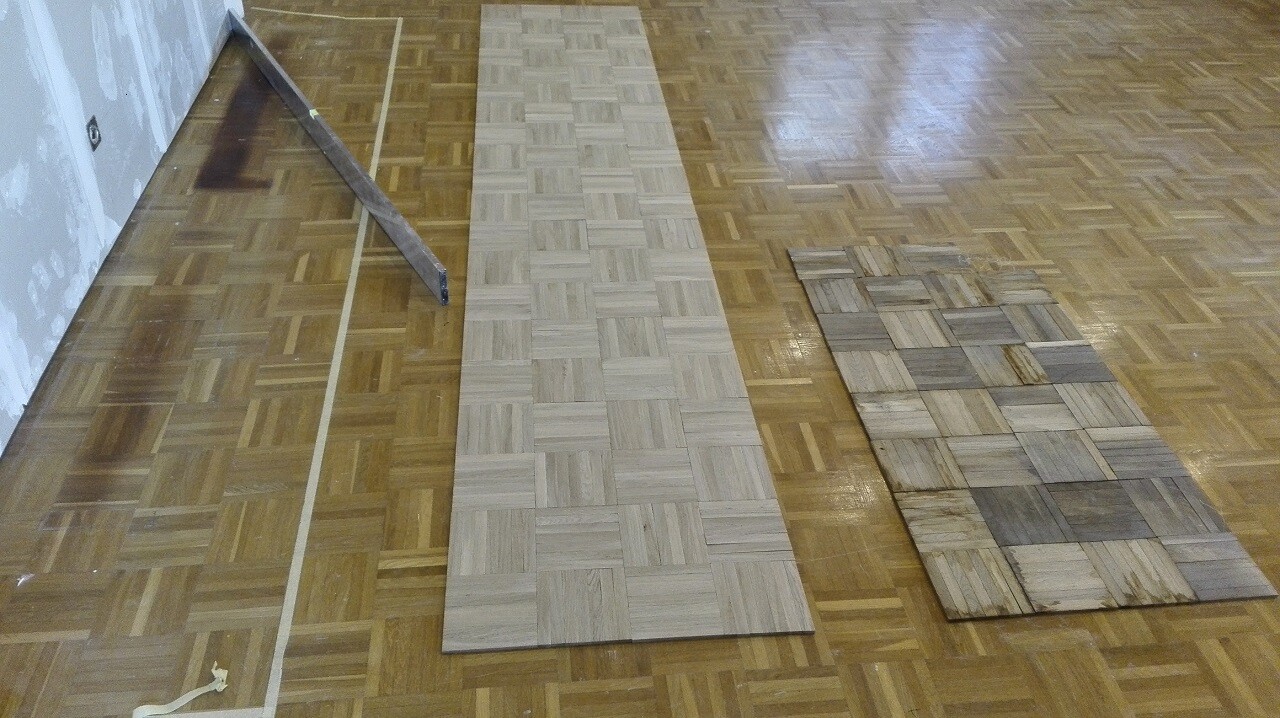
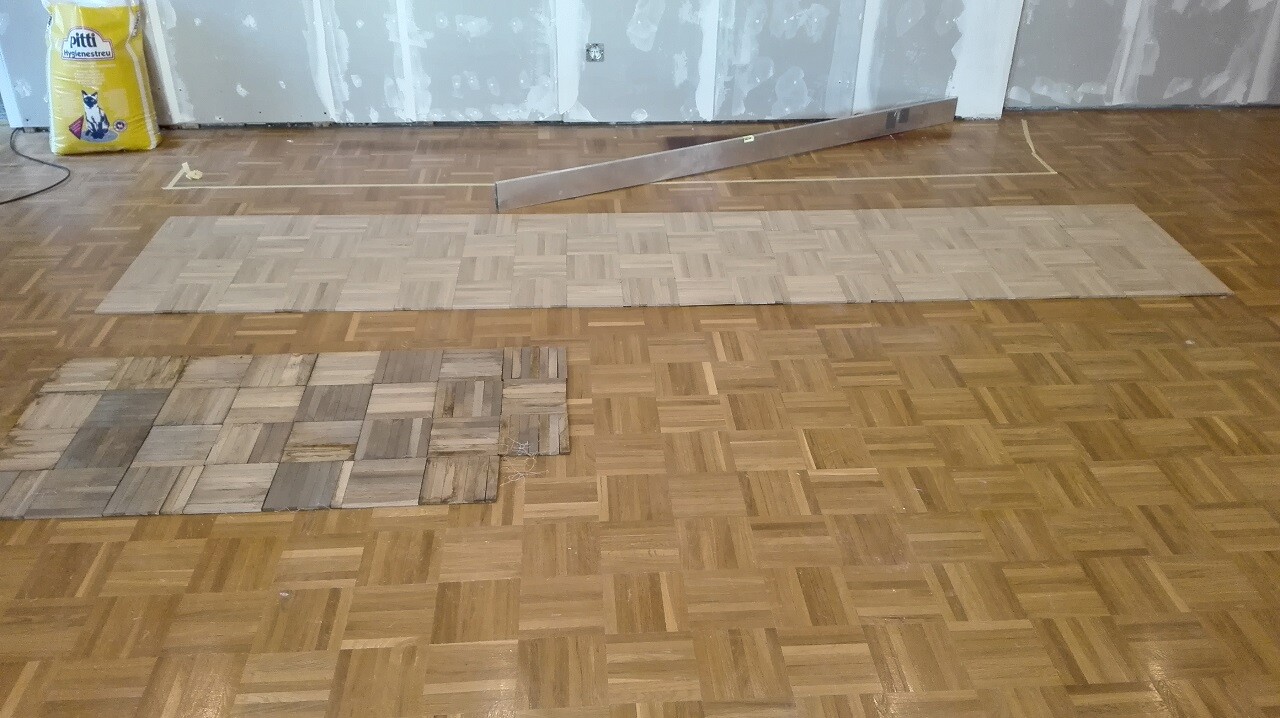
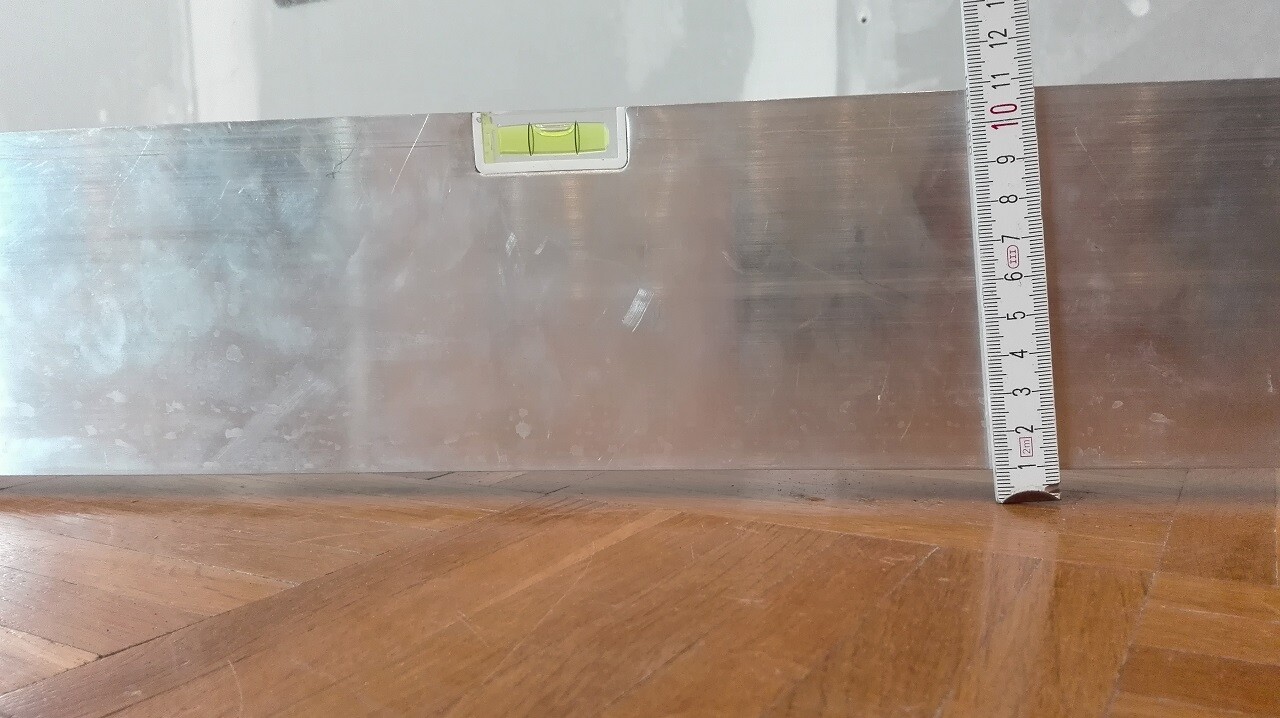
In the property we purchased, the floor in an extension has settled, or rather a row of chipboard panels has bent downward by about 1–1.5 cm (0.4–0.6 inches) under the weight of two night storage heaters, each weighing 300 kg (660 lbs). The night storage heaters have already been removed as we switched to a conventional gas condensing boiler. Such a load is not expected again in the same spot.
I was able to inspect the construction from the basement and ruled out any cracks in the chipboard or even in the joists.
My plan is to remove the existing parquet flooring in the affected areas, fill the low spots with a good flexible tile adhesive, level remaining unevenness with a self-leveling compound, and then reinstall the parquet. The new parquet is probably necessary due to burns, likely caused by the night storage heaters.
I’m always grateful for advice—if you spot any mistakes in my plan, please let me know 🙂
Now to the issues:
The mosaic parquet measures 156 x 156 x 8 mm (6.1 x 6.1 x 0.3 inches) and consists of 7 strips. So far, I have only found 160 x 160 x 8 mm (6.3 x 6.3 x 0.3 inches) sizes online and in specialist stores.
The previous owners left some spare parquet for the necessary area, but unfortunately only for about 50% of the surface, and the material was exposed to dirt and moisture, untreated.
Due to my oversight, I have already bought parquet for the damaged area in the 160 x 160 x 8 mm size.
Here are my questions:
- Does it make sense to still use the worn old parquet, or are discolorations likely to remain even after sanding, filling, and oiling?
- Is it conceivable to integrate parquet with the wrong dimensions in such a way that the difference is hardly noticeable in everyday use? A sideboard and a tall cabinet will later be placed in that area. However, the furniture won’t completely hide the issue.
- Where else could I source parquet in the required dimensions? (I’ve already checked eBay 🙂)

I would first check whether the old installed parquet floor is still suitable for sanding. In our previous apartment, everything was just resealed because sanding was no longer possible without making it too thin. However, after a year, more and more panels started to come loose from the floor and creaked when walking on them. Fortunately, it was only a rental, so it’s no longer my concern. What I mean is, maybe remove the floor completely and plan for the long term.

Lay out the new mosaic precisely to see if the offset is very noticeable, although I don’t think it will be. However, as @Sunny pointed out, check whether the old mosaic still has enough material to be sanded.
This statement
as well as this one
I honestly don’t fully understand.
I don’t know your professional background, but I doubt that a structural assessment can be reliably made just by looking at beams and particle boards. To be clear, I’m not qualified to judge this (especially not based on pictures), so I won’t comment on the proposed floor construction. Maybe someone with expertise here can evaluate the floor structure properly.
This statement
expone schrieb:
........ or a row of particle boards has sagged about 1–1.5 cm (0.4–0.6 inches) under the weight of two night storage heaters weighing 300 kg (660 lbs) each.
as well as this one
expone schrieb:
I was able to inspect the structure from the basement and rule out any breaks in the particle boards or even in the supporting beams.
I honestly don’t fully understand.
I don’t know your professional background, but I doubt that a structural assessment can be reliably made just by looking at beams and particle boards. To be clear, I’m not qualified to judge this (especially not based on pictures), so I won’t comment on the proposed floor construction. Maybe someone with expertise here can evaluate the floor structure properly.
Similar topics