
ᐅ Renovate the workshop ceiling (refurbish or replace wood wool panels)
Created on: 13 Apr 2026 14:01
L
Lukas97Hello everyone,
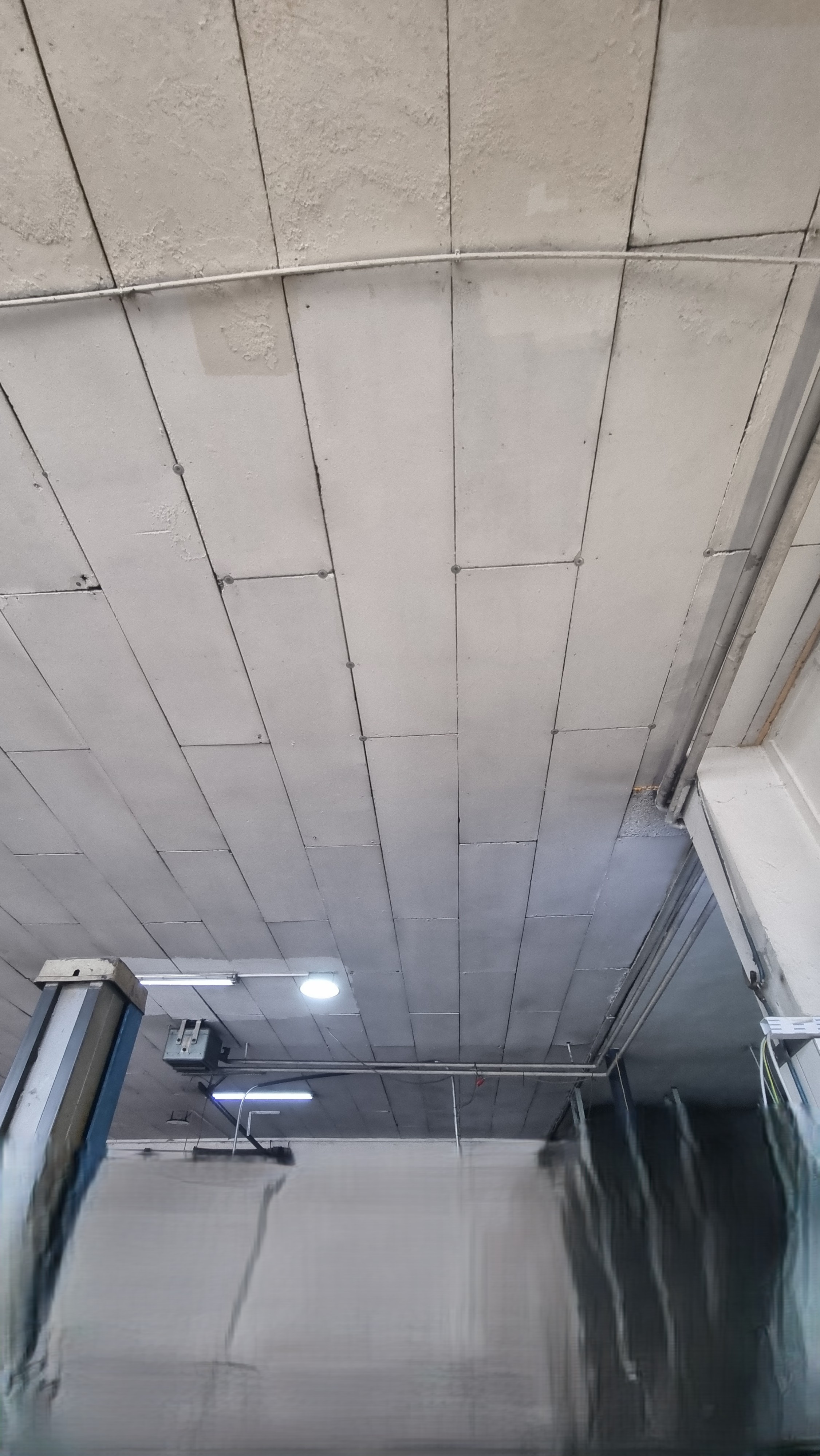
Over the years, the ceiling in our workshop has unfortunately deteriorated visually. The paint is peeling, some areas are sagging, and from a functional standpoint (heating in winter), a lot of energy is lost. Therefore, we want to either cover the existing Heraklith boards or replace them with something cleaner and more modern.
Workshop, built around 1975
Existing ceiling: Heraklith boards, approximately 200 x 60 cm (79 x 24 inches) in size, with about a 1 m (3 ft) gap above to the flat roof.
Supporting structure according to initial assessment: nail truss construction, beam spacing roughly 60 cm (24 inches).
For now, only an area of about 5 x 15 m (16 x 49 ft) should be renovated, since a fresh air duct will be installed there. The rest of the area would be done later.
At first, plasterboard with mineral wool came to mind, but for that size, it would mean quite a lot of work with filling and sanding. If possible, I would prefer to avoid this route.
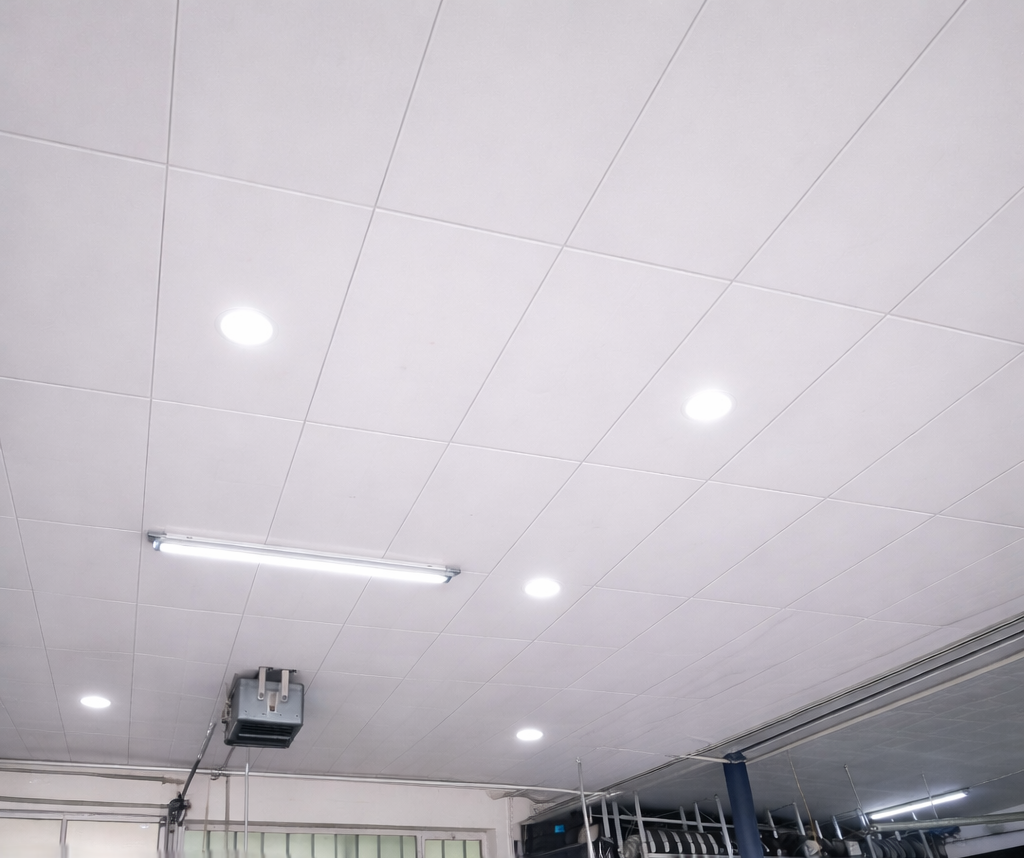
During my research, I also came across sandwich panels as a suspended ceiling. This option appeals to me in principle because no filling and painting would be needed, and the insulation core is already included.
My questions:
What would you recommend for improving or renewing such a Heraklith board ceiling?
Are there any other solutions?
Is plasterboard advisable here, or rather not?
Would sandwich panels be a practical alternative as an interior ceiling? Does anyone have experience with this?
If possible, I would prefer not to dismantle the existing boards.
Image 1 original
Image 2 my vision of how it could look.
If the project proceeds, it will of course be reviewed by a structural engineer beforehand and carried out only with permission / building permit.
Thanks in advance for your assessments and experiences.
Over the years, the ceiling in our workshop has unfortunately deteriorated visually. The paint is peeling, some areas are sagging, and from a functional standpoint (heating in winter), a lot of energy is lost. Therefore, we want to either cover the existing Heraklith boards or replace them with something cleaner and more modern.
Workshop, built around 1975
Existing ceiling: Heraklith boards, approximately 200 x 60 cm (79 x 24 inches) in size, with about a 1 m (3 ft) gap above to the flat roof.
Supporting structure according to initial assessment: nail truss construction, beam spacing roughly 60 cm (24 inches).
For now, only an area of about 5 x 15 m (16 x 49 ft) should be renovated, since a fresh air duct will be installed there. The rest of the area would be done later.
At first, plasterboard with mineral wool came to mind, but for that size, it would mean quite a lot of work with filling and sanding. If possible, I would prefer to avoid this route.
During my research, I also came across sandwich panels as a suspended ceiling. This option appeals to me in principle because no filling and painting would be needed, and the insulation core is already included.
My questions:
What would you recommend for improving or renewing such a Heraklith board ceiling?
Are there any other solutions?
Is plasterboard advisable here, or rather not?
Would sandwich panels be a practical alternative as an interior ceiling? Does anyone have experience with this?
If possible, I would prefer not to dismantle the existing boards.
Image 1 original
Image 2 my vision of how it could look.
If the project proceeds, it will of course be reviewed by a structural engineer beforehand and carried out only with permission / building permit.
Thanks in advance for your assessments and experiences.
I would take a more sober look at the issue with the sandwich panels. At first, it sounds like a "no mess, quick finish" solution, but it’s only half that. These panels can weigh around 10–12 kg/m² (2–2.5 lb/ft²) depending on the core; with 75 m² (807 ft²), you quickly end up with almost 1 ton (2,200 lb) of additional load… Have you checked what your nail trusses say about that, or is it still more of a gut feeling?
What stands out in your description is that a 1-meter (3.3 ft) air cavity is practically ineffective from an energy perspective. You can insulate all you want, but if the top remains open, part of the insulation effect will be lost anyway. Are you planning to make the level airtight or will it stay more like a "workshop standard"?
Honestly, I wouldn’t bother with drywall unless you’re up for 2–3 rounds of filling and sanding over an area of 5 x 15 m (16 x 49 ft)… It’s no fun and offers little practical benefit in use. Corrugated metal sheeting with support and insulation over it is often a more straightforward solution—looks don’t matter much, but it’s functionally stable and faster to install.
I would just leave the Heraklith boards as they are, as long as nothing is falling off. Everything else is unnecessary effort.
Good luck!
What stands out in your description is that a 1-meter (3.3 ft) air cavity is practically ineffective from an energy perspective. You can insulate all you want, but if the top remains open, part of the insulation effect will be lost anyway. Are you planning to make the level airtight or will it stay more like a "workshop standard"?
Honestly, I wouldn’t bother with drywall unless you’re up for 2–3 rounds of filling and sanding over an area of 5 x 15 m (16 x 49 ft)… It’s no fun and offers little practical benefit in use. Corrugated metal sheeting with support and insulation over it is often a more straightforward solution—looks don’t matter much, but it’s functionally stable and faster to install.
I would just leave the Heraklith boards as they are, as long as nothing is falling off. Everything else is unnecessary effort.
Good luck!
I reconsidered this now.
Using trapezoidal metal sheets for cladding sounds reasonable, but trimming them seems difficult to me.
I can cut and fill drywall panels.
Can you help me? Is there any reason not to install Knauf D112 using only mounting profiles?
Or D113 flush-mounted?
Kind regards
Using trapezoidal metal sheets for cladding sounds reasonable, but trimming them seems difficult to me.
I can cut and fill drywall panels.
Can you help me? Is there any reason not to install Knauf D112 using only mounting profiles?
Or D113 flush-mounted?
Kind regards
Similar topics