
D
dietrichd28 Apr 2026 11:01Hello everyone,
We recently purchased a house and are currently in the middle of renovation.
Initial situation:
Additionally, the heating system is located in the attic (above the hallway).
A few years ago, water leaked down there, but everything has since dried.
I removed the glued compressed insulation and would replace it.
Questions:
Thank you in advance for your help!
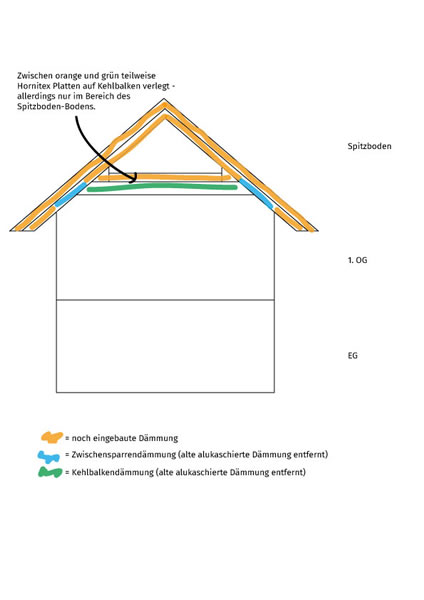
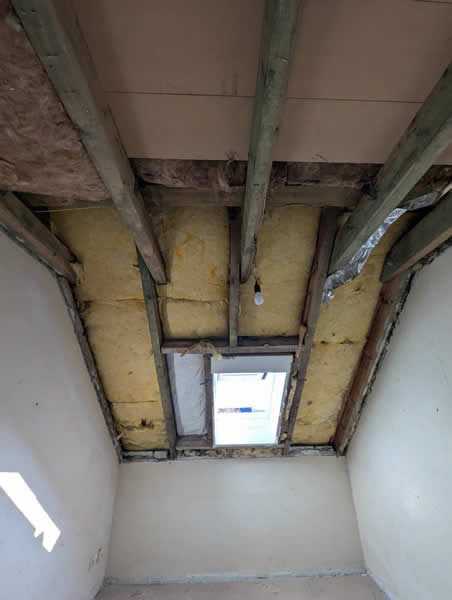
We recently purchased a house and are currently in the middle of renovation.
Initial situation:
- The rafters were doubled up a few years ago.
- The attic was insulated and covered with drywall (basically used as a substitute for a basement room).
- On the upper floor, we removed the old wooden paneling and want to replace it with drywall. Behind it was an older aluminum foil-faced insulation, which we would like to renew as part of the work.
- In the hallway, the previous owner already renewed the structure: 18 cm (7 inches) of compressed insulation with a vapor retarder – but it was neither installed properly nor sealed.
- Brick including battens
- Breathable underlay membrane
- Rafter doubling with glass/mineral wool, about 10 cm (4 inches)
- Rafters with aluminum foil-faced glass wool insulation, about 13 cm (5 inches) (not airtight, rather loosely stuffed)
- Wooden paneling
- Brick including battens
- Breathable underlay membrane
- Rafter doubling with glass/mineral wool, about 10 cm (4 inches) (to remain as it is okay)
- Rafters with wood wool insulation, about 13 cm (5 inches)
- Vapor retarder
- Battens (installation space 4-6 cm (1.5-2.5 inches))
- Drywall
Additionally, the heating system is located in the attic (above the hallway).
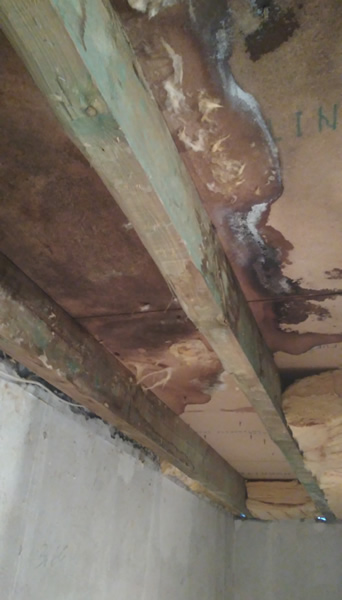
A few years ago, water leaked down there, but everything has since dried.
I removed the glued compressed insulation and would replace it.
Questions:
- Is the planned structure reasonable as proposed?
- Water stains are still visible on the Hornitex boards. Should they still be replaced, or is it sufficient to clean them a bit?
Thank you in advance for your help!

The roof structure obviously lacks the ventilation layer beneath the roof tiles, which is necessary to carry away warm, moist indoor air driven through the roof construction by vapor pressure and to vent it out at the ridge. The current setup therefore does not function correctly in terms of building physics.
The ventilation layer is created by the so-called "counter battens"; roofing battens at least 30/50 millimeters (1.2/2 inches), which are installed on the windproof and vapor-permeable underlay (underlayment) running along the rafters’ direction/pitch. The supporting battens for the tiles are then laid crosswise on these counter battens.
The ventilation layer is created by the so-called "counter battens"; roofing battens at least 30/50 millimeters (1.2/2 inches), which are installed on the windproof and vapor-permeable underlay (underlayment) running along the rafters’ direction/pitch. The supporting battens for the tiles are then laid crosswise on these counter battens.
- Solution 1: Remove the roof covering, dismantle the battens and most likely the underlayment that is not truly vapor-permeable, and rebuild the system as described.
- Solution 2: Leave the roof covering in place, cut out the underlayment that is probably not truly vapor-permeable (unless it is specified by the manufacturer/product data sheet as suitable and clearly still undamaged by UV), relocate the ventilation layer to the interior, for example replacing it with wood fiber insulation boards between the rafters. Then increase the rafter height if necessary by adding cross battens, insulate with at least about 20 cm (8 inches) of insulation with a thermal conductivity of 0.035 W/(m·K), seal the interior with a vapor-retarder that adapts to humidity, and install a drywall or equivalent lining on battens on the interior side to close the space. Intake vents must also be installed at the eaves and exhaust vents at the ridge (ridge vent profile) to provide ventilation for the ventilation layer.
- Solution 3: Attempt to use the roof structure that is not really suitable in terms of building physics by installing a 100% airtight vapor barrier on the interior side/under the rafters.
- Solution 1 is the most reasonable and designed for long-term durability.
- Solution 2 is a fiddly, intricate approach and accordingly expensive if performed by professional contractors.
- Solution 3 is not recommended because no vapor retarder or vapor barrier can be installed 100% airtight—certainly not in the roof area with presumably numerous penetrations.
D
dietrichd28 Apr 2026 12:15Thank you for your reply.
By “tiles including battens,” I meant both the battens and counter battens – sorry for the unclear wording.
The roof structure is currently as follows:
Would this then provide the required ventilation layer?
By “tiles including battens,” I meant both the battens and counter battens – sorry for the unclear wording.
The roof structure is currently as follows:
- Tiles
- Supporting battens</li>
- Counter battens</li>
- Underlay membrane</li>
- …
Would this then provide the required ventilation layer?
Similar topics