
Hello everyone,
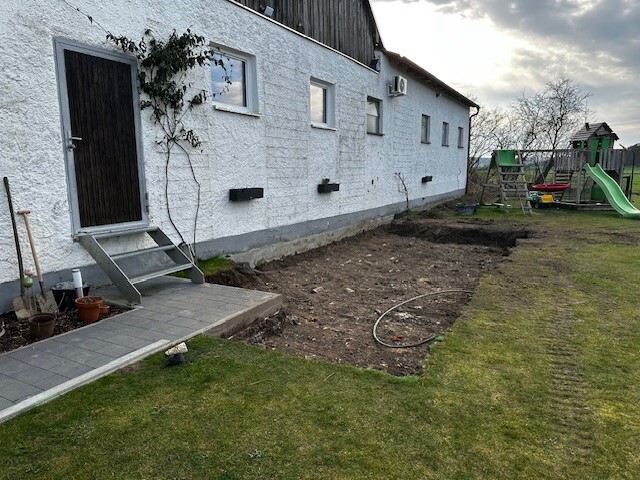
As part of building a terrace, I would like to repair the base of an old barn.
Many years ago, the ground here was raised slightly, and the soil was just piled against the building with a dimpled membrane.
An excavator has been on site and dug down to the strip foundation.
Now, a drip edge strip is being installed.
Before that, I want to remove the paint and loose plaster from the base, as it is already coming off.
How exactly should I proceed here, and which materials would you recommend?
Priming, waterproof slurry, plaster, dimpled membrane...
I appreciate any help.
Best regards,
Tom
As part of building a terrace, I would like to repair the base of an old barn.
Many years ago, the ground here was raised slightly, and the soil was just piled against the building with a dimpled membrane.
An excavator has been on site and dug down to the strip foundation.
Now, a drip edge strip is being installed.
Before that, I want to remove the paint and loose plaster from the base, as it is already coming off.
How exactly should I proceed here, and which materials would you recommend?
Priming, waterproof slurry, plaster, dimpled membrane...
I appreciate any help.
Best regards,
Tom

Hi Tom,
It looks like you’ve already done a great job with the excavation – you have a solid foundation to build on now.
Regarding the base course, I would proceed as follows: First, thoroughly remove all loose material, such as old plaster, paint, and crumbly substrate – best done with a scraper, wire brush, and possibly a small rotary hammer with a chisel or scarifier attachment. Then sweep thoroughly and prime with a deep primer or bonding agent suitable for mineral substrates.
Next comes the waterproofing slurry – depending on the product, apply 2–3 coats crosswise. Pay special attention to transitions and edges. This is absolutely essential in splash water zones.
After that, you can apply the base coat plaster (e.g., cement or lime-cement plaster) neatly. If you want it especially durable, you can reinforce the base coat plaster with mesh or additional reinforcement.
If you plan to install a dimpled membrane again: leave a gap from the wall (about 1cm (0.4 inches)), with the dimples facing the wall, and finish neatly at the top with a termination profile – this prevents moisture from accumulating behind the membrane.
Good luck – looks like a great project!
It looks like you’ve already done a great job with the excavation – you have a solid foundation to build on now.
Regarding the base course, I would proceed as follows: First, thoroughly remove all loose material, such as old plaster, paint, and crumbly substrate – best done with a scraper, wire brush, and possibly a small rotary hammer with a chisel or scarifier attachment. Then sweep thoroughly and prime with a deep primer or bonding agent suitable for mineral substrates.
Next comes the waterproofing slurry – depending on the product, apply 2–3 coats crosswise. Pay special attention to transitions and edges. This is absolutely essential in splash water zones.
After that, you can apply the base coat plaster (e.g., cement or lime-cement plaster) neatly. If you want it especially durable, you can reinforce the base coat plaster with mesh or additional reinforcement.
If you plan to install a dimpled membrane again: leave a gap from the wall (about 1cm (0.4 inches)), with the dimples facing the wall, and finish neatly at the top with a termination profile – this prevents moisture from accumulating behind the membrane.
Good luck – looks like a great project!
Thanks in advance for your reply. Since I hadn’t received any answers yet, I went ahead on my own. I used a mortar grinder to remove all loose material and paint. Then I replastered with cement plaster and reinforcement mesh. However, I didn’t apply any waterproof slurry; instead, I plan to use a bitumen coating in the areas in contact with the ground (mainly because I already bought it). I have a question about the drainage membrane. I have a drainage membrane with a fleece layer. Would you not recommend using that? As far as I know, the fleece (which is attached to the studs) is supposed to face the soil, right?
Thanks again and best regards,
Tom
Thanks again and best regards,
Tom
Similar topics