
G
georgs_town-128 Apr 2015 13:04Dear insulation experts,
I am new here and need some expert advice:
Together with a few friends, I want to buy and renovate three old farm buildings (so-called Rustici) in Ticino. Both the shell and the roofs of these Rustici are made entirely of gneiss slabs. These roofs are extremely durable and stable, but individual displaced stones can cause leaks. There are only a few specialized roofers left who are familiar with this type of roof, and they can fix leaks by carefully repositioning the stones. However, to do this, they need to be able to access the roof from the inside.
This leads to our challenge: We want to insulate the roof from the inside, but with a construction that can be relatively easily removed again (in case a leak occurs).
I would be very grateful for your ideas. Here is what I have considered:
- Placing insulation mats between the rafters, directly under the gneiss slabs, then screwing OSB boards onto the rafters (which could also act as vapor barriers).
- An even neater solution would be to install insulation directly on the OSB boards, so the entire assembly could be removed at once. Which insulation material would you recommend for this?
What do you think of this idea? I am not an expert and would really appreciate any advice!
Kind regards
I am new here and need some expert advice:
Together with a few friends, I want to buy and renovate three old farm buildings (so-called Rustici) in Ticino. Both the shell and the roofs of these Rustici are made entirely of gneiss slabs. These roofs are extremely durable and stable, but individual displaced stones can cause leaks. There are only a few specialized roofers left who are familiar with this type of roof, and they can fix leaks by carefully repositioning the stones. However, to do this, they need to be able to access the roof from the inside.
This leads to our challenge: We want to insulate the roof from the inside, but with a construction that can be relatively easily removed again (in case a leak occurs).
I would be very grateful for your ideas. Here is what I have considered:
- Placing insulation mats between the rafters, directly under the gneiss slabs, then screwing OSB boards onto the rafters (which could also act as vapor barriers).
- An even neater solution would be to install insulation directly on the OSB boards, so the entire assembly could be removed at once. Which insulation material would you recommend for this?
What do you think of this idea? I am not an expert and would really appreciate any advice!
Kind regards
G
georgs_town-128 Apr 2015 17:34Hello Roman,
Thanks for the tip! So something like this (see picture)?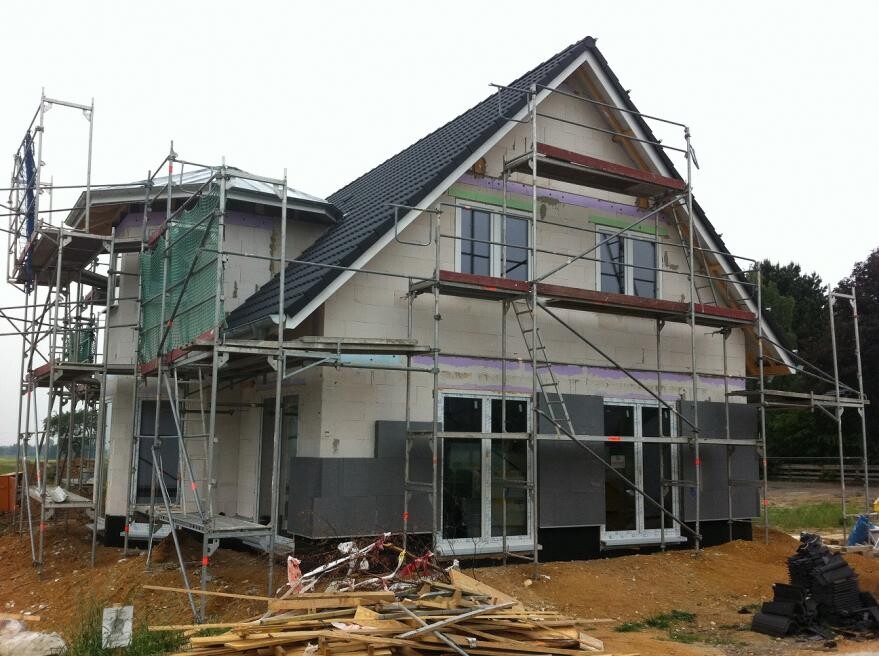
Thanks for the tip! So something like this (see picture)?
G
georgs_town-14 May 2015 17:07Ah, thanks for your reply! I didn’t know it was waterproof! That would have the added benefit of detecting a leak more quickly, since the insulation wouldn’t soak up water and start to rot first!
Similar topics