
Hello everyone,
I have a small question regarding the relationship between the pump characteristic curve and the pipe network characteristic curve. If I increase the head (pressure) at the pump, I would expect a lower flow rate in the heating circuit, which seems logical. The pipe network characteristic curve rises with increasing flow rate because it represents the pressure loss – meaning that a higher flow rate results in higher pressure loss in the system, which also makes sense.
Now, if I have a flow meter in the system, increasing the pump head should actually show a lower flow rate, right? However, what happens in reality is the opposite: a higher pump head results in a greater flow rate with all other parameters staying the same.
Maybe someone can help me overcome this mental block.
Thank you in advance!
I have a small question regarding the relationship between the pump characteristic curve and the pipe network characteristic curve. If I increase the head (pressure) at the pump, I would expect a lower flow rate in the heating circuit, which seems logical. The pipe network characteristic curve rises with increasing flow rate because it represents the pressure loss – meaning that a higher flow rate results in higher pressure loss in the system, which also makes sense.
Now, if I have a flow meter in the system, increasing the pump head should actually show a lower flow rate, right? However, what happens in reality is the opposite: a higher pump head results in a greater flow rate with all other parameters staying the same.
Maybe someone can help me overcome this mental block.
Thank you in advance!
More pressure at the pump (since this determines the delivery head) results in a higher flow rate, according to the pump curve. If you provide more pressure, greater pressure losses can be compensated for. Anything else is illogical; otherwise, you could simply reduce the pump pressure continuously and still get more water flow, almost for free, because a pump on the lowest setting uses very little energy.
from on the go
from on the go
Hello,
thank you very much for the response. Then my confusion is rather about the pump performance curve, for example:
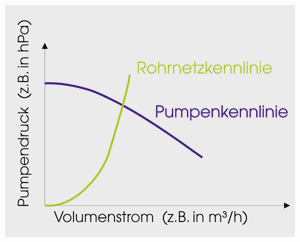
I can understand the pipe network characteristic curve better – higher flow rate means more pressure losses or resistance in the pipe system – but how does this relate to the pump performance curve?
thank you very much for the response. Then my confusion is rather about the pump performance curve, for example:
I can understand the pipe network characteristic curve better – higher flow rate means more pressure losses or resistance in the pipe system – but how does this relate to the pump performance curve?
First of all, there is no direct correlation. The pipe characteristic curve indicates how much pressure is needed to achieve a certain flow rate (the higher the flow rate, the more pressure is logically required); the pump characteristic curve shows the maximum pressure the pump can generate at different flow rates. The more liquid the pump moves, the harder it is for the pump to generate pressure (simplified).
At one point, the pipe network and the pump intersect. The system stabilizes at this value, where the pump can no longer increase pressure due to the existing flow rate (which the pipe network would require for a higher flow rate). However, if the flow were lower, the pump could generate more pressure, causing the flow rate to increase.
At one point, the pipe network and the pump intersect. The system stabilizes at this value, where the pump can no longer increase pressure due to the existing flow rate (which the pipe network would require for a higher flow rate). However, if the flow were lower, the pump could generate more pressure, causing the flow rate to increase.
Hello, thanks again for your reply. I can imagine the two characteristic curves separately. However, it doesn’t quite make sense to me yet that if I increase the pump head (→ less power consumption by the pump), the operating point of the system curve adjusts in such a way that more flow reaches the piping network. Logically, of course, this makes sense as you mentioned, but I’m missing the connection to the characteristic curve. For example, the system curve would become flatter if there is less pressure loss, such as fewer radiators being open. But that doesn’t help me understand the flow rate.
For me, it doesn’t quite make sense yet that increasing the pump head (-> less power consumption by the pump) would cause the operating point of the system curve to adjust so that a higher flow rate reaches the pipe network. Increasing the pump head means raising the pressure of the pump (<- more power for the pump = more pressure initially), so according to the system curve, this settles at a higher flow rate. If you adjust the pump, for example, by changing the power supply, you basically shift the pump curve slightly upward parallel to the x-axis (the pump can generate more pressure at the same flow rate with higher power input). The intersection with the system curve moves to the right, so the whole system settles at a higher flow rate. The system curve itself would not change in this case.
If you close a radiator valve, the pressure loss should decrease, because the water has to pass through bends, valves, etc.; this means that with the same pressure, the flow rate increases. You can imagine this as the system curve stretching slightly to the right (not shifting, since the point “no pressure – no flow” at the origin remains the same). In this case as well, the intersection moves to the right, and the system settles at a higher flow rate if nothing else changes.
This can be a problem in house construction when too many valves close (due to individual room controls and poorly adjusted heating systems). The remaining water then flows quite quickly through the unregulated pumps, and the temperature spread (difference between supply and return) becomes too small, which leads to frequent cycling of the heat source in the system.
I’m now wondering what exactly you want to understand about the flow rate. For more detailed information, you might want to search online for technical physics knowledge—there’s likely to be plenty available.