
Hello,
we are currently building and do not have an independent expert involved, so please no fundamental discussions on that topic. Interior work has been ongoing for two weeks. This week, we are bringing in an expert who can at least assess the current state to see if anything has gone wrong before everything inside is closed up. Key details:
- Angular bungalow built with solid construction (calcium silicate bricks) with an uninsulated roof and external thermal insulation composite system (ETICS)
- Approximately 1 m (3 ft 3 in) frost protection strip, reinforced concrete slab foundation (there is definitely a type of dimpled membrane underneath)
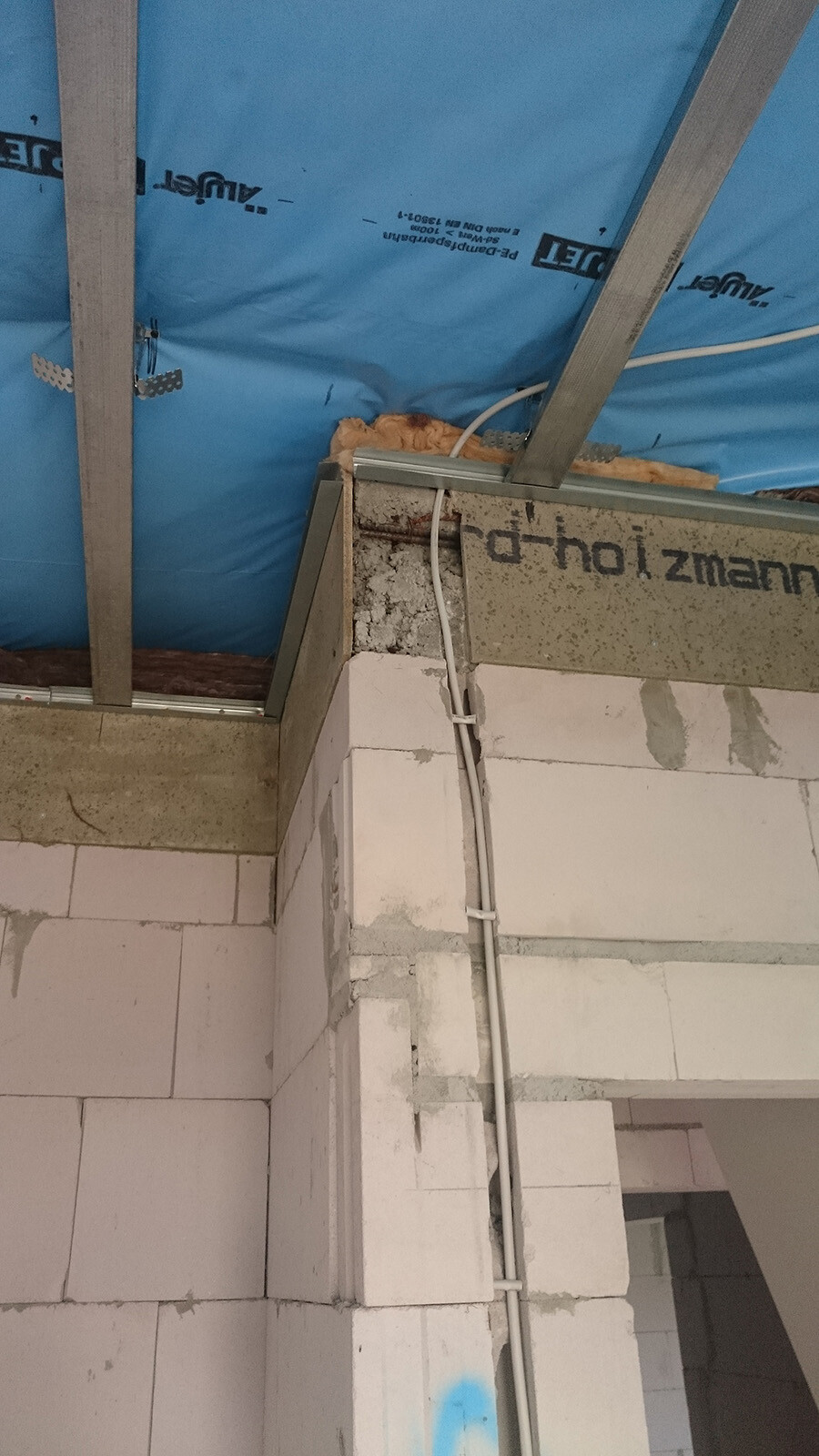
So far, from what I could see, I have not found any major errors. Last week, the electricians started and had to partially remove the wooden formwork of the ring beam while laying the electrical wiring for the lighting. At two points, we noticed that the concrete in the ring beam was not properly compacted in certain areas. A photo is attached. Since interior work has already begun, it is no longer really feasible to remove all the wooden formwork (160 m² (1720 sq ft) living area, and the ring beam covers all the interior walls as well).
Should I be concerned about this? In principle, with the external insulation and assuming no thermal bridges occur, the ring beam should always remain dry and corrosion should not be an issue, right? In this case, it is "only" a non-load-bearing interior wall, but what if similar voids have occurred in other areas? The builder does not consider this critical (our relationship with him is good).
we are currently building and do not have an independent expert involved, so please no fundamental discussions on that topic. Interior work has been ongoing for two weeks. This week, we are bringing in an expert who can at least assess the current state to see if anything has gone wrong before everything inside is closed up. Key details:
- Angular bungalow built with solid construction (calcium silicate bricks) with an uninsulated roof and external thermal insulation composite system (ETICS)
- Approximately 1 m (3 ft 3 in) frost protection strip, reinforced concrete slab foundation (there is definitely a type of dimpled membrane underneath)
So far, from what I could see, I have not found any major errors. Last week, the electricians started and had to partially remove the wooden formwork of the ring beam while laying the electrical wiring for the lighting. At two points, we noticed that the concrete in the ring beam was not properly compacted in certain areas. A photo is attached. Since interior work has already begun, it is no longer really feasible to remove all the wooden formwork (160 m² (1720 sq ft) living area, and the ring beam covers all the interior walls as well).
Should I be concerned about this? In principle, with the external insulation and assuming no thermal bridges occur, the ring beam should always remain dry and corrosion should not be an issue, right? In this case, it is "only" a non-load-bearing interior wall, but what if similar voids have occurred in other areas? The builder does not consider this critical (our relationship with him is good).
K
Knallkörper17 Oct 2016 21:13The prescribed concrete cover is not met, so it is fundamentally not compliant.
Yes, I already suspected that the concrete cover here is insufficient. What interests me much more is: what happens next? I mean, they wouldn’t completely remove the formwork from every ring beam by default, would they? And: would these signs of concern be enough to have the entire ring beam inspected? That would mean removing all the formwork on suspicion, wouldn’t it?
B
Bieber081517 Oct 2016 23:12Now I definitely know what the wooden cover is for!
R
readytorumble18 Oct 2016 07:24What is the wooden cover for, other than hiding poor workmanship? In our case, the formwork for the ring beam was removed after 2-3 days and has been exposed ever since. Apart from a galvanized metal sheet where the sole plate is attached, nothing protrudes from it.
Similar topics